GERONTOLOGY CLASS
Week 1:
1. Question:
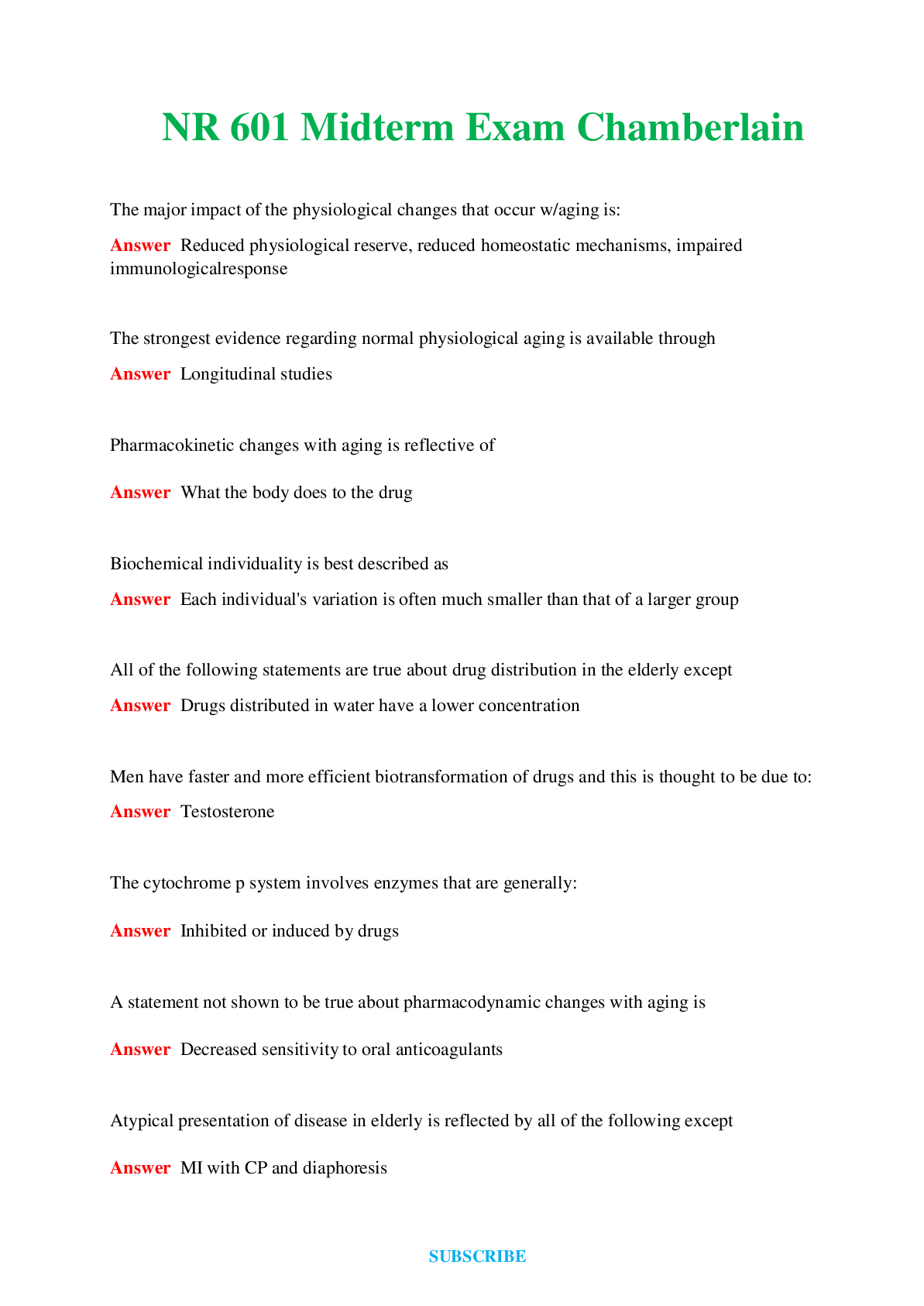
The major impact of the physiological changes that occur with aging is:
Reduced physiological reserve
Reduced homeostatic mechanisms
Impaired immunological response
CORRECT A
...
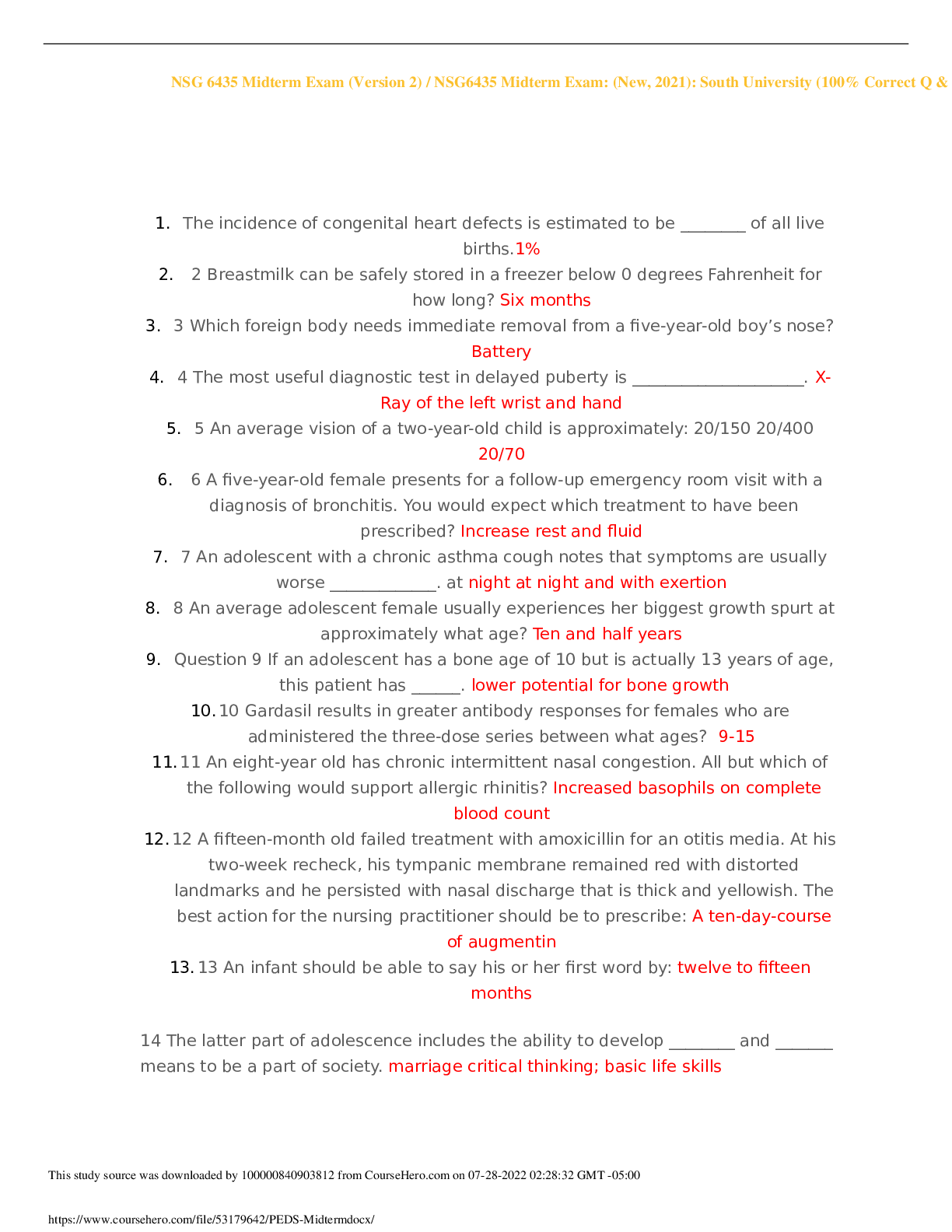
GERONTOLOGY CLASS
Week 1:
1. Question:
The major impact of the physiological changes that occur with aging is:
Reduced physiological reserve
Reduced homeostatic mechanisms
Impaired immunological response
CORRECT All of the above
Instructor Explanation: The major impact of all of these physiological changes can be
highlighted with three primary points. First, there is a reduced physiological reserve of most body
systems, particularly cardiac, respiratory, and renal. Second, there are reduced homeostatic mechanisms
that fail to adjust regulatory systems such as temperature control and fluid and electrolyte balance.
Third, there isimpaired immunological function: infection risk is greater, and autoimmune diseases are
more prevalent. (Kennedy-Malone 3)
Kennedy-Malone, Laurie, Kathleen Fletcher, Lori Martin-Plank. Advanced Practice Nursing in the Care of
Older Adults. F.A. Davis Company, 2014-01-14. Vital Book file.
Question 2. Question:
Men have faster and more efficient biotransformation of drugs and this is thought to be due to:
Less obesity rates than women
Prostate enlargement
CORRECT Less estrogen than women
Instructor Explanation: Men have faster and more efficient biotransformation, presumably
because ofserum testosterone. Conditions of increased or decreased liver perfusion alter the overall
level of the drug that is absorbed and how it is metabolized. (Kennedy-Malone 5)
Kennedy-Malone, Laurie, Kathleen Fletcher, Lori Martin-Plank. Advanced Practice Nursing in the Care of
Older Adults. F.A. Davis Company, 2014-01-14. VitalBook file.
Question 3. Question :
The cytochrome p system involves enzymes that are generally:
Inhibited by drugs
South University 2
NSG6420
Induced by drugs
CORRECT Inhibited or induced by drugs
Associated with decreased liver perfusion
Instructor Explanation: Biotransformation occurs in all body tissues but primarily in the liver,
where enzymatic activity (cytochrome P [CYP] system) alters and detoxifies the drug and prepares it for
excretion. (Kennedy-Malone 5)
Kennedy-Malone, Laurie, Kathleen Fletcher, Lori Martin-Plank. Advanced Practice Nursing in the Care of
Older Adults. F.A. Davis Company, 2014-01-14. VitalBook file.
Question 4. Question :
Functional abilities are best assessed by:
Self-report of function
CORRECT Observed assessment of function
A comprehensive head-to-toe examination
Family report of function
Instructor Explanation: Two well-established tools used to evaluate function in older adults are
the Katz Activities of Daily Living Scale (Katz et al., 1963) and the Lawton and Brody scale for
Instrumental Activities of Daily Living (Lawton & Brody, 1969). It is important to be cautious about selfreport of function (rather than direct observation of function) and to ask, “Do you …?” instead of “Can
you …?” in order to determine if patients actually perform the activity. (Kennedy-Malone 40)
Kennedy-Malone, Laurie, Kathleen Fletcher, Lori Martin-Plank. Advanced Practice Nursing in the Care of
Older Adults. F.A. Davis Company, 2014-01-14. VitalBook file.
Question 5. Question :
Iron Deficiency Anemia (IDA) is classified as a microcytic, hypochromic anemia. This classification refers
to which of the following laboratory data?
Hemoglobin and Hematocrit
CORRECT Mean Corpuscular Volume (MCV) and Mean Corpuscular Hemoglobin (MCH)
Serum ferritin and serum iron
Total iron binding capacity and transferrin saturation
South University 3
NSG6420
Instructor Explanation: RBC indices reveal an MCV (mean corpuscular volume/RBC size) that will
be decreased to <80 fL in adults; MCH (mean corpuscular hemoglobin/RBC color) will show hypochromia
or pale cells; RBC distribution width (RDW)/volume variation will be increased.
(Kennedy-Malone page 519)
Kennedy-Malone, Laurie, Kathleen Fletcher, Lori Martin-Plank. Advanced Practice Nursing in the Care of
Older Adults. F.A. Davis Company, 2014-01-14. VitalBook file.
Question 6. Question :
When interpreting laboratory data, you would expect to see the following in a patient with Anemia of
Chronic Disease (ACD):
Hemoglobin <12 g/dl, MCV decreased, MCH decreased
Hemoglobin >12 g/dl, MCV increased, MCH increased
CORRECT Hemoglobin <12 g/dl, MCV normal, MCH normal
Hemoglobin >12 g/dl, MCV decreased, MCH increased
Instructor Explanation: Hemoglobin (Hgb): <12 g/dL (120 g/L) women <13 g/dL (130 g/L) men
Rarely <10 g/dL (100 g/L) Mean corpuscular volume: 80–96 mcm3 (normocytic) Mean corpuscular
hemoglobin Normochromic (normal color) RBC distribution width: normal (Kennedy-Malone page 517)
Kennedy-Malone, Laurie, Kathleen Fletcher, Lori Martin-Plank. Advanced Practice Nursing in the Care of
Older Adults. F.A. Davis Company, 2014-01-14. VitalBook file.
Question 7. Question :
The pathophysiological hallmark of ACD is:
Depleted iron stores
CORRECT Impaired ability to use iron stores
Chronic uncorrectable bleeding
Reduced intestinal absorption of iron
Instructor Explanation: The pathophysiological hallmark of ACD is a disregulation of iron
homeostasis, characterized by an increased uptake and retention of iron within the cells of the
reticuloendothelial system (liver/spleen), resulting in decreased RBC production. Essentially, iron is
present but inaccessible for use in the production of Hgb with the erythrocytes (Bross et al., 2010). A
shortened RBC survival is also a contributing factor to ACD. (Kennedy-Malone page 516-517)
South University 4
NSG6420
Kennedy-Malone, Laurie, Kathleen Fletcher, Lori Martin-Plank. Advanced Practice Nursing in the Care of
Older Adults. F.A. Davis Company, 2014-01-14. VitalBook file.
Question 8. Question :
The main focus of treatment of patients with ACD is:
Replenishing iron stores
Providing for adequate nutrition high in iron
CORRECT Management of the underlying disorder
Administration of monthly vitamin B12 injections
Instructor Explanation: Treatment: Treatment of ACD focuses on management of the underlying
disorder. Iron supplementation is of no benefit in ACD, except in cases of coexisting IDA. A therapeutic
trial of iron supplementation of no longer than 1 month may be useful in delineating between ACD and
IDA. In ACD, there would be no hematological response to iron therapy (Chen & Gandhi, 2004).
(Kennedy-Malone page 518)
Kennedy-Malone, Laurie, Kathleen Fletcher, Lori Martin-Plank. Advanced Practice Nursing in the Care of
Older Adults. F.A. Davis Company, 2014-01-14. VitalBook file.
Question 9. Question :
In addition to the complete blood count (CBC) with differential, which of the following laboratory tests is
considered to be most useful in diagnosing ACD and IDA?
Student Answer: Serum iron
Total iron binding capacity
Transferrin saturation
CORRECT Serum ferritin
Instructor Explanation: Treatment: Treatment of ACD focuses on management of the underlying
disorder. Iron supplementation is of no benefit in ACD, except in cases of coexisting IDA. A therapeutic
trial of iron supplementation of no longer than 1 month may be useful in delineating between ACD and
IDA. In ACD, there would be no hematological response to iron therapy (Chen & Gandhi, 2004).
(Kennedy-Malone page 518)
Kennedy-Malone, Laurie, Kathleen Fletcher, Lori Martin-Plank. Advanced Practice Nursing in the Care of
Older Adults. F.A. Davis Company, 2014-01-14. VitalBook file
South University 5
NSG6420
Question 10. Question :
Symptoms in the initial human immunodeficiency virus(HIV) infection include all of the following except:
Sore throat
Fever
CORRECT Weight loss
Headache
Instructor Explanation: Signal symptoms: The initial HIV infection is characterized by
mononucleosis-like illness with fever, sore throat, lymphadenopathy, headache, and fatigue. A roseolalike rash may also develop. These initial symptoms are followed by an asymptomatic phase, which may
last 10 years or more. Later, if untreated, lymphadenopathy, weight loss, myalgias, and diarrhea may
develop (Cohen, Kuritzkes, & Sax, 2011). In advanced disease, malignancies and opportunistic infections
occur. Co-infection with hepatitis B or C is common (25% to 30%) in IV drug users, so hepatitis symptoms
may also appear (Centers for Disease Control and Prevention [CDC], 2010a).
(Kennedy-Malone page 521)
Kennedy-Malone, Laurie, Kathleen Fletcher, Lori Martin-Plank. Advanced Practice Nursing in the Care of
Older Adults. F.A. Davis Company, 2014-01-14. VitalBook file.
Question 11. Question :
Essential parts of a health history include all of the following except:
Chief complaint
History of the present illness
CORRECT Current vital signs
All of the above are essential history components
Instructor Explanation: Vital signs are part of the physical examination portion of patient
assessment, not part of the health history.
Question 12. Question :
Which of the following clinical reasoning tools is defined as evidence-based resource based on
mathematical modeling to express the likelihood of a condition in selectsituations,settings, and/or
patients?
South University 6
NSG6420
Clinical practice guideline
CORRECT Clinical decision rule
Clinical algorithm
Clinical recommendation
Instructor Explanation: Clinical decision (or prediction) rules provide another support for clinical
reasoning. Clinical decision rules are evidence-based resources that provide probabilistic statements
regarding the likelihood that a condition exists if certain variables are met with regard to the prognosis of
patients with specific findings. Decision rules use mathematical models and are specific to certain
situations, settings, and/or patient characteristics. Goolsby page 7
Question 13. Question :
The firststep in the genomic assessment of a patient is obtaining information regarding:
CORRECT Family history
Environmental exposures
Lifestyle and behaviors
Current medications
Instructor Explanation: A critical firststep in genomic assessment, including assessment of risk,
is the use of family history. Family history is considered the first genetic screen (Berry & Shooner 2004)
and is a critical component of care because it reflects shared genetic susceptibilities, shared
environment, and common behaviors (Yoon, Scheuner, & Khoury 2003). Goolsby page 18
Question 14. Question :
In autosomal recessive (AR) disorders, individuals need:
Only one mutated gene on the sex chromosomes to acquire the disease
Only one mutated gene to acquire the disease
CORRECT Two mutated genes to acquire the disease
Two mutated genesto become carriers
Instructor Explanation: In autosomal recessive (AR) disorders, the offspring inherits the
condition by receiving one copy of the gene mutation from each of the parents. Autosomal recessive
disorders must be inherited through both parents (Nussbaum et al. 2007). Individuals who have an AR
disorder have two mutated genes, one on each locus of the chromosome. Parents of an affected person
South University 7
NSG6420
are called carriers because each carries one copy of the mutation on one chromosome and a normal
gene on the other chromosome. Carriers typically are not affected by the disease. Goolsby page 28
Question 15. Question :
In AR disorders, carriers have:
Two mutated genes; two from one parent that cause disease
A mutation on a sex chromosome that causes a disease
A single gene mutation that causes the disease
CORRECT One copy of a gene mutation but not the disease
Instructor Explanation: Individuals who have an AR disorder have two mutated genes, one on
each allele of the chromosome. Parents of an affected person are called carriers because each parent
carries one copy of the mutation on one chromosome and a normal gene on the other chromosome.
Carriers typically are not affected by the disease. In pedigrees with an AR inheritance patterns, males
and females will be equally affected because the gene mutation is on an autosome. Goolsby page 28
Question 16. Question :
A woman with an X-linked dominant disorder will:
Not be affected by the disorder herself
CORRECT Transmit the disorder to 50% of her offspring (male or female)
Not transmit the disorder to her daughters
Transmit the disorder to only her daughters
Instructor Explanation: Everyone born with an X-linked dominant disorder will be affected with
the disease. Transmission of the disorder to the next generation varies by gender, however. A woman will
transmit the mutation to 50% of all her offspring (male or female). Goolsby page 29
Question 17. Question :
According to the Genetic Information Nondiscrimination Act (GINA):
Nurse Practitioners (NPs) should keep all genetic information of patients confidential
NPs must obtain informed consent prior to genetic testing of all patients
Employers cannotinquire about an employee’s genetic information
South University 8
NSG6420
CORRECT All of the above
Instructor Explanation: On May 21, 2008, President George W. Bush signed the Genetic
Information Nondiscrimination Act (GINA) to protect Americans against discrimination based upon their
genetic information when it comes to health insurance and employment, paving the way for patient
personalized genetic medicine without fear of discrimination (National Human Genome Research
Institute 2012). Goolsby page 43
Question 18. Question :
Which of the following would be considered a “red flag” that requires more investigation in a patient
assessment?
Colon cancer in family member at age 70
Breast cancer in family member at age 75
CORRECT Myocardial infarction in family member at age 35
All of the above
Instructor Explanation: Early onset cancer syndromes, heart disease, or dementia are red flags
that warrant further investigation regarding hereditary disorders. Goolsby page 36
Question 19. Question :
Your 2-year-old patientshowsfacial features,such as epicanthal folds, up-slanted palpebral fissures,
single transverse palmar crease, and a low nasal bridge. These are referred to as:
Variable expressivity related to inherited disease
CORRECT Dysmorphic featuresrelated to genetic disease
De novo mutations of genetic disease
Different penetrantsigns of genetic disease
Instructor Explanation: Assessing for dysmorphic features may enable identification of certain
syndromes or genetic or chromosomal disorders (Jorde, Carey, & Bamshad 2010; Prichard &Korf 2008).
Dysmorphology is defined as “the study of abnormal physical development” (Jorde, Carey, & Bamshad
2010, 302). Goolsby page 37
Question 20. Question :
In order to provide a comprehensive genetic history of a patient, the NP should:
Ask patients to complete a family history worksh
[Show More]



 GRADE A SOLUTION.png)






.png)