NUR2755 / NUR 2755 Multidimensional Care 2 / MDC II - Final Exam - Rasmussen
*PT PAP HOT*
▪ Pituitary
▪ Thyroid
▪ Pancreas
▪ Adrenals
▪ Parathyroid
▪ Hypothalamus
▪ Ovaries
▪ Testes - What are the glands
...
NUR2755 / NUR 2755 Multidimensional Care 2 / MDC II - Final Exam - Rasmussen
*PT PAP HOT*
▪ Pituitary
▪ Thyroid
▪ Pancreas
▪ Adrenals
▪ Parathyroid
▪ Hypothalamus
▪ Ovaries
▪ Testes - What are the glands of the endocrine system? (SATA Q?)
Grave's disease - an autoimmune disorder that is caused by hyperthyroidism and is characterized by *goiter and/or exophthalmos*
*Treatments*
▪ Rx: methimazole, atenolol, and *iodine-131*
▪ radiation therapy
*Nursing Interventions*
▪ provide a calm environment
▪ keep patients room cool
▪ assess pain
▪ prepare patient for surgery
▪ post-operative care
▪ maintain a patent airway
-------- same as hypothyroidism ---------
▪ provide periods of rest
▪ continuous cardiac monitoring
▪ monitor vital signs
▪ daily weight
▪ monitor I&O
▪ monitor laboratory tests
▪ apply antiembolism stockings to prevent DVT
▪ provide skin care - *HYPERthyroidism aka Grave's disease*
▪ Treatments
pituitary gland - _________ is considered to be the "master gland" as it secretes hormones that control other parts of the endocrine system.
▪ ACTH
▪ TSH
▪ are the most life threatening because they cause a decrease in the secretion of vital hormones from the adrenal and thyroid glands. - *Anterior HYPOpituitarism*
▪ Deficiencies of which two hormones are the most life threatening?
Bloodwork (*all are DECREASED*)
▪ T3
▪ T4
▪ Prolactin
▪ Testosterone
▪ Estradiol
Scans (you'll always draw blood work first for diagnostics though)
▪ CT/MRI - detect bone or soft tissue lesions
▪ Skull X-ray - detect enlargement, erosions, and calcification of the sella turcica - *Anterior HYPOpituitarism*
▪ Laboratory & Diagnostic Tests
TRUE! We have very small amounts of testosterone or estradiol no matter if we are men or women. - T/F: do both men and women have testosterone and estradiol?
*INCREASED:*
▪ Prolactin - this might be the answer to the Q
▪ Cortisol
▪ TSH
▪ LH (men)
▪ FSH (men)
▪ Glucose
*DECREASED:*
▪ Gonadotropin - *Anterior HYPERpituitarism*
(SATA Q?)
▪ Laboratory Tests
▪ Prevent infection because they are immunosuppressed
▪ handwashing - HYPERcortisolism (aka Cushing's Disease)
*Priority Intervention*
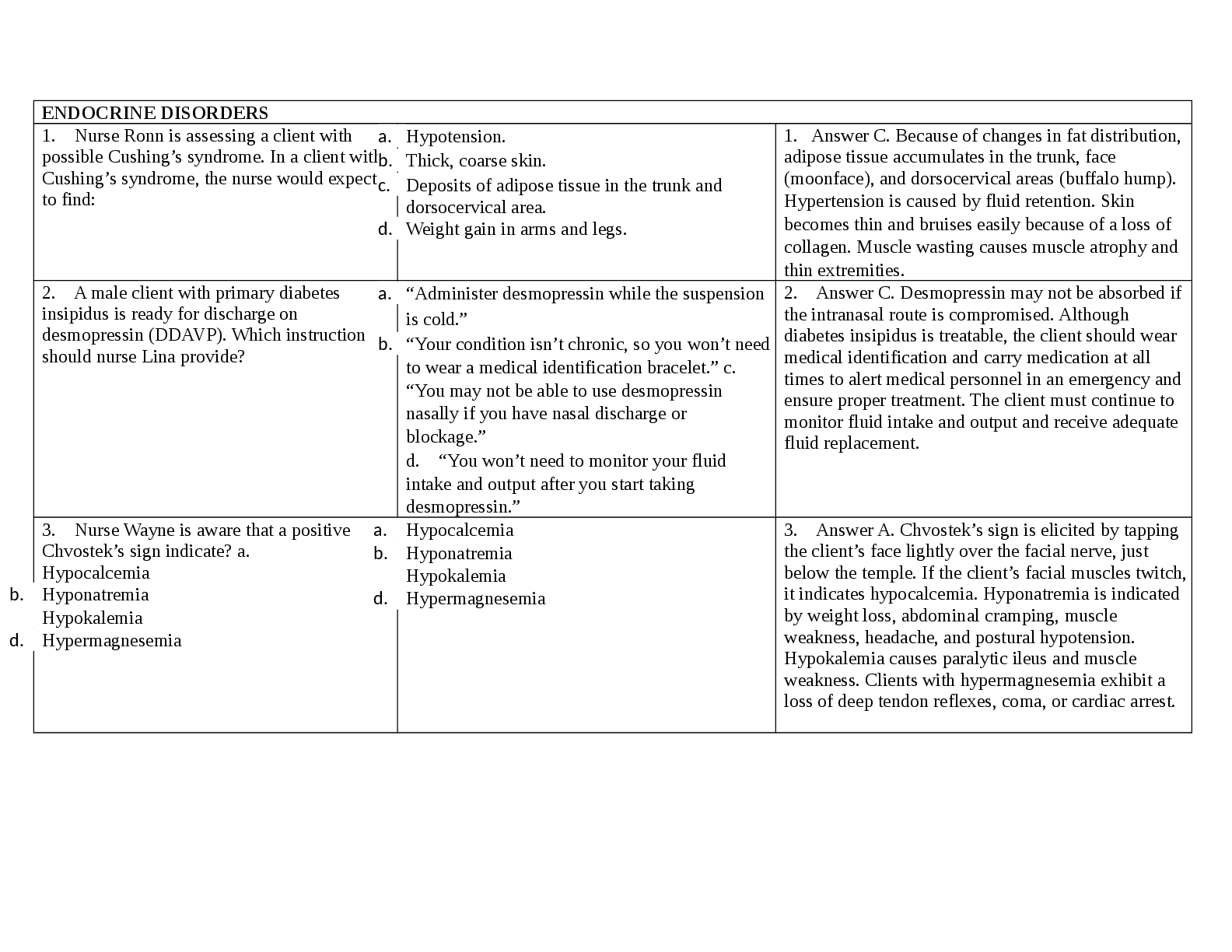
diabetes insipidus - ▪ *Deficiency of ADH* resulting in large volumes of dilute urine
▪ A disorder of the posterior pituitary gland
*They are losing a lot of water:*
• polyuria
• polydipsia
• dehydration
• fluid/electrolyte imbalance
• dilute, low urine specific gravity (<1.005)
• high plasma osmolarity
• output does not decrease when fluid intake decreases
*remember! your s/s are going to look like dehydration*
• tachycardia
• hypotension
• poor turgor
• dry mucous membranes
• decreased cognition
• ataxia
• irritability - *Posterior Pituitary Gland: Diabetes Insipidus:*
▪ What will the patient present with?/Key Symptoms
▪ desmopressin acetate (a synthetic form of *vasopressin*)
▪ can be PO, SL, or intranasal - *Posterior Pituitary Gland: Diabetes Insipidus:*
▪ Drug Therapy
Addison's disease - What is adrenal gland hypofunction?
▪ If the patient remains alert and oriented x 3 - *Addison's Disease*
▪ How do you know the therapy is working?
▪ Glucocorticoid drugs *MUST be withdrawn slowly so you don't wind up with Addison's or adrenal insufficiency*
▪ This allows for pituitary protection of ACTH and activation of the adrenal cortex to produce cortisol - *Addison's Disease*
▪ How do you discontinue glucocorticoid therapy to avoid secondary adrenal insufficiency?
*▪ Muscle weakness*
▪ Muscle/joint pain
▪ Fatigue - *Addison's Disease*
▪ Neuromuscular S/S
*▪ Hypertension*
▪ Dependent edema
▪ Bruising
▪ Petechiae - *Cushing's Disease aka hypercortisolism*
▪ Cardiovascular S/S
*INCREASED*
• blood glucose level
• sodium level
• late-night salivary cortisol
**• urine cortisol**
*DECREASED*
• lymphocyte count
• calcium level - *Cushing's Disease aka hypercortisolism*
▪ Laboratory Tests
*INCREASED*
*▪ potassium (K)*
▪ calcium (Ca)
▪ BUN
*DECREASED*
▪ serum cortisol
▪ salivary cortisol
▪ fasting blood glucose
*▪ sodium (Na)* - *Addison's Disease*
▪ Laboratory Tests
Sodium increases
Potassium decreases - In *hyperaldosteronism* what happens with potassium and sodium? (Remember...it's the opposite of Addison's disease)
*Heat intolerance* - they are sweaty! - *Hyperthyroidism aka Grave's disease*
▪ Hallmark assessment
Pheochromocytoma - a benign tumor of the adrenal medulla that causes the gland to produce excess epinephrine, so you are in a constant fight/flight state.
▪ Do not smoke
▪ Do not drink caffeine
▪ Do not change position suddenly
▪ Eat a diet rich in calories, vitamins, and minerals (avoid tyramine foods)
Any of the above can cause a hypertensive crisis (closely monitor their BP!)
*never palpate or can give pt a massive rush of catecholamines (epinephrine)* - *Pheochromocytoma*
▪ Patient Education
*Cold intolerance*
Other S/S:
▪ think dehydration: fatigue, weakness, lethargy, constipation, dry skin
▪ poor memory
▪ fatigue
▪ lack of energy -> sleeping more frequently
▪ muscle aches
▪ stiff muscles - *Hypothyroidism*
▪ Hallmark assessment
Improvement usually occurs within 2 weeks - *Thyroid Therapy*
▪ When will a patient feel therapeutic effects?
iatrogenic hypoparathyroidism - What does a thyroidectomy cause?
Thyroid surgery can cause parathyroid gland injury which results in *tetany and hypocalcemia*
Assess for:
▪ muscle twitching
▪ muscle spasms
▪ tingling around the mouth
▪ tingling of the toes and fingers
▪ hoarseness
▪ stridor
▪ suture line pressure
▪ thyroid storm - *Thyroid Surgery (thyroidectomy)*
▪ What is the biggest thing we are watching for post-op?
*Think hypocalcemia S/S*
▪ muscle cramps
▪ muscle spasms of the hands and feet.
▪ Mild tingling/numbness to muscle tetany
▪ Seizures w/o loss of consciousness
▪ Irritability
*▪ Positive Chvostek's and Trousseau's Signs* - *Hypoparathyroidism*
▪ Signs & Symptoms
thyroid storm
*priority: maintain a patent airway and adequate ventilation.* - ▪ a relatively rare, life-threatening condition caused by exaggerated hyperthyroidism
▪ an individual's heart rate, blood pressure, and body temperature can soar to dangerously high levels.
*Even with treatment may lead to death.*
DECREASE - hypothyroidism - As a person ages, thyroid levels may ______________.
*INCREASED*
▪ TSH
▪ Serum thyroglobulin level (*Thyroid Cancer*)
*DECREASED*
▪ T3, T4 - *Hypothyroidism*
▪ Diagnostic Labs
*Treatments*
▪ Rx: levothyroxine sodium or liothyronine sodium
*Nursing Interventions*
▪ maintain fluid restriction
▪ provide warm blankets
▪ assess bowel sounds and elimination patterns
▪ assess for changes in neurological status
▪ monitor for S/S of myxedema coma: bradycardia, hypotension, decreased RR, hypothermia, change in LOC
--------- same as hyperthyroidism ----------
▪ provide periods of rest
▪ continuous cardiac monitoring
▪ monitor vital signs
▪ daily weight
▪ monitor I&O
▪ monitor laboratory tests
▪ apply antiembolism stockings to prevent DVT
▪ provide skin care - *HYPOthyroidism*
▪ Treatments
Hashimoto's disease - ▪ an autoimmune disease in which the body's own antibodies attack and destroy the cells of the thyroid gland
▪ chronic hypothyroidism
▪ triggered by bacterial or viral infection
*INCREASED*
▪ T3, T4
*DECREASED*
▪ TSH - *Hyperthyroidism aka Grave's disease*
▪ Laboratory Tests
type 1 diabetes mellitus - ____________ is an autoimmune disorder where *Beta cells are destroyed*
▪ *Polyuria*
▪ *Polydipsia*
▪ *Polyphagia*
▪ *Kussmaul Respirations*
▪ Fruity breath
▪ Abdominal pain
▪ Ketone bodies
▪ Dehydration
▪ Orthostatic Hypotension
▪ Hypoxia
▪ Weight loss
▪ Fatigue
▪ Nausea
▪ Anxiety
▪ Rashes
▪ Skin infections
▪ Peripheral neuropathy - *Type I Diabetes*
▪ Signs & Symptoms
INCREASED:
▪ Hemoglobin A1C
▪ Random blood glucose
▪ Fasting blood glucose - *Type I or Type II Diabetes*
▪ Laboratory tests
*Normal range: fasting glucose <110 mg/dL*
*Normal range: hemoglobin A1C < 6.5%*
▪ They may have eaten poorly the night before (had alcohol or a high carb dinner) but otherwise have been compliant the past 3 months. - *How would you interpret?*
▪ A patient has a fasting blood glucose level of 260 mg/dL and a hemoglobin A1C of 6.0%
*Normal range: fasting glucose <110 mg/dL*
*Normal range: hemoglobin A1C < 6.5%*
▪ They tried to eat well a few days leading up to the test but have not been compliant the past 3 months. - *How would you interpret?*
▪ A patient has a fasting blood glucose level of 99 mg/dL and a hemoglobin A1C of 9.0%
*Normal range: fasting glucose <110 mg/dL*
*Normal range: hemoglobin A1C < 6.5%*
▪ They have not been compliant at all! - *How would you interpret?*
▪ A patient has a fasting blood glucose level of 260 mg/dL and a hemoglobin A1C of 10.0%
*This is a short-acting, regular insulin*
▪ at the peak point (half-life), which for Novolin R is at *2.5-5 hrs*
▪ this means they need to plan to eat something at that time
▪ not recommended to take before bedtime b/c of this issue - If we are giving a patient Novolin R, when are they at the greatest risk for hypoglycemia?
p. 1294
▪ onset: 1-5 hours
▪ peak: 4-12 hours - *NPH (intermediate-acting insulin)*
▪ Onset, Peak
p. 1294
▪ onset: 2-4 hours
▪ peak: 6-12 hours - *Long-acting insulin*
▪ Onset, Peak
p. 1294
Kussmaul breathing - _____________ is a type of hyperventilation that is the lung's emergency response to acidosis. It causes a labored, deeper breathing rate. It is most commonly associated with conditions that cause metabolic acidosis, *particularly diabetes*
*▪ IV normal saline*
*▪ regular, short-acting insulin*
*▪ hydration*
"Hydration...Insulin...Electrolyte Replacement"
▪ assess airway, LOC, hydration, electrolytes, and blood glucose
▪ check vitals every 15 minutes
[Show More]


.png)


 Rasmussen.png)
.png)