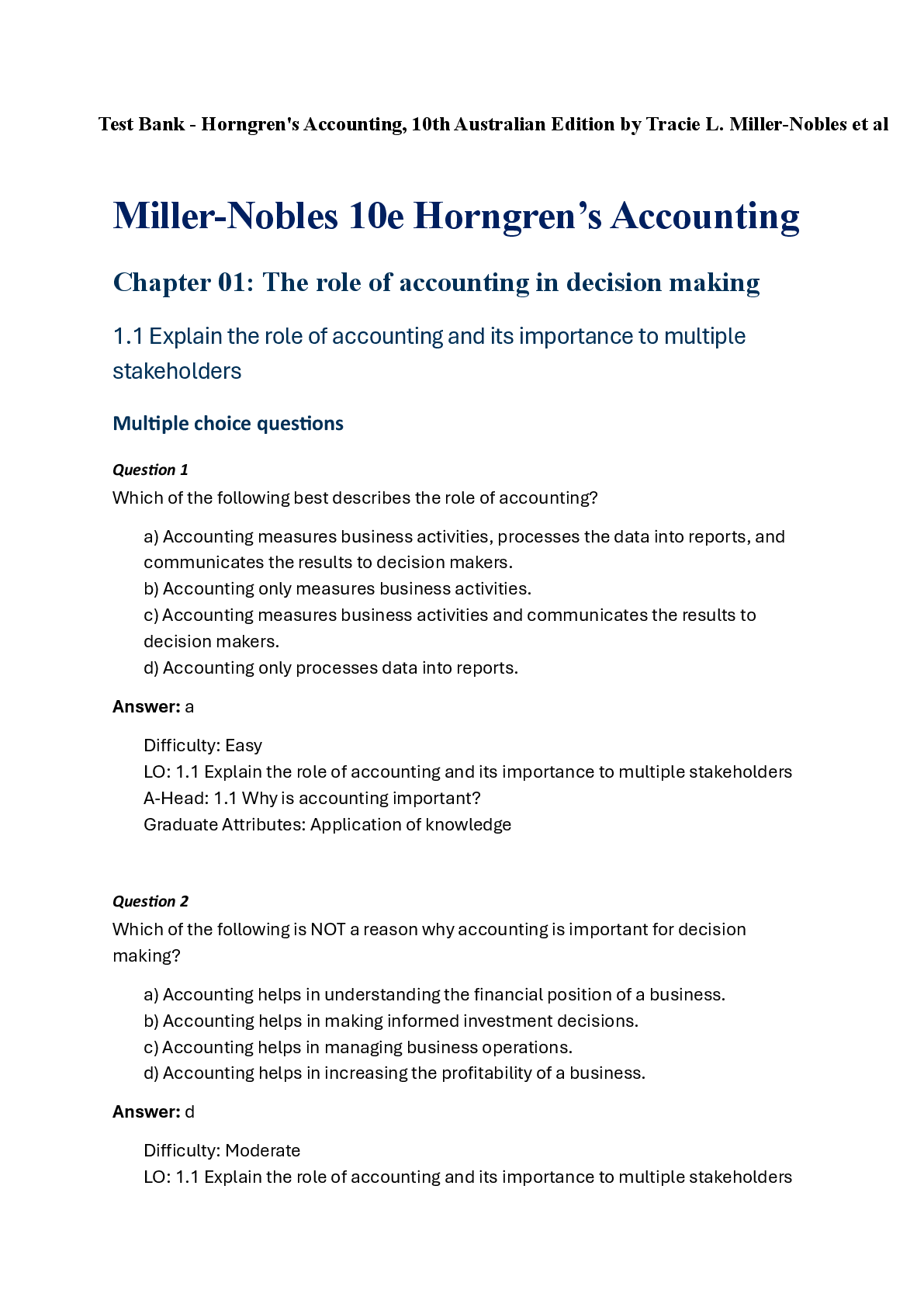
Test Bank for Data Analytics for Accounting, 3rd e by Vernon Richardson and Katie Terrell and Ryan Teeter TEST BANK
ISBN-13: 9781264444908
Full chapters included
Chapter 1: Data Analytics for Accounting and Identi
...
Test Bank for Data Analytics for Accounting, 3rd e by Vernon Richardson and Katie Terrell and Ryan Teeter TEST BANK
ISBN-13: 9781264444908
Full chapters included
Chapter 1: Data Analytics for Accounting and Identifying the Questions
Data Analytics
How Data Analytics Affects Business
How Data Analytics Affects Accounting
Auditing
Management Accounting
Financial Reporting and Financial Statement Analysis
Tax
The Data Analytics Process Using the IMPACT Cycle
Step 1: Identify the Questions (Chapter 1)
Step 2: Master the Data (Chapter 2)
Step 3: Perform Test Plan (Chapter 3)
Step 4: Address and Refine Results (Chapter 3)
Steps 5 and 6: Communicate Insights and Track Outcomes (Chapter 4 and each chapter thereafter)
Back to Step 1
Data Analytic Skills and Tools Needed by Analytic-Minded Accountants
Choose the Right Data Analytics Tools
Hands-On Example of the IMPACT Model
Identify the Questions
Master the Data
Perform Test Plan
Address and Refine Results
Communicate Insights
Track Outcomes
Summary
Key Words
Answers to Progress Checks
Multiple Choice Questions
Discussion and Analysis
Problems
Lab 1-0 How to Complete Labs
Lab 1-1 Data Analytics Questions in Financial Accounting
Lab 1-2 Data Analytics Questions in Managerial Accounting
Lab 1-3 Data Analytics Questions in Auditing
Lab 1-4 Comprehensive Case: Questions about Dillard’s Store Data
Lab 1-5 Comprehensive Case: Connect to Dillard’s Store Data
Chapter 2: Mastering the Data
How Data Are Used and Stored in the Accounting Cycle
Internal and External Data Sources
Accounting Data and Accounting Information Systems
Data and Relationships in a Relational Database
Columns in a Table: Primary Keys, Foreign Keys, and Descriptive Attributes
Data Dictionaries
Extract, Transform, and Load (ETL) the Data
Extract
Transform
Load
Ethical Considerations of Data Collection and Use
Summary
Key Words
Answers to Progress Checks
Multiple Choice Questions
Discussion and Analysis
Problems
Lab 2-1 Request Data from IT—Sláinte
Lab 2-2 Prepare Data for Analysis—Sláinte
Lab 2-3 Resolve Common Data Problems—LendingClub
Lab 2-4 Generate Summary Statistics—LendingClub
Lab 2-5 Validate and Transform Data—College Scorecard
Lab 2-6 Comprehensive Case: Build Relationships among Database Tables—Dillard’s
Lab 2-7 Comprehensive Case: Preview Data from Tables—Dillard’s
Lab 2-8 Comprehensive Case: Preview a Subset of Data in Excel, Tableau Using a SQL Query—Dillard’s
Chapter 3: Performing the Test Plan and Analyzing the Results
Performing the Test Plan
Descriptive Analytics
Summary Statistics
Data Reduction
Diagnostic Analytics
Standardizing Data for Comparison (Z-score)
Profiling
Cluster Analysis
Hypothesis Testing for Differences in Groups
Predictive Analytics
Regression
Classification
p-Values versus Effect Size
Prescriptive Analytics
Decision Support Systems
Machine Learning and Artificial Intelligence
Summary
Key Words
Answers to Progress Checks
Multiple Choice Questions
Discussion and Analysis
Problems
Chapter 3 Appendix: Setting Up a Classification Analysis
Lab 3-1 Descriptive Analytics: Filter and Reduce Data—Sláinte
Lab 3-2 Diagnostic Analytics: Identify Data Clusters—LendingClub
Lab 3-3 Perform a Linear Regression Analysis—College Scorecard
Lab 3-4 Comprehensive Case: Descriptive Analytics: Generate Summary Statistics—Dillard’s
Lab 3-5 Comprehensive Case: Diagnostic Analytics: Compare Distributions—Dillard’s
Lab 3-6 Comprehensive Case: Create a Data Abstract and Perform Regression Analysis—Dillard’s
Chapter 4: Communicating Results and Visualizations
Communicating Results
Differentiating between Statistics and Visualizations
Visualizations Increasingly Preferred over Text
Determine the Purpose of Your Data Visualization
Quadrants 1 and 3 versus Quadrants 2 and 4: Qualitative versus Quantitative
A Special Case of Quantitative Data: The Normal Distribution
Quadrants 1 and 2 versus Quadrants 3 and 4: Declarative versus Exploratory
Choosing the Right Chart
Charts Appropriate for Qualitative Data
Charts Appropriate for Quantitative Data
Learning to Create a Good Chart by (Bad) Example
Further Refining Your Chart to Communicate Better
Data Scale and Increments
Color
Communication: More Than Visuals—Using Words to Provide Insights
Content and Organization
Audience and Tone
Revising
Summary
Key Words
Answers to Progress Checks
Multiple Choice Questions
Discussion and Analysis
Problems
Lab 4-1 Visualize Declarative Data—Sláinte
Lab 4-2 Perform Exploratory Analysis and Create Dashboards—Sláinte
Lab 4-3 Create Dashboards—LendingClub
Lab 4-4 Comprehensive Case: Visualize Declarative Data—Dillard’s
Lab 4-5 Comprehensive Case: Visualize Exploratory Data—Dillard’s
Chapter 5: The Modern Accounting Environment
The Modern Data Environment
The Increasing Importance of the Internal Audit
Enterprise Data
Common Data Models
Automating Data Analytics
Continuous Monitoring Techniques
Alarms and Exceptions
Working Papers and Audit Workflow
Electronic Working Papers and Remote Audit Work
Summary
Key Words
Answers to Progress Checks
Multiple Choice Questions
Discussion and Analysis
Problems
Lab 5-1 Create a Common Data Model—Oklahoma
Lab 5-2 Create a Dashboard Based on a Common Data Model—Oklahoma
Lab 5-3 Set Up a Cloud Folder and Review Changes—Sláinte
Lab 5-4 Identify Audit Data Requirements—Sláinte
Lab 5-5 Comprehensive Case: Setting Scope—Dillard’s
Chapter 6: Audit Data Analytics
When to Use Audit Data Analytics
Identify the Questions
Master the Data
Perform Test Plan
Address and Refine Results
Communicate Insights
Track Outcomes
Descriptive Analytics
Aging of Accounts Receivable
Sorting
Summary Statistics
Sampling
Diagnostic Analytics
Box Plots and Quartiles
Z-Score
t-Tests
Benford’s Law
Drill-Down
Exact and Fuzzy Matching
Sequence Check
Stratification and Clustering
Advanced Predictive and Prescriptive Analytics in Auditing
Regression
Classification
Probability
Sentiment Analysis
Applied Statistics
Artificial Intelligence
Additional Analyses
Summary
Key Words
Answers to Progress Checks
Multiple Choice Questions
Discussion and Analysis
Problems
Lab 6-1 Evaluate Trends and Outliers—Oklahoma
Lab 6-2 Diagnostic Analytics Using Benford’s Law—Oklahoma
Lab 6-3 Finding Duplicate Payments—Sláinte
Lab 6-4 Comprehensive Case: Sampling—Dillard’s
Lab 6-5 Comprehensive Case: Outlier Detection—Dillard’s
Chapter 7: Managerial Analytics
Application of the IMPACT Model to Management Accounting Questions
Identify the Questions
Master the Data
Perform Test Plan
Address and Refine Results
Communicate Insights and Track Outcomes
Identifying Management Accounting Questions
Relevant Costs
Key Performance Indicators and Variance Analysis
Cost Behavior
Balanced Scorecard and Key Performance Indicators
Master the Data and Perform the Test Plan
Address and Refine Results
Summary
Key Words
Answers to Progress Checks
Multiple Choice Questions
Discussion and Analysis
Problems
Lab 7-1 Evaluate Job Costs—Sláinte
Lab 7-2 Create a Balanced Scorecard Dashboard—Sláinte
Lab 7-3 Comprehensive Case: Analyze Time Series Data—Dillard’s
Lab 7-4 Comprehensive Case: Comparing Results to a Prior Period—Dillard’s
Lab 7-5 Comprehensive Case: Advanced Performance Models—Dillard’s
Chapter 8: Financial Statement Analytics
Financial Statement Analysis
Descriptive Financial Analytics
Vertical and Horizontal Analysis
Ratio Analysis
Diagnostic Financial Analytics
Predictive Financial Analytics
Prescriptive Financial Analytics
Visualizing Financial Data
Showing Trends
Relative Size of Accounts Using Heat Maps
Visualizing Hierarchy
Text Mining and Sentiment Analysis
XBRL and Financial Data Quality
XBRL Data Quality
XBRL, XBRL-GL, and Real-Time Financial Reporting
Examples of Financial Statement Analytics Using XBRL
Summary
Key Words
Answers to Progress Checks
Multiple Choice Questions
Discussion and Analysis
Problems
Lab 8-1 Create a Horizontal and Vertical Analysis Using XBRL Data—S&P100
Lab 8-2 Create Dynamic Common Size Financial Statements—S&P100
Lab 8-3 Analyze Financial Statement Ratios—S&P100
Lab 8-4 Analyze Financial Sentiment—S&P100
Chapter 9: Tax Analytics
Tax Analytics
Identify the Questions
Master the Data
Perform Test Plan
Address and Refine Results
Communicate Insights and Track Outcomes
Mastering the Data through Tax Data Management
Tax Data in the Tax Department
Tax Data at Accounting Firms
Tax Data at the IRS
Tax Data Analytics Visualizations
Tax Data Analytics Visualizations and Tax Compliance
Evaluating Sales Tax Liability
Evaluating Income Tax Liability
Tax Data Analytics for Tax Planning
What-If Scenarios
What-If Scenarios for Potential Legislation, Deductions, and Credits
Summary
Key Words
Answers to Progress Checks
Multiple Choice Questions
Discussion and Analysis
Problems
Lab 9-1 Descriptive Analytics: State Sales Tax Rates
Lab 9-2 Comprehensive Case: Calculate Estimated State Sales Tax Owed—Dillard’s
Lab 9-3 Comprehensive Case: Calculate Total Sales Tax Paid—Dillard’s
Lab 9-4 Comprehensive Case: Estimate Sales Tax Owed by Zip Code—Dillard’s and Avalara
Lab 9-5 Comprehensive Case: Online Sales Taxes Analysis—Dillard’s and Avalara
Chapter 10: Project Chapter (Basic)
Evaluating Business Processes
Question Set 1: Order-to-Cash
QS1 Part 1 Financial: What Is the Total Revenue and Balance in Accounts Receivable?
QS1 Part 2 Managerial: How Efficiently Is the Company Collecting Cash?
QS1 Part 3 Audit: Is the Delivery Process Following the Expected Procedure?
QS1 Part 4 What Else Can You Determine about the O2C Process?
Question Set 2: Procure-to-Pay
QS2 Part 1 Financial: Is the Company Missing Out on Discounts by Paying Late?
QS2 Part 2 Managerial: How Long Is the Company Taking to Pay Invoices?
QS2 Part 3 Audit: Are There Any Erroneous Payments?
QS2 Part 4 What Else Can You Determine about the P2P Process?
Chapter 11: Project Chapter (Advanced): Analyzing Dillard’s Data to Predict Sales Returns
Estimating Sales Returns
Question Set 1: Descriptive and Exploratory Analysis
QS1 Part 1 Compare the Percentage of Returned Sales across Months, States, and Online versus In-Person Transactions
QS1 Part 2 What Else Can You Determine about the Percentage of Returned Sales through Descriptive Analysis?
Question Set 2: Diagnostic Analytics—Hypothesis Testing
QS2 Part 1 Is the Percentage of Sales Returned Significantly Higher in January after the Holiday Season?
QS2 Part 2 How Do the Percentages of Returned Sales for Holiday/Non-Holiday Differ for Online Transactions and across Different States?
QS2 Part 3 What Else Can You Determine about the Percentage of Returned Sales through Diagnostic Analysis?
Question Set 3: Predictive Analytics
QS3 Part 1 By Looking at Line Charts for 2014 and 2015, Does the Average Percentage of Sales Returned in 2014 Seem to Be Predictive of Returns in 2015?
QS3 Part 2 Using Regression, Can We Predict Future Returns as a Percentage of Sales Based on Historical Transactions?
QS3 Part 3 What Else Can You Determine about the Percentage of Returned Sales through Pr
[Show More]
Preview 10 out of 169 pages


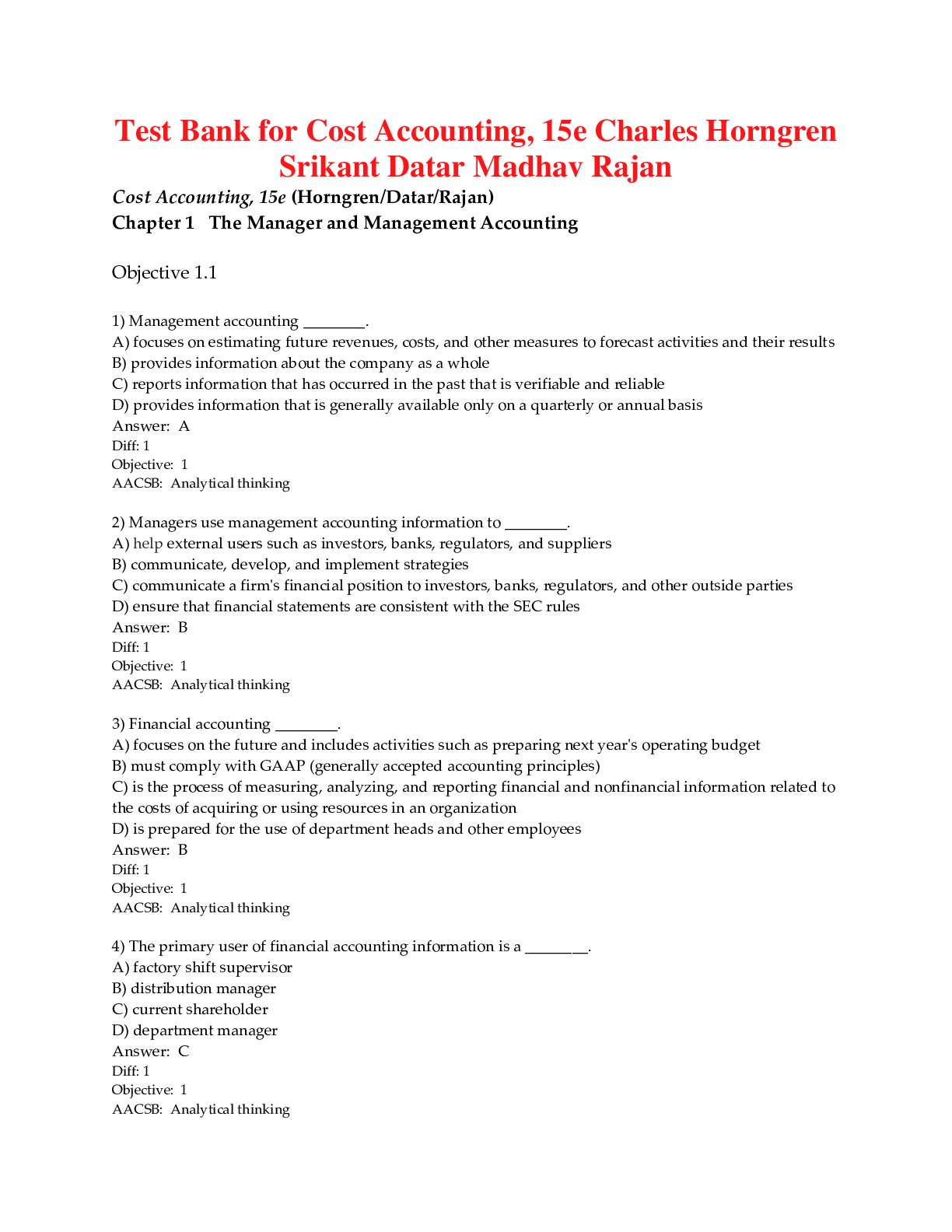
 Srikant Datar, Madhav Rajan.png)



 1e Gail Fayerman.png)
.png)
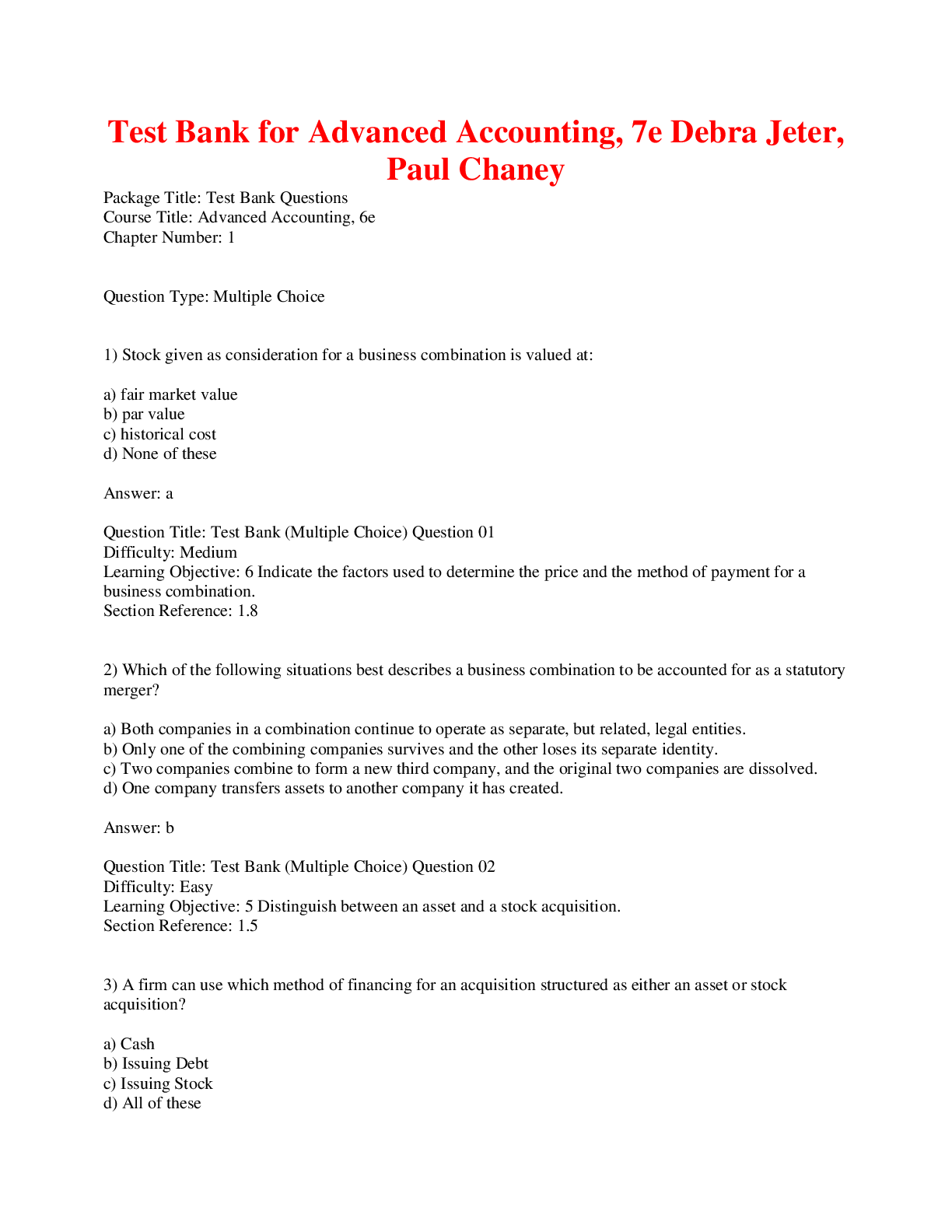
![Preview of Advanced Accounting 5th Edition By Susan Hamlen - TEST BANK [All Chapters 1-16]](https://scholarfriends.com/storage/TB 5e Susan Hamlen_Updated.png)