FTEC 093 Cardiology FISDAP. Exam. 75 Questions and Answers
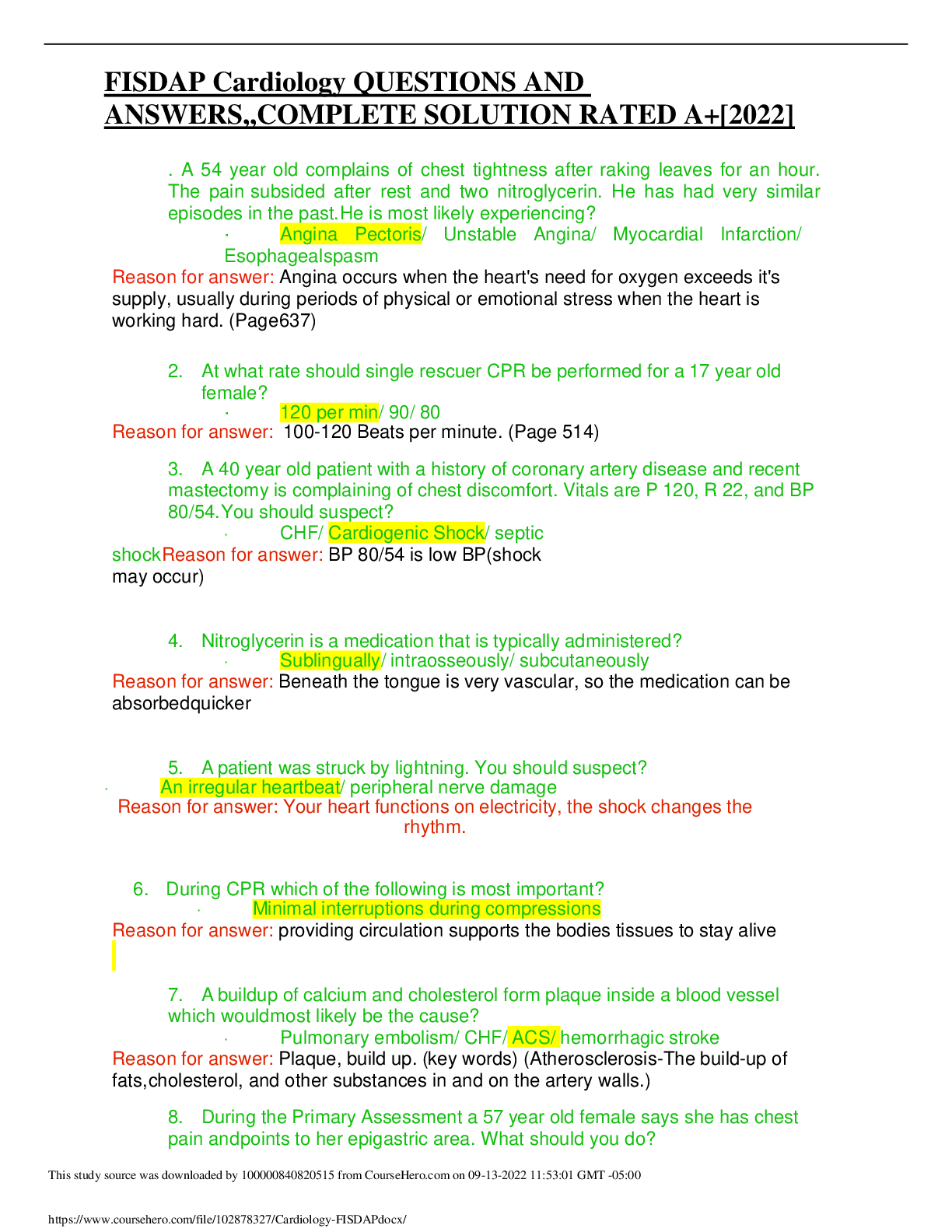
. A 54 year old complains of chest tightness after raking leaves for an hour. The pain
subsided after rest and two nitroglycerin. He has had very similar epis
...
FTEC 093 Cardiology FISDAP. Exam. 75 Questions and Answers
. A 54 year old complains of chest tightness after raking leaves for an hour. The pain
subsided after rest and two nitroglycerin. He has had very similar episodes in the past.
He is most likely experiencing?
· Angina Pectoris/ Unstable Angina/ Myocardial Infarction/ Esophageal
spasm
2. At what rate should single rescuer CPR be performed for a 17 year old female?
· 120 per min/ 90/ 80
3. A 40 year old patient with a history of coronary artery disease and recent
mastectomy is complaining of chest discomfort. Vitals are P 120, R 22, and BP 80/54.
You should suspect?
· CHF/ Cardiogenic Shock/ septic shock)
4. Nitroglycerin is a medication that is typically administered?
· Sublingually/ intraosseously/ subcutaneously
5. A patient was struck by lightning. You should suspect?
· An irregular heartbeat/ peripheral nerve damage
6. During CPR which of the following is most important?
· Minimal interruptions during compressions
7. A buildup of calcium and cholesterol form plaque inside a blood vessel which would
most likely be the cause?
· Pulmonary embolism/ CHF/ ACS/ hemorrhagic stroke
8. During the Primary Assessment a 57 year old female says she has chest pain and
points to her epigastric area. What should you do?
· Obtain vital signs/ Admin Nitro/ Assess breathing/ Admin oxygen
9. What is the cause of heart failure?
· Inadequate ejection of blood from the ventricles/ fluid in lungs/ poor gas
exchange in alveoli/ backup of fluid in lower extremities
10. A cardiac arrest patient has been down for 6 minutes without care. What should you
do?
· Start compressions/ attach AED/ Insert opa and ventilate
11. An adult patient is in cardiac arrest with bystander CPR in progress. What should
you do?
· Continue CPR while partner does AED
12. If the heart lacks the power to pump blood through the circulatory system, it is known
as?
· Cardiogenic shock/ Distributive/ hypovolemic shock
13. A 67 year old male has significant shortness of breath, chest pain, and nausea. He is
ashen and clammy. Vitals are BP 90/60, P 148, and R 34. You should?
· Place supine position/ place in position of comfort/ admin Nitro/ admin
albuterol
14. A child is in cardiac arrest with unknown down time. What should you do?
· Perform CPR while attaching AED.
15. When do coronary arteries fill with blood?
· Diastolic/ systolic/ exhalation/ inhalation
.
16. A 36 year old female with history of congenital heart defects is slow to respond. She
is pale, cool, and clammy. Vitals are BP 68/30, P 128, and R 26. What should you
suspect?
· CHF/ Syncopal episode/ angina/ cardiogenic shock
17. A 73 year old female has chest pain and shortness of breath with bilateral crackles.
Vitals are 80/40, P 112, and R 22. What is the most likely cause?
· Pneumonia/ cardiogenic shock/ hypovolemic shock/ unstable angina
18. A 65 year old male complains of weakness and indigestion that began in the
morning. Vitals are 150/90, P 116, and R 24. You should suspect?
· Myocardial Infarction/ Pul edema/ CVS
19. What is the primary action of Nitroglycerin?
20. 20.An oriented 78 year old female with pale, moist skin is complaining of indigestion.
Vital signs are BP 180/90, P 116, and irregular, R 24 and regular. What should you
suspect?
· Appendicitis/ hypoglycemic shock/ myocardial infarction/ stroke
21. A patient presents with a sudden onset of tearing chest pain, absent radial pulse on
the right arm, and a history of high blood pressure.
· Arterial occlusion/ pulmonary embolism/ aortic dissection/ MI
22. 22.A 67 year old male with a history of asthma complains of chest tightness,
shortness of breath. Took 1 Nitro but no relief. He is pale and sweaty. Oxygen saturation
of 76%. What should you do?
· Obtain vitals/ give oxygen via nonrebreather/ more nitro/ assist with
prescribed inhaler
23. 23.Sudden severe increase of blood pressure is called?
· Transient ischemic attack/ hypotensive emergency/ hypertensive crisis/
central vascular accident
24. 24.A 64 year old patient tells you I feel like I’m about to die. You administer Nitro and
oxygen and there is no relief of chest pain. Vitals are BP 90/66, P 60, R 24. You should?
· Begin assisting ventilations/ more nitro/ transport immediately
25. 25.69 year old male lying in bed complains of chest pain during your primary
assessment he becomes unresponsive and pulseless. What should you do?
· Move him to a hard surface
26. 26.What valve controls blood flow between the left atrium and left ventricle?
· Mitral valve
27. Which patient is most likely to benefit from an AED?
· 54 year old choking patient who becomes unresponsive with no carotid
pulse
28. 28.What action does Aspirin have in the body that makes it beneficial for patients
experiencing an AMI?
· Breaks up red blood cell clots/ Prevents platelets from clotting
29. 29.Which vessels regulate regional blood flow to the capillary bodies?
· Venules/ alveoli/ capillary ducts/ arterioles
30. 30.Which of the following is the largest artery in the body?
· Carotid/ femoral/ great saphenous/ aorta
31. Systolic blood pressure measures which of the following?
· Ventricular contraction
32. 32.The pulmonary artery carries?
· Oxygenated blood to the heart/ deoxygenated blood away from the heart/
oxygenated blood away from the heart/ deoxygenated blood to heart
33. 33.What is the muscular middle layer of the heart?
· Pericardium/ epicardium/ endocardium/ myocardium
34. 34.What best describes PEA?
· Organized electrical activity without a pulse
35. 35.Chronic hypertension in adults typically begins at a pressure of higher than?
· 140/90, 200/100, 120/80, 100/60
36. 36.A 44 year old awakened with shortness of breath complaining of indigestion,
nausea, and epigastric pressure. Antacids didn’t help. You should suspect?
· Acute cholecystitis/ gastroesophageal reflux disease/ peptic ulcer
disease/ Myocardial infarction
37. An adult with a heart rate of 50 is considered?
· Irregular/ normal/ bradycardia/ tachycardia
38. 38.A 36 year old with chest pain is conscious and alert Sp02 93%, you should?
· Non rebreather at 15/ nasal cannula 4 lpm
39. 39.Blood enters the right atrium from?
· Vena Cava
40. 40.A 78 year old diabetic patient with syncopal episode has anxiety, shortness of
breath and back pain. You should suspect?
· ACS/ hypotensive crisis
41. 2 minutes after assisting with 3rd nitro. Complains of dizziness and sweaty. Radial
pulse is present but rapid and weak. You should suspect?
· Allergy to nitro/ cause vasoconstriction impaired cardiac output/ nitro lost
potency/Nitro caused vasodilation and decreased perfusion
42. 42.A 60 year old with short of breath, cyanotic, lung sounds crackles and accessory
muscle use. You should suspect?
· Left heart failure/ right heart failure/ pneumonia/ chronic bronchitis
43. 43.Which electrical cardiac disturbance will an AED shock?
· V-Fib
44. 44.During CPR why is the upstroke of the compression critical?
· Allows blood to fill the heart chamber
45. 45.After blood has been oxygenated it returns to the heart by entering the
· Left atrium
46. 46.During adult CPR you should compress the chest
· At least 2 inches
47. You just arrived at scene of a 75 year old male with weakness and chest pain. He
has not taken his prescribed medications of Nitro, aspirin, and atenolol. You should?
· *Contact medical control to assist the patient with Nitro
48. 48.A 62 year old patient complains of chest pain and lightheadedness. Vitals are
88/56, 126, and 18. What is the best position for this patient?
· Supine
49. 49.EMRs have been performing effective CPR on a patient in cardiac arrest. Upon
arrival the AED indicates “shock advised.” What should you do?
· Defibrillate the patient
50. 50.Asthmatic 50 year old female patient is sitting at her desk. She is anxious and
complaining of tightness in her chest. You should?
· Contact medical control/ obtain BP administer Nitro/ assist with prescribed
inhaler/ perform focused history and physical exam
51. Which of the following is a sign of cardiogenic shock?
· Systemic vasodilation/ jugular vein Distention /progressive
hypotension/ deep vein thrombosis
52. 52.You observe an older male slumped on the floor. He is pulseless. What should
you do?
· Start compressions
53. 53.After delivering one shock with an AED your patient now has a pulse and effective
respirations. Which position should you put them in?
· Recovery
54. 54.Chest pain prior to calling, she took 3 doses of her prescribed sublingual nitro with
no relief. What should you do?
· Assess her vital signs/ admin O2/ consider placing AED pads/ admin your
nitro
55. 55.What causes heart failure?
· Poor gas exchange in alveoli/ inadequate ejection of blood from
ventricles/ backup of excess fluid in lower extremities/ fluid accumulation in lungs
56. 56.Aspirin is administered to patients with chest pain because it?
· Decreases ability of platelets to form clots/ breaks up blood clots
occluding the vessel/ relieves the patients chest pain/ eliminates side effects of
nitro
57. CPR has been ongoing for 10 minutes on a patient in cardiac arrest. An AED has
just been applied and is ready to analyze. You should?
· Stop compressions but continue ventilation/ stop CPR and clear the
patient/ Stop CPR and check for a pulse/ Continue CPR until a shock is advised
58. 58.A 48 year old male complains of an 8/10 crushing chest pain that radiates to his
neck. Vital signs are 112/78, 60, and 18. Patients daily medications include metoprolol,
Cialis, and aspirin. What should you do?
· Assist the patient in admin nitro/ transport rapidly in a position of comfort
to closest facility/ admin 405 mg of aspirin and reassess vitals/ perform a focused
exam of the chest and reassess vital signs
59. 59.While performing chest compressions, you should?
· Make sure your knees are together/ keep your elbows slightly bent/
position your shoulders over your hands/ maintain positive pressure on the chest
60. 60.A Patient who collapsed has been revived following one shock with an AED. She
is now moaning and breathing on her own. What should you do?
· Remove the AED and transport to the nearest facility/ insert opa and do
the jaw thrust maneuver/ put the patient on their side and monitor their airway/
keep her supine and jaw thrust
61. Patient complains of chest pain radiating to both sides of his shoulders after dinner.
He is pale, diaphoretic, and slightly short of breath. Pain worsens with a deep breath.
Vitals are 150/90, 120 and irregular, and 20. You should suspect?
· Costochondritis/ Myocardial infarction/ Angina/ Indigestion
62. 62.A 78 year old diabetic patient with a syncopal episode now complains of anxiety,
shortness of breath, and back pain. You should suspect?
· Acute asthma attack/ Acute coronary syndrome/ Hypotensive crisis/
transient ischemic attack
63. 63.An 84 year old male with a history of “heart problems” complains of chest pain.
The chest pain started 30 minutes ago while at rest. Vital signs are 110/70, 92, 20, Sp02
95%. What should you do?
· Assist patient with prescribed nitro/ apply oxygen at 10 lpm via non
rebreather/ apply AED pads for an impending heart cardiac arrest/ obtain a
detailed medical history
64. 64.A patient complains of substernal chest pain with radiating pain to his back and
jaw, the pain is not relieved with rest, you should suspect?
65. 65.A 49 year old man with a history of heart problems complains of chest pressure
and shortness of breath. You should assist him in taking his nitroglycerin if he?
66. 66.A 48 year old patient complains of difficulty breathing, patients history reveals an
acute myocardial infarction 8 months ago, vital signs are 144/86, 110, and 24,
auscultation reveals crackles in the lung bases. You should suspect?
67. After an AED has analyzed a patient, the machine states “shock advised.” The most
likely cause is:
· Ventricular tachycardia/ atrial fibrillation/ PEA/ asystole
68. 68.The vessels that supply the myocardium are called the:
· Coronary arteries
69. An 80 year old male presents with shortness of breath, fatigue, peripheral edema, and
jugular vein distention. Breath sounds reveal crackles and rhonchi. The most likely cause is
70. You shocked a patient back into normal rhythm with an AED. During transport, the patient
becomes cyanotic and pulseless. What should you do?
71. A patient complains of chest pain radiating to both of his shoulders after dinner. He is pale,
diaphoretic and slightly short of breath. The pain worsens with a deep breath. Vital signs are BP
150/90, P 120 and irregular, R 20. You should suspect:
72. A 57 year old female developed severe weakness and mild shortness of breath while
shoveling snow. She is diaphoretic and complaining of nausea and jaw pain. You should
suspect
73. you are in an airport and see an adult collapse. As you get the AED from the wall, a
bystander starts CPR. If indicated, you should deliver your first shock:
[Show More]