1. The decision-making concepts covered in Data Analysis & Decision Making book include which of the
following?
a. Optimization techniques b. Decision analysis with uncertainty
c. Structured sensitivity analysis d. Al
...
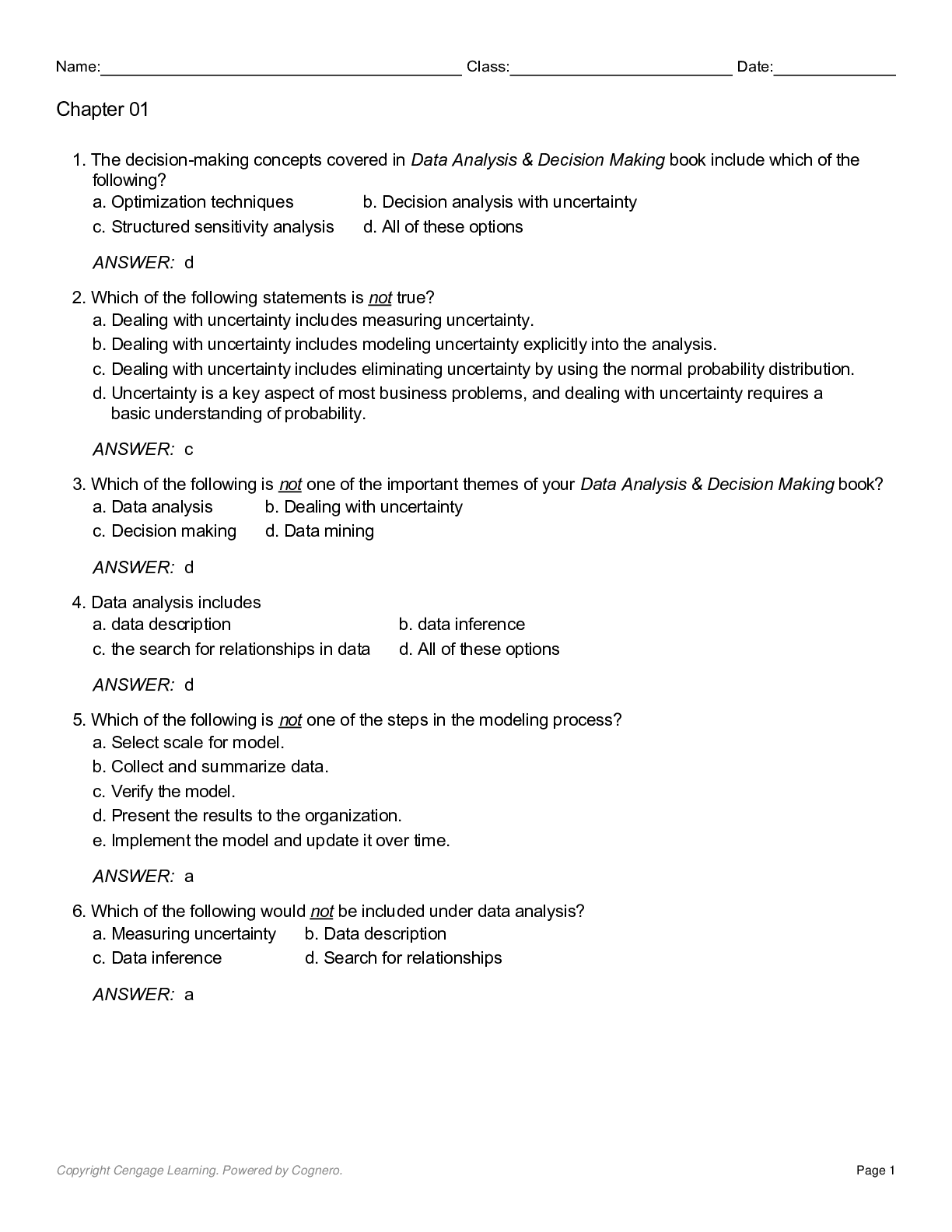
1. The decision-making concepts covered in Data Analysis & Decision Making book include which of the
following?
a. Optimization techniques b. Decision analysis with uncertainty
c. Structured sensitivity analysis d. All of these options
2. Which of the following statements is not true?
a. Dealing with uncertainty includes measuring uncertainty.
b. Dealing with uncertainty includes modeling uncertainty explicitly into the analysis.
c. Dealing with uncertainty includes eliminating uncertainty by using the normal probability distribution.
d. Uncertainty is a key aspect of most business problems, and dealing with uncertainty requires a
basic understanding of probability.
3. Which of the following is not one of the important themes of your Data Analysis & Decision Making book?
a. Data analysis b. Dealing with uncertainty
c. Decision making d. Data mining
4. Data analysis includes
a. data description b. data inference
c. the search for relationships in data d. All of these options
5. Which of the following is not one of the steps in the modeling process?
a. Select scale for model.
b. Collect and summarize data.
c. Verify the model.
d. Present the results to the organization.
e. Implement the model and update it over time.
6. Which of the following would not be included under data analysis?
a. Measuring uncertainty b. Data description
c. Data inference d. Search for relationships
Copyright Cengage Learning. Powered by Cognero. Page 1
Name: Class: Date:
Chapter 01
7. The decision-making process includes
a. optimization techniques for problems with no uncertainty
b. decision analysis for problems with uncertainty
c. structured sensitivity analysis
d. All of these choices
8. Which of the following is not one of the types of models described in Data Analysis & Decision Making
book?
a. Algebraic model b. Spreadsheet model
c. Scale model d. Graphical model
9. The modeling process discussed in Data Analysis & Decision Making book is a
a. seven-step process
b. six-step process
c. five-step process
d. four-step process
e. three-step process
10. Which of the following is an Excel add-in for performing what-if analyses?
a. PrecisionTree
b. TopRank
c. Solver
d. @Risk
e. StatTools
11. Which of the following statements are false?
a. The modeling process discussed in Data Analysis & Decision Making book is five-step process.
b. Dealing with uncertainty requires a basic understanding of probability.
c. Uncertainty is a key aspect of most business problems.
d. Data description and data inference are included under data analysis.
Copyright Cengage Learning. Powered by Cognero. Page 2
Name: Class: Date:
Chapter 01
12. Which of the following statements are false?
a. Decision-making includes optimization techniques for problems with certainty, decision analysis for
problems with certainty, and structured sensitivity analysis.
b. Graphical models can be very helpful for simple problems. For complex problems, however,
graphical models usually fail to show the important elements of a problem and how they are related.
c. Dealing with uncertainty includes measuring uncertainty and modeling uncertainty explicitly into the
analysis.
d. All of these options
13. Which of the following statements are true?
a. An alternative to algebraic modeling is spreadsheet modeling. Instead of relating various quantities
with algebraic equations and inequalities, they are related in a spreadsheet with cell formulas.
b. Data are usually meaningless until they are analyzed for trends, patterns, relationships, and other
useful information.
c. Algebraic models, by means of algebraic equations and inequalities, specify a set of relationships in
a very precise way. Their main drawback is that they require an ability to work with abstract
mathematical symbols.
d. When we make inferences from data and search for relationships in data, or when we use decision
trees to help make decisions, we must deal with uncertainty.
e. All of these options
14. Which of the following statements are true?
a. Three important themes run through the book. Two of them are in the title: data analysis and
decision making. The third is dealing with uncertainty.
b. Data analysis includes data description, data inference, and the search for relationships in data.
c. Decision making includes optimization techniques for problems with no uncertainty, decision
analysis for problems with uncertainty, and structured sensitivity analysis.
d. Dealing with uncertainty includes measuring uncertainty and modeling uncertainty explicitly into the
analysis.
e. All of these options
15. Which of the following is an Excel add-in for simulation?
a. PrecisionTree
b. TopRank
c. Solver
d. @Risk
e. StatTools
Copyright Cengage Learning. Powered by Cognero. Page 3
Name: Class: Date:
Chapter 01
16. Data analysis includes data description, data inference, and the search for relationships in data.
a. True
b. False
17. Decision-making includes optimization techniques for problems with certainty, decision analysis for
problems with certainty, and structured sensitivity analysis.
a. True
b. False
18. Dealing with uncertainty includes measuring uncertainty and modeling uncertainty explicitly into the
analysis.
a. True
b. False
19. The authors of the Data Analysis & Decision Making book described three types of models: graphical
models, algebraic models, and spreadsheet models.
a. True
b. False
20. Graphical models are the least intuitive type of model. Its purpose is simply to provide enough quantitative
details to enable us solve the problem of interest.
a. True
b. False
21. Three important themes run through this book: data analysis, decision making, and dealing with
uncertainty.
a. True
b. False
22. Graphical models can be very helpful for simple problems. For complex problems, however, graphical
models usually fail to show the important elements of a problem and how they are related.
a. True
b. False
Copyright Cengage Learning. Powered by Cognero. Page 4
Name: Class: Date:
Chapter 01
23. The overall modeling process typically done in the business world always require seven steps: define the
problem, collect and summarize data, develop a model, verify the model, select one or more suitable
decisions, present the results to the organization, and implement the model and update it over time.
a. True
b. False
24. Algebraic models, by means of algebraic equations and inequalities, specify a set of relationships in a very
precise way. Their main drawback is that they require an ability to work with abstract mathematical
symbols.
a. True
b. False
25. Data are usually meaningless until they are analyzed for trends, patterns, relationships, and other useful
information.
a. True
b. False
26. An alternative to algebraic modeling is spreadsheet modeling. Instead of relating various quantities with
algebraic equations and inequalities, they are related in a spreadsheet with cell formulas.
a. True
b. False
27. When we use simulation models to help make decisions, we do not deal with uncertainty at all, since we
often must make inferences from the simulated data.
a. True
b. False
28. When we make inferences from data and search for relationships in data, or when we use decision trees
to help make decisions, we must deal with uncertainty.
a. True
b. False
29. The @Risk is an Excel add-in that can be used to run replications of a simulation, keep track of outputs,
create useful charts, and perform sensitivity analyses.
a. True
b. False
Copyright Cengage Learning. Powered by Cognero. Page 5
Name: Class: Date:
Chapter 01
30. Graphical models are probably the least intuitive and most quantitative type of model.
a. True
b. False
Copyright Cengage Learning. Powered by Cognero. Page 6
Name: Class: Date:
Chapter 01
[Show More]