Food and Nutrition > EXAM > Sample questions for the exam of the FQD10306 box. (All)
Sample questions for the exam of the FQD10306 box.
Document Content and Description Below
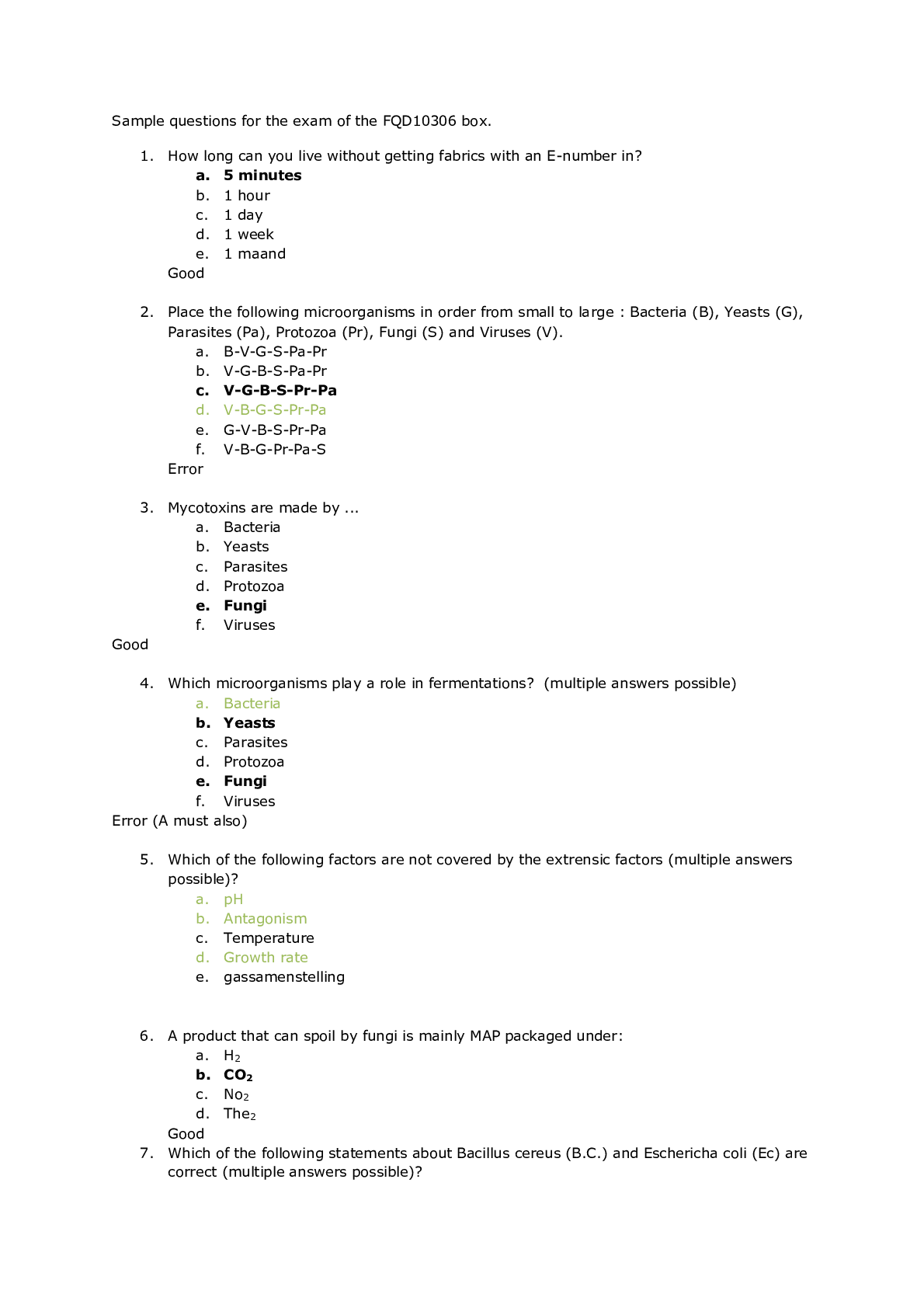
Sample questions for the exam of the FQD10306 box. 1. How long can you live without getting fabrics with an E-number in? a. 5 minutes b. 1 hour c. 1 day d. 1 week e. 1 maand 2. Place the fo ... llowing microorganisms in order from small to large : Bacteria (B), Yeasts (G), Parasites (Pa), Protozoa (Pr), Fungi (S) and Viruses (V). a. B-V-G-S-Pa-Pr b. V-G-B-S-Pa-Pr c. V-G-B-S-Pr-Pa d. V-B-G-S-Pr-Pa e. G-V-B-S-Pr-Pa f. V-B-G-Pr-Pa-S 3. Mycotoxins are made by ... a. Bacteria b. Yeasts c. Parasites d. Protozoa e. Fungi f. Viruses 4. Which microorganisms play a role in fermentations? (multiple answers possible) a. Bacteria b. Yeasts c. Parasites d. Protozoa e. Fungi f. Viruses 5. Which of the following factors are not covered by the extrensic factors (multiple answers possible)? a. pH b. Antagonism c. Temperature d. Growth rate e. gassamenstelling 6. A product that can spoil by fungi is mainly MAP packaged under: a. H2 b. CO2 c. No2 d. The2 7. Which of the following statements about Bacillus cereus (B.C.) and Eschericha coli (Ec) are correct (multiple answers possible)? a. Both make toxins that can make you sick b. Both make tracks c. From both bacteria you get (heavy) diarrhee d. Ec is an intestinal bacterium, B.C. 8. Which of the pathogens below does not cause a food infection? a. Clostridium botulinum b. Escherichia coli c. Listeria monocytogenes d. Salmonella typhimurium 9. What is the main reason for intensive heat treatment when canning vegetables? A. Preserving the original colour of the vegetables B. Preserving the original texture of the vegetables c. Preserving the nutritional value of the vegetables d. Killing off microorganisms to extend shelf life 10. Natural flavourings and colourings belong to the product groups......? A. Raw materials B. Composite products c. Refined products d. Ingredients 11. What gas composition would you choose for packing fresh salmon? a. 100% N2 (nitrogen) b. 50% CO2 (carbon dioxide), 50% N2 c. 30% O2 (oxygen), 30% CO2,40% N2 d. 21% The2, 79% N2 e. 100% CO2 12. The following information must (among other things) be required on the food label: a. Brand name/ingredients/quantity/shelf life b. Holdability/product name/producer name/quantity c. Food claim/ingredients/shelf life/storage instruction d. Allergens/barcode/shelf life/quantity 13. Which of the following statements is true: S1: "Nutritional information of the product should always be on the packaging" S2: "The weight of the product should always be on the packaging" a. Both theses are true b. Both statements are false c. S1 is true, S2 is untrue d. S1 is false, S2 is true 14. What can you compare the amount of energy needed to produce all the packaging that an average family uses in a year? a. With 20% of the average use of the family car b. With 10% of the energy needed to produce the food for the family c. With a return flight London - Cape Town d. With 50% of the energy for heating the home 15. Which of the following statements is true: S1: "If the claim: 'helps you to lose 1kg per month' is on a product, that product must contain at least 30% less energy than a reference product" S2: "A claim indicating that health may be adversely affected by the non-consumable consumption of that product is prohibited by the EU" a. Both theses are true b. Both statements are false c. S1 is true, S2 is untrue d. S1 is false, S2 is true 16. Which of the following statements is true: S1: "The 'rich in milk' claim is an example of a food claim" S2: "The claim 'helps lower your cholesterol levels' is an example of a health claim" a. Both theses are true b. Both statements are false c. S1 is true, S2 is untrue d. S1 is false, S2 is true 17. The "check mark" logos: a. Are seen as claims under the law b. May in principle be put on any product, as long as the company pays for it c. Are no claims at all d. Are used by all producers on their healthiest products within a product group 18. A product with a green "check mark" : a. Is organically produced b. Is the healthiest of all products in the same product group c. Meets the nutritional requirements specific to this product group d. Is a healthy product 19. What form product is most vulnerable to food fraud a. Large objects, e.g. apples b. Small particles, e.g. coffee beans, spices c. Ground products, e.g. minced meat d. Liquids 20. If you investigate the vulnerability to fraud as a company, you only need to look at the suppliers a. Where b. Not true 21. The man/woman balance in economic fraud is... a. 85/15 b. 65/35 c. 50/50 d. 35/65 e. 15/85 22. What approach to analytical fraud is useful and is applied in practice. a. Measuring single substances and comparing them to a standard value b. Measuring different single substances at the same time and comparing them with standard values c. Measuring analytical finger prints and testing using databases and statistical comparison d. Measuring single substances and comparing it to a standard value and measuring different single substances at the same time and comparing them with standard values e. Measuring single substances and comparing them with a standard value; measuring different single substances at the same time and comparing them with standard values, and measuring analytical finger prints and testing using databases and statistical comparison. 23. You are a product developer at a company that makes dried meal mixes. You are at the beginning of the development process and have figured out that you want to develop a tomato-olive-peach meal mix. You have made two variants of the meal mix, one with organic tomatoes and peach and one with 'regular' tomatoes and peach. You would like to know on which sensory attributes these meal mixes differ, what kind of test is best used? a. A hedonic test b. A descriptive test c. A difference test (discrimination test) 24. What can you conclude from the graph below? (multiple answers possible) a. Product 5 and 9 score lowest on taste acid b. The less acidic the product, the tastier the consumer finds the product c. Product 6 is more acidic in taste than product 10 d. Product 5 is rated the least delicious. 25. What kind of panel(s) do you need when you want to know if a product is tasty? a. Only a consumer panel b. A screened panel that is also trained c. Only a screened panel d. A consumer panel that is also trained 26. What are the basic flavours used in sensory research? a. Sweet, sour, salty and bitter b. Sweet, sour and bitter c. Sweet, sour, salty, bitter and umami d. Sweet and sour, bitter and umami e. Sweet, sour, salty, bitter and astringent 27. Which macronutrients are always listed in a nutritional table on the packaging? a. Proteins, carbohydrates and fats b. Dietary fiber, carbohydrates, iron c. Protein and energy d. Vitamins and fats 28. Waar of niet waar: Most vegetable fats are liquid at room temperature and most animal fats are then solid. a. Where b. Not true 29. Animal fats contain cholesterol; vegetable fats do not. a. Where b. Not true 30. Omega-3 fats are mainly common in Mediterranean plants a. Where b. Not true 31. Fat can be a safety issue because: a. It can oxidize b. It may contain heavy metals c. It can't be organic d. It may contain dioxins and other fat-soluble chemicals. 32. Palm oil is often used as a substitute for margarine or butter. What are consumers' reservations about the use of palm oil? a. It contains more calories than other fats b. It is rich in palm acid; that's unhealthy c. Cultivating oil palms for palm oil extraction causes deforestation in Malaysia and Indonesia d. All the above answers 33. Consumers associate proteins with: (more answers possible) a. Important nutrient for growth, especially for children b. A possible source for allergies c. Animal products, so not sustainable in the long term d. None of the above 34. The digestibility of proteins (more answers possible) a. Is an important aspect for babies and people with specific diseases b. Is a more relevant aspect for plant than for animal proteins c. Can be changed by editing processes d. Is only relevant for dairy and eggs 35. Why does a nutritional table say "the amount of carbohydrates, of which sugars" a. Because consumers want to reduce sugar intake b. Because carbohydrates and sugars have a different energy value c. Because many people are allergic to sugar d. Because consumers love sweet products 36. Starch is a cheap energy source a. Where b. Not true 37. Cellulose is a polysacharide and present in most vegetables a. Where b. Not true 38. Starch changes physical structure during cooking (it gels) and therefore becomes unpalatable a. Where b. Not true 39. Which of the following statements is correct S1. Dietary fibres hold water and this ensures the firmness of fruits and vegetables S2. Cellulose is a soluble dietary fiber a. S1 true; S2 not true b. S1 not true; S2 where c. Both true d. Both not true 40. Which of the product characteristics listed below are nutritional related? a. The concentration of proteins b. Quality mark 'Organic' c. Expiry date d. Indication that the product is 'gluten free'. [Show More]
Last updated: 3 years ago
Preview 1 out of 7 pages
Buy this document to get the full access instantly
Instant Download Access after purchase
Buy NowInstant download
We Accept:

Reviews( 0 )
$5.00
Can't find what you want? Try our AI powered Search
Document information
Connected school, study & course
About the document
Uploaded On
Dec 09, 2020
Number of pages
7
Written in
All

Additional information
This document has been written for:
Uploaded
Dec 09, 2020
Downloads
0
Views
102
.png)


.png)