NOC REPORTING TEMPLATE
Date Updated: 3/22/2021 Name: Bruce Bracey
A. Introduction
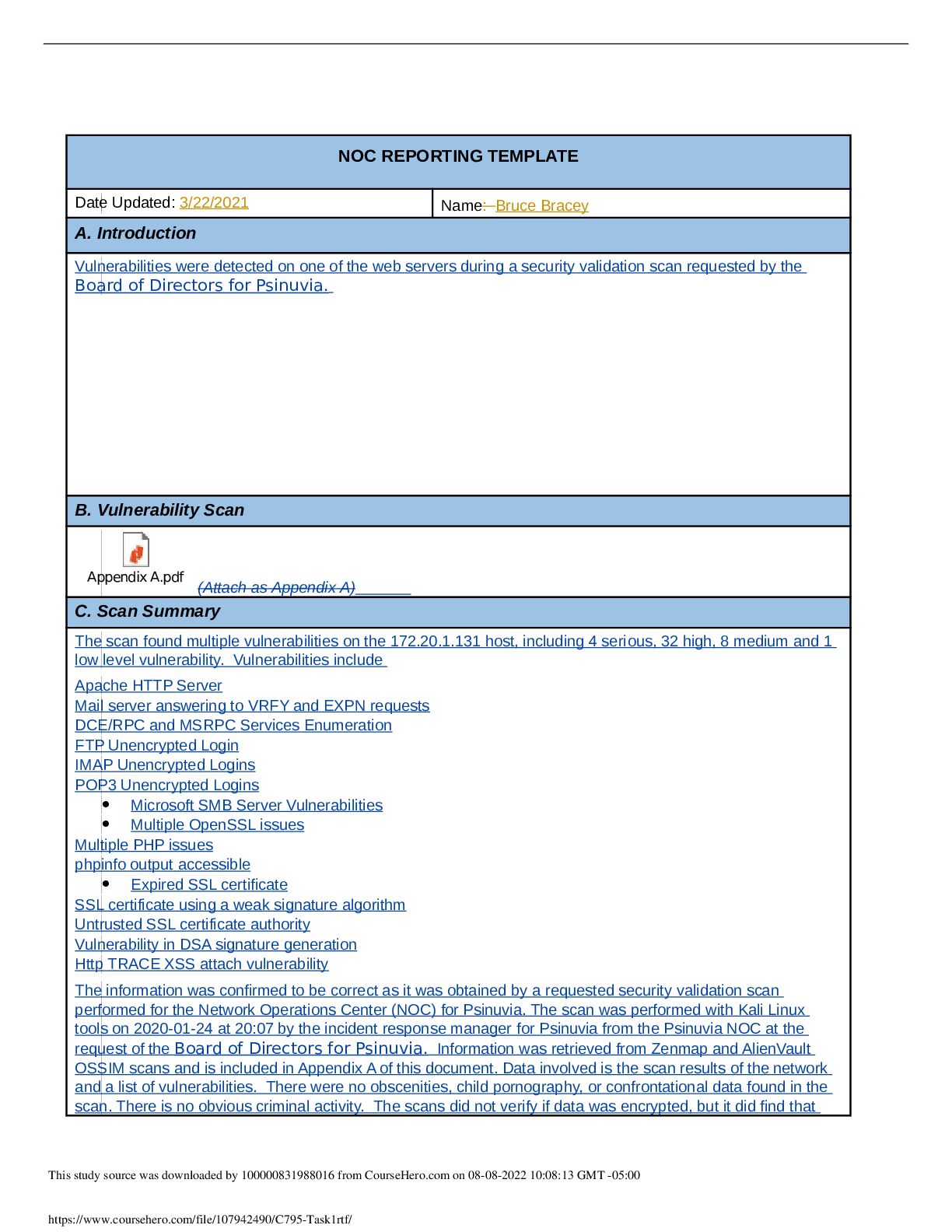
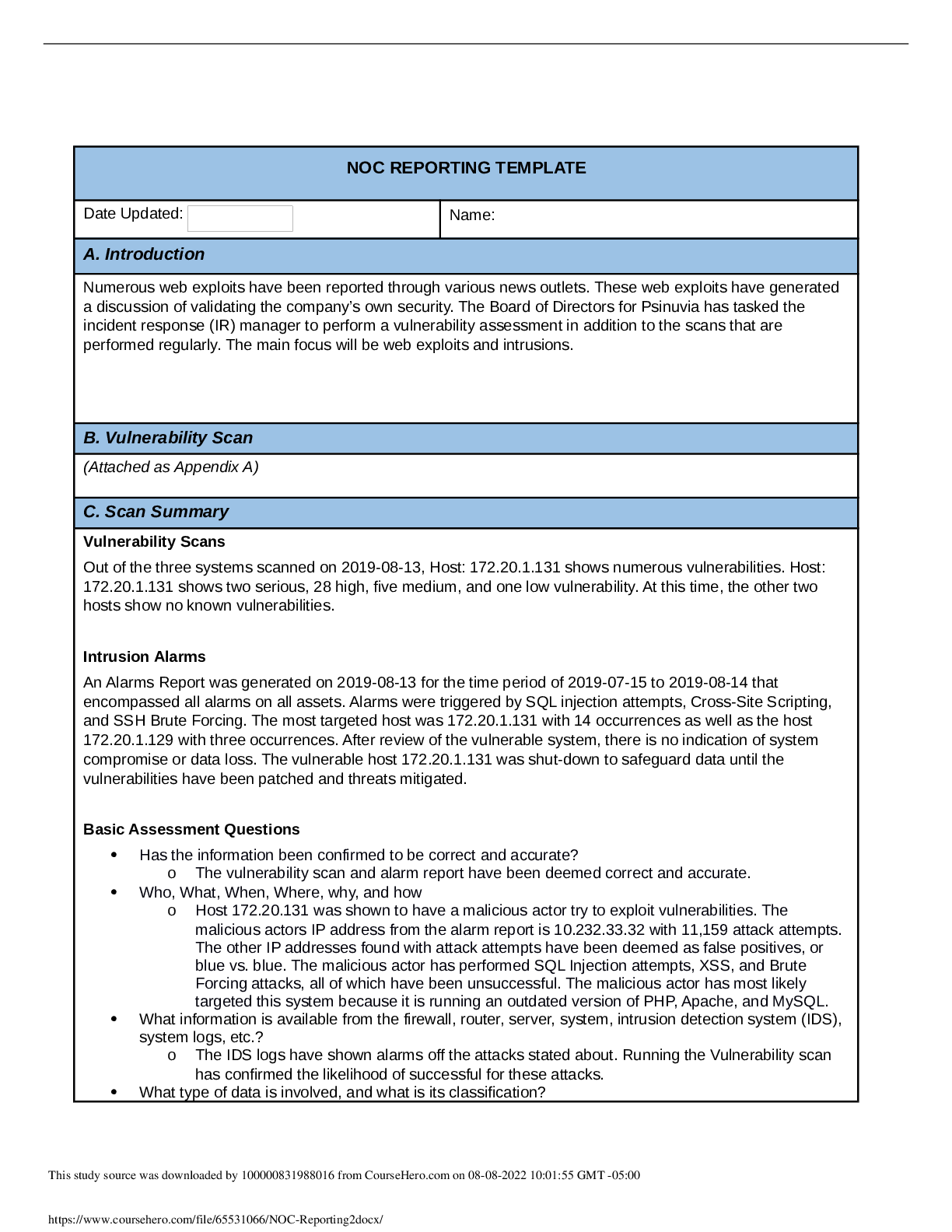
Vulnerabilities were detected on one of the web servers during a security validation scan requested by the
Board of Directors for Psin
...
NOC REPORTING TEMPLATE
Date Updated: 3/22/2021 Name: Bruce Bracey
A. Introduction
Vulnerabilities were detected on one of the web servers during a security validation scan requested by the
Board of Directors for Psinuvia.
B. Vulnerability Scan
Appendix A.pdf
(Attach as Appendix A)
C. Scan Summary
The scan found multiple vulnerabilities on the 172.20.1.131 host, including 4 serious, 32 high, 8 medium and 1
low level vulnerability. Vulnerabilities include
Apache HTTP Server
Mail server answering to VRFY and EXPN requests
DCE/RPC and MSRPC Services Enumeration
FTP Unencrypted Login
IMAP Unencrypted Logins
POP3 Unencrypted Logins
Microsoft SMB Server Vulnerabilities
Multiple OpenSSL issues
Multiple PHP issues
phpinfo output accessible
Expired SSL certificate
SSL certificate using a weak signature algorithm
Untrusted SSL certificate authority
Vulnerability in DSA signature generation
Http TRACE XSS attach vulnerability
The information was confirmed to be correct as it was obtained by a requested security validation scan
performed for the Network Operations Center (NOC) for Psinuvia. The scan was performed with Kali Linux
tools on 2020-01-24 at 20:07 by the incident response manager for Psinuvia from the Psinuvia NOC at the
request of the Board of Directors for Psinuvia. Information was retrieved from Zenmap and AlienVault
OSSIM scans and is included in Appendix A of this document. Data involved is the scan results of the network
and a list of vulnerabilities. There were no obscenities, child pornography, or confrontational data found in the
scan. There is no obvious criminal activity. The scans did not verify if data was encrypted, but it did find that
This study source was downloaded by 100000831988016 from CourseHero.com on 08-08-2022 10:08:13 GMT -05:00
https://www.coursehero.com/file/107942490/C795-Task1rtf/
FTP, IMAP and POP3 are using unencrypted logins. The magnitude is one server has multiple vulnerabilities
that could be exploited. The vulnerabilities still require remediation. Containment has not been accomplished
and will only be possible after patching/updating of the system is complete. The estimated cost is the time
required for patching/updating the system.
D. Detailed Analysis
A scan was performed with Zenmap using the ‘intense scan’ option to obtain a list of hosts on the 172.20.1.0/24
network from a KALI Linux server.
bbracey_C795_Task1_part1_000201576.pdf
Once complete, a vulnerability scan from AlienVault OSSIM was run against the hosts in the 172.20.1.0/24
network, returning a list of hosts and a count of vulnerabilities.
bbracey_C795_Task1_part2_000201576.pdf
Finally, a report was generated from the alarms in the scan using AlienVault OSSIM:
bbracey_C795_Task1_part3_000201576.pdf
The results were recorded in Appendix A of the vulnerability scan section of this document.
This study source was downloaded by 100000831988016 from CourseHero.com on 08-08-2022 10:08:13 GMT -05:00
https://www.coursehero.com/file/107942490/C795-Task1rtf/
E. Scan Response
The event level for this scan is low as there has been no loss of data, network disruption or other malicious
activity. However, the director of Security Ops should be made aware of the results within 72 hours of the scan
completion.
F. Remediation
The 172.20.1.131 host should be taken offline for patching and updates during a scheduled maintenance
window as the other hosts in the scan do not support redundant services. 173.20.1.129 is running an Apache
server, but it is unclear if the content is the same as 172.20.1.131 as it is running Ubuntu. It does not run FTP or
a mail server. 172.20.1.132 does not run HTTP, FTP or a mail server. During patching/updates, FTP and mail
This study source was downloaded by 100000831988016 from CourseHero.com on 08-08-2022 10:08:13 GMT -05:00
https://www.coursehero.com/file/107942490/C795-Task1rtf/
will be unavailable so this should be scheduled for after hours or over a weekend.
G. Recommendations
Administrative Controls:
In addition to the regular intrusion scans of systems,
a vulnerability scan should also be scheduled at least
quarterly. This scan should be reviewed and
the actions taken to update/patch systems.
Applications on the servers should periodically be
reviewed for versioning to verify they are current and
none are reaching end-of-life.
SSL certificates renewals should be documented and
reviewed quarterly to ensure certificates do not
[Show More]