Module 6 Case Study AP1
Question 1
1 out of 1 points
Donna, a 42-year-old mother of two, has been experiencing intermittent tingling and
numbness in both of her feet. She has also had trouble holding a pen while wr
...
Module 6 Case Study AP1
Question 1
1 out of 1 points
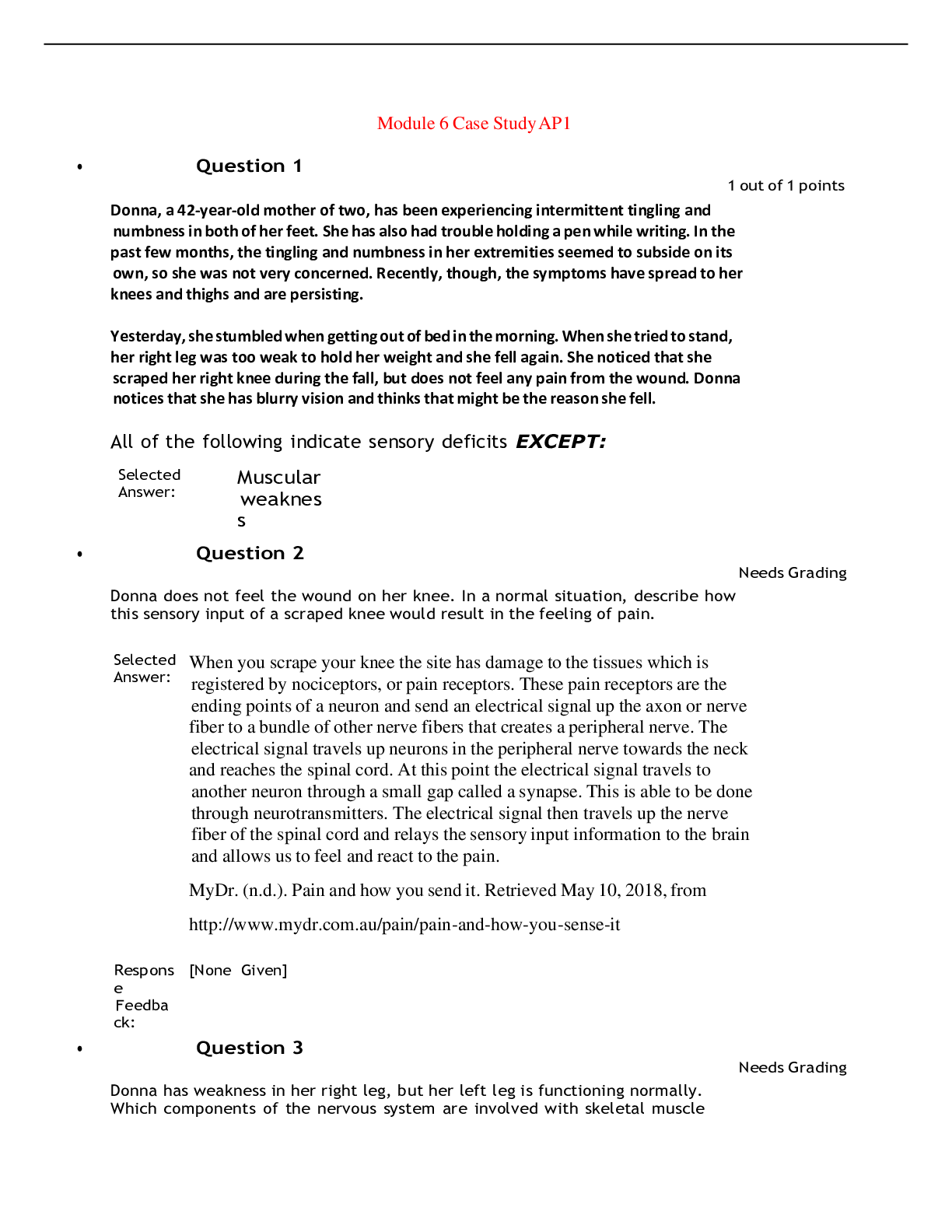
Donna, a 42-year-old mother of two, has been experiencing intermittent tingling and
numbness in both of her feet. She has also had trouble holding a pen while writing. In the
past few months, the tingling and numbness in her extremities seemed to subside on its
own, so she was not very concerned. Recently, though, the symptoms have spread to her
knees and thighs and are persisting.
Yesterday, she stumbled when getting out of bed in the morning. When she tried to stand,
her right leg was too weak to hold her weight and she fell again. She noticed that she
scraped her right knee during the fall, but does not feel any pain from the wound. Donna
notices that she has blurry vision and thinks that might be the reason she fell.
All of the following indicate sensory deficits EXCEPT:
Selected
Answer:
Muscular
weakness
Question 2
Needs Grading
Donna does not feel the wound on her knee. In a normal situation, describe how
this sensory input of a scraped knee would result in the feeling of pain.
Selected
Answer:
When you scrape your knee the site has damage to the tissues which is
registered by nociceptors, or pain receptors. These pain receptors are the
ending points of a neuron and send an electrical signal up the axon or nerve
fiber to a bundle of other nerve fibers that creates a peripheral nerve. The
electrical signal travels up neurons in the peripheral nerve towards the neck
and reaches the spinal cord. At this point the electrical signal travels to
another neuron through a small gap called a synapse. This is able to be
done through neurotransmitters. The electrical signal then travels up the
nerve fiber of the spinal cord and relays the sensory input information to
the brain and allows us to feel and react to the pain.
MyDr. (n.d.). Pain and how you send it. Retrieved May 10, 2018, from
http://www.mydr.com.au/pain/pain-and-how-you-sense-it
Respons
e
Feedbac
k:
[None Given]
Question 3
Needs Grading
Donna has weakness in her right leg, but her left leg is functioning normally.
Which components of the nervous system are involved with skeletal muscle
This study source was downloaded by 100000805030033 from CourseHero.com on 08-09-2022 06:15:13 GMT -05:00
https://www.coursehero.com/file/30931671/AP-1-Module-6-Case-Studydocx/
movement? Be specific about how the motor impulse moves through the body.
Selected
Answer:
The somatic nervous system is responsible for muscle movement. A motor
impulse is sent through the body by sending the signals from neuron to
neuron via th synapse and traveling along motor fibers. This signal then
reaches the muscle and an action response is carried out.
Biology dictionary. (n.d.). Somatic nervous system.
Retrieved May 10, 2018, from
https://biologydictionary.net/somatic-nervous-system/
Respons
e
Feedbac
k:
[None Given]
Question 4
1 out of 1 points
Which of the following correctly defines a motor unit?
Selected
Answer:
A single neuron and all the muscle cells it
innervates
Question 5
1 out of 1 points
Which of the following statements is true?
Selected
Answer:
Donna is experiencing both motor and
sensory deficits.
Question 6
Needs Grading
List and describe any and all symptoms in Donna’s history that could be related to a
pathology of her motor neurons.
Selected
Answer:
Holding a pen while writing, muscle weakness in lower extremities.
Henderson, J. M. (n.d.). Motor impairment. Retrieved May 10, 2018,
from http://www.neuromodulation.com/motor-impairment
Response
Feedback:
[None Given]
Question 7
1 out of 1 points
Donna’s primary care physician wants to screen her for Multiple Sclerosis. Which
of the following tests would provide the most definitive diagnosis for MS?
Selected
Answer:
MRI
This study source was downloaded by 100000805030033 from CourseHero.com on 08-09-2022 06:15:13 GMT -05:00
https://www.coursehero.com/file/30931671/AP-1-Module-6-Case-Studydocx/
Question 8
Needs Grading
If Donna does have MS, the disease is affecting her myelin sheath. Briefly describe what
happens to the myelin sheath and how it disrupts nerve function in patients with Multiple
Sclerosis.
Sele
cted
Ans
wer:
In MS the T-cells from the body's immune system attack the myelin sheath which
causes damage, or full destruction of the sheath. Because of this damage, or
destruction, the axon is left uninsulated and exposed. When messages are being sent
from the brain to the various body parts, they are delayed, and possibly distorted,
causing misinterpretation of the wanted reaction.
Dangond, F. (n.d.). Myelin sheath in multiple sclerosis. Retrieved May 10, 2018,
from
https://www.emedicinehealth.com/myelin_and_the_central_nervous_system/article_
em.htm#ms_symptoms_and_signs_of_destroyed_myelin_demyelination
Res
pon
se
Fee
dba
ck:
[None Given]
Question 9
1 out of 1 points
Donna later sees a specialist who wants to perform a spinal tap, which is an
analysis of cerebrospinal fluid. Where is cerebrospinal fluid (CSF) found?
Selected
Answer:
Surrounding the structures of the Central
Nervous System
Question 10
Needs Grading
After extensive testing, Donna’s care team concluded that she does have
Multiple Sclerosis and have prescribed steroid treatment. How will steroids help
alleviate her symptoms?
Selected
Answer:
Steroids are used as an anti inflammatory. They suppress the multiple
pathways that are inflamed in the body. In MS there are exacerbations, or
flare ups, of inflammation to the nerve pathways. Steroids are used to
control the inflammation and aid in stopping any acute damage for
occuring.
Minton, L. S. (n.d.). Corticosteroids for the treatment of MS. Retrieved
May 10, 2018, from https://multiplesclerosis.net/treatment/corticosteroids/
This study source was downloaded by 100000805030033 from CourseHero.com on 08-09-2022 06:1
[Show More]


.png)



 Correct Study Guide, Download to Score A.png)





.png)
.png)