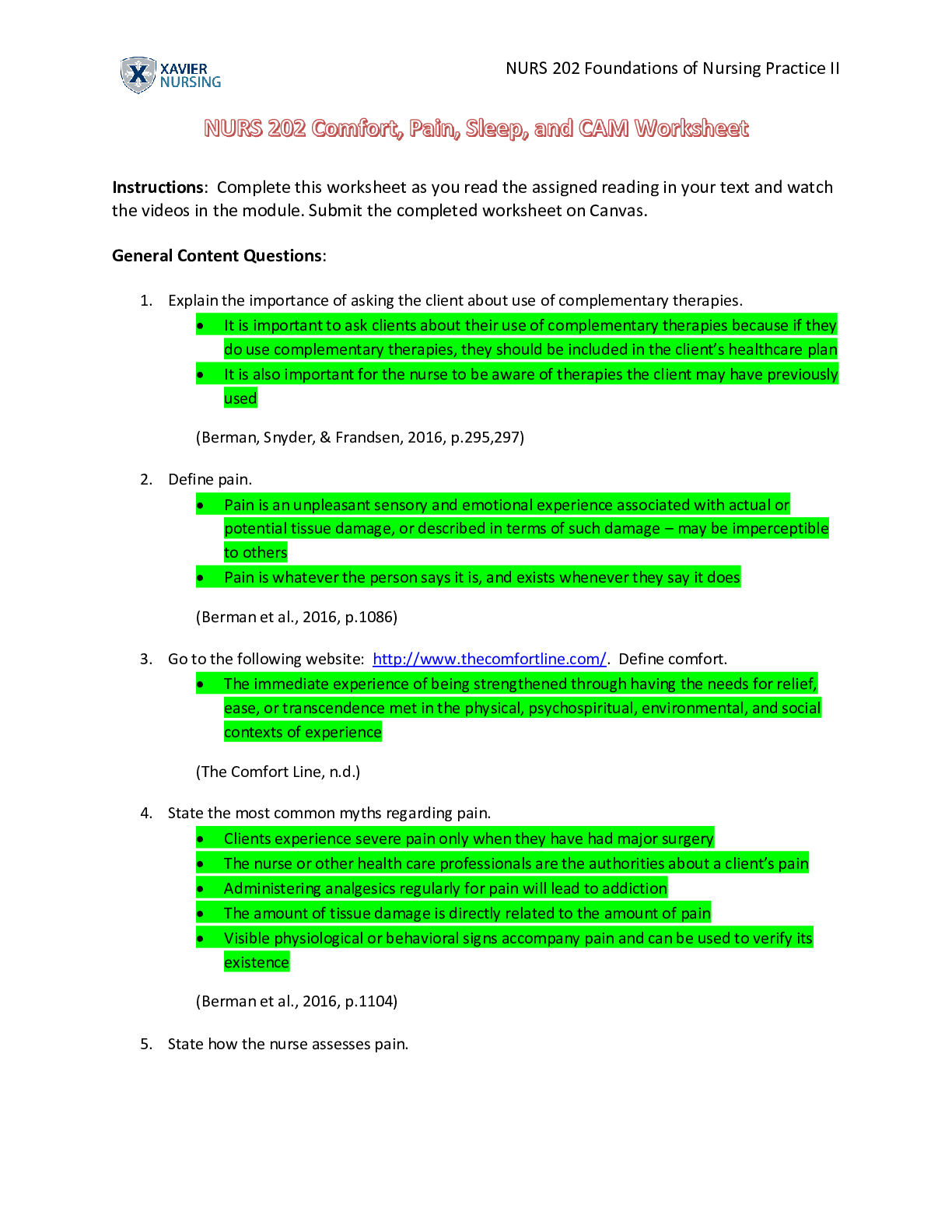
NURS 202 Comfort, Pain, Sleep, and CAM Worksheet
Instructions: Complete this worksheet as you read the assigned reading in your text and watch the videos in the module. Submit the completed worksheet on Canvas.
Ge
...
NURS 202 Comfort, Pain, Sleep, and CAM Worksheet
Instructions: Complete this worksheet as you read the assigned reading in your text and watch the videos in the module. Submit the completed worksheet on Canvas.
General Content Questions:
1. Explain the importance of asking the client about use of complementary therapies.
2. Define pain.
3. Go to the following website: http://www.thecomfortline.com/. Define comfort.
4. State the most common myths regarding pain.
5. State how the nurse assesses pain.
6. What pain scale does the nurse use for verbal patient? For non-verbal patients and young children?
7. Describe the nurse's role in pharmacologic and non-pharmacologic pain management.
8. Describe the individual who has inadequate amounts of sleep.
9. Should naps be encouraged with certain groups such as the hospitalized and elderly?
10. List the drugs that disrupt sleep.
11. What are the clinical manifestations of insomnia?
12. What is hypersomnia?
13. What is narcolepsy?
14. What central nervous system stimulant is most commonly given to a client with narcolepsy?
15. What are the precautions for clients on oral contraceptives or who have hepatic dysfunction?
16. Briefly describe sleep apnea.
17. What is parasomnia? Provide at least three examples.
18. List at least three nursing interventions to promote sleep.
Sleep Case Study:
Sheena, a 42-year-old woman, is referred to the sleep disorders center with a complaint of chronic, severe insomnia affecting her daytime functioning. The single mother of three teenage boys, she first experienced insomnia eight years ago when bankruptcy threatened her small business. Although the business recovered a year later, her insomnia has remained almost unchanged over the next eight years.
Medication History: She has unsuccessfully taken Ativan (lorazepam), Restoril (temazepam), and Ambien (zolpidem tartrate). Although an initial benefit was derived from each of these medications, she gave up on each of them after a few weeks because of their side effects and/or lack of efficacy. She is currently trying Melatonin, an over-the-counter sleep aid.
1. What is the action of sedative hypnotics? What are the considerations for initial dosing, regular use, and cessation?
2. Which of the above medications would most likely cause the most daytime sleepiness?
Social History: Sheena feels she is just “hanging on by her fingernails,” and that looking after her business and her sons takes all of her energy. Her insomnia has forced her to give up her social life, including her fly-fishing hobby and gym workouts. She feels depleted and stressed all of the time.
Review of Sleep Pattern: Sheena tries to go to bed around 11:00 PM. She usually falls asleep in less than 15 minutes, but occasionally it seems to take her hours to fall asleep. She wakes up three to four times per night, and at least one of these awakenings lasts two to three hours. She gets frustrated when she “sees the clock ticking away;” in response, she usually gets out of bed to work on the computer until she becomes sleepy, which often does not happen until around 5:30 AM — which is the time she should be getting up. At that time, Sheena falls into a very deep sleep and may not awaken until 7:00 or 8:00 AM.
1. What nursing diagnoses are appropriate for this patient (include “related to” and “as evidenced by”)?
2. List at least four suggestions the nurse can give the patient when teaching about promoting sleep.
References
Berman, A., Snyder, S.J., & Frandsen, G. (2016). Kozier & Erb’s Fundamentals of Nursing: Concepts, Process, and Practice (10th ed.) Hoboken, New Jersey: Pearson Education, Inc.
Philosophical Perspectives. (n.d.). Retrieved from https://www.thecomfortline.com/philosophical-perspectives
[Show More]