*NURSING  >  EXAM  >  NURS6700 Week 7.docx (All)

NURS6700 Week 7.docx

Document Content and Description Below

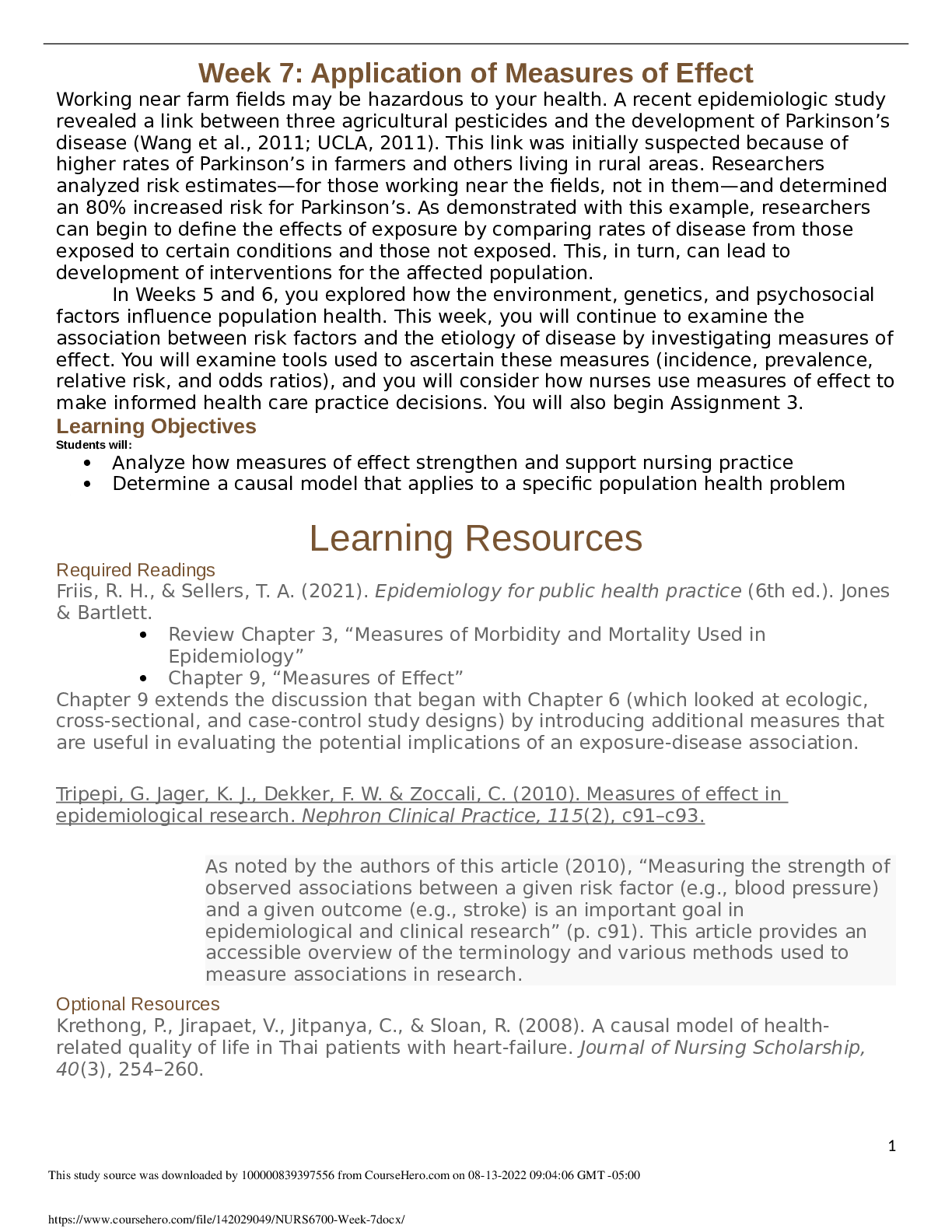
Working near farm fields may be hazardous to your health. A recent epidemiologic study revealed a link between three agricultural pesticides and the development of Parkinson’s disease (Wang et al. ... , 2011; UCLA, 2011). This link was initially suspected because of higher rates of Parkinson’s in farmers and others living in rural areas. Researchers analyzed risk estimates—for those working near the fields, not in them—and determined an 80% increased risk for Parkinson’s. As demonstrated with this example, researchers can begin to define the effects of exposure by comparing rates of disease from those exposed to certain conditions and those not exposed. This, in turn, can lead to development of interventions for the affected population. In Weeks 5 and 6, you explored how the environment, genetics, and psychosocial factors influence population health. This week, you will continue to examine the association between risk factors and the etiology of disease by investigating measures of effect. You will examine tools used to ascertain these measures (incidence, prevalence, relative risk, and odds ratios), and you will consider how nurses use measures of effect to make informed health care practice decisions. You will also begin Assignment 3. Learning Objectives Students will:  Analyze how measures of effect strengthen and support nursing practice  Determine a causal model that applies to a specific population health problem Learning Resources Required Readings Friis, R. H., & Sellers, T. A. (2021). Epidemiology for public health practice (6th ed.). Jones & Bartlett.  Review Chapter 3, “Measures of Morbidity and Mortality Used in Epidemiology”  Chapter 9, “Measures of Effect” Chapter 9 extends the discussion that began with Chapter 6 (which looked at ecologic, cross-sectional, and case-control study designs) by introducing additional measures that are useful in evaluating the potential implications of an exposure-disease association. Tripepi, G. Jager, K. J., Dekker, F. W. & Zoccali, C. (2010). Measures of effect in epidemiological research. Nephron Clinical Practice, 115 (2), c91–c93. As noted by the authors of this article (2010), “Measuring the strength of observed associations between a given risk factor (e.g., blood pressure) and a given outcome (e.g., stroke) is an important goal in epidemiological and clinical research” (p. c91). This article provides an accessible overview of the terminology and various methods used to measure associations in research. Optional Resources Krethong, P., Jirapaet, V., Jitpanya, C., & Sloan, R. (2008). A causal model of healthrelated quality of life in Tha [Show More]

Last updated: 3 years ago

Preview 1 out of 4 pages

Buy Now

Instant download

We Accept:

Payment methods accepted on Scholarfriends (We Accept)
Preview image of NURS6700 Week 7.docx document

Buy this document to get the full access instantly

Instant Download Access after purchase

Buy Now

Instant download

We Accept:

Payment methods accepted on Scholarfriends (We Accept)

Reviews( 0 )

$20.00

Buy Now

We Accept:

Payment methods accepted on Scholarfriends (We Accept)

Instant download

Can't find what you want? Try our AI powered Search

83
0

Document information


Connected school, study & course


About the document


Uploaded On

Aug 13, 2022

Number of pages

4

Written in

All

Seller


Profile illustration for PROFmax
PROFmax

Member since 3 years

0 Documents Sold

Additional information

This document has been written for:

Uploaded

Aug 13, 2022

Downloads

 0

Views

 83

Document Keyword Tags

Recommended For You

Get more on EXAM »
$20.00
What is Scholarfriends

Scholarfriends.com Online Platform by Browsegrades Inc. 651N South Broad St, Middletown DE. United States.

We are here to help

We're available through e-mail, Twitter, and live chat.
 FAQ
 Questions? Leave a message!


Copyright © Scholarfriends · High quality services·