Mental Retardation - ANSWER A. IQ of 70 or below
B. Concurrent deficits or impairments in at least 2 of the following areas: communication, self-care, home living, social/interpersonal skills, use of community resources
...
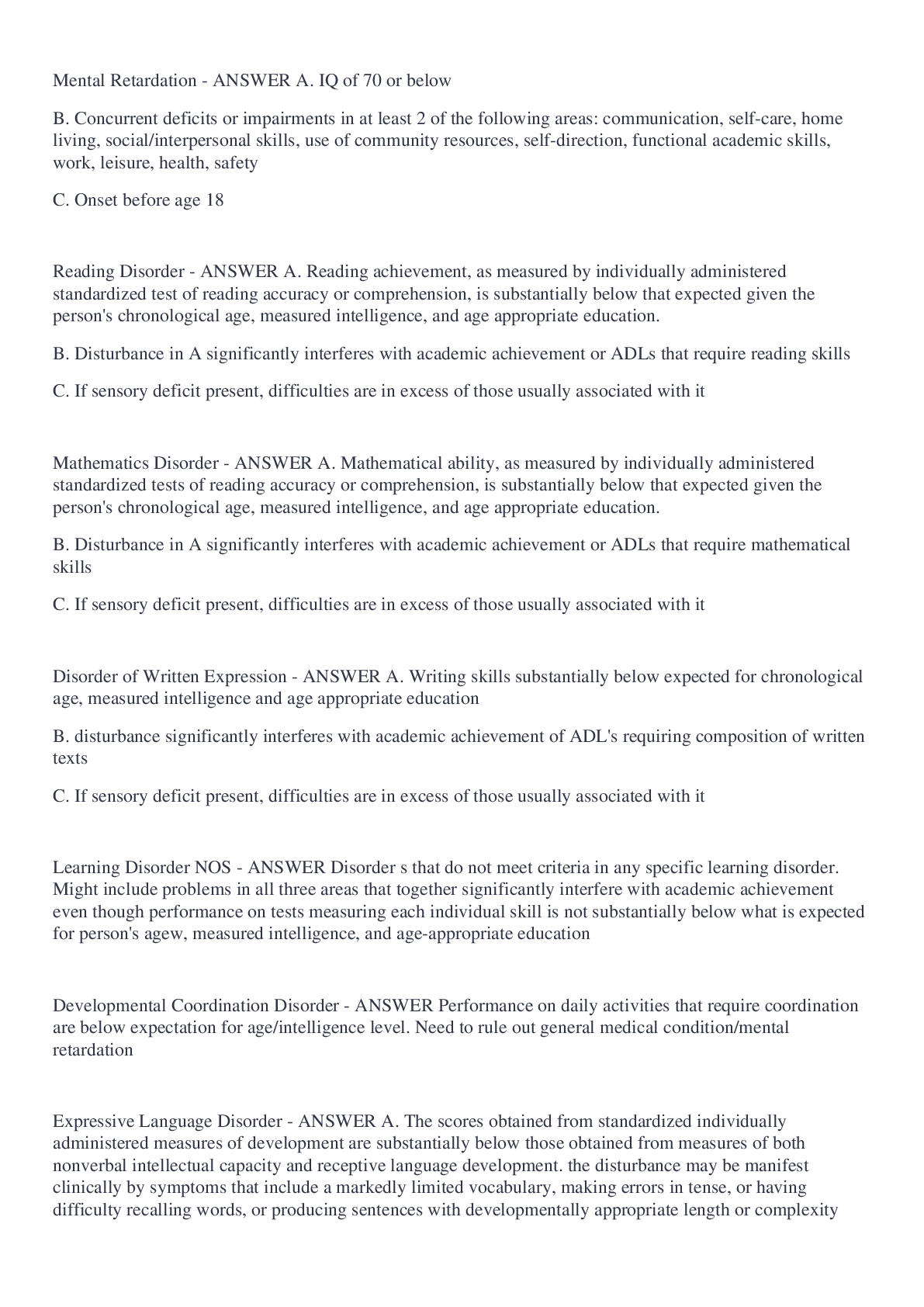
Mental Retardation - ANSWER A. IQ of 70 or below
B. Concurrent deficits or impairments in at least 2 of the following areas: communication, self-care, home living, social/interpersonal skills, use of community resources, self-direction, functional academic skills, work, leisure, health, safety
C. Onset before age 18
Reading Disorder - ANSWER A. Reading achievement, as measured by individually administered standardized test of reading accuracy or comprehension, is substantially below that expected given the person's chronological age, measured intelligence, and age appropriate education.
B. Disturbance in A significantly interferes with academic achievement or ADLs that require reading skills
C. If sensory deficit present, difficulties are in excess of those usually associated with it
Mathematics Disorder - ANSWER A. Mathematical ability, as measured by individually administered standardized tests of reading accuracy or comprehension, is substantially below that expected given the person's chronological age, measured intelligence, and age appropriate education.
B. Disturbance in A significantly interferes with academic achievement or ADLs that require mathematical skills
C. If sensory deficit present, difficulties are in excess of those usually associated with it
Disorder of Written Expression - ANSWER A. Writing skills substantially below expected for chronological age, measured intelligence and age appropriate education
B. disturbance significantly interferes with academic achievement of ADL's requiring composition of written texts
C. If sensory deficit present, difficulties are in excess of those usually associated with it
Learning Disorder NOS - ANSWER Disorder s that do not meet criteria in any specific learning disorder. Might include problems in all three areas that together significantly interfere with academic achievement even though performance on tests measuring each individual skill is not substantially below what is expected for person's agew, measured intelligence, and age-appropriate education
Developmental Coordination Disorder - ANSWER Performance on daily activities that require coordination are below expectation for age/intelligence level. Need to rule out general medical condition/mental retardation
Expressive Language Disorder - ANSWER A. The scores obtained from standardized individually administered measures of development are substantially below those obtained from measures of both nonverbal intellectual capacity and receptive language development. the disturbance may be manifest clinically by symptoms that include a markedly limited vocabulary, making errors in tense, or having difficulty recalling words, or producing sentences with developmentally appropriate length or complexity
B. Difficutlies interfere with academic or occupational achievement or with social communication
C. Criteria not met for Mixed Receptive-Expressive Language Dx or Pervasive Developmental Disorder
Mixed Receptive-Expressive Language Disorder - ANSWER the scores obtained from standardized individually administered measures of both receptive and expressive language development are substantially below those obtained from measures of nonverbal intellectual capacity. symptoms include difficulty understanding words, sentences, or specific types of words, such as spatial terms
Phonolgical Disorder - ANSWER Failure to use developmentally expected speech sounds that are appropriate for age and dialect (errors in sound production, use, representation, or organization such as sustitutions of one sound for another)
Stuttering - ANSWER Disturbance in the normal fluency and time patterning of speech (inappropriate for the individual's age), characterized by frequent occurrences of one or more of the following: sound and syllable repetitions; sound prolongations; interjections; broken words; audible or silent locking; circumlocutions (word substitutions); words pronounced with an excess of physical tension; momsyllabic whole-word repetitions
Autistic Disorder - ANSWER Developmental disorder characterized by qualitative impairments in social interaction, qualitative impairments in communication, and restricted repetitive and stereotyped patterns of behavior, intersts, and activities. Delays or abnormal functioning in at least one of the following areas (social interaction, language as used in social communication, or symbolic or imaginative play) prior to age 3
Rett's Disorder - ANSWER Apparently normal prenatal and perinatal development, psychomotor development through first 5 months after birth, normal head circumference at birth-
onset of following from 5 months to 4 years (deceleration of head growth, loss of previously acquired hand skills and hand movements, loss of social engagement, poorly coordinated trunk and gait movements, impaired expressive and receptive language development with severe psychomotor retardation - only reported in females
Childhood Disintegrative Disorder - ANSWER Onset 2-10 yrs of age
Skills acquired are completely lost in 2 of the following 6 areas: language skills; receptive language skills; social skills and self-care skills; control over bowel and bladder; play skills; motor skills
Lack of normal function also occurs in 2 of the 3 areas: social interaction; communication; restrictive,repetitive, and stereotyped behavior and interest pattern
Asperger's Disorder - ANSWER Severe and sustained impairment in social interaction and the development of restricted, repetitive patterns of behavior,interests,activities. Disturbance causes clinically significant impairment in social, occupational, or other areas of functioning. No clinically significant delays in language acquisition although more subtle aspects of social communication may be affected. During first 3 years of life, there are no clinically significant delays in cognitive development (express normal curiosity about environment, have age-appropriate learning skills and adaptive behaviors other than social interaction).
Attention-Deficit/Hyperactivity Disorder - ANSWER Symptoms must have persisted for at least 6 months
Persistent pattern of inattention and /or hyperactivity-impulsivity that is more frequently displayed and more severe than is typically observed in individuals at a comparable level of development. Some symptoms have to have been present before age 7. Some impairment from the symptoms must be present in at least two settings (home, school, work). There must be clear evidence of interference with developmentally appropriate social, academic, or occupational functioning.
Attention-Deficit/Hyperactivity Disorder NOS - ANSWER 1.Meet criteria for ADHD, Predominately inattentive type but whose age at onset is 7 years or after
2. Clinically significant impairment who present with inattention but whose symptom pattern does not meet full criteria for disorder but have a behavioral pattern marked by sluggishness, daydreaming, and hypoactivity
Conduct Disorder - ANSWER a repetitive and persistent pattern of behavior in which the basic rights of others or major age-appropriate societal norms or rules are violated, as manifested by the presence of three or more of the following criteria in the past 12 months, with at least one criterion present in the past 6 months (agression to people or animals, destruction of property, deceitfulness or theft, serious violation of rules)
these disturbances in behavior causes significant impairment in social, academic, or occupational functioning
Oppositional Defiant Disorder - ANSWER Pattern of negativistic, hostile, and defiant behavior lasting at least 6 months, during which 4 or more of the following are present: often loses temper, often aruges with adults, refuses to comply with request or rules, deliberately tries to annoy others, blames others for his or her mistakes or misbehaviors, touchy or easily annoyed, angry and resentful, and spiteful or vidictive.
Disruptive Behavior Disorder NOS - ANSWER Disorders that do not meet criteria for Conduct Disorder or Oppositional Defiant Disorder but in which there is clinically significant impairment.
Pica - ANSWER persistent eating of nonnutritive substances for a period of at least one month; inappropriate to the developmental level; not part of a culturally sanctioned practice.
Rumination Disorder - ANSWER repeated regurgitation and re-chewing of food for a period of at least one month following a period of normal functioning; not due to an associated gastrointestinal or other general medal condition (e.g. esophageal reflux)
Feeding Disorder of Infancy or Early Childhood - ANSWER feeding disturbance as manifested by persistent failure to eat adequately with significant failure to gain weight or significant loss of weight over at least one month; not due to an associated gastrointestinal or other general medal condition (e.g. esophageal reflux). Onset is before age 6.
Tourette's Disorder - ANSWER tic disorder- involves multiple motor tics and a minimum of one vocal tic over the course of the disorder, although not necessarily concurrently. Tics must occur multiple times per day almost every day or intermittently for more than 12 months. During this period, there should be no more than 3 consecutive months that are considered "tic-free." Onset before age 18.
Chronic motor or Vocal Tic Disorder - ANSWER single or multiple motor or vocal tics, but not both, have been present at some time during the illness. Tics occur many times a day nearly every day or intermittently throuoghout a period of more than 1 year, and during this time there was never a tic-free period of more than 3 consecutive months. Onset before age 18.
Transient Tic Disorder - ANSWER single or multiple motor or vocal tics. Tics occur many times a day, nearly every day for at least 4 weeks, but for no longer than 12 consecutive months. Onset before age 18.
Encopresis - ANSWER repeated passage of feces into inappropriate places (e.g. clothing or floor) whether involuntary or intentional. At least one such event a month for at least 3 months. Chronological age is at least 4 yo.
Enuresis - ANSWER repeated voiding of urine into bed or clothes (whether involuntary or intentional). Behavior manifested by either a frequency of twice a week for at least 3 consecutive months or the presence of clinically significant distress or impairment in social, academic (occupational), or other important areas of functioning. Chronological age is at least 5 yo.
Separation Anxiety Disorder - ANSWER Developmentally inappropriate and excessive anxiety concerning separation from home or attachment figures, as evidenced by at least 3 of the following :recurrent distress when separated from attachment figure, worry that harm will befall attachment figure, refuses to go to school or elsewhere if separated from figure, unwilling to stay alone, unwilling to sleep alone, recurrent separation dreams, somatic complaints when situation looms. Duration of disturbance is at least 4 weeks.
Selective Mutism - ANSWER consistent failure to speak in specific social situations (in which there is an expectation for speaking, e.g. at school) despite speaking in other situations; it is not due to a lack of knowledge or comfort with the spoken language; disturbance interferes with educational or occupational achievement or with social communication; duration of the disturbance is at least 1 month
Reactive Attachment Disorder - ANSWER Markedly disturbed and developmentally inappropriate social relatedness in most contexts that begins before age 5 and is associated with grossly pathological care. Two types of presentations- Inhibited type (pattern of excessively inhibited, hypervigilant, or highly ambivalent responses) and Disinhibited type (indiscriminate sociability or lack of selectivity in the choice of attachment figures).
Stereotypic Movement Disorder - ANSWER repetitive seemingly driven, and nonfunctional motor behavior (e.g. hand shaking or waving, body rocking, head banging, mouthing of objects, self biting, hitting own body) which interferes with normal activites or results in self-inflicted bodily injury. Behavior persists for 4 weeks or longer.
Delirium Due to a General Medical Condition - ANSWER A. Disturbance of consciousness (i.e., reduced clarity of awareness of the environment)
with reduced ability to focus, sustain, or shift attention.
B. A change in cognition (such as memory deficit, disorientation, language disturbance) or the development of a perceptual disturbance that is not better accounted for by a preexisting, established, or evolving dementia.
e. The disturbance develops over a short period of time (usually hours to days) and tends to fluctuate during the course of the day.
D. There is evidence from the history, physical examination, or laboratory findings that the disturbance is caused by the direct physiological consequences of a general medical
condition.
Substance-Induced Delirium - ANSWER A. Disturbance of consciousness (i.e., reduced clarity of awareness of the environment) with reduced ability to focus, sustain, or shift attention.
B. A change in cognition (such as memory deficit, disorientation, language disturbance) or the development of a perceptual disturbance that is not better accounted for by
a preexisting, established, or evolving dementia.
C. The disturbance develops over a short period of time (usually hours to days) and tends to fluctuate during the course of the day.
D. There is evidence from the history, physical examination, or laboratory findings of either (1) the symptoms in Criteria A and B developed during Substance Intoxication or (2) medication use is etiologically related to the disturbance·
Substance Withdrawal Delirium - ANSWER A. Disturbance of consciousness, with reduced ability to focus, sustain, or shift attention
B. Change in cognition or development of perceptual disturbance not better accounted for by dementia
C. Develops over a short period of time (hours-days), tends to fluctuate over the course of the day
D. Disturbance developed during, or shortly after, a withdrawal syndrome
Delirium Due to Multiple Etiologies - ANSWER A. Disturbance of consciousness (i.e., reduced clarity of awareness of the environment) with reduced ability to focus, sustain, or shift attention.
B. A change in cognition (such as memory deficit, disorientation, language disturbance) or the development of a perceptual disturbance that is not better accounted for by
a preexisting, established, or evolving dementia.
C. The disturbance develops over a short period of time (usually hours to days) and tends to fluctuate during the course of the day.
D. There is evidence from the history, physical examination, or laboratory findings that the delirium has more than one etiology (e.g ., more than one etiological general
medical condition, a general medical condition plus Substance Intoxication or medication side effect).
Delirium Not Otherwise Specified - ANSWER Delirium that does not meet criteria for any specific types of delirium such as delirium which is suspected to be due to a general medical condition or substance use but for which there is insufficient evidence to establish etiology or dilirium due to causes not listed in this section (sensory deprivation)
Dementia [differentiated based on etiology] - ANSWER Disorders characterized by the development of multiple cognitve deficits that include memory impairment and at least one of the following cognitive disturbances (aphasia, apraxia, agnosia, or disturbance in executive functioning) that are due to the direct physiological effects of either a general medical condition, substance abuse, or to multiple etiologies. Deficits must be sufficiently severe to cause impairment in occupational or social functioning and must represent a decline from a previously higher level of functioning.
Amnestic Disorder due to General Medical Condition - ANSWER Development of memory impairment as manifested by impairment in the ability to learn new information or the inability to recall previously learned information. Disturbance causes significant impairment in social or occupational functioning and represents a decline from a previous level of functioning. Mujst have evidence that disturbance is the effect of a general medical condition.
Transient: impairment lasts for 1 month or less
Chronic: impairment lasts for more than one month
Substance Induced Persisting Amnestic Disorder - ANSWER Development of memory impairment as manifested by impairment in the ability to learn new information or the inability to recall previously learned information. Disturbance causes significant impairment in social or occupational functioning and represents a decline from a previous level of functioning. Disturbance persists beyond the usual duration of substance intoxication or withdrawal. Evidence that the disturbance is etiologically related to the persisting effects of substance use (drug abuse, a medication)
Substance Dependence - ANSWER Maladaptive pattern of substance use as manifested by 3 or more of the following at any time in the same 12 month period (tolerance, withdrawal, substance taken in larger amounts or over longer period than intended, persistent desire or unsuccessful attemtps to cut down or control the use, a great deal of time is spent in activieis necessary to obtain/use/ recover from the effects of use, important social/occupational/recreational activities given up or reduced because of use, use continued despite knowledge of having a persistent or recurrent physical or psychological problem that is likely to have been caused by the substance).
Substance Abuse - ANSWER Maladaptive pattern of substance use as manifested by 1 or more of the following occurring within a 12 month period (failrue to fulfill major role obligations, recurrent use in situations which it is physically hazardous, recurrent legal
[Show More]


![Preview of AORN PERIOP 101 FINAL EXAM 2026 QUESTIONS AND VERIFIED ANSWERS [LATEST UPDATE]](https://browseimages.nyc3.digitaloceanspaces.com/paper-images/2026/04/07/sGJvJ3aH2026-04-07-04-5869d464cbba16f.png)