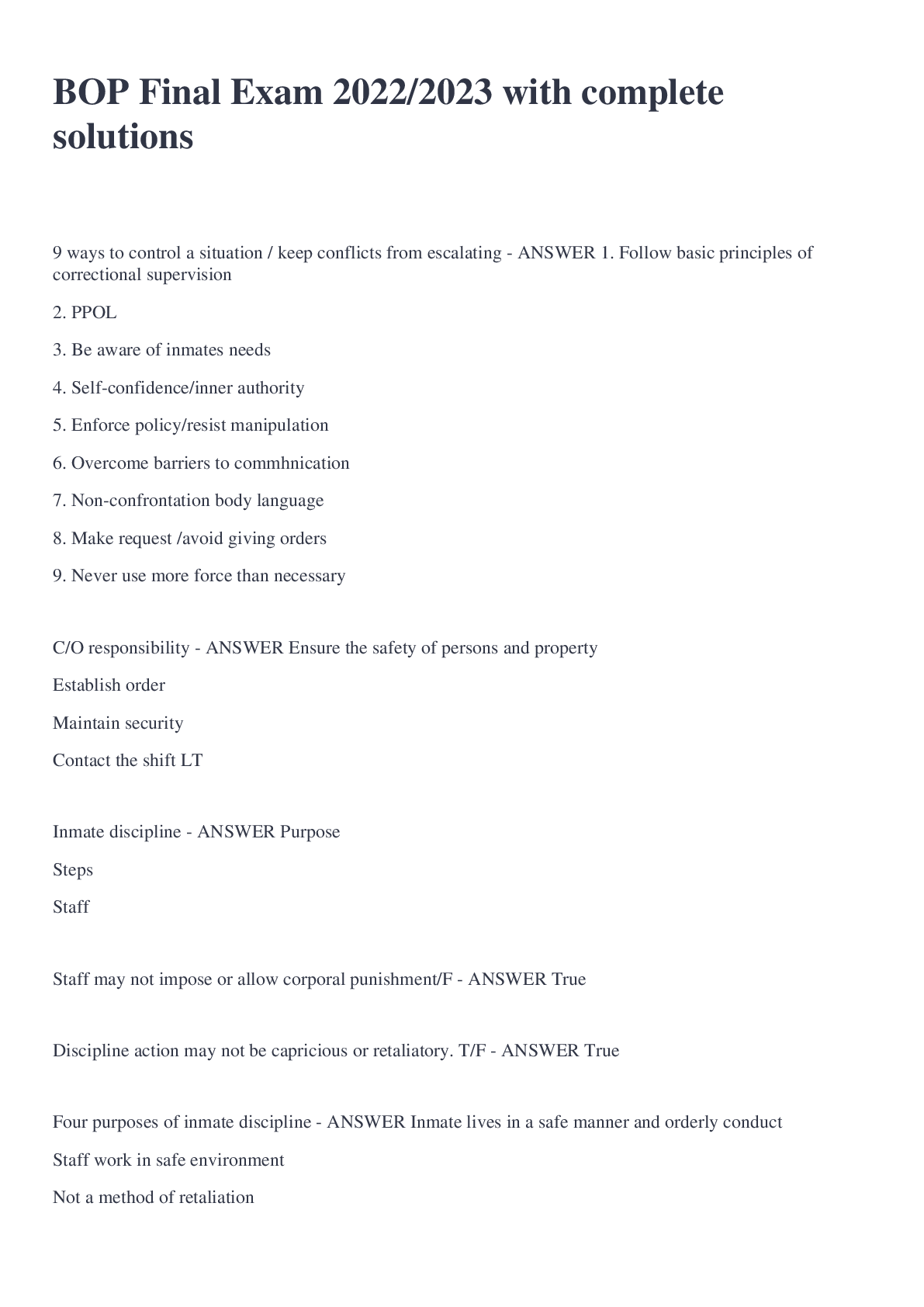
9 ways to control a situation / keep conflicts from escalating - ANSWER 1. Follow basic principles of correctional supervision
2. PPOL
3. Be aware of inmates needs
4. Self-confidence/inner authority
5. Enforce polic
...
9 ways to control a situation / keep conflicts from escalating - ANSWER 1. Follow basic principles of correctional supervision
2. PPOL
3. Be aware of inmates needs
4. Self-confidence/inner authority
5. Enforce policy/resist manipulation
6. Overcome barriers to commhnication
7. Non-confrontation body language
8. Make request /avoid giving orders
9. Never use more force than necessary
C/O responsibility - ANSWER Ensure the safety of persons and property
Establish order
Maintain security
Contact the shift LT
Inmate discipline - ANSWER Purpose
Steps
Staff
Staff may not impose or allow corporal punishment/F - ANSWER True
Discipline action may not be capricious or retaliatory. T/F - ANSWER True
Four purposes of inmate discipline - ANSWER Inmate lives in a safe manner and orderly conduct
Staff work in safe environment
Not a method of retaliation
Not an opportunity for punishment
BOP goals - ANSWER To regulate inmate behavior, ensure it complies with BOP rules , and staff and inmates may work /live in a safe and orderly environment
Cooperative Controls
Blue level - ANSWER Inmate behavior is controlled by normal correctional supervision
Containment Techniques
Green level - ANSWER Generally involves actions like issuing warnings, orders and writing Incident Reports
In order to meet these responsibilities, you may need to do the three steps - ANSWER Intervene: verbal conflict between inmates
Take responsibility: once involved, responsible to stop it
Get both sides of the story: be fair and impartial
At least two things you as a listener need to do - ANSWER 1. Concentrate closely on the person who is talking
2. Communicate your attention to the person, inmate fell you have lost interest and will stop talking
Four Communicating skills attention while listening - ANSWER 1. Maintain eye contact
2. Attentive Posture, Positioning, and Body Language (sit or lean forward, keep still , be aware of the look on your face )
3. Follow the speaker verbally
4. Use silence effectively ( let yourself be quiet , let the speaker be quiet too )
Responding involves two techniques - ANSWER 1. Paraphrasing
2. Reflecting
Two things are involved when Paraphrasing the words - ANSWER 1. Determine what the speaker basic message is (what they mean)
2. Rephrase in own words (
Two parts to Reflecting - ANSWER 1. Identify basic feelings ( see it from speaker view)
2. Capture the specific mood and feeling in words and reflect them back to the speaker ( act like a mirror)
Effective communication can - ANSWER Prevent a situation from escalating
Listen ,show them you are interested, and respond to show you understand both their words and feelings
Probing is - ANSWER Getting information from someone
9 Probing Skills - ANSWER 1. Is the subject or feeling need to be explored
2. Use open ended questions (what,when,where,how)
3. Identify topics that need to be explored further
4. Listen for gaps,inconsistencies,and points are not clear
5. Focus on one topic at a time ,explore each issue completely before moving on
6. Do not ask yes/no questions
7. Do not ask leading questions reflect your own opinion or assumptions
8. Do not ask leading questions that will cause them to defend self
9. Use directive statements to give attention on specific points
Summarizing - ANSWER Brief statement to highlight main points of discussion. Confirming the information
Summarizing is used at - ANSWER The end of the topic
Summarizing will focus on - ANSWER The attention on the key subjects, clarify misunderstandings
Paraphrasing happens - ANSWER During the conversation
How to summarize: 7 ways - ANSWER 1. Select main points discussed
2. Listen for consistent theme or patterns. Does the conversation return the same point
3. Select highlights of what the speaker said and how they feel
4. Summarize periodically when the convo hits natural breaking point
5. Tie together main points and feed them back for confirmation
6. Keep your own ideas and assumptions to yourself
7. Ask for feedback on accuracy ( have I got that right ?)
Summary - ANSWER How to phrase questions and statements effectively to get the information you need. Use open ended questions and statements to prompt the speaker to clarify the situation and direct or redirect focus.
Use summarizing to select the main points and feed them back to the speaker for confirmation
Closure - ANSWER Wrapping it up ,deciding what action,if any to take to resolve the problem situation
Identify the problem - ANSWER Find an acceptable solution
SHU is known as - ANSWER Restrictive housing unif
Inmates should be housed in a - ANSWER Least restrictive setting necessary to ensure their own safety as well as staff, other inmates, and the public
Restrictive Housing should always serve as - ANSWER A specific penological purpose
There are three types of restrictive housing units - ANSWER 1. Admin Maximum Control Unit (ADX/Florence)
2. Special management unit (SMU) (USP Allenwood/ USP Lewisburg)
3. Special Housing Units (SHU)
ADX - ANSWER Most violent inmates , disruptive , and escape prone. Demonstrate improved behavior and the ability ,motivation , and willingness to eventually interstate into an open population
SMU - ANSWER Multi level program mission to teach self discipline,pro social values. Complete program in 12months and inmates may redesignated to an appropriate facility
SMU in the BOP are located - ANSWER USP Allenwood and USP Lewisburg
SHU - ANSWER Separated from general population,may be housed either alone or with other inmates.helps ensure the safety ,security,and orderly operation of correctional facilities
Housing units with more intensive monitoring - ANSWER Communication Management Unit (CMU)
WITSEC
Secure Mental a health Unit
Sex Offender Management Unit (SOMP)
Two status designations while in SHU - ANSWER Administrative Detention (AD)
Disciplinary Segregation
(DS)
Administrative Dentention - ANSWER Non punitive. Warden shall prepare an admin detention order , copy will be given to inmate with 24 hours of placement unless it compromises security or the inmate is a holdover
Variety reasons for Administrative Dention - ANSWER Own inmate protection, pending classification or reclassification , pending a transfer , (holdover) in route to another institution, mental health concerns, has a short term, pending investigation or trial for criminal act, awaiting a hearing from UDC/DHO, investigation of BOP regulations, inmate confinement disciplinary segregation is being terminated and placement is general pop is not prudent
AD inmates are allowed - ANSWER Same general privileges as those in general population ( library,education, social counseling, religious,recreation, exercise is 5 hour per week, radio with ear plugs, allowed visits ,telephone and correspondence privileges
AD review official times
3 days
7 days
7 days - ANSWER 3 days: record review
7 days: hearing and formal review
7 days: record review
AD review official times
30days - ANSWER 30 days: hearing and formal review
AD review official times with staff - ANSWER Staff will conduct review must be certified in inmate disciplinary matters
AD review official time with psy - ANSWER Assessment after 30 days
What is SRO - ANSWER Segregation Review Official
SRO will conduct - ANSWER A record review within 3 work days ( two work days for protective custody ) of inmate placement in AD
SRO / AD - ANSWER AD shall hold a hearing and formally review the status of each inmate who spend 7 continuous days in AD
After 7 days SRO shall - ANSWER Review theses cases on the record each week and shall hold a hearing and review theses cases formally at least every 30 days
When an inmate is placed on AD for protection not at the inmates request - ANSWER The Warden is to review the inmate status within two (2) work days of his placement to determine / continue protective custody .
A formal hearing within 7 days of inmate placement
Disciplinary Segregation Status (Punitive) - ANSWER After found guilty
Inmates with serious violations of BOP rules
Confined by DHO for a specified period of time
Removed from gen pop
Fewer privileges than thoses in AD
Warden may put inmates in DS for up to 5 days
SHU conditions - ANSWER Cell occupancy: 2 inmates only / should not exceed the number for which the space was designated
If humane , Warden may increase capacity of SHU cells
SHU authorized items - ANSWER No belts
No less than 5 hours exercise per week
Lt. Must visit SHU during each shift
SHU must have a sally port
Officers will not have both set of keys to the sally port
In Shu staff and inmates - ANSWER Min one staff per inmate when moving
Inmates will be restrained with handcuffs when moved , double locked , inmate will place their hands through food slot to be restrained, officer will never place their hands or clothing inside the cell or food slot
Never allow inmate to dictate the type of placement of restraints
Personal Hygiene - ANSWER Linens will be same frequency as general pop
Each inmate shall have the opportunity to shower and shave at least 3 x a week
Multi-disciplinary Team - ANSWER Weekly basis
Special housing operations - ANSWER Lt must visit SHU every shift
Provide identification
SHU rounds are done - ANSWER Irregular 30 mins and document
All inmates will ___ away from cell door prior to its opening - ANSWER Face
Random visual searches - ANSWER Performed when returning
Bar taps are done - ANSWER Weekly
Inmates rotate cells every - ANSWER 21 days and both the cell they are being moved to and the one they came from must be searched thoroughly
No obstructions of windows in SHU. T/F - ANSWER True
All inmates will be pat searched and screened with a (SHU procedure) - ANSWER Metal detector when exciting a cell
Suicidal high risk group - ANSWER New inmates , protective custody , long term protective custody, mental health inmates
( a cut down tool will be located in a secure area , and shadow board in SHU)
Attempted suicide - ANSWER Always call for backup before entering a cell for an attempted suicide
LT . Holds - ANSWER Direct the actions of staff during escort
Lt hold is to be utilized in conjunction with other escort procedures (2/3 man holds) The Lt. Only has to be present while inmate is being moved
Two man hold - ANSWER 2 staff the entire time
Three man hold - ANSWER 2 staff / 1 staff will follow safe distance
Telephone privileges at SHU - ANSWER 1st call /
every 30 days /
once a month
ADX hold - ANSWER Lt must be present at all time when the inmate is out of their cell or secure area and direct of staff while inmate is being moved
2 staff , 1 will escort , 1 will carry the baton while remaining close but a safe distance until inmate is excited
Hunger strikes - ANSWER Staff will observe inmate not eating or drinking on excess of 72 hours. Refer to medical or mental health for eval
SHU ranges,outside recreation , and other grills should be - ANSWER Locked at all times. Food slots are secured when not use. When feeding unlock the slot feed through and secure the lock
Food carts in SHU - ANSWER All food carts shall be secured by food service prior to entering SHU. Shu staff will inspect and search each cart for contraband
Shu will be - ANSWER Vented , adequate lighting, appropriately heated , and maintained in a sanitary condition at all times
Shu work orders - ANSWER Shall be sent to captains secretary
Protection cases - ANSWER Inmate as protection cases and shu
Victims of inmate assault
Inmate informants
Inmate sexual pressure
Inmates fromer Leo
Inmates Gun guard, dog caretakers, local correctional facilities
Inmates pressured by unidentifiable inmates
Inmates who would not determine
Inmates have good reason serious bodily harm
BP A-0292 - ANSWER Special Housing Unit Record
BP A 0295 - ANSWER Special Housing Review
BP A 0308 - ANSWER Admin Detention Order
BP A321 - ANSWER Special Housing Unit- temporary restrictive housing unit order
BP A0383 - ANSWER Inmate personal property record
What are the myth - ANSWER All people are homo or straight
Homo's act like the opposite sex
One homo event makes some a homo
Homosexuality is contagious
Rape is common
Four type of inmates behavioral style - ANSWER 1. Predatory
2. Weak inmates
3. Average inmates
4. Psychologically disturbed inmated
What is a predatory inmate - ANSWER Tough guy, prey on the weak, psychopath/ sociopath
Very charming , lack conscience ,inflates view of self restless and easily bored ,gut thinker ,openly aggressive , feels hostility, self centered
Avoid taking responsibilities, victimizer
What is an weak inmate - ANSWER Mule, scared , prey on , poor judgment in probing inmates
Extreme negative emotions anxiety ,guilty , self doubt , and resentment. Whiners or cry babies
What is average inmate - ANSWER Very cooperative ,reliable , quiet inmate , keep distance between himself and other inmates under normal condition "Good inmate"
What is psychological inmate - ANSWER Severe depression with suicidal thoughts and psychotic / schizophrenia disorder
Hostage four conditions that may lead to a hostage situation - ANSWER 1.crime in progress
2. Riot or Mob Action
3. Inmate grievance
Individual action
Bop neutralize hostage situation - ANSWER Hostage need to remain calm during hostage negation.
Planned assault coordinated assault
Use of chemical agents:munitions ,smoke and blast dispersion
Use marksman fire as last resort and only specific approval by BOp official
Behavioral strategies for hostages - ANSWER Accept the role as a hostage
Prepare for extended hostage incident
Get comfy and remove songs of your title
Do not increase stress level
Limit convo with the hostage taker
Escape attempts
Emergency plans
Pay attention to details
Good listener
Stay in plan view of hostage taker
Develop positive relationships with hostage takers
Resist rape ,follow hostage takers instructions with reasonable delay
Remember details
Do not negotiate
Give credibility to the negotiator
Stockholm syndrome - ANSWER Interpersonal bond ,develop between the hostage and taker
What happens with Stockholm syndrome - ANSWER 1. Hostage may develo
[Show More]