Example of Changing Directions - ANSWER Instead of trying to answer whether or not a target nation will invade, focusing on under what conditions they would attack.
What are the Eight Elements of Thought? - ANSWER -Pu
...
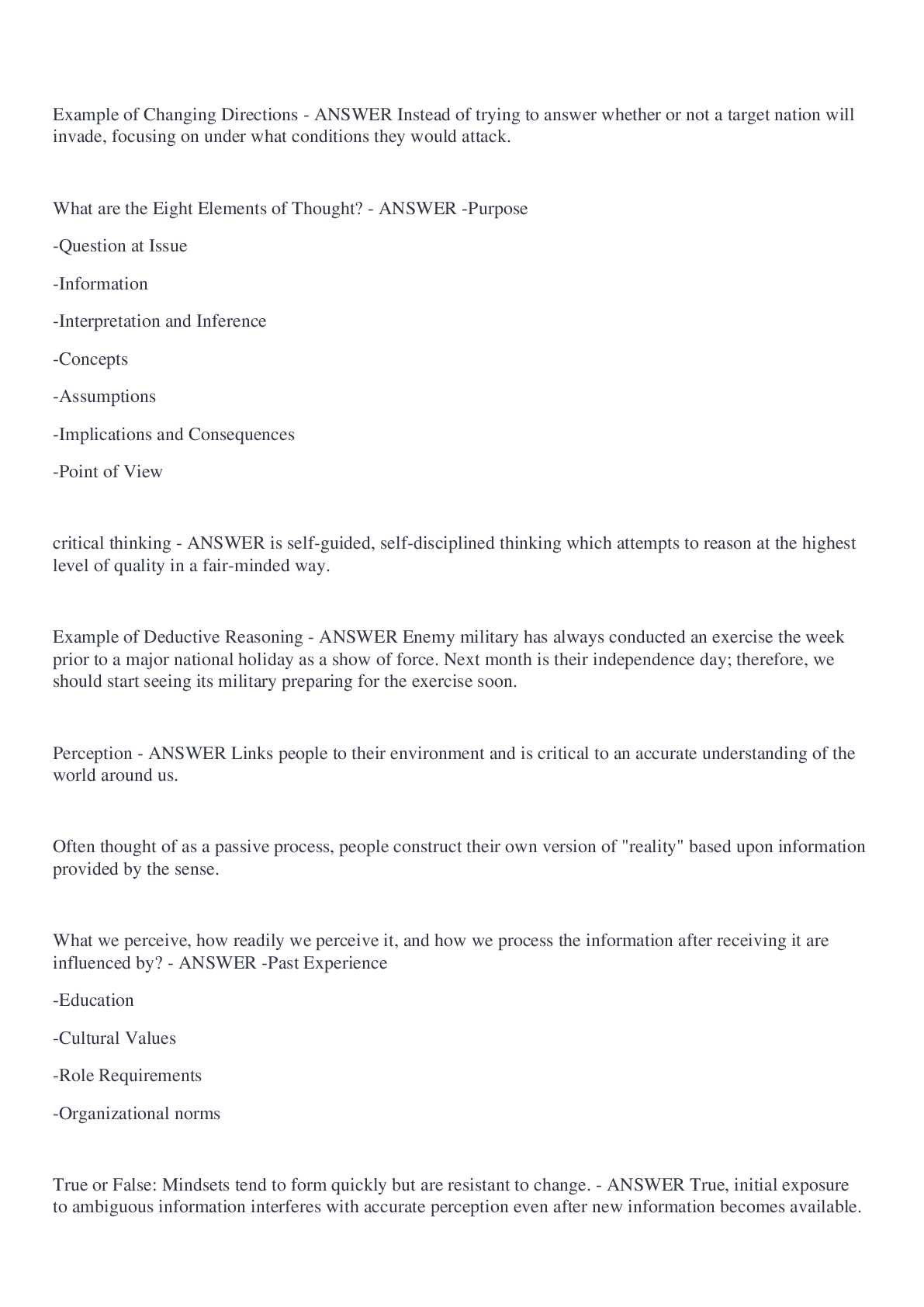
Example of Changing Directions - ANSWER Instead of trying to answer whether or not a target nation will invade, focusing on under what conditions they would attack.
What are the Eight Elements of Thought? - ANSWER -Purpose
-Question at Issue
-Information
-Interpretation and Inference
-Concepts
-Assumptions
-Implications and Consequences
-Point of View
critical thinking - ANSWER is self-guided, self-disciplined thinking which attempts to reason at the highest level of quality in a fair-minded way.
Example of Deductive Reasoning - ANSWER Enemy military has always conducted an exercise the week prior to a major national holiday as a show of force. Next month is their independence day; therefore, we should start seeing its military preparing for the exercise soon.
Perception - ANSWER Links people to their environment and is critical to an accurate understanding of the world around us.
Often thought of as a passive process, people construct their own version of "reality" based upon information provided by the sense.
What we perceive, how readily we perceive it, and how we process the information after receiving it are influenced by? - ANSWER -Past Experience
-Education
-Cultural Values
-Role Requirements
-Organizational norms
True or False: Mindsets tend to form quickly but are resistant to change. - ANSWER True, initial exposure to ambiguous information interferes with accurate perception even after new information becomes available.
True or False: An analyst's experience has no effect on how he or she perceives the environment because the sensory input isn't affected . - ANSWER False, this is a reason why there are barriers to reasoning.
True or False: Understanding how we use our past experiences to interpret or filter our observations will help us determine the customer's needs or the target's behavior. - ANSWER True, understanding our own perception helps us overcome the barrier to reason.
What are the four barriers to reasoning? - ANSWER - Emotion
- Mental Shortcuts
-Patterns
-Group think
Emotion - ANSWER the primary problem with "this" is that it hijacks reason, making rationality secondary.
Mental Shortcuts - ANSWER Previous experiences shape our response to new problem. "This" reduces the need to re-learn lessons, thus promoting efficient thinking, "they" are the basis of expertise.
Patterns - ANSWER "These" impose the order our minds seek and can blind us to new explanations. Because we need to make sense of things, we do not have accurate explanations all the time.
Group Think - ANSWER the mode of thinking that occurs when the desire for harmony in a decision-making group overrides a realistic appraisal of alternatives
7 Defects of Groupthink - ANSWER -Discussion limited to merely two or a few alternative courses of action (often only two).
-No survey of objectives to be fulfilled and the values implicated by the choice.
-Failure to re-examine the selected COA from the standpoint of non-obvious risk and drawbacks not considered during the original evaluation.
-Neglect COA's initially evaluated as unsatisfactory.
-Little or no attempt to gain information from experts on other COA's.
-Interest only in information that supports the group decision.
-Failure to work out contingency plans to cope with foreseeable setbacks.
Mirror Imaging - ANSWER assuming that other states or individuals will act just the way a particular country or person does
Example of Emotion Barrier - ANSWER Making a hasty analysis in anger after hearing leave has been cancelled.
Example of Mental Shortcut - ANSWER Identifying a target unit based solely on the call-sign they used last year.
Example of Patterns - ANSWER Claiming the squadron preforms weekly training based on intelligence from three previous three months, that unit hasn't done so for two of the past three weeks.
Example of Groupthink - ANSWER Intelligence Community agrees that Iraq had stockpile of weapons of mass destruction without questioning the validity of the sources.
Biases - ANSWER an unconscious belief that guides, governs, and compels our behavior.
Shapes our ability to think and solve problems, makes us look for evidence that supports our beliefs and oppose information that does not.
Satisficing - ANSWER accept the first plausible explanation and use it to filter out non-supporting information
Cognitive Biases - ANSWER a mental error that consistent and predictable regardless of cultural differences. Like an optical illusion.
Does not result from an emotional or intellectual predisposition toward a certain judgement, but rather from subconscious mental procedures for processing information.
Biases in Evaluation of Evidence - ANSWER information presented in vivid and concrete detail often has unwarranted impact, and people tend to disregard abstract or statistical information that may have greater value. Oversensitive to the consistency of the evidence and insufficiently sensitive to the reliability of the evidence. Impressions can still be left even if the "proof" has been completely discredited.
Biases in Perception of Cause and Effect - ANSWER overestimating the extent to which other countries are pursuing a coherent , coordinated, rational plan, and thus also overestimated their own ability to predict future events in those nations. Also tend to assume that causes are proportional to their effects: important or large effects must have large causes.
Biases in Estimating Probability - ANSWER -Availability Bias
-Expression of Uncertainty
Availability Bias - ANSWER is strongest when making quick "gut" judgments without really analyzing the situation. An unconscious cue of "this" occurs when the probability of an event can be easily imagined and the number of instances easily remembered.
Expression of Uncertainty - ANSWER Words of estimative probability have long been recognized as sources of misunderstanding. When no guide is provided, the words are given meaning by their context and what the reader already perceives about that context.
Biases in Evaluation of Reporting (hind sight bias) - ANSWER Biases in favor of Causal Explanations
-overestimate the quality of their analytic performance.
-Consumers underestimate how much they learned from intelligence reports
-Overseers of intelligence production, who conduct postmortem analysis of an intelligence failure, normally judge events as more readily foreseeable than was in fact the case.
tend to blame these biases on ignorance, self-interest or lack of objectivity.
creativity - ANSWER an ability, attitude, and process
Ability - ANSWER to imagine or invent something new
attitude - ANSWER to accept change and newness, the willingness to play with ideas and possibilities, and the flexibility of potential outlook
Process - ANSWER work hard to continually improve ideas and solutions by making gradual alterations and refinements to their works
What are the Five Methods to increase creativity? - ANSWER -Evolution
-Synthesis
-Revolution
-Re-application
-Changing Direction (creative Insight)
Evolution - ANSWER incremental improvements. Every problem that has been solved can be resolved again in a more precise manner
Synthesis - ANSWER two or more existing ideas are combined into a third, new idea
Revolution - ANSWER sometimes the best new idea is completely a different one: a marked change from the previous version
Re-application - ANSWER look at something old in a new way. Go beyond labels. Remove prejudices, expectations and assumptions by discovering how something can be re-applied
Changing Direction - ANSWER attention is shifted from one angle of a problem to another. The goal is to solve the problem, not implement a particular solution.
True or False: Every problem has only one solution. - ANSWER False, most problems can be solved in a number of ways. If a solution works then it is a good solution.
The Four Mental Blocks to creative thinking - ANSWER -Prejudice
-Learned Helplessness
-Functional Fixation
-Psychological Blocks
Prejudice - ANSWER preconceptions often prevent us from seeing beyond what we already know or believe to be possible. Inhibit change and progress.
Learned Helplessness - ANSWER Feeling that you don't have the tools, knowledge, materials, or ability to do anything, so you might as well not try
Functional Fixation - ANSWER sometimes we see an object only in terms of its name rather than in terms of what it can do
Psychological Blocks - ANSWER some solutions are not considered or are rejected simply because our reaction to them is "yuck"
Example of Evolution - ANSWER Changing the way we maintain continuity of knowledge (e.g. hard copy, digital files, wiki pages, cloud)
Example of Synthesis - ANSWER A new task force manned with analysts across the IC and academia to track new/emerging religious fundamentalist groups.
Example of Revolution - ANSWER Integrating natural language processing turning live audio to real-time speech-to-text transcription.
Example of Re-application - ANSWER Re-purposing code used for accountability in tech school to compare/ contrast changes between shipping manifests for a target company.
Purpose - ANSWER goal, objective, what are you trying to accomplish
Question at Issue - ANSWER lays out the problem or issue and guides our thinking
Information - ANSWER includes facts, data, evidence or experiences we use to figure things out
Interpretation and Inference - ANSWER conclusions you come to
Concepts - ANSWER ideas, theories, laws, principles, or hypotheses we use in thinking to make sense of things
Assumptions - ANSWER beliefs you take for granted
Implications and Consequences - ANSWER things that might happen if you decided to do something, "one" follows from thoughts and "the other" follow from actions
Point of View - ANSWER "the place" from which you view something
What is used to measure the 8 elements of Thoughts? - ANSWER -Clarity
-Gateway Standard
-Accuracy
-Precision
-Relevance
-Depth
-Breadth
-Logic
-Significance
-Fairness
Clarity - ANSWER understandable, the meaning can be grasped, free from confusion
Gateway Standard. - ANSWER If a statement/problem is not clear you can't determine whether it is accurate and/or relevant.
Accuracy (8 Elements of Thoughts) - ANSWER free from errors, mistakes and/or distortions, true and correct
Precision - ANSWER specific, delivered to the necessary level of detail. The analysis can be both clear and accurate, but not precise.
Relevance - ANSWER upon or relating to the matter at hand, important to the matter at hand
Depth - ANSWER thoroughly covers all the complexities of an issue, considers the many variables in context, situation, idea etc.
Breadth - ANSWER encompasses multiple view points, comprehensive
Logic - ANSWER the parts make sense together, doesn't contradict itself, shows sound reasoning
Siginificance - ANSWER has importance, having considerable or substantial meaning
Fairness - ANSWER Free from bias, dishonesty, favoritism, deception
Intelligence Community (IC) - ANSWER 17 agencies and organizations, including ODNI, within the Executive Branch that work both independently and collaboratively to gather and analyze intelligence.
What AFI does the IC standards for the AF come from? - ANSWER AFI 14-133
AF 10 Standards - ANSWER -Timeliness
-Appropriate Sourcing
-Accuracy
-Level of Confidence
-Assumptions vs. Judgement
-Alternative Analysis
-Relevance
-Logical Argumentation
-Utility
-Customer Engagement
Timeliness - ANSWER to impact planning, mission objectives, operations and otherwise aid in commander's decisions.
The aim is to deliver information and knowledge at the earliest time and place to enable customers to effectively make decisions and take action.
Appropriate Sourcing - ANSWER analysis sites all sources used, when feasible, and includes and objective assessment of the quality, credibility, and reliability of the underlying source
Accuracy - ANSWER analysis will make the most accurate judgement and assessments possible, based on the intelligence available and in light of known information gaps. A retrospective assessment of "this" will help identify biases and other potential trade craft errors for correction in future analysis
Level of Confidence - ANSWER to help quantify accuracy and to present analysis in a uniform and consistent manner across the AF, analyst will indicate the degree of confidence/certainty associated with analytic judgement and conclusions to the best of their ability, given currently available intelligence.
High Confidence - ANSWER -Almost Certain
-Very Likely
80-99%
Almost Certain - ANSWER 95-99%
No assumptions
Very Likely - ANSWER 80-95%
Minimal Assumptions
Moderate Confidence - ANSWER -Likely
-Roughly Even Chance
45-80%
Likely - ANSWER 55-80%
Few Assumptions
Roughly Even Chance - ANSWER 45-55%
Several Assumptions
Low Confidence - ANSWER -Unlikely
20-45%
Unlikely - ANSWER 20-45%
Improbable
Assumptions vs. Judgement - ANSWER analysis clearly distinguished among underlying intelligence, analyst assumptions, and analyst judgments
Alternative Analysis - ANSWER analysis will incorporate plausible alternative assessments, judgments, or hypotheses, particularly when major judgement contend with significant uncertainties, complexity or a lack of available intelligence, or when low probability events could produce high impact results.
Whenever possible, analysis should be vetted through at least one other intelligence professional to minimize individual analyst bias.
Relevance of Analysis - ANSWER Analysts should make every effort to ensure products and services fulfill the customer's intent and request, while also ensuring product ans services are available to others for use beyond original intent.
Logical Argumentation - ANSWER analysis will employ coherent and logical reasoning techniques, be supported by all key relevant information, and be internally consistent
Utility - ANSWER AF analytic products and services will use formats (written, verbal, visual, etc.) that best enable understanding by the customer. Intelligence analysis will be disseminated at the lowest classifications and widest releasability levels without jeopardizing its usefulness to the customer
Customer Engagement - ANSWER Analysis should fully address customer requirements within time constraints and in a manner most useful. Analyst Airmen will be responsive to customer feedback. While challenging to evaluate, this trade craft standard is foundation to AF intelligence analysis
Example of Purpose - ANSWER To determine whether or not adversary military forces will invade its neighboring country.
Example of Information - ANSWER IMINT shows 75% of the enemy's ground forces are deployed in that field.
Example of Assumptions vs Judgement - ANSWER Based on GPS plots from terrorist facilitator's cell phone, we believe he is moving weapons and conclude that terrorists are planning an attack soon.
Example of Relevance - ANSWER Analysis of Suspected terrorists' social networks will address the President's recent concern that there will be a terrorist attack in the US.
Analysis Skill - ANSWER a specific ability or collection of capabilities required to competently conduct analysis
acquired through training and/or experience
Analysis trade craft - ANSWER established or prescribed analysis technique, practice, or systematic process the "how"
Intelligence Analysis - ANSWER is what transforms data into the information and knowledge necessary for war fighters and decision makers to decide and act.
Framing the Intelligence Question - ANSWER is the most important factor in assuring the overall quality of intelligence analysis
helps identify and anticipate emerging trends and developments and focus efforts on addressing issues most relevant to their respective customers
drives information discovery, the selection of analytic approaches and methods,
[Show More]