Microbiology - ✔✔The specialized area of biology that deals with organisms too small to be seen with the naked eye
6 major groups of microorganisms - ✔✔1. Bacteria
2. Algae
3. Protozoa
4. Helminths
5. Fungi
6. V
...
Microbiology - ✔✔The specialized area of biology that deals with organisms too small to be seen with the naked eye
6 major groups of microorganisms - ✔✔1. Bacteria
2. Algae
3. Protozoa
4. Helminths
5. Fungi
6. Viruses
What do microbiologists study? - ✔✔- Cell structure
- Growth and Physiology
- Genetics
- Taxonomy and evolutionary history
- Interactions with living and non living environment
What are the 6 different branches of study in microbiology? - ✔✔1. Medical microbiology
2. Public Health microbiology and Epidemiology
3. Immunology
4. Industrial Microbiology
5. Agricultural Microbiology
6. Environmental Microbiology
Medical Microbiology - ✔✔Study of microbes as they relate to medicine, deals with microbes that causes disease in humans and animals
Public Health Microbiology and Epidemiology - ✔✔Monitor and control the spread of disease in communities. USPHS, CDC, WHO
Industrial Microbiology - ✔✔- Use of microbes to manufacture important compounds
- Safeguards our food and water
- Also includes biotechnology
- Ranges from bread making to gene therapy
- Microbes can be used to create large quantities of substances such as amino acids, beer, drugs, enzymes, and vitamins
Agricultural Microbiology - ✔✔- Deals with the relationships between microbes and domesticated plants and animals
- Plant specialists focus on plant diseases, soil fertility, and nutritional interactions
- Animal specialists work with infectious diseases and other associations animals have with microorganisms
Immunology - ✔✔Studies a diverse areas such as vaccination, blood testing, and allergy. Immunologists investigate the role of the immune system in cancer and autoimmune diseases
Environmental Microbiology - ✔✔Studies the effect of microbes on the earth's diverse habitats.
Example- aquatic microbiology, soil microbiology, geomicrobiology, and astrobiology
eu-kary means? - ✔✔true nucleus; cells with a nucleus are classified as eukaryotes
Pro-kary means? - ✔✔Pre-nucleus; bacteria and archaea do not have a nucleus and have been traditionally classified as prokaryotes
What is a microbe? - ✔✔A microorganism
How are biology and microbiology different? How are they similar? - ✔✔Biology is concerned with all the different scales of size that microorganisms exist on, but many fields on biology are concerned with more complex organisms such as mammals. Microbiology is concerned specifically with smaller, individual organisms. Microbiologists might be concerned with something as big as a bacteria, and they do study systems, such as the immune system, but generally they focus on smaller individual organisms. They are similar because they both study organisms, just on different scales.
Bacteria - ✔✔- Unicellular microorganisms
- Some cause human, animal, or plant diseases; others are beneficial.
- Prokaryotic
Algae - ✔✔- Unicellular microorganisms
- Prokaryotic
- Food or water borne
- Reproduce Asexually
- Photosythetic
Protozoa - ✔✔- Unicellular
- Eukaryotic
- Live independently or as parasites
- Mostly found in soil or water
Helminths - ✔✔- Multicellular
- Eukaryotic
- Worms
Fungi/Yeast - ✔✔- Eukaryotic
- Multicellular
- Protists characterized by the absence of chlorophyll and by the presence of a rigid cell wall
Medical Microbiology - ✔✔- Deals with diseases of humans and animals
- Study the way microorganisms cause disease
- Example: A Microbiologist at the CDC may examine a culture of the influenza virus in order to understand why is is so harmful
Public Health Microbiology & Epidemiology - ✔✔- Monitor and control the spread of diseases in communities
- CDC, USPHS, & WHO
- Example: Epidemiologists conduct interviews as a part of the effort to curb the cholera epidemic in Haiti
Immunology - ✔✔- Studies the web of protective substances and cells produced in response to infection
- Vaccination, blood testing, and allergy
- Immunologists investigate the role of the immune system in cancer and autoimmune diseases
- Example: Immunologists freeze dry samples of infectious diseases
Industrial Microbiology - ✔✔- Branch of microbiology in which microbes are manipulated to manufacture useful products
- Ranges from bread making to gene therapy
- Safeguards our food and water
- Microbes can be used to create large quantities of substances such as amino acids, berm drugs, enzymes and vitamins
- Example: Scientists use a multispectural imaging systems for inspection of chickens to be manufactured
Agricultural Microbiology - ✔✔- Concerned with the relationship between microbes and domesticated plants and animals
- Plant specialists focus on plant diseases, soil fertility, and nutritional interactions
- Animal specialists focus on infectious diseases and other associations animals have with microorganisms
Environmental Microbiology - ✔✔- Studies the effect of microbes on the Earth's diverse habitats
- 4 Types: Aquatic, Soil, Geo, and Astro
- Studies microbes in the earths surface water, soil, crust, and places off of our planet
What type of cells originated first on planet Earth? What type of cells evolved next? What type of organism evolved last? - ✔✔Prokaryotic cells originated fist, followed by Eukaryotic cells, and lastly viruses
Photosynthesis - ✔✔Light-fueled conversion of carbon dioxide to organic material, accompanied by the formation of oxygen
What kind of organisms can proceed with photosynthesis? - ✔✔Bacteria and Algae
What is decomposition? - ✔✔Breakdown of dead matter and wastes into simple compounds that can be recycled
What type of organisms can proceed with decomposition? - ✔✔Bacteria and Fungi
Genetic Engineering - ✔✔Manipulates the genetics of microbes, plants, and animals for the purpose of creating new products and genetically modified organisms (GMOs)
Recombinant DNA Technology - ✔✔Techniques that allow the transfer of genetic material from one organism to another and deliberately alter DNA
Bioremediation - ✔✔Introduction of microbes into the environment to restore stability or to clean up toxic pollutants
Biotechnology - ✔✔Manipulation of microorganisms to make products in an industrial setting
What is the difference between a pathogen and a microbe? - ✔✔A pathogen is a microorganism that has the potential to cause disease, but microbes are not always pathogens
True or Face: All microbes are pathogenic - ✔✔False, few microbes are pathogens
What are the top causes of infectious disease deaths in the U.S versus worldwide? - ✔✔In the U.S: Influenza and pneumonia
Worldwide: HIV/AIDS and Diarrheal diseases
Bacteria and Archaea consist of what type of cells? - ✔✔Prokaryotic
Helminths, fungi, Protozoa, and algae consist of of what type of cells? - ✔✔Eukaryotic
What us a tiny infectious particle that requires a host cell? - ✔✔Virus
What type of cell contains membrane bound organelles and a nucleus? - ✔✔Eukaryotic
What type of cell does not have have membrane bound organelles nor a nucleus? - ✔✔Prokaryotic
What type of microbe is not a cell? - ✔✔Virus
What is Robert Hooke responsible for in Microbiology? - ✔✔The first observations of microbes
What is Antoine van Leeuwenhoek responsible for in Microbiology? - ✔✔Invention of the microscope
Describe the most recent scientific discoveries that have made an impact in the field of microbiology. - ✔✔1970s: Discovery of restriction enzymes
1980s: Inventions of the PCR technique
2000s: Importance of small RNAs
2010s: Role of the human microbiome
What is John Tyndall responsible for in Microbiology? - ✔✔Found that microbes in the dust and air have high heat resistance
What is Ferdinand Cohn responsible for in Microbiology? - ✔✔- Discovered and described bacterial endospores
- Discovered Sterile, which is completely free of all life forms including endospores and virus particles
What are Ignaz Semmelweis, Dr. Oliver Wendell Homes, and Joseph Lister known for in Microbiology? - ✔✔Dr. Oliver Wendell Holmes and Dr. Ignaz Semmelweis - Development of Aseptic techniques. Showed that women became infected in the maternity ward after examinations done by physicians who had been working in the autopsy rooms.
Joseph Lister - First to introduce aseptic technique and utilize hand washing and misting operating rooms with antimicrobial chemicals. These techniques are still used today
What are Luis Pasteur and Robert Koch responsible for in Microbiology? - ✔✔Luis Pasteur - Contributed to the microbial fermentation role in wine and beer production, invented pasteurization, showed that human diseases could arise from infection
Robert Koch - Established Koch's postulates, a series of proofs that verified the germ theory of disease, linked a specific microorganism with a specific disease (Anthrax- Bacillus anthracis). Also developed numerous lab techniques
What is spontaneous generation? - ✔✔The theory that life appears from nonliving things
Who is responsible for disproving spontaneous generation? - ✔✔Luis Pasteur
Who verified the germ theory? - ✔✔Robert Koch
Describe the steps in order for the Scientific Method - ✔✔1. Make an observation - through experience, thoughts, or reading
2. Conduct background research - learn more about what you have observed
Make a hypothesis - form a question to be tested and answered
3. Experiment - Test the question with an experiment
4. Observe outcome - Observe what is seen from the experiment
5. Analyze data and draw conclusions - Explain what was seen and whether or not the hypothesis was corrrect
6. Develop a theory backed by research
What is a theory? - ✔✔A well tested explanation that unifies a broad range of observations
What is the field of taxonomy? - ✔✔Science of classifying living things
Nomenclature - ✔✔Assignment of scientific names to the various taxonomic categories and individual organisms
Classification - ✔✔Attempts the orderly arrangement of organisms into a hierarchy of taxa (categories)
Identification - ✔✔Process of discovering and recording the traits of organisms so they can be recognized and placed in a taxonomic scheme
What are the 8 levels of classification from general to specific? - ✔✔Domain
Kingdom
Phylum
Class
Order
Family
Genus
Species
How do you write by a hand the proper scientific nomenclature for Staphylococcus aureus, Proteus vulgaris, Escherichia Coli, and Steptococcus pyogenes? - ✔✔Capitalize the first letter of the first word, lower case second word, then underline both words
What are the Causative Organisms for the following diseases? Malaria, Amoebic dysentery, HIV/AIDS, Schistosomiasis, Anthrax, Red tide, Yellow fever, Cat-scratch disease, Hepatitis, Cholera, Meningitis, Typhoid fever, Chagas' disease, Trichomoniasis, Tuberculosis, Toxoplasmosis, Lyme disease, Leptospirosis, SARS, Rotavirus, Onchocerciasis, Pertussis, African Sleeping Sickness, Leishmaniasis, Gonorrhea, & Ringworm - ✔✔Malaria - Protozoa
Amoebic dysentery - Bacteria
HIV/AIDS - Virus
Schistosomiasis - Helminth
Anthrax - Bacteria
Red tide - Algae
Yellow fever - Virus
Catch-scratch disease - Bacteria
Hepatitis - Virus
Cholera - Bacteria
Meningitis - Bacteria and Virus
Typhoid fever - Bacteria
Chagas' disease - Protozoa
Trichomoniasis - Protozoa
Tuberculosis - Bacteria
Lyme disease - Bacteria
Leptospirosis - Bacteria
SARS - Virus
Rotavirus - Virus
Onchocerciasis - Helminth
Pertussis - Bacteria
African Sleeping Sickness - Protozoa
Measles - Virus
Leishmaniasis - Protozoa
Gonorrhea - Bacteria
Ringworm - Fungus
The accumulation of changes that occurs in organisms as they adapt to their environments - ✔✔Evolution
Consist of prokaryotic cells and Staphylococcus aureus and Escherichia Coli are examples of this organism - ✔✔Bacteria
What type of microbe is classified as a tiny infectious particle? - ✔✔Virus
List the taxonomic categories in order from general to specific - ✔✔- Domain
- Kingdom
- Phylum
- Class
- Order
- Family
- Genus
- Species
The purposeful addition of a specimen into/onto culture medium - ✔✔Inoculation
A microscopic cluster of cells that originated from a single cell - ✔✔Colony
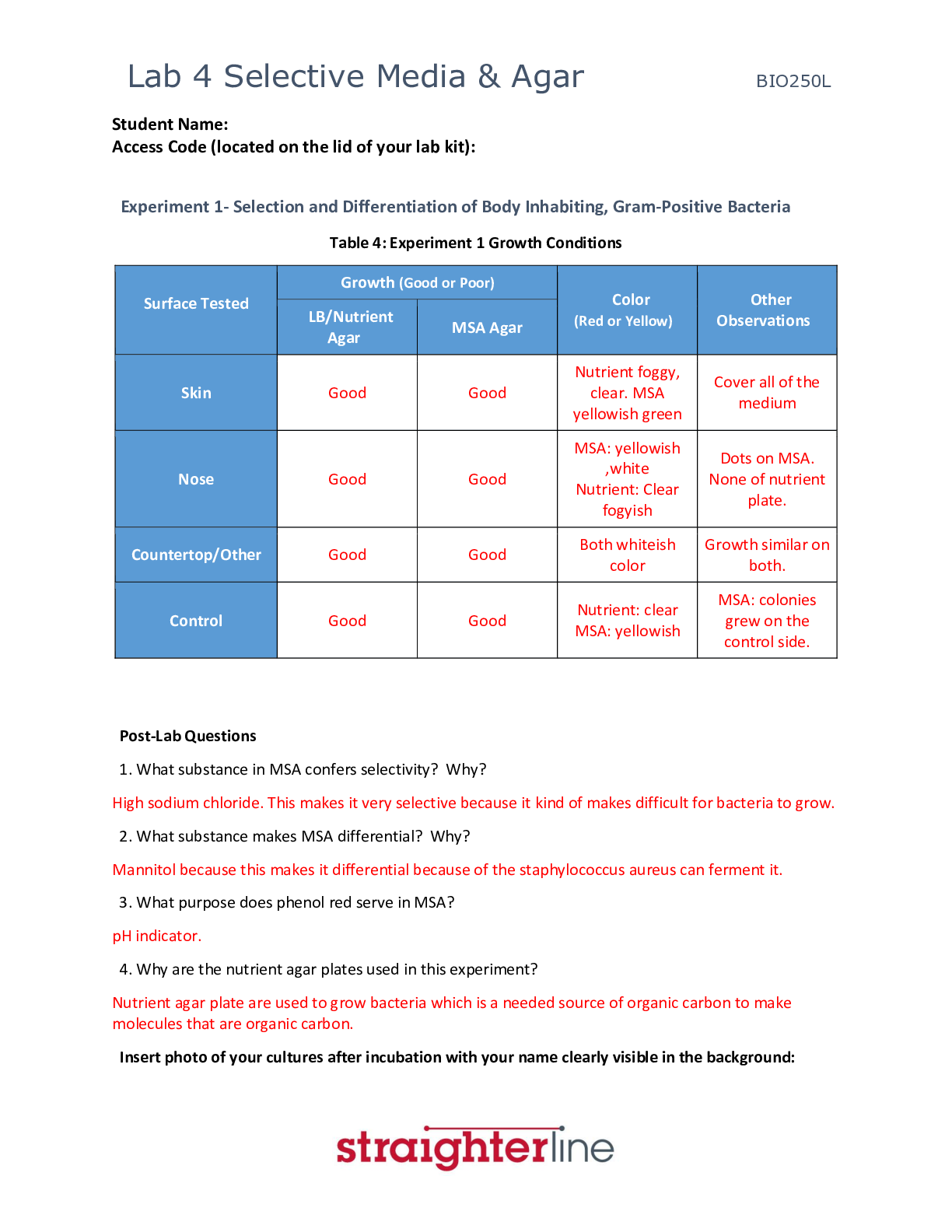
What type of medium allows multiple types of microbes to grow but is designed to show visible color differences among those organisms? - ✔✔Differential
What type of microscope uses visible light and produces well-defined, three-dimensional images? - ✔✔Compound microscope
What type of dyes are used in positive staining and are attracted top the negatively charged cell? - ✔✔Basic
Name several specimens that can be collected for culturing microorganisms, then name the five I's in order. - ✔✔Nearly any object or material can be collected for culturing microorganisms, common ones are body fluids and tissues, foods, water, or soil.
Five I's:
- Inoculation
- Incubation
- Isolation
- Inspection
- Identification
Inoculation - ✔✔- Sample is placed into a container of sterile medium
- Cultivation of microorganisms
- Involves spreading the sample on the surface of a solid medium or introducing the sample into a flask or tube
Incubation - ✔✔- An incubator creates the proper growth temperature and other conditions
- Promotes multiplication of the microbes over a period of hours, days, and even weeks.
- Produces a culture - the visible growth of the microbe in or on the medium
Isolation - ✔✔Microbes may take the form of separate colonies on solid media, or turbidity in broths. Single species of microbe
[Show More]