Layer - Service - ANSWER Defines the basic services provided by cloud providers.
Layer - Physical Resource - ANSWER Includes all the physical resources used to provide cloud services, most notably, the hardware and th
...
Layer - Service - ANSWER Defines the basic services provided by cloud providers.
Layer - Physical Resource - ANSWER Includes all the physical resources used to provide cloud services, most notably, the hardware and the facility.
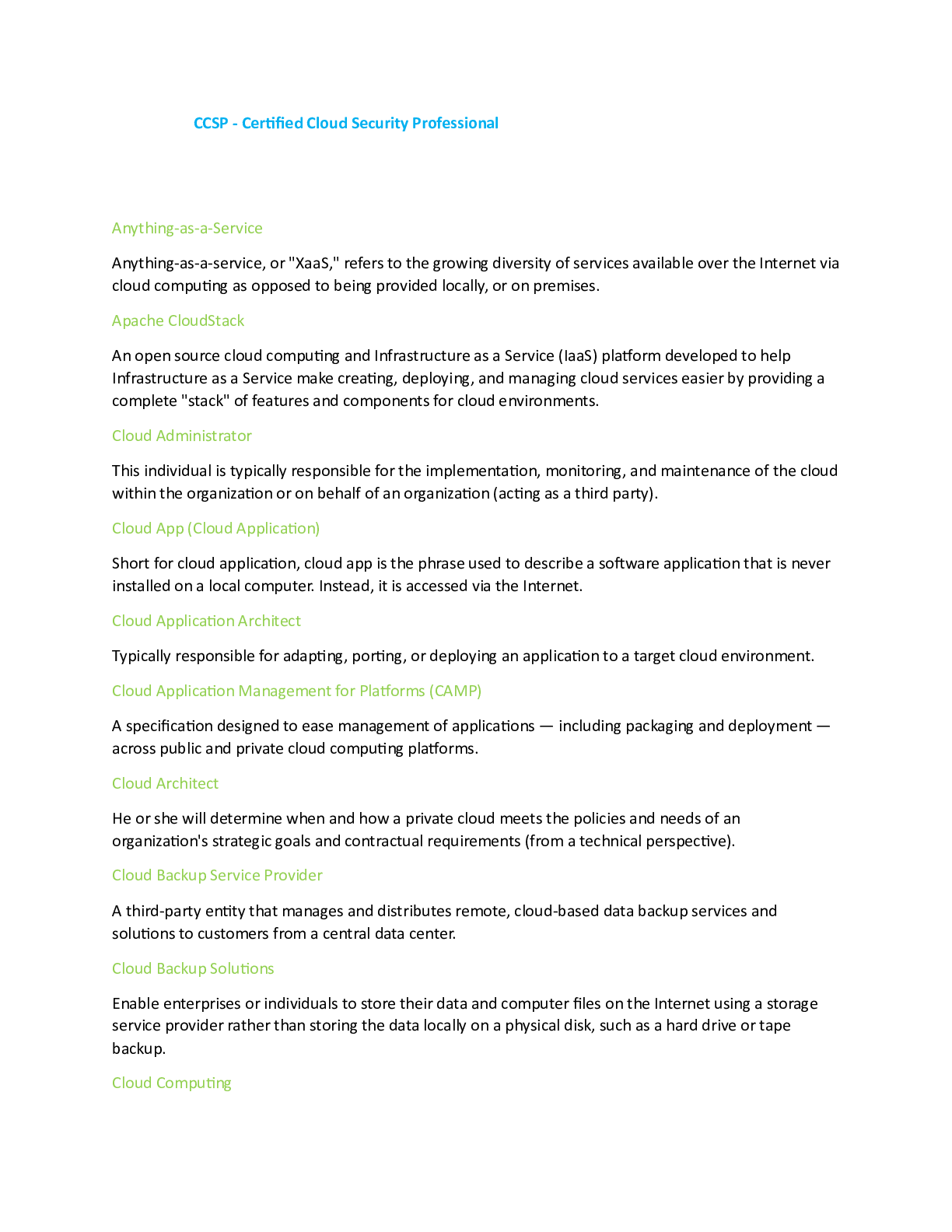
Anything-as-a-Service - ANSWER Anything-as-a-service, or "SaaS," refers to the growing diversity of services available over the Internet via cloud computing as opposed to being provided locally, or on premises.
Apache Cloud Stack - ANSWER An open source cloud computing and Infrastructure as a Service (IaaS) platform developed to help Infrastructure as a Service make creating, deploying, and managing cloud services easier by providing a complete "stack" of features and components for cloud environments.
Cloud Administrator - ANSWER This individual is typically responsible for the implementation, monitoring, and maintenance of the cloud within the organization or on behalf of an organization (acting as a third party).
Cloud App (Cloud Application) - ANSWER Short for cloud application, cloud app is the phrase used to describe a software application that is never installed on a local computer. Instead, it is accessed via the Internet.
Cloud Application Architect - ANSWER Typically responsible for adapting, porting, or deploying an application to a target cloud environment.
Cloud Application Management for Platforms (CAMP) - ANSWER A specification designed to ease management of applications — including packaging and deployment — across public and private cloud computing platforms.
Cloud Architect - ANSWER He or she will determine when and how a private cloud meets the policies and needs of an organization's strategic goals and contractual requirements (from a technical perspective).
Cloud Backup Service Provider - ANSWER A third-party entity that manages and distributes remote, cloud-based data backup services and solutions to customers from a central data center.
Cloud Backup Solutions - ANSWER Enable enterprises or individuals to store their data and computer files on the Internet using a storage service provider rather than storing the data locally on a physical disk, such as a hard drive or tape backup.
Cloud Computing - ANSWER A type of computing, comparable to grid computing that relies on sharing computing resources rather than having local servers or personal devices to handle applications.
Cloud-specific risks include but are not limited to the following:
■■ Management plane breach: Arguably, the most important risk is a management
plane (management interface) breach. Malicious users, whether internal or external,
can affect the entire infrastructure that the management interface controls.
■■ Resource exhaustion: Because cloud resources are shared by definition, resource
exhaustion represents a risk to customers. This can play out as being denied
access to resources already provisioned or as the inability to increase resource
consumption.
Examples include sudden lack of CPU or network bandwidth,
which can be the result of overprovisioning to tenants by the CSP. Related to
resource exhaustion are the following:
■■ Denial-of-service (DoS) attacks, where a common network or other resource is
saturated, leading to starvation of users
■■ Traffic analysis
■■ Manipulation or interception of data in transit
■■ Isolation control failure: Resource sharing across tenants typically requires the
CSP to realize isolation controls. Isolation failure refers to the failure or nonexistence
of these controls. Examples include one tenant's VM instance accessing or
affecting instances of another tenant, failure to limit one user's access to the data
of another user (in a software as a service [SaaS] solution), and entire IP address
blocks being blacklisted as the result of one tenant's activity.
■■ Insecure or incomplete data deletion: Data erasure in most OSs is implemented
by just removing directory entries rather than by reformatting the storage used.
This places sensitive data at risk when that storage is reused due to the potential
for recovery and exposure of that data.
■■ Control conflict risk: In a shared environment, controls that lead to more security
for one stakeholder (blocking traffic) may make it less secure for another (loss
of visibility).
■■ Software-related risks: Every CSP runs software, not just the SaaS providers. All
software has potential vulnerabilities. From the customer's perspective, control is
transferred to the CSP, which can mean an enhanced security and risk awareness,
but the ultimate accountability for compliance still falls to the customer.
Cloud Computing Accounting Software - ANSWER Accounting software that is hosted on remote servers.
Cloud Computing Reseller - ANSWER A company that purchases hosting services from a cloud server hosting or cloud computing provider and then re-sells them to its own customers.
Cloud Database - ANSWER A database accessible to clients from the cloud and delivered to users on demand via the Internet.
Cloud Data Architect - ANSWER Ensures the various storage types and mechanisms utilized within the cloud environment meet and conform to the relevant SLAs and that the storage components are functioning according to their specified requirements.
Cloud Developer - ANSWER Focuses on development for the cloud infrastructure itself. This role can vary from client tools or solutions engagements, through to systems components.
Cloud Enablement - ANSWER The process of making available one or more of the following services and infrastructures to create a public cloud-computing environment: cloud provider, client, and application.
Cloud Management - ANSWER Software and technologies designed for operating and monitoring the applications, data, and services residing in the cloud. Cloud management tools help to ensure a company's cloud computing-based resources are working optimally and properly interacting with users and other services.
Cloud Migration - ANSWER The process of transitioning all or part of a company's data, applications, and services from on-site premises behind the firewall to the cloud, where the information can be provided over the Internet on an on-demand basis.
Cloud OS - ANSWER A phrase frequently used in place of Platform as a Service (PaaS) to denote an association to cloud computing.
Cloud Portability - ANSWER The ability to move applications and its associated data between one cloud provider and another — or between public and private cloud environments.
Cloud Provider - ANSWER A service provider who offers customers storage or software solutions available via a public network, usually the Internet.
Cloud Provisioning - ANSWER The deployment of a company's cloud computing strategy, which typically first involves selecting which applications and services will reside in the public cloud and which will remain on-site behind the firewall or in the private cloud.
[Show More]