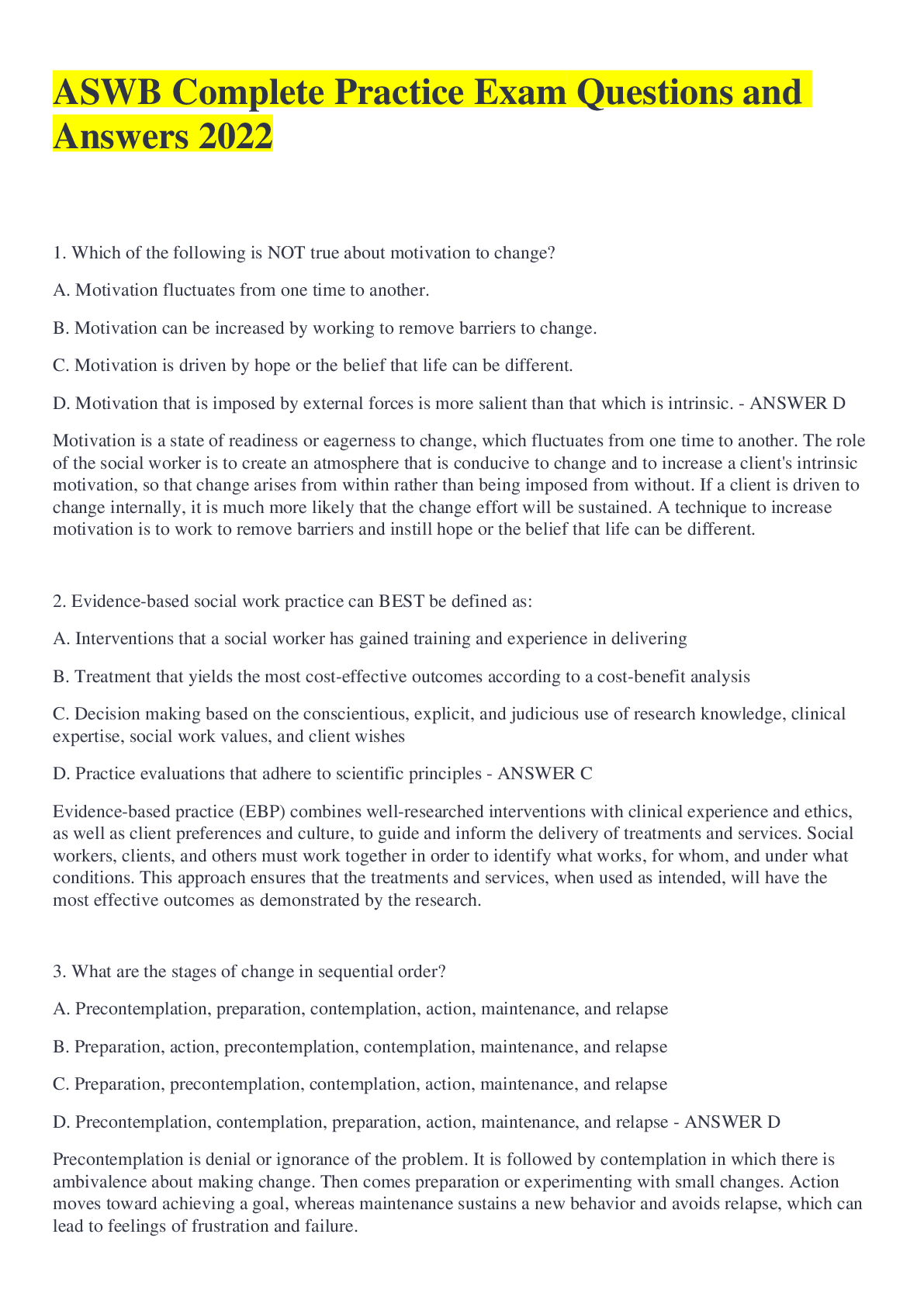
1. Which of the following is NOT true about motivation to change?
A. Motivation fluctuates from one time to another.
B. Motivation can be increased by working to remove barriers to change.
C. Motivation is driven b
...
1. Which of the following is NOT true about motivation to change?
A. Motivation fluctuates from one time to another.
B. Motivation can be increased by working to remove barriers to change.
C. Motivation is driven by hope or the belief that life can be different.
D. Motivation that is imposed by external forces is more salient than that which is intrinsic. - ANSWER D
Motivation is a state of readiness or eagerness to change, which fluctuates from one time to another. The role of the social worker is to create an atmosphere that is conducive to change and to increase a client's intrinsic motivation, so that change arises from within rather than being imposed from without. If a client is driven to change internally, it is much more likely that the change effort will be sustained. A technique to increase motivation is to work to remove barriers and instill hope or the belief that life can be different.
2. Evidence-based social work practice can BEST be defined as:
A. Interventions that a social worker has gained training and experience in delivering
B. Treatment that yields the most cost-effective outcomes according to a cost-benefit analysis
C. Decision making based on the conscientious, explicit, and judicious use of research knowledge, clinical expertise, social work values, and client wishes
D. Practice evaluations that adhere to scientific principles - ANSWER C
Evidence-based practice (EBP) combines well-researched interventions with clinical experience and ethics, as well as client preferences and culture, to guide and inform the delivery of treatments and services. Social workers, clients, and others must work together in order to identify what works, for whom, and under what conditions. This approach ensures that the treatments and services, when used as intended, will have the most effective outcomes as demonstrated by the research.
3. What are the stages of change in sequential order?
A. Precontemplation, preparation, contemplation, action, maintenance, and relapse
B. Preparation, action, precontemplation, contemplation, maintenance, and relapse
C. Preparation, precontemplation, contemplation, action, maintenance, and relapse
D. Precontemplation, contemplation, preparation, action, maintenance, and relapse - ANSWER D
Precontemplation is denial or ignorance of the problem. It is followed by contemplation in which there is ambivalence about making change. Then comes preparation or experimenting with small changes. Action moves toward achieving a goal, whereas maintenance sustains a new behavior and avoids relapse, which can lead to feelings of frustration and failure.
4. Which of the following is NOT an essential step in ethical problem solving?
A. Identifying the ethical standards that may be compromised
B. Determining whether there is an ethical dilemma
C. Weighing ethical issues in light of social work values and principles
D. Asking a supervisor to monitor practice to identify new ethical issues or dilemmas - ANSWER D
A social worker, not his or her supervisor, should monitor practice to identify whether new issues or dilemmas arise.
5. A young boy is stopped by a police officer and claims that he is a member of the armed forces, though it is obvious that he is not. This assertion by the boy is MOST likely a:
A. Comorbid thought
B. Dissociation
C. Folie à deux
D. Delusion - ANSWER D
A delusion is a false, fixed belief despite evidence to the contrary (i.e., believing something that is not true). Comorbid means existing at the same time. Dissociation is a change in memory, perception, or consciousness. Folie à deux is a shared delusion.
6. A social work administrator is having trouble finding a group home manager for a new program scheduled to open in 2 weeks. Further delays in locating staff will delay clients from moving into the program. The administrator temporarily hires her niece, who just graduated with a social work degree, for this position. This action is:
A. Ethical because the niece is clearly qualified for the position
B. Unethical because this is a conflict of interest
C. Ethical because the position is temporary and ensures clients get the services needed
D. Unethical because clients will experience staff turnover when a new manager is hired - ANSWER B
Social workers should avoid situations interfering with impartial judgment. Hiring a family member creates a dual relationship and should be avoided.
7. A social worker is interested in seeing the extent to which current clients are satisfied with a new relapse prevention program. The social worker distributes a client satisfaction survey to those in the program. The social worker then collects the surveys and analyzes the results that are presented to a management team in the agency. The social worker is conducting which type of evaluation?
A. Summative
B. Experimental
C. Quasi-experimental
D. Formative - ANSWER D
Formative evaluations examine the process of delivering services, whereas summative evaluations examine the outcomes. Formative evaluations are ongoing processes that allow for feedback to be implemented during service delivery. These types of evaluations allow social workers to make changes as needed to help achieve program goals. Summative evaluations occur at the end of services and provide an overall description of their effectiveness. Summative evaluation examines outcomes to determine whether objectives were met.
The design described is not experimental—which requires a control group and randomization of assignment—or quasi-experimental, which does not require randomization, but has more support for causal inferences than does preexperimental designs.
8. Which of the following is an example of social stratification?
A. A child is not included in group activities in school because of his or her poor social skills.
B. Children who are violent need to be segregated from their peers.
C. A child with social deficits is assumed to be delayed in cognition without additional assessment.
D. Children from affluent households receive a better public education than those from low-income households. - ANSWER D
Stratification refers to structured inequality of entire categories of people in society who have unequal access to social rewards. Stratification applies to individuals based on ethnic and racial background, social status, and/or other factors.
9. During an intake interview, a client reports that she is extremely depressed and has self-destructive thoughts. She has had prior suicide attempts, but tells the social worker not to worry as she won't "do it again." The social worker should FIRST:
A. Tell the client that her decision not to harm herself is a good one
B. Explore with the client what is causing her depression
C. Conduct a safety assessment
D. Refer the client to a psychiatrist for a medication evaluation - ANSWER C
Despite the client's report that she will not act on her thoughts, she is at risk because she has had these feelings and has acted on them in the past. The case vignette does not describe the social worker taking any action yet. A safety assessment will determine the severity of the depression and whether the client is at risk for a suicide attempt. It must be done FIRST before any other action is taken.
10. A client with a Social Anxiety Disorder will MOST likely be prescribed which of the following medications to take on an ongoing basis?
A. Zoloft (sertraline)
B. Mellaril (thioridazine)
C. Thorazine (chlorpromazine)
D. Valium (diazepam) - ANSWER A The primary medications used to treat social anxiety disorder are selective serotonin reuptake inhibitors (SSRIs), which were first developed to treat depression. They have been found to be effective in the treatment of a wider range of disorders. Zoloft (sertraline) is an SSRI.
Benzodiazepines, such as Valium (diazepam), reduce levels of anxiety. However, they are habit-forming and sedating, so they are typically prescribed for only short-term use.
Mellaril (thioridazine) and Thorazine (chlorpromazine) are antipsychotic medications for the treatment of psychosis.
11. A social worker is appointed by the court to conduct a child custody evaluation for a couple that is divorcing. The mother reports that her husband is verbally abusive, controlling, and neglects the children when they are in his care. She reports that the children have missed a lot of school when staying with their father because he does not assist with getting them ready for school or doing their homework. The father states that his wife is lazy, irresponsible, and cannot meet the children's basic needs. He reports that the school frequently has to provide lunch for the children because the mother does not supply it when they are in her care. In order to BEST evaluate the legitimacy of the information, the social worker should:
A. Ask the husband and wife to put their allegations in writing and sign them, attesting to their accuracy
B. Determine whether the husband or wife have had any past instances with being untruthful
C. Always speak to the husband and wife together so that they are more likely to be honest
D. Obtain information from school personnel and records after obtaining parental consent - ANSWER D
Collateral information is often used when the credibility and validity of information obtained from a client or others is questionable. For example, child custody cases are inherently characterized by biased data within an adversarial process. Social workers should use data from neutral parties, such as the school, because this information has higher integrity.
12. A social worker is facilitating a psychotherapy group for individuals who are in recovery from substance abuse. After group, a client mentions that she has been having problems dealing with job stress without the use of substances. In order to meet this client's needs, the social worker should: A. Recommend that the client see the social worker individually in addition to the group therapy because she appears to need some additional support
B. Suggest that the client bring this topic up in the group next week to see if others are having similar problems
C. Evaluate whether group therapy is the best treatment modality for the client due to the issue being mentioned to the social worker outside of the group context
D. Determine if there is an employee assistance program in the client's work setting to assist - ANSWER B
In group therapy, the group is the major helping agent. Issues should be brought back to the group to address. There is no need for the client to see the social worker for individual therapy. Contacting an employee assistance program would breach confidentiality.
13. An 11-year-old child would like to start helping around the house with chores. She approaches her mother many times, but is told she cannot assist because "she won't do it right." During several attempts to do things on her own, she is scolded. According to psychosocial development theory, she may experience doubts in her abilities due to a crisis in which of the following stages?
A. Industry versus inferiority
B. Initiative versus guilt
C. Autonomy versus shame/doubt
D. Generativity versus stagnation - ANSWER A
Industry versus inferiority—From age 6 to puberty, children begin to develop a sense of pride in their accomplishments. If children are encouraged and reinforced for their initiative, they begin to feel industrious and feel confident in their ability to achieve goals. If this initiative is not encouraged and is restricted, children begin to feel inferior, doubting their abilities.
14. A social worker employed in a hospital is asked to use a SOAP format in a client's record. In this format, the "A" stands for:
A. Action plan
B. Assessment
C. Active treatment
D. Adjustments to services needed - ANSWER B
SOAP stands for Subjective, Objective, Assessment, and Plan. In the Assessment portion, a social worker pulls together objective and subjective findings and consolidates them into a short assessment.
15. Aphasia is BEST defined as difficulty with:
A. Walking or running
B. Common motor skills such as combing hair, despite normal strength
C. Understanding language or using language to speak or write
D. Recognizing familiar objects - ANSWER C
Aphasia is a change in cognition (mental ability) that is characterized by difficulty understanding language or using language to speak or write. Difficulty with common motor skills is known as ataxia. Inability to recognize familiar objects is labeled agnosia.
16. Culture-bound syndromes in the DSM-5 are replaced by all of the following concepts EXCEPT:
A. Cultural syndromes
B. Cultural stratification
C. Cultural idioms of distress
D. Cultural explanations - ANSWER B
In the DSM-5, there is recognition that every disorder is inherently culture-bound. These new guidelines help a social worker be more sensitive to cultural differences and understand that a client is manifesting symptoms in a way that his or her culture experiences them. Cultural syndromes are clusters of invariant symptoms in a specific cultural group. Cultural idioms of distress are a way of talking about suffering among people in a cultural group, and cultural explanations or perceived causes for symptoms, illness, or distress have been added to assist with diagnosing.
17. A social worker receives a court order to provide records of a former client. In this instance, the social worker should submit the records:
A. And try to contact the client to inform her about the disclosure
B. With the contact information of the client so the court can contact her about the release
C. But not contact the client as court orders are not to be discussed by anyone other than judges and attorneys
D. And write to the judge to see if he or she wants the client to know about the court order - ANSWER A
Social workers should inform clients, to the extent possible, about the disclosure of confidential information and the potential consequences, when feasible, before any disclosure is made. This applies whether social workers disclose confidential information on the basis of a legal requirement or client consent
18. A family comes into treatment because of their young daughter's behavior. They report, upon intake, that she yells at her parents, doesn't listen, and complains about their behavior. There is little progress during the course of treatment and the girl reports that she has no intention of changing. After the sixth session, a social worker tells the girl that she cannot help with her behavior and she should continue to "do as she wishes." According to strategic family therapy, the social worker's directive is known as a:
A. Paradoxical intent
B. Pretend technique
C. Relabeling paradigm
D. Differentiation response - ANSWER A
A paradoxical intent or directive prescribes the symptomatic behavior so the client realizes control over it and uses the strength of resistance to change.
19. A social worker is leaving one agency to work at another. In order to address this situation ethically, the social worker should:
A. Not inform clients in order to avoid causing them undue stress and harm
B. Advise clients that it would be best for them to transfer services to the social worker's new agency to avoid any interruptions in treatment
C. Inform clients of appropriate options for the continuation of services and the benefits and risks of the options
D. Discontinue services to clients immediately - ANSWER C
Social workers who are leaving an employment setting should inform clients of appropriate options for the continuation of services and of the benefits and risks of the options.
20. Federal law requires health care facilities that receive Medicare and Medicaid reimbursements to do all of the following with regard to advance directives EXCEPT:
A. Inform clients of their rights to have advance directives that will allow them to make decisions regarding their health care
B. Use a portion of their revenues to assist clients with the costs associated with creating advance directives
C. Ask clients if they have advance directives and document their responses
D. Provide education about advance directives - ANSWER B
The Patient Self-Determination Act of 1991 specifies facilities that receive Medicare and Medicaid inform clients of their rights to make decisions concerning their own health care, ask and document whether clients have advance directives, and provide education for staff and the community.
21. In which of the following circumstances is task-centered treatment NOT recommended?
A. When the client wants to see immediate results or changes in circumstances
B. When the client is anxious to be an active part of the change process
C. When there is a time limited period in which to work with the client
D. When the client is addressing long-standing problems that are complex in nature - ANSWER D
A task-centered approach aims to quickly engage clients in the problem-solving process because it is usually delivered in a time-limited environment. The client is an active part of the change process and the approach is highly structured to attempt to achieve immediate results as goals are broken into defined tasks. Termination begins in the first session. This approach is too brief to address long-standing problems that are complex.
22. A client is currently taking Clozaril for the treatment of Schizophrenia. The client is MOST likely going to be required to undergo what medical monitoring due to this medication use?
A. Weight checks
B. Blood work
C. Dietary restrictions
D. Exercise regimen - ANSWER B
Clozaril increases the risk of agranulocytosis (low white blood cell count). Monitoring of the white blood cell count through regular blood work is required.
23. Which of the following inhibits the establishment of a therapeutic relationship?
A. A universalism approach or the acceptance of a standard set of norms or standards
B. A pluralistic approach that values cultural pluralism
C. Clients examined as being influenced by their environment with problems being seen as resulting from role ambiguity rather than individual deficits
D. Flexible treatment approaches that take into account the subjective realities of clients - ANSWER A
Universalism is based on one acceptable norm or standard for everyone versus many valid standards that have been developed by clients that they have determined to be most useful to them.
24. Which of the following is NOT an exception to a social worker's duty to protect confidentiality?
A. When a client poses a serious risk to self and others
B. When child abuse is suspected
C. When a client has violated criminal laws and has not been properly prosecuted
D. When there is an imminent threat by a client to an identifiable third party - ANSWER C
In all other instances, there is a serious threat to the health and safety of self or others. D is required under duty to warn (Tarasoff decision).
25. Which of the following theories is used to explain why clients in battering relationships will not leave until the benefits exceed the risks?
A. Psychoanalytic
B. Problem solving
C. Functional
D. Social exchange - ANSWER D
Social exchange theory is based on the idea of totaling potential benefits and losses to determine behavior. A client will leave a battering relationship when the alternative is seen as better than the current situation (rewards outweigh costs).
26. A social worker is working with a client who is anxious about public speaking. The social worker asks the client to close her eyes, visualize herself speaking to a large group, and describe her feelings related to the imaginary situation in detail. This technique by the social worker is known as:
A. Covert modeling
B. Self-modeling
C. Live modeling
D. Symbolic modeling - ANSWER A
Covert modeling is when clients are asked to use their imagination, visualize the desired behavior, and describe it in detail.
Self-modeling is when clients are videotaped demonstrating the desired behavior and this tape is watched and discussed. Live modeling refers to watching a real person performing the desired behavior. Symbolic modeling includes watching others who have been videotaped perform the desired behavior.
27. Which of the following is an example of role discomplementarity?
A. A husband complains that his wife does not take responsibility for keeping the house clean and a wife is upset that her husband does not financially provide for the family.
B. A woman states that she does not like working and wants to quit her job.
C. A young child wants to play in the neighborhood unsupervised.
D. A man struggles to fit in time at home with his family due to his hectic work schedule. - ANSWER A
Role discomplementarity results when roles conflict or when the role expectations of others differ from one's own. In this situation, the husband and wife do not have the same expectations with regard to the tasks for which each other should be responsible.
28. Which of the following is NOT one of six levels of cognition?
A. Synthesis
B. Knowledge
C. Affective
D. Evaluation - ANSWER C
The six levels of cognition are, in sequential order—knowledge, comprehension, application, analysis, synthesis, and evaluation. Teaching techniques should match the cognitive objective, such as knowing specific facts, theories, or information (knowledge) or creating something new/integrating it into a solution (synthesis). Learning aimed at judging the quality of something is known as evaluation.
29. Which of the following is NOT a stated purpose of the professional code of ethics?
A. To be used by malpractice insurance companies to mitigate liability
B. To summarize the values on which the profession is based
C. To be used by the profession to determine whether social workers have acted unethically
D. To serve as a guide to socialize new social workers in the field - ANSWER A
The Code of Ethics also provides ethical standards to which the general public can hold the profession accountable and social workers can consult if professional obligations conflict. These functions of the Code are printed immediately after the preamble. The mitigation of liability by third-party payers is not based on the values of the profession and is not a stated purpose of the Code.
30. Which of the following is an example of role reversal?
A. A mother who shares her 11-year-old daughter's clothes and collects stuffed animals
B. A mother expecting her 11-year-old daughter to stay at home unsupervised
C. A mother with relationship problems who is repeatedly emotionally comforted by her 11-year-old daughter
D. A mother who arranges a date for her 11-year-old daughter - ANSWER C
A role reversal is when two people switch or reverse roles. In this answer, the mother is emotionally dependent and the child is the comforter. These behaviors are usually reversed in a parent-child relationship. The other response choices may relate to roles, but are not reversals.
31. A social worker receives a subpoena from the courts in the mail for a former client's records. In this situation, a social worker should:
A. Immediately send in the original records to the courts
B. Prepare a summary of the records to send in immediately
C. Claim privilege to protect the confidentiality of the client
D. Ignore the subpoena because it relates to a former client and is not relevant - ANSWER C
A subpoena is not a court order and no documents should be sent unless ordered by the court. However, a social worker does have to respond and should not send in the records when receiving a subpoena unless the client has provided a written release.
32. In the DSM-5, when a social worker provides a reason why a condition does not qualify for a disorder, it should be noted as:
A. Not otherwise specified
B. Other specified
C. Unspecified
D. Not specified elsewhere - ANSWER B
In the DSM-5, "Not Otherwise Specified" (NOS) categories for disorders that do not fit under specific disorder categories are replaced. "Other Specified" (i.e., "Other Specified Depressive Disorder") categories are used when a social worker provides the reason why the condition does not qualify for a specific diagnosis (i.e., short duration). "Unspecified" is used when no additional explanation is provided as to why the disorder does not meet the usual criteria.
33. A client abruptly stops coming to therapy after the sixth session. She shows up at the office several weeks later demanding a copy of her records. The social worker does not believe that the information in the record could cause harm to the client, but denies access because the client did not provide any reason for the abrupt termination or reason for wanting the copies. The actions by the social worker are:
A. Unethical because the client should have access to his or her record under these circumstances
B. Ethical because the reason for the release must be disclosed to the social worker
C. Ethical because the client terminated without notice
D. Unethical because the client is always able to access his or her record under any circumstances - ANSWER A
A social worker who is concerned that client access to his or her records could cause serious harm to the client can limit access to the record or portion of the record when the rationale for the request is documented in the file. This case vignette clearly states that the social worker is not concerned that releasing the record to the client would be harmful, so it must be released and to not do so is unethical.
34. A client was referred to a mental health agency for treatment. Upon admission, he reported feeling lethargic and hopeless and had difficulty getting out of bed. Several weeks later, he states that he is sleepless, agitated, and unable to focus. Which of the following medications is the client MOST likely going to be prescribed?
A. Ativan (lorazepam)
B. Nardil (phenelzine)
C. Lithium (lithium carbonate)
D. Buspar (buspirone) - ANSWER C
Ativan and Buspar are antianxiety medications and Nardil is an antidepressant. Lithium is a mood stabilizer, and this client appears to be experiencing depression upon admission, as well as mania later in treatment. A mood stabilizer is used for the treatment of Bipolar Disorder.
35. When clients are at high risk for relapse after discharge, all of the following should occur after termination EXCEPT:
A. Regular assessments to determine whether services are needed
B. Creation of client contracts that reinforce positive behaviors
C. Utilization of natural supports and peer support services
D. Follow-up to see whether discharge plans are being implemented - ANSWER B
Clients who are at high risk for developing problems after services have ended should receive regular assessments to see if additional services are needed and/or discharge plans are being implemented. Natural supports and peer supports, such as 12-step programs, are good resources to assist with sustaining progress made. The creation of a contract is not done after termination because it indicates the presence of an intervention in a therapeutic relationship. It is incorrect given the order of the problem-solving process.
36. A social worker in private practice designs a standard intake form that includes questions about the client's demographic information including age, gender, marital status, sexual orientation, education, and drug/alcohol use. This form is:
A. Ethical since it contains important information for the social worker to know in order to work with the client effectively
B. Ethical since all of this information will be kept confidential
C. Unethical since this information may not be needed for treatment
D. Unethical unless the social worker makes it clear that the client has the choice as to whether to complete it - ANSWER C
Social workers should respect clients' right to privacy. Social workers should not solicit private information from clients unless it is essential to providing services or conducting social work evaluation or research. Information about the client's sexual orientation and/or drug or alcohol use may not be relevant to the presenting problem or treatment.
37. A social worker is charged with creating a behavioral objective to assist her client, John, in his educational setting. Which of the following statements is the BEST example of this type of objective?
A. John will make eye contact during conversations in practical arts class at least 75% of the time.
B. John will be motivated to complete his homework daily in order to achieve a grade of a B or better.
C. The teacher will praise John during class at least 10 times per hour.
D. John will sit in his chair at least 80% of the time. - ANSWER A
A behavioral objective should be client-oriented and emphasize what a client needs to do. C is excluded as it focuses on the teacher's actions. An important element of behavioral objectives is that they are observable. Motivation is not easily observed. The conditions under which the behavior will be performed should also be included. D does not indicate if the expectation regarding sitting is to take place during class or all of the time. A has all of the elements—it specifies the target behavior, the conditions under which the behavior will be performed, and the criteria for determining when the acceptable performance of the behavior occurs.
38. A new client enters the office walking slowly, using a cane, and has difficulty picking up objects, swallowing, and speaking as a result of a stroke. The BEST diagnosis for this client is:
A. Agnosia
B. Ataxia
C. Prosopagnosia
D. Acalculia - ANSWER B
Ataxia describes a lack of muscle control during voluntary movements, such as walking or picking up objects. A sign of an underlying condition, ataxia can affect movement, speech, eye movement, and swallowing.
Persistent ataxia usually results from damage to the cerebellum—the part of the brain that controls muscle coordination. Many conditions can cause ataxia, including alcohol abuse, stroke, tumor, cerebral palsy, and multiple sclerosis.
An inability to recognize familiar objects is agnosia, and an inability to recognize familiar faces is prosopagnosia. Acalculia is the inability to do simple arithmetic.
39. Echolalia is BEST defined as:
A. Mimicking another's speech
B. Spontaneous movement
C. Repetitive movements
D. Odd mannerisms or actions - ANSWER A
Echolalia is repeating noises and phrases. It is sometimes associated with Catatonia, Autism Spectrum Disorder, Schizophrenia, and other disorders.
40. A man who is having problems at work finds that he is yelling at his children more and has begun to have marital issues with his wife. The husband is MOST likely using the defense mechanism of:
A. Reaction formation
B. Projection
C. Conversion
D. Displacement - ANSWER D
Displacement is directing an impulse, wish, or feeling toward another person or situation that is less threatening. The man unconsciously realizes that he cannot express his anger on the job or it may have negative consequences, so he goes home and yells at his wife and children.
41. Upon admission, a client reports that he has always feared disapproval and rejection from others in his life. Several weeks later, the client appears anxious and worried. When asked about his behavior, he states that he feels judged by the social worker and that the social worker is being critical of him when he sees her. The client's feelings are an example of:
A. Countertransference
B. Psychosis
C. Paranoia
D. Transference - ANSWER D
Transference refers to redirection of a client's feelings for a significant person to a social worker. Transference is often manifested as an erotic attraction toward a social worker, but can be seen in many other forms such as rage, hatred, mistrust, parentification, extreme dependence, or even placing a social worker in an esteemed status.
42. Which of the following is the MOST significant change in the DSM-5 concerning Substance Related Disorders?
A. Substance Abuse and Substance Dependence have been combined into a single Substance Use Disorder.
B. Recurrent legal problems were added to the criteria for Substance Use Disorders.
C. Craving or a strong desire to use a substance was deleted from Substance Dependence.
D. Recurrent legal problems were deleted from the criteria for Substance Abuse. - ANSWER A
DSM-IV created separate diagnoses for "abuse" and "dependence" although substance-related problems occur on a continuum. The DSM-5 uses "Substance Use Disorders" as the diagnosis for people with such problems.
"Recurrent legal problems" was deleted as a criterion for Substance Use Disorders and "craving or a strong desire or urge to use a substance" was added to the criteria.
43. A social worker sees that a colleague is distracted when interacting with clients and is showing up for appointments late. The social worker learns that this behavior began several weeks earlier, after the death of her colleague's husband. In this instance, the social worker should:
A. Give the colleague additional time to grieve and monitor the colleague's actions to see if the behavior subsides on its own
B. Speak to a supervisor to see if the colleague's workload could be reduced for a period of time
C. Contact the human resources department to see if there are employee assistance services available
D. Speak to the colleague directly about the observations to see if additional assistance is needed - ANSWER D
A social worker with direct knowledge of a colleague's impairment due to personal problems, psychological stress, and so on, that interferes with practice effectiveness should consult with the colleague when feasible and assist the colleague in taking remedial action.
44. Which of the following is NOT true of life crises?
A. They must be precipitated by major life events.
B. The ways in which they are addressed significantly impact subsequent functioning.
C. They can produce healthier behavior if understood and overcome.
D. They produce anxiety, tension, and disequilibrium. - ANSWER A
Life crises do not have to be a major event. They can be the "last straws" in a series of events that exceed the client's ability to cope. Addressing crises appropriately significantly impacts subsequent client functioning and can assist in the development of healthy coping skills.
45. Which of the following is true of BOTH networking in business and networking in social work practice?
A. It aims to educate about the problems experienced by others and thereby helps to effect system changes.
B. It aims to attract more individuals to organizations so that these entities can prosper.
C. It is beneficial for clients as it keeps the costs down through sharing of resources.
D. It creates a community and builds alliances around a common interest or goal. - ANSWER D
The first answer is true for social work, but not for business. B is true for business networking, but the aim in social work is not to attract clients for the betterment of the agency. C may not be true in business because lower operating costs are not always passed on to clients; they may mean more profits for a company. In both business and social work, networking provides opportunities to work with others toward the achievement of common goals and helps in establishing professional relationships or alliances.
46. Which of the following is the MOST important benefit of community participation in social work practice?
A. It puts the decision-making power partly or wholly with community members.
B. It shows the media that individuals want to get involved when there is a good cause.
C. It informs community members about the work that needs to be done to make change.
D. It divides the workload so that it can be distributed across a larger group. - ANSWER A
The values and principles of social work practice should be used as the basis for selecting the most important benefit. A is based on the belief of self-determination or that individuals and groups should be in charge of taking actions that are best for them. The other response choices may be true, but they are not based on this fundamental concept in social work practice.
47. If a client has a Substance Use Disorder in addition to Schizophrenia, these two disorders are considered to be:
A. Premorbid
B. Comorbid
C. Contraindicated
D. Dissociated - ANSWER B
Comorbid refers to two problems, conditions, or disorders that exist at the same time—such as the presence of a mental health and substance use issue, or a mental health and medical problem.
48. A woman complains that her 7-year-old son "makes things up and exaggerates." He often adds information when recalling experiences and talks about knights and dragons being part of his everyday world. The woman is angry about this behavior and worried that it is an indication of some mental health problem. In order to best assist, the social worker should:
A. Explain that the behaviors are associated with the preoperational thought stage of cognitive development
B. Conduct a mental status examination on the child
C. Refer the child for a mental health evaluation based upon the mother's concerns
D. Determine whether this behavior is a concern to others, including hi
[Show More]