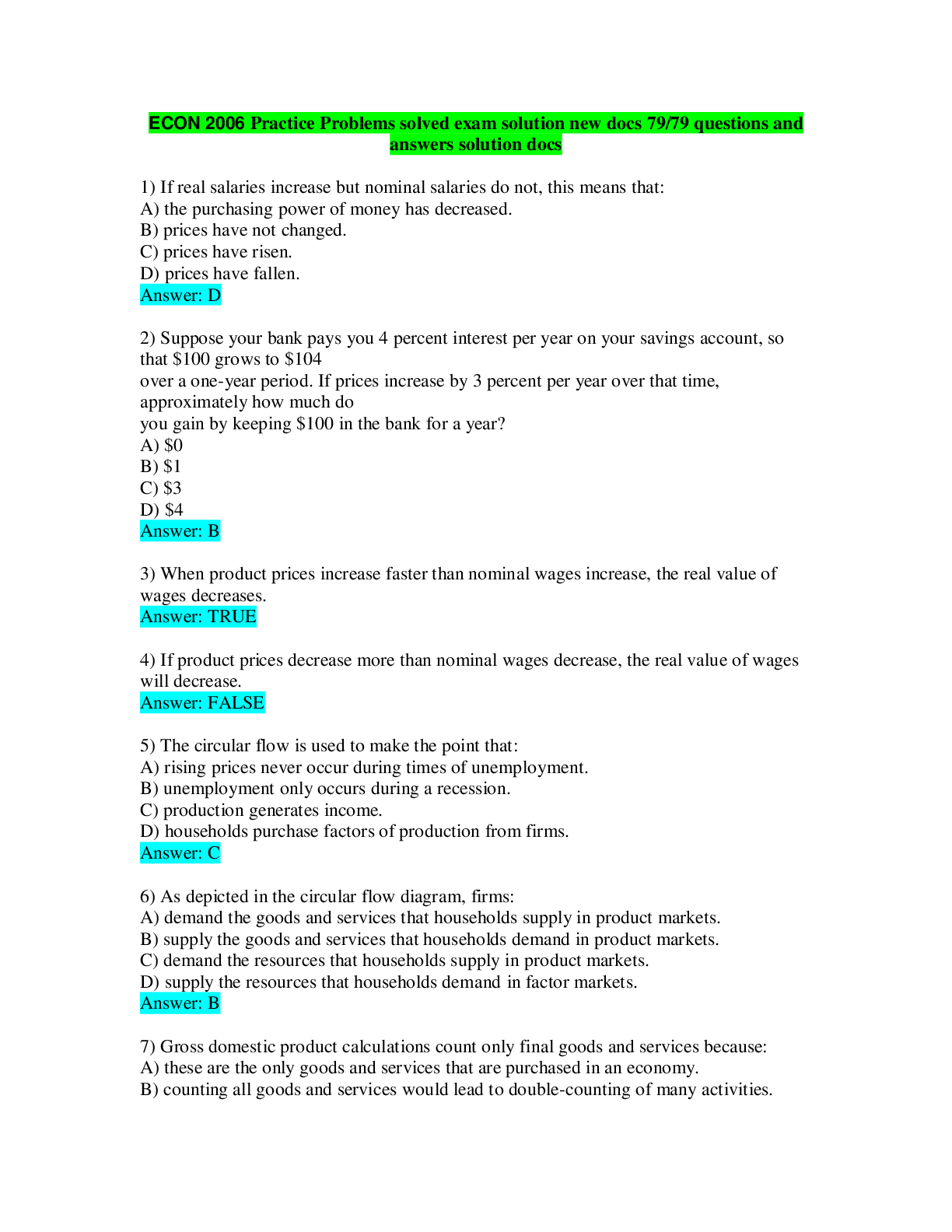
ECON 2006 Practice Problems solved exam solution new docs 79/79 questions and answers solution docs
1) If real salaries increase but nominal salaries do not, this means that:
A) the purchasing power of money has dec
...
ECON 2006 Practice Problems solved exam solution new docs 79/79 questions and answers solution docs
1) If real salaries increase but nominal salaries do not, this means that:
A) the purchasing power of money has decreased.
B) prices have not changed.
C) prices have risen.
D) prices have fallen.
2) Suppose your bank pays you 4 percent interest per year on your savings account, so that $100 grows to $104
over a one-year period. If prices increase by 3 percent per year over that time, approximately how much do
you gain by keeping $100 in the bank for a year?
A) $0
B) $1
C) $3
D) $4
3) When product prices increase faster than nominal wages increase, the real value of wages decreases.
4) If product prices decrease more than nominal wages decrease, the real value of wages will decrease.
5) The circular flow is used to make the point that:
A) rising prices never occur during times of unemployment.
B) unemployment only occurs during a recession.
C) production generates income.
D) households purchase factors of production from firms.
6) As depicted in the circular flow diagram, firms:
A) demand the goods and services that households supply in product markets.
B) supply the goods and services that households demand in product markets.
C) demand the resources that households supply in product markets.
D) supply the resources that households demand in factor markets.
7) Gross domestic product calculations count only final goods and services because:
A) these are the only goods and services that are purchased in an economy.
B) counting all goods and services would lead to double-counting of many activities.
C) it is difficult to measure the prices of intermediate goods produced.
D) one cannot calculate the quantities of intermediate goods produced.
8) "Final goods and services" are those that are:
A) produced outside the United States.
B) used in the production of other goods and services.
C) double counted in the calculation of GDP.
D) sold to ultimate or final purchasers.
9) A rancher raises sheep. Once a year he shears them and sells the raw wool to a processor who cleans it and spins it into yarn. The yarn is then sold to a knitting mill, which produces and sells sweaters. In calculating GDP we would count:
A) the raw wool, the yarn and the sweaters.
B) only the yarn and the sweaters.
C) only the sweaters.
D) only the raw wool and the yarn.
10) When there are sustained increases in real GDP over time, we say that the economy is undergoing:
A) economic stagnation.
B) a recession.
C) economic growth.
D) massive changes in productive capacity.
11) Which prices are used to measure goods and services in calculating the GDP?
A) past years prices
B) current prices
C) average prices
D) projected prices
12) Which of the following is not a component of gross domestic product?
A) net exports
B) government purchases
C) purchases by consumers of used goods
D) purchases by consumers of finished goods
13) The largest component of GDP is:
A) government spending.
B) consumption expenditures.
C) private investment expenditures.
D) net exports.
14) For the purpose of GDP accounting, consumption expenditures include:
A) only non-durable goods.
B) only durable goods.
C) both non-durable goods and services.
D) durable goods, non-durable goods, and services.
15) Going to the dentist would be counted in GDP as:
A) crowns and fillings.
B) insurance utilization.
C) a service.
D) a measure of welfare.
16) Suppose that a hardware store had $1000 of paintbrushes on its shelves at the beginning of the year and $1500
at year-end. The inventory amount included in GDP would be:
A) $1000.
B) $1500.
C) $1250.
D) $500.
17) Which of the following is not a component of private investment, for purposes of GDP accounting?
A) newly produced housing
B) additions to firms' stock of inventories
C) purchases by firms of used machinery
D) newly built factories
18) Gross investment is:
A) what is left over from total new private investment after depreciation.
B) the total amount of private investment purchases, whether new or previously -existing.
C) the total amount of new private investment purchases.
D) the wear and tear on private investment.
19) Depreciation is:
A) what is left over from total new private investment after use for a year.
B) the total amount of private investment purchases, whether new or previously -existing.
C) the total amount of new private investment purchases.
D) the wear and tear on private investment.
20) Net investment is:
A) what is left over from total new private investment after depreciation.
B) the total amount of private investment purchases, whether new or previously -existing.
C) the total amount of new private investment purchases.
D) gross investment plus depreciation.
21) If in the third quarter of 2005 total investment spending was $2,099 billion and depreciation was $1,604 billion,
then the amount counted in GDP, which is known as gross investment, would be:
A) $2,099 billion.
B) $495 billion.
C) $1,604 billion.
D) $3,703 billion.
22) If in the third quarter of 2005 total investment spending was $2,099 billion and depreciation was $1,604 billion,
then net investment is equal to:
A) $2,099 billion.
B) $495 billion.
C) $1,604 billion.
D) $3,703 billion.
23) Which of the following is not an example of private investment expenditure?
A) new plants and equipment added during the year
B) new houses built during the year
C) using credit cards to purchase durable and nondurable goods
D) increases in inventories on goods produced during the year
24) For the purposes of GDP accounting, government purchases include:
A) the purchases of new military equipment.
B) social security payments.
C) direct transfer payments by the government to other individuals.
D) welfare payments.
25) For the purposes of GDP accounting, government purchases:
A) are considered part of investment.
B) are considered part of consumption.
C) include transfer payments.
D) include wages and benefits paid to government workers.
26) Transfer payments are excluded from government purchases in GDP accounting because:
A) they are difficult to measure.
B) they are a reward to individuals who have been productive their entire lives.
C) they are already included as part of investment.
D) nothing is being produced in return for the payment.
27) Net exports include goods produced:
A) domestically that are sold domestically, less goods produced domestically that are sold abroad.
B) domestically that are sold abroad, less goods produced domestically that are sold domestically.
C) domestically that are sold abroad, less goods that are produced abroad that are sold domestically.
D) abroad that are sold domestically, less goods that are produced domestically that are sold abroad.
28) Which of the following should be included in U.S. GDP?
A) a computer manufactured in Mexico and sold in the United States
B) a computer manufactured in Mexico by a U.S. firm and sold in the United States
C) a computer manufactured in the United States and sold in Mexico
D) a used computer manufactured in the United States and sold in Mexico
29) A trade surplus occurs when:
A) a country purchases more from abroad than other countries purchase from it.
B) a country sells more abroad than it purchases from abroad.
C) a country's firms open more stores abroad than foreign firms open in the country.
D) foreign firms open more stores in a country than the country opens in foreign countries.
30) Exports ________ GDP and imports ________ GDP.
A) increase; decrease
B) decrease; increase
C) increase; increase
D) decrease; decrease
31) The GDP is supposed to measure the goods ________ the United States.
A) purchased in
B) produced in
C) imported to
D) exported to
32) The value of goods produced in a previous year but sold in the current year is added to the GDP for the current
year.
33) Wages paid to teachers, police personnel, and postal workers are not transfer payments because they are payments for services and not simply "transfers" of money.
34) When gross domestic product (GDP) is adjusted by adding any income earned abroad by U.S. firms or residents which is sent back to the U.S. and by subtracting any income earned in the U.S. by non -U.S. corporations or foreign nationals which is sent back to their home countries, it is called:
A) depreciation.
B) subsidized income.
C) international GDP .
D) gross national product (GNP).
35) Depreciation is subtracted from GNP to determine:
A) net income.
B) net national product (NNP).
C) net GDP.
D) net imbalance on exports.
36) Which of the following is a category of national income?
A) net interest
B) corporate profits
C) rental income
D) all of the above
37) Which of the following is the largest component of national income?
A) net interest
B) corporate profits
C) rental income
D) compensation of employees by firms
38) Which of the following is not a component of value added of a firm?
A) expenditures on intermediate goods
B) profits
C) wages
D) interest
39) The amount of income that households keep after paying taxes is:
A) national income.
B) personal income.
C) personal disposable income.
D) value added income.
40) Personal income and personal disposable income refer to payments ultimately flowing to:
A) firms.
B) households.
C) governments.
D) foreigners.
41) A firm's value added can be measured as the value of its:
A) profits.
B) purchases of inputs from other firms.
C) total sales.
D) total sales, less purchases from other firms.
42) If a coffee store purchases 40 cents worth of coffee and spends 20 cents on wages per cup of coffee to produce a 75 cent cup of coffee, that firm's value added per cup of coffee is:
A) 15 cents.
B) 20 cents.
C) 35 cents.
D) 40 cents.
43) If a coffee store purchases 50 cents worth of coffee and spends 15 cents on wages per cup of coffee to produce a 75-cent cup of coffee, that firm's contribution to GDP is:
A) 10 cents.
B) 50 cents.
C) 15 cents.
D) 25 cents.
44) When GDP is measured in "current prices" it is known as the:
A) real GDP.
B) nominal GDP.
C) real GNP.
D) nominal GNP.
45) When the GDP is measured using "adjustments for price changes" it is known as the:
A) real GDP.
B) nominal GDP.
C) real GNP.
D) nominal GNP.
46) When differences between "nominal" GDP and "real" GDP result due to price changes and nothing else are compared, an index is created called the:
A) inflation index.
B) consumer price index.
C) GDP deflator.
D) index of leading indicators.
47) Imagine that an economy produces two goods, hot dogs and baseballs. In the year 2000 the economy produces 20 hot dogs and 15 baseballs, and the prices of hot dogs and baseballs were $2 and $5, respectively. In the year 2001 the economy produces 25 hot dogs and 20 baseballs, and the prices of hot dogs and baseballs were $3 and $6, respectively. What happened to nominal GDP from 2000 to 2001? What happened to real GDP?
48) Between 1987 and 1990, a country's nominal GDP grew by 30 percent and its inflation rate (based on the chain-type price index for GDP) was 17 percent. How fast did real GDP grow over this period?
49) "Recession" refers to a period when the economy:
A) fails to grow for at least six months.
B) suffers due to political instability.
C) grows rapidly.
D) experiences a rise in living standards.
50) Business cycles are:
A) movements in stock prices.
B) the transfer of executives between firms.
C) used to describe fluctuations in GDP.
D) a description of the time required to bring a new product to market.
51) When real GDP falls for two consecutive quarters the economy is in a:
A) depression.
B) recession.
C) peak.
D) trough.
52) The period of time in which the level of output moves from a trough to a peak is called a:
A) recovery.
B) depression.
C) contraction.
D) plateau.
53) A depression is:
A) a very severe recession.
B) a sustained economic upturn.
C) another word for a bull market.
D) the period of time following a peak in the business cycle.
54) During periods of poor economic performance, real GDP:
A) declines and unemployment rises.
B) declines and unemployment declines.
C) declines but unemployment typically does not change.
D) is unchanged but unemployment rises sharply.
55) An economic fluctuation is:
A) an upturn in the economy.
B) a downturn in the economy.
C) either an upturn or a downturn in the economy.
D) an increase in economic activity.
56) Economists define the unemployed as individuals who are:
A) not currently working.
B) not currently working but are actively looking for work.
C) working but looking for a different job.
D) working less than their desired amount of time.
57) If Sam does not have a job and is not looking for work, he is considered:
A) unemployed and in the labor force.
B) unemployed and not in the labor force.
C) not in the labor force.
D) unemployed.
58) People who are currently not working but are actively looking for work are classified officially as:
A) unemployed and in the labor force.
B) unemployed and out of the labor force.
C) employed and in the labor force.
D) employed and out of the labor force.
59) Suppose an economy consists of 300,000 individuals 16 years and older, 160,000 are employed, and 18,000 are unemployed but actively seeking work. In this example the labor force is:
A) 300,000.
B) 160,000.
C) 140,000.
D) 178,000.
60) Suppose an economy consists of 300,000 individuals 16 years and older, 160,000 are employed, and 18,000 are unemployed but actively seeking work. In this example the unemployment rate is approximately:
A) 6.0 percent.
B) 11.3 percent.
C) 13.7 percent.
D) 10.1 percent.
61) The existence of discouraged workers will lead to an official unemployment rate that is:
A) overstated.
B) understated.
C) either overstated or understated.
D) unbiased.
62) The unemployment rate:
A) rises during booms and falls during recessions.
B) rises during recessions and falls during booms.
C) rises during times of rapid economic growth and falls during times of slow economic growth.
D) tends to remain the same in booms and recessions.
63) Seasonally adjusted unemployment rates:
A) adjust for the predictable summer increase in the unemployment rate for teenagers.
B) adjust for the predictable summer decrease in the unemployment rate for teenagers.
C) are the same as the unadjusted rates in periods of bad weather.
D) are not calculated for the U.S. economy.
64) Unemployment that naturally occurs during the normal workings of an economy as people change jobs and move across the country is called:
A) natural unemployment.
B) frictional unemployment.
C) structural unemployment.
D) cyclical unemployment.
65) If Jane quits her job voluntarily and actively searches for other work, then she is considered:
A) structurally unemployed.
B) cyclically unemployed.
C) frictionally unemployed.
D) not to be unemployed.
66) Auto workers laid off from Hot-Rod Autoworks as the result of a recession are considered:
A) structurally unemployed.
B) cyclically unemployed.
C) frictionally unemployed.
D) seasonally unemployed.
67) Telephone operators who have lost their jobs as a result of computerized switchboards are an example of:
A) structural unemployment.
B) cyclical unemployment.
C) frictional unemployment.
D) voluntary unemployment.
68) At full employment the unemployment rate equals the:
A) cyclical unemployment rate.
B) structural unemployment rate.
C) structural unemployment rate plus the cyclical unemployment rate.
D) structural unemployment rate plus the frictional unemployment rate.
69) Economists say that the economy is at "full employment" when the:
A) structural unemployment rate is zero.
B) total unemployment rate is zero.
C) frictional unemployment rate is zero.
D) cyclical unemployment rate is zero.
70) In periods when GDP fails to grow at its normal rate, the actual unemployment rate will be ________ than the natural rate of unemployment.
A) lower
B) higher
C) the same
D) falling faster
71) Actual unemployment can exceed the natural rate of unemployment due to:
A) structural unemployment.
B) cyclical unemployment.
C) frictional unemployment.
D) all of the above
72) In periods when GDP grows very rapidly for a long period, the actual unemployment rate will be ________
than the natural rate of unemployment.
A) lower
B) higher
C) the same
D) more variable
73) The value of a dollar:
A) is its purchasing power.
B) remains constant over time.
C) is its face value.
D) is set by the government.
74) The Consumer Price Index (CPI) relies on the calculation of:
A) prices of a fixed basket of goods that does not change often.
B) prices of a variable basket of goods that changes frequently.
C) the components of GDP that change annually.
D) the components of GDP that do not change frequently.
75) What does the Consumer Price Index (CPI) measure?
A) prices of durable goods
B) prices of non durable goods
C) the cost of living over time
D) the cost of replacing lost items
76) Social security payments automatically increase when the CPI goes up because of the:
A) age of the recipient.
B) years receiving social security.
C) cost-of-living adjustments.
D) individual being married or unmarried.
77) Suppose that the CPI in a country was 180 in 2004 and 230 in 2005. The inflation rate between those two years was:
A) 50 percent.
B) 27.78 percent.
C) 21.73 percent.
D) 25 percent.
78) Suppose that the CPI in a country was 125 in 2004 and 140 in 2005. The inflation rate between those two years was:
A) 10.7 percent.
B) 26.5 percent.
C) 15 percent.
D) 12 percent.
79) Critically evaluate the statement "Little Rock is an inexpensive place to live. Therefore the inflation rate must be low in Little Rock."
[Show More]




 answers.png)


