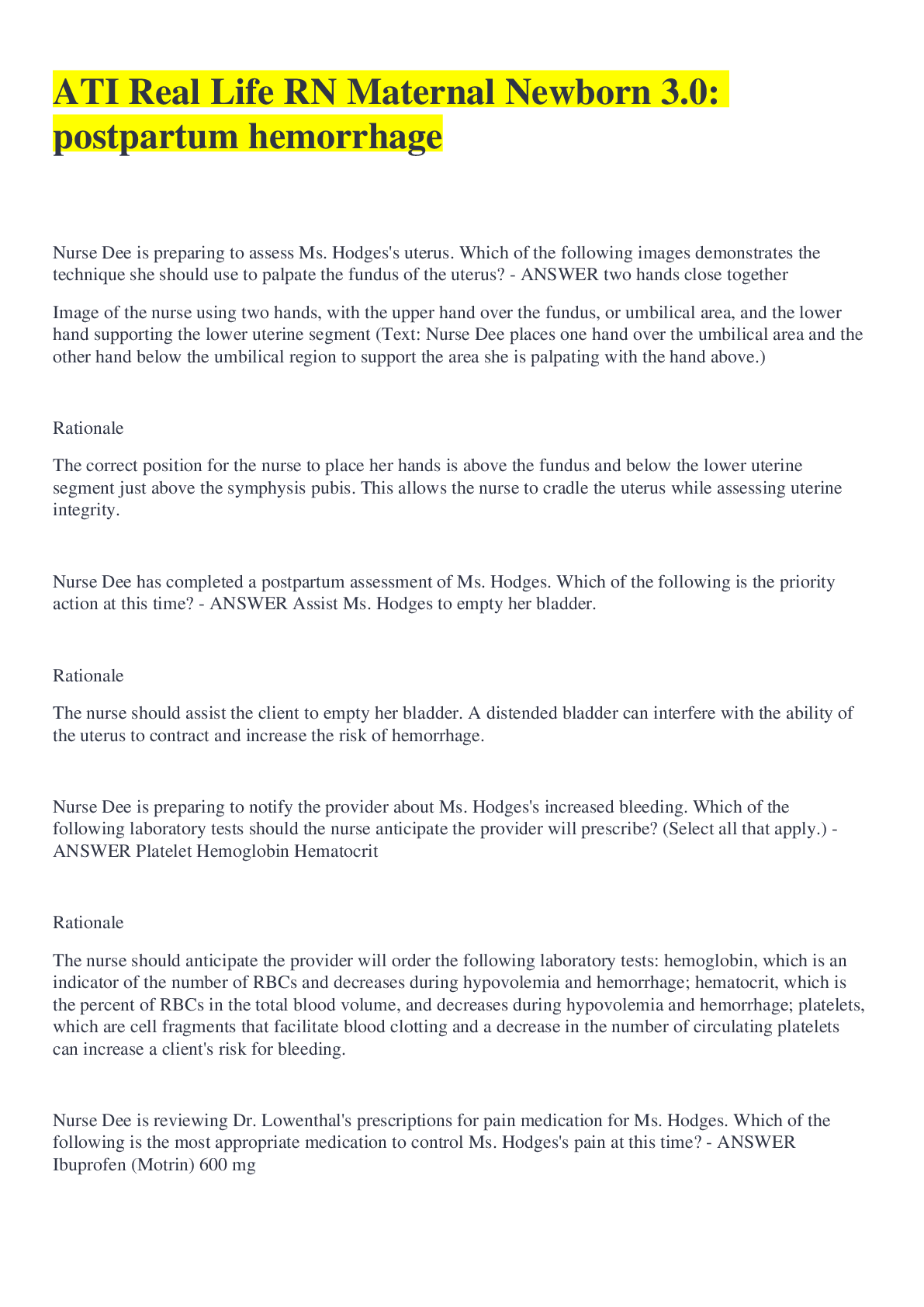
Nurse Dee is preparing to assess Ms. Hodges's uterus. Which of the following images demonstrates the technique she should use to palpate the fundus of the uterus? - ANSWER two hands close together
Image of the nurse usi
...
Nurse Dee is preparing to assess Ms. Hodges's uterus. Which of the following images demonstrates the technique she should use to palpate the fundus of the uterus? - ANSWER two hands close together
Image of the nurse using two hands, with the upper hand over the fundus, or umbilical area, and the lower hand supporting the lower uterine segment (Text: Nurse Dee places one hand over the umbilical area and the other hand below the umbilical region to support the area she is palpating with the hand above.)
Rationale
The correct position for the nurse to place her hands is above the fundus and below the lower uterine segment just above the symphysis pubis. This allows the nurse to cradle the uterus while assessing uterine integrity.
Nurse Dee has completed a postpartum assessment of Ms. Hodges. Which of the following is the priority action at this time? - ANSWER Assist Ms. Hodges to empty her bladder.
Rationale
The nurse should assist the client to empty her bladder. A distended bladder can interfere with the ability of the uterus to contract and increase the risk of hemorrhage.
Nurse Dee is preparing to notify the provider about Ms. Hodges's increased bleeding. Which of the following laboratory tests should the nurse anticipate the provider will prescribe? (Select all that apply.) - ANSWER Platelet Hemoglobin Hematocrit
Rationale
The nurse should anticipate the provider will order the following laboratory tests: hemoglobin, which is an indicator of the number of RBCs and decreases during hypovolemia and hemorrhage; hematocrit, which is the percent of RBCs in the total blood volume, and decreases during hypovolemia and hemorrhage; platelets, which are cell fragments that facilitate blood clotting and a decrease in the number of circulating platelets can increase a client's risk for bleeding.
Nurse Dee is reviewing Dr. Lowenthal's prescriptions for pain medication for Ms. Hodges. Which of the following is the most appropriate medication to control Ms. Hodges's pain at this time? - ANSWER Ibuprofen (Motrin) 600 mg
Rationale
The nurse should give ibuprofen, an NSAID, for mild to moderate pain.
Nurse Dee has completed another assessment of Ms. Hodges. Which of the following is the priority action? - ANSWER Provide firm, continuous fundal massage.
Rationale
The first action the nurse should take is to provide continuous and firm fundal massage. This will stimulate contraction of the uterus and its blood vessels, which will decrease blood loss.
Nurse Dee is estimating the amount of blood Ms. Hodges has lost. Which of the following methods provides the most accurate measurement of the amount of blood lost? - ANSWER Weight of the perineal pads soiled in the past hour
Rationale
The most accurate method for determining the amount of blood lost is to weigh the perineal pads because subjective estimation is inconsistent among nurses. The blood saturation pattern also varies in relation to the type of pad the client uses.
Nurse Dee is preparing to administer carboprost (Hemabate) to Ms. Hodges. Which of the following should Dee report to Dr. Lowenthal prior to administration? - ANSWER Ms. Hodges has a history of asthma.
Rationale
Carboprost should be used with caution for clients who have asthma. It is appropriate to notify the provider because administration of the medication can precipitate an asthma attack.
Nurse Dee is responding to Ms. Hodges's question about her increased bleeding. Which of the following is an appropriate response? - ANSWER "You have increased bleeding because you have chorioamnionitis."
Rationale
Relaxation of the uterus, also called uterine atony, is the most common cause of postpartum hemorrhage. Uterine atony commonly occurs after the birth of a large fetus, prolonged labor, vacuum-assisted birth, and chorioamnionitis, all of which were present in the client.
Nurse Dee is evaluating Ms. Hodges's condition. Which of the following clinical findings is the most concerning at this time? - ANSWER Hematocrit
Rationale
A hematocrit of 23% indicates only 23% of the client's circulating blood volume is made up of RBCs. Using the ABC priority-setting framework, this significant decrease in circulating RBCs will negatively affect tissue perfusion and exchange of blood gases.
Nurse Dee is obtaining consent for surgery from Ms. Hodges. Which of the following is an appropriate action? - ANSWER Verify that Ms. Hodges received enough information to give consent.
Rationale
It is the nurse's responsibility to verify the client received enough information to give consent prior to signing the consent form. If the client has additional questions, the nurse should notify the provider so she can speak with the client again and answer any additional questions.
Nurse Dee is preparing to give Ms. Hodges packed RBCs . Which of the following types of packed RBCs is appropriate? - ANSWER O-
Rationale
O- blood is the universal donor type of blood. The client can receive O- blood in addition to blood that matches her B- type of blood.
Nurse Dee is educating Ms. Hodges about breastfeeding her newborn. Which of the following should Dee include in the teaching? - ANSWER "You should feed him eight to 12 times during each 24-hour period."
Rationale
The nurse should recommend the client breastfeed eight to 12 times in a 24-hr period to promote infant contentment and effective weight gain.
Megan, the lactation specialist, is educating Ms. Hodges on signs of effective breastfeeding. Which of the following statements is appropriate? - ANSWER "He should have six to eight wet diapers per day."
Rationale
This is the expected number of wet diapers an infant should produce in a 24-hr period after the mother's milk has come in.
[Show More]