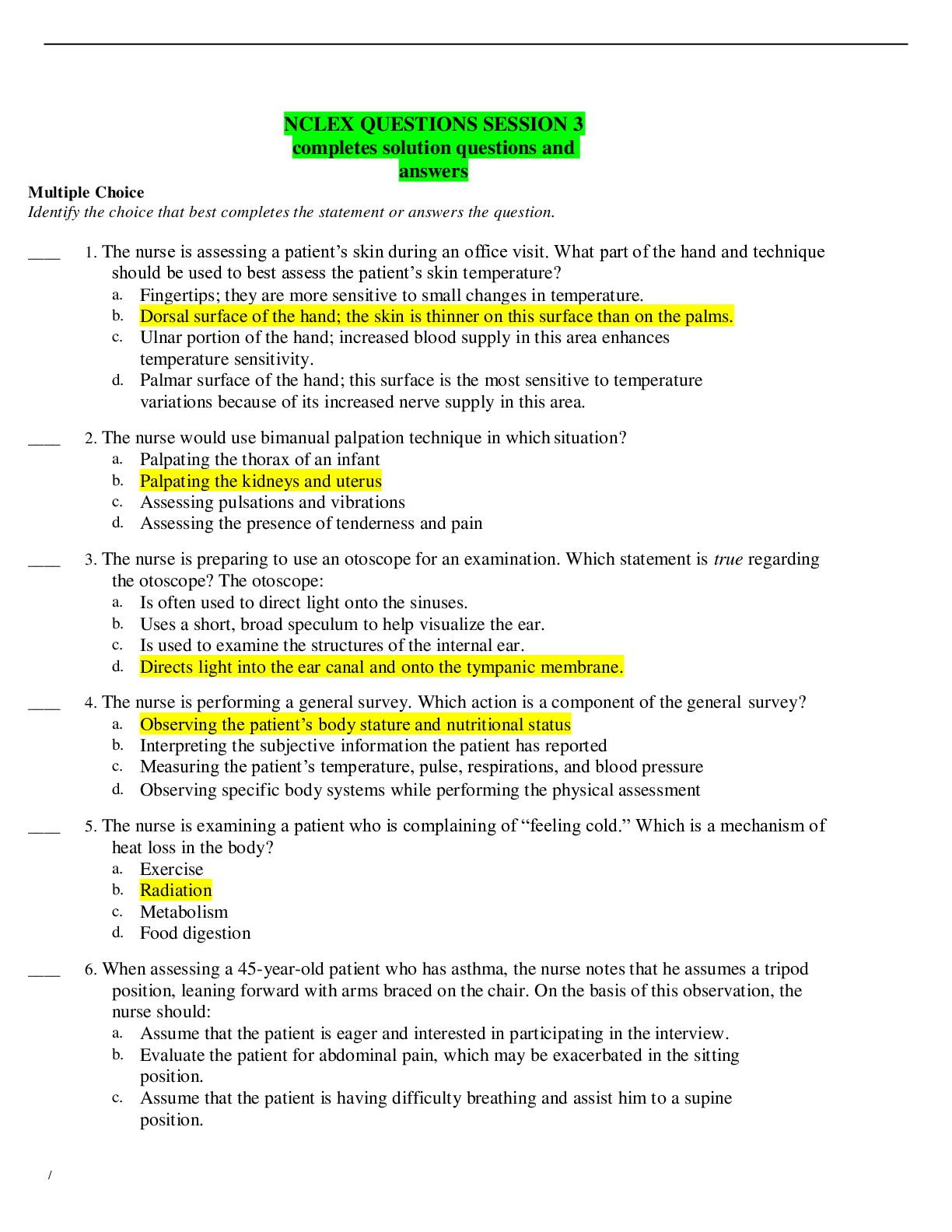
NCLEX QUESTIONS SESSION 3 completes solution questions and answers
Multiple Choice
Identify the choice that best completes the statement or answers the question.
____ 1. The nurse is assessing a patient’s skin dur
...
NCLEX QUESTIONS SESSION 3 completes solution questions and answers
Multiple Choice
Identify the choice that best completes the statement or answers the question.
____ 1. The nurse is assessing a patient’s skin during an office visit. What part of the hand and technique should be used to best assess the patient’s skin temperature?
a. Fingertips; they are more sensitive to small changes in temperature.
b. Dorsal surface of the hand; the skin is thinner on this surface than on the palms.
c. Ulnar portion of the hand; increased blood supply in this area enhances temperature sensitivity.
d. Palmar surface of the hand; this surface is the most sensitive to temperature variations because of its increased nerve supply in this area.
____ 2. The nurse would use bimanual palpation technique in which situation?
a. Palpating the thorax of an infant
b. Palpating the kidneys and uterus
c. Assessing pulsations and vibrations
d. Assessing the presence of tenderness and pain
____ 3. The nurse is preparing to use an otoscope for an examination. Which statement is true regarding the otoscope? The otoscope:
a. Is often used to direct light onto the sinuses.
b. Uses a short, broad speculum to help visualize the ear.
c. Is used to examine the structures of the internal ear.
d. Directs light into the ear canal and onto the tympanic membrane.
____ 4. The nurse is performing a general survey. Which action is a component of the general survey?
a. Observing the patient’s body stature and nutritional status
b. Interpreting the subjective information the patient has reported
c. Measuring the patient’s temperature, pulse, respirations, and blood pressure
d. Observing specific body systems while performing the physical assessment
____ 5. The nurse is examining a patient who is complaining of “feeling cold.” Which is a mechanism of heat loss in the body?
a. Exercise
b. Radiation
c. Metabolism
d. Food digestion
____ 6. When assessing a 45-year-old patient who has asthma, the nurse notes that he assumes a tripod position, leaning forward with arms braced on the chair. On the basis of this observation, the nurse should:
a. Assume that the patient is eager and interested in participating in the interview.
b. Evaluate the patient for abdominal pain, which may be exacerbated in the sitting position.
c. Assume that the patient is having difficulty breathing and assist him to a supine position.
d. Recognize that a tripod position is often used when a patient is having respiratory difficulties.
____ 7. The nurse notices a colleague is preparing to check the blood pressure of a patient who is obese by using a standard-sized blood pressure cuff. The nurse should expect the reading to:
a. Yield a falsely low blood pressure.
b. Yield a falsely high blood pressure.
c. Be the same, regardless of cuff size.
d. Vary as a result of the technique of the person performing the assessment.
____ 8. A student is late for his appointment and has rushed across campus to the health clinic. The nurse should:
a. Allow 5 minutes for him to relax and rest before checking his vital signs.
b. Check the blood pressure in both arms, expecting a difference in the readings because of his recent exercise.
c. Immediately monitor his vital signs on his arrival at the clinic and then 5 minutes later, recording any differences.
d. Check his blood pressure in the supine position, which will provide a more accurate reading and will allow him to relax at the same time.
____ 9. The nurse is performing a general survey of a patient. Which finding is considered normal?
a. When standing, the patient’s base is narrow.
b. The patient appears older than his stated age.
c. Arm span (fingertip to fingertip) is greater than the height.
d. Arm span (fingertip to fingertip) equals the patient’s height.
____ 10. When considering the concepts related to blood pressure, the nurse knows that the concept of mean arterial pressure (MAP) is best described by which statement?
a. MAP is the pressure of the arterial pulse.
b. MAP reflects the stroke volume of the heart.
c. MAP is the pressure forcing blood into the tissues, averaged over the cardiac cycle.
d. MAP is an average of the systolic and diastolic blood pressures and reflects tissue perfusion.
____ 11. A 35-year-old man with a history of hypertension was recently changed to a new antihypertensive drug. He reports feeling dizzy at times. How should the nurse evaluate his blood pressure?
a. Blood pressure and pulse should be recorded in the supine, sitting, and standing positions.
b. The patient should be directed to walk around the room and his blood pressure assessed after this activity.
c. Blood pressure and pulse are assessed at the beginning and at the end of the examination.
d. Blood pressure is taken on the right arm and then 5 minutes later on the left arm.
____ 12. A patient has had arthritic pain in her hips for several years since a hip fracture. She is able to move around in her room and has not offered any complaints so far this morning. However, when asked, she states that her pain is “bad this morning” and rates it at an 8 on a 1-to-10 scale. What does the nurse suspect? The patient:
a. Is addicted to her pain medications and cannot obtain pain relief.
b. Does not want to trouble the nursing staff with her complaints.
c. Is not in pain but rates it high to receive pain medication.
d. Has experienced chronic pain for years and has adapted to it.
____ 13. A patient is asked to indicate on a form how many times he eats a specific food. This method describes which of these tools for obtaining dietary information?
a. Food diary
b. Calorie count
c. 24-hour recall
d. Food-frequency questionnaire
____ 14. The nurse is performing a nutritional assessment on a 25-year-old girl who tells the nurse that she is “so fat.” Assessment reveals that she is 5 feet 4 inches and weighs 110 pounds. The nurse’s appropriate response would be:
a. “How much do you think you should weigh?”
b. “Don’t worry about it; you’re not that overweight.”
c. “The best thing for you would be to go on a diet.”
d. “I used to always think I was fat when I was your age.”
____ 15. In performing an assessment on a 49-year-old woman who has imbalanced nutrition as a result of dysphagia, which data would the nurse expect to find?
a. Increase in hair growth
b. Inadequate nutrient food intake
c. Weight 10% to 20% over ideal
d. Sore, inflamed buccal cavity
____ 16. A 21-year-old woman has been on a low-protein liquid diet for the past 2 months. She has had adequate intake of calories and appears well nourished. After further assessment, what would the nurse expect to find?
a. Poor skin turgor
b. Decreased serum albumin
c. Increased lymphocyte count
d. Triceps skinfold less than standard
____ 17. When performing a physical assessment, the first technique the nurse will always use is:
a. Palpation.
b. Inspection.
c. Percussion.
d. Auscultation.
____ 18. The nurse is preparing to assess a patient’s abdomen by palpation. How should the nurse proceed?
a. Palpation of reportedly “tender” areas are avoided because palpation in these areas may cause pain.
b. Palpating a tender area is quickly performed to avoid any discomfort that the patient may experience.
c. The assessment begins with deep palpation, while encouraging the patient to relax and to take deep breaths.
d. The assessment begins with light palpation to detect surface characteristics and to accustom the patient to being touched.
____ 19. The nurse is preparing to percuss the abdomen of a patient. The purpose of the percussion is to assess the of the underlying tissue.
a. Turgor
b. Texture
c. Density
d. Consistency
____ 20. The nurse is reviewing percussion techniques with a newly graduated nurse. Which technique, if used by the new nurse, indicates that more review is needed?
a. Percussing once over each area
b. Quickly lifting the striking finger after each stroke
c. Striking with the fingertip, not the finger pad
d. Using the wrist to make the strikes, not the arm
[Show More]


 answers.png)


