Student Name: BIO202L
Access Code (located on the lid of your lab kit): AC-JBM7Q58
Pre-Lab Questions
1. What is the function of the ureter?
2. Compare and contrast the male and female urethra.
3. Describe the tw
...
Student Name: BIO202L
Access Code (located on the lid of your lab kit): AC-JBM7Q58
Pre-Lab Questions
1. What is the function of the ureter?
2. Compare and contrast the male and female urethra.
3. Describe the two layers of the kidneys.
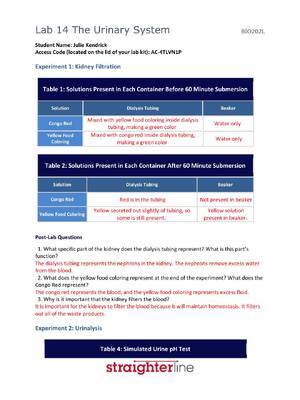
Experiment 1: Kidney Filtration
Table 1: Solutions Present in Each Container Before 60 Minutes Submersion
Solution Dialysis Tubing Beaker
Congo Red
Yellow Food Coloring
Table 2: Solutions Present in Each Container After 60 Minutes Submersion
Solution Dialysis Tubing Beaker
Congo Red
Yellow Food Coloring
Post-Lab Questions
Lab 14 The Urinary System BIO202L
”1. What specific part of the kidney does the dialysis tubing represent? What is this part’s
function?”
”2. What does the yellow food coloring represent at the end of the experiment? What does the
Congo Red represent? ”
”3. Why is it important that the kidney filters the blood? ”
Experiment 2: Urinalysis
Table 3: Urine Test
Test Normal Abnormal
pH 4.5 - 7.5 Acidic Urine (below 4.5) - Diabetes, starvation, dehydration,
respiratory acidosis.
Alkaline Urine (above 7.5) - Kidney disease, kidney failure, urinary
tract infection, respiratory alkalosis.
Glucose None
Protein None
Yeast None
Ketones Little or
None
Table 4: Simulated Urine pH Test
Simulated Urine Sample pH
A
B
C
Lab 14 The Urinary System BIO202L
D 8
Table 5: Simulated Urine Glucose Test
Simulated Urine Sample Color Before Hot Water Bath Color After Hot Water Bath
A green green
B green red
C green yellow
D green green
Table 6: Simulated Urine Protein Test
Simulated Urine Sample Color Before Biuret Solution Color After Biuret Solution
A
B
C
D
Table 7: Simulated Urine Yeast Test
Simulated Urine Sample Bubbles Before Hydrogen
Peroxide? Bubbles After Hydrogen
Peroxide?
A
B
C
D
Lab 14 The Urinary System BIO202L
Table 8: Simulated Urine Ketone Test
Simulated Urine Sample Odor Observation
A no smell
B no smell
C very strong smell
D no smell
Fill in Tables 9 through 12. Refer to Table 3 to determine if each result was normal or abnormal.
If abnormal, include the data which indicates this (e.g., a pH of 3.2 means that glucose is
present). Using the test results from each of the urine samples, diagnose the condition(s), if
any, that each of the sample patients is experiencing. ”
Table 9: Sample A
Test Test Results
pH
Glucose
Protein
Yeast
Ketones
Lab 14 The Urinary System BIO202L
Table 10: Sample B
Test Test Results
pH 4, acidic urine, diabetes, starvation, dehydration, respiratory
acidosis
Glucose red, glucose present, diabetes
Protein normal
Yeast normal
Ketones normal
Table 11: Sample C
Test Test Results
pH
Glucose
Protein
Yeast
Ketones
Table 12: Sample D
Test Test Results
pH
Glucose
Protein
Yeast
Ketones
Lab 14 The Urinary System BIO202L
Post-Lab Questions
”1. Using the results from each urine sample, along with Table 3, diagnose the condition(s), if
any, that each sample patient is experiencing.
Table 9 Diagnosis: k
Table 10 Diagnosis:
Table 11 Diagnosis:
Table 12 Diagnosis:
2. If you were a doctor and a patient’s urinalysis came back with high levels of glucose, ketones
and an acidic pH, what diagnosis would you immediately look into? ”
”3. If you were a doctor and a patient’s urinalysis came back with an alkaline pH and high levels
of protein, what diagnosis would you immediately look into? ”
”4. What other conditions can urine be used to test for? ”
Experiment 3: Virtual Model – The Urinary System
Insert screenshot of the prostate:
Insert screenshot of the renal medulla:
Insert screenshot of the renal pelvis:
Post-Lab Questions
1. Which component of the urinary system is more lateral: the left kidney or the urinary bladder?
left kidney
2. Which component of the urinary system is a funnel shaped cavity formed by the union of
calices, ending in the ureter.
Renal Pelvis
3. What is the most superior component of the urinary system?
Kidneys
4. Where is the prostatic sinus in relation to the prostate?
The prostatic sinus is medial to the prostate.
Experiment 4: Fetal Pig Dissection of the Urinary System
1. Identify the labeled components of the kidney in the image below.
B - calyx
C - cortex
D - renal artery
E - renal vein
F -ureter
2. What is the function of the urinary bladder?
4. Would you think the kidneys are highly vascularized? Why or why not?
5. Explain in detail the process by which urine is made.
Insert photo of your pig’s dissected kidney with your name clearly visible in the background: ”
Lab 14 The Urinary System BIO202L
[Show More]