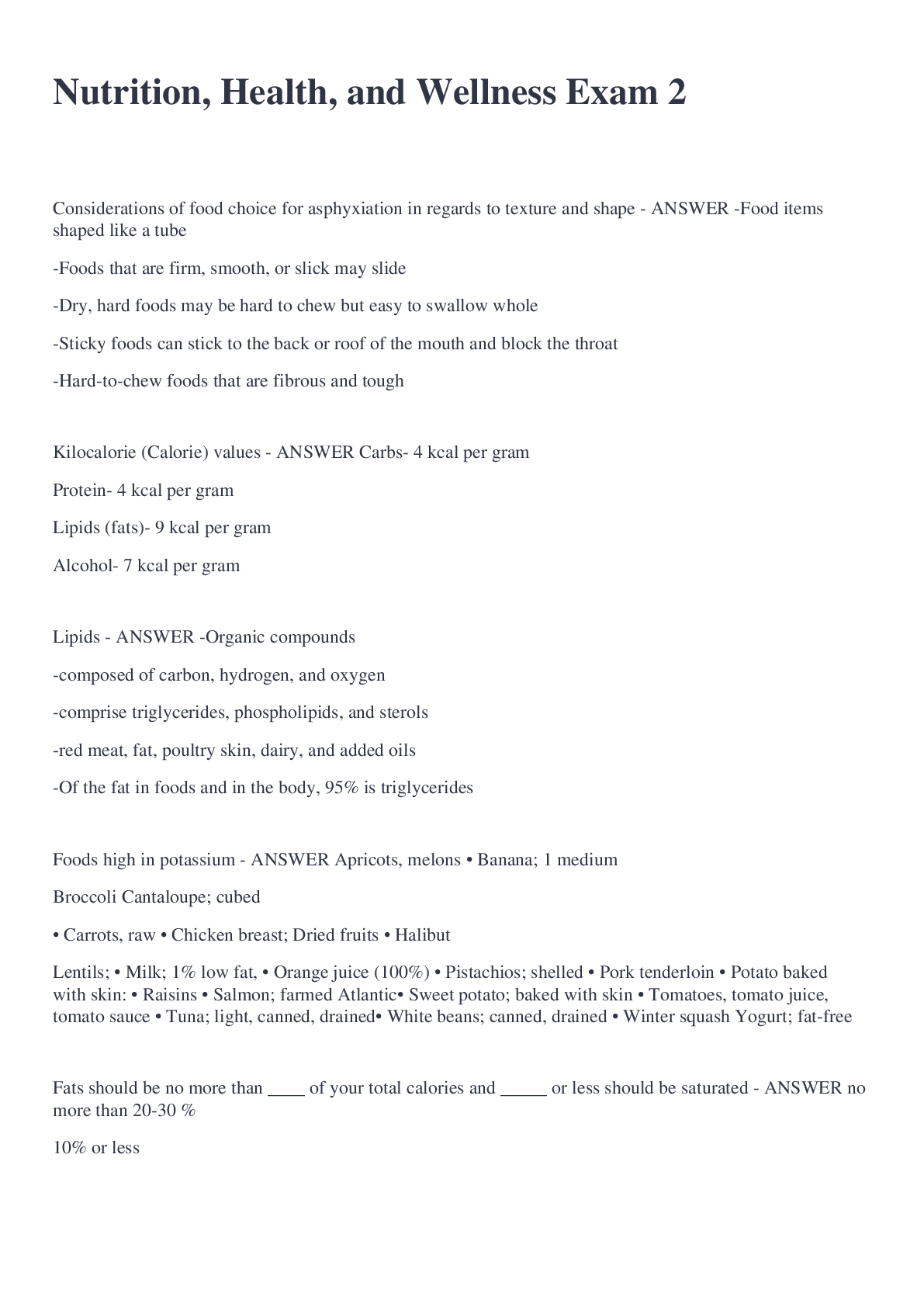
Considerations of food choice for asphyxiation in regards to texture and shape - ANSWER -Food items shaped like a tube
-Foods that are firm, smooth, or slick may slide
-Dry, hard foods may be hard to chew but easy to s
...
Considerations of food choice for asphyxiation in regards to texture and shape - ANSWER -Food items shaped like a tube
-Foods that are firm, smooth, or slick may slide
-Dry, hard foods may be hard to chew but easy to swallow whole
-Sticky foods can stick to the back or roof of the mouth and block the throat
-Hard-to-chew foods that are fibrous and tough
Kilocalorie (Calorie) values - ANSWER Carbs- 4 kcal per gram
Protein- 4 kcal per gram
Lipids (fats)- 9 kcal per gram
Alcohol- 7 kcal per gram
Lipids - ANSWER -Organic compounds
-composed of carbon, hydrogen, and oxygen
-comprise triglycerides, phospholipids, and sterols
-red meat, fat, poultry skin, dairy, and added oils
-Of the fat in foods and in the body, 95% is triglycerides
Foods high in potassium - ANSWER Apricots, melons • Banana; 1 medium
Broccoli Cantaloupe; cubed
• Carrots, raw • Chicken breast; Dried fruits • Halibut
Lentils; • Milk; 1% low fat, • Orange juice (100%) • Pistachios; shelled • Pork tenderloin • Potato baked with skin: • Raisins • Salmon; farmed Atlantic• Sweet potato; baked with skin • Tomatoes, tomato juice, tomato sauce • Tuna; light, canned, drained• White beans; canned, drained • Winter squash Yogurt; fat-free
Fats should be no more than ____ of your total calories and _____ or less should be saturated - ANSWER no more than 20-30 %
10% or less
Polyunsaturated fats - ANSWER Sources: Vegetable oils (corn, safflower, wheat germ, canola, sesame, and sunflower) fish, and margarine
-omega 3- fatty acids
-Omega 6 fatty acids
Unsaturated fats - ANSWER liquid at room temperature
-Contains one or more double bonds
Monounsaturated fats include - ANSWER Primary sources include olive oil, peanuts (peanuts and peanut oil, avocado, and canola oil)
**oleic acid is main MUFA in foods
Saturated fats - ANSWER -originate from animal sources and are solid at room temp
-Heavier denser and more solid than unsaturated fats
-very high melting point and they're less likely to go bad
-meats, cheese, and eggs
Celiac disease - ANSWER chronic autoimmune disorder in which mucosa of small intestine esp. duodenum and proximal jejunum is damaged by dietary gluten
S/S of celiac disease - ANSWER -diarrhea, abdominal distention, fat malabsorption, and weight loss
- if untreated anemia, osteoporosis, infertility or lymphoma
-some pts are asymptomatic
-Mild- steatorrhea
Severe cases- digestions and absorption of proteins, fats, carbohydrates, and other nutrients are impaired
Pts with celiac disease are able to eat what types of grains - ANSWER Rice, Corn
Amaranth, Quinoa
Teff (or Tef), Millet Finger millet (ragi)
Sorghum, Indian rice grass (Montina)
Arrowroot, Buckwheat
Flax, Job's tears
Sago, Potato, Soy
Legumes, Mesquite, Tapioca
Wild rice, Cassava (Manloc)
Yucca, Nuts, Seeds
What grains are celiac disease patients told to avoid? - ANSWER Wheat, all varieties, including:
•Einkorn • Emmer • Spelt • Kamut • Wheat bran • Wheat germ • Cracked wheat • Hydrolyzed wheat protein
Barley
Rye
Cross-bread varieties such as triticale (cross between wheat and rye)
Processed food that may contain wheat, barley, or rye that celiac disease pts should try and avoid - ANSWER Bouillon cubes
Brown rice syrup
Candy
Cold cuts Communion wafers*
French fries
Gravy
Hot dogs
Imitation fish
Licorice
Matzoh
Rice mixes
Salami
Sauces
Sausage
Seasoned snack foods (e.g., tortilla chips, potato chips)
Seitan S
elf-basting turkey
Soups
Soy sauce
Vegetables in sauce
What are the specific storage proteins known as gluten that trigger a toxic reaction in predisposed individuals? - ANSWER The gliadin fraction in wheat, secalin in rye, and hordein in barley
Prebiotics - ANSWER special form of dietary fiber that acts as a fertilizer for healthy gut bacteria
-EX: raw asparagus or onions and garlic, jicama, Jerusalem artichokes, honey, slightly unripe bananas, and raw dandelion greens
Probiotics - ANSWER Live bacteria found in yogurt, kefir, aged cheese, kimchi, miso soup, sauerkraut, tempeh, and sweet acidophilus milk
Physiologic functions of triglycerides - ANSWER - Stored energy
- Adipose tissue storage form of fat (mainly triglycerides)
- Important source of fuel during illness and food restriction, and major energy source for muscle work
- Organ protection
- Temperature regulator
- Insulation
Functions of phospholipids - ANSWER -cell membrane structure
-lecithin, main phospholipid, part of lipoproteins
Functions of sterols - ANSWER -precursors to bile, vitamin D, sex hormones, cells in brain and central nervous system
-cholesterol part of cell membranes, nerve tissue, and hormones
-liver synthesizes cholesterol to produce bile
What is an example of a sterol? - ANSWER cholesterol
-contained only in animal-derived foods
Dietary cholesterol is ______ of the body's cholesterol, where does the rest come from? - ANSWER 25%
The rest is provided by liver synthesis
Triglycerides - ANSWER Largest class of lipids in body and foods
Composed of glycerol and three fatty acids
Fatty acids:
•Saturated fatty acids
•Monounsaturated fatty acids
•Polyunsaturated fatty acids
Triglycerides provide food functions of.. - ANSWER energy, palatability, satiety, food processing, and source of nutrients
Where can natural antioxidants be found? - ANSWER Vitamin C (Spinach, broccoli, papaya, strawberry, tomato, oranges)
and
Vitamin E (Spinach, broccoli, asparagus, almonds, avocados, pumpkin, sunflower seeds, dried apricots, papaya)
Essential fatty acids - ANSWER Made up from broken down fats and have to be supplied through diet because our body can not make
Which oils have more than 50% fat? - ANSWER Canola oil
Safflower oil
Sunflower oil
Corn oil
Olive oil
Soybean oik
Peanut oil
Margarine
Vegetable shortening
Palm kernel oil
Coconut oil
Palm oil
Lard
Beef fat
Butter fat
Phospholipids - ANSWER Lipid compounds that form parts of cell walls and act as fat emulsifiers
-Body manufactures phospholipids; therefore, they are not essential nutrients.
•Lecithin, the main body phospholipid, functions as an emulsifier.
What is cholesterol vital for? - ANSWER -Vital component of bile salts and helps in digestion
-Vital to vitamin D, sex hormones, cells in brain, and central nervous system
Provided only in animal dried foods
-dont really need to take it in with the food we eat
Dietary cholesterol should be limited to ________ mg/day - ANSWER 200-300 mg
Steps of digestion of fats in the body - ANSWER •Mouth
➢Primary fat digestive process is mechanical, as teeth masticate fatty food.
➢Glands of tongue produce fat-splitting enzyme (lingual lipase), released with saliva.
•Stomach
➢Mechanical digestion continues through peristalsis.
➢Fat-splitting enzymes such as gastric lipase, hydrolyze fatty acids from triglycerides.
•Small intestine
➢Duodenum releases hormone cholecystokinin (CCK).
•CCK action causes gallbladder to release bile into small intestine.
➢Muscular action continues digestion.
➢Pancreatic enzyme, lipase, breaks down triglycerides.
➢Some fats may pass through undigested and are excreted.
_______ assist movement of lipids to the villi during absorption - ANSWER Bile salts
What are some general fat functions besides flavor and filling? - ANSWER 1. Fuel
2. Vitamin absorption
3. Contain/transport fat soluble vitamins (A,D,E,K)
4. Supplies or transport essential faty acids
5. Support and protection
6. Temp regulation
7. Lubrication
How does fat help with lubrication of our body? - ANSWER lubricates and makes oil in our sebaceous glands, which then lubricates our skin, decreasing water loss from the outside environment
4 types of lipoproteins - ANSWER chylomicrons, VLDL, LDL, HDL
LDL (low density lipoprotein) - ANSWER Major source of cholesterol
-transports cholesterol from the liver to the tissues
-leading to atherosclerosis
HDLs (high density lipoproteins) - ANSWER good cholesterol
-goes from the tissue to the liver to be recycled
-higher HDL decreases risk of atherosclerosis
Where does the major portion of lipid metabolism occur? - ANSWER Small intestine
Pancreatic lipase - ANSWER breaks down fats
How are lipoproteins formed? - ANSWER By fats combining with plasma proteins
True or false: if it's solid, when you start and you melt it and then you eat it, it becomes solid again inside of you - ANSWER True
Is cholesterol digested? - ANSWER No, its absorbed
Fat soluble vitamin transport becomes protective adipose tissue to... - ANSWER protect internal organs
[Show More]