Active Inquiry - ANSWER The process of developing a strong research agenda driven by the writer's interests, the need to solve real-world problems or controversies, and the needs of stakeholders with differing background
...
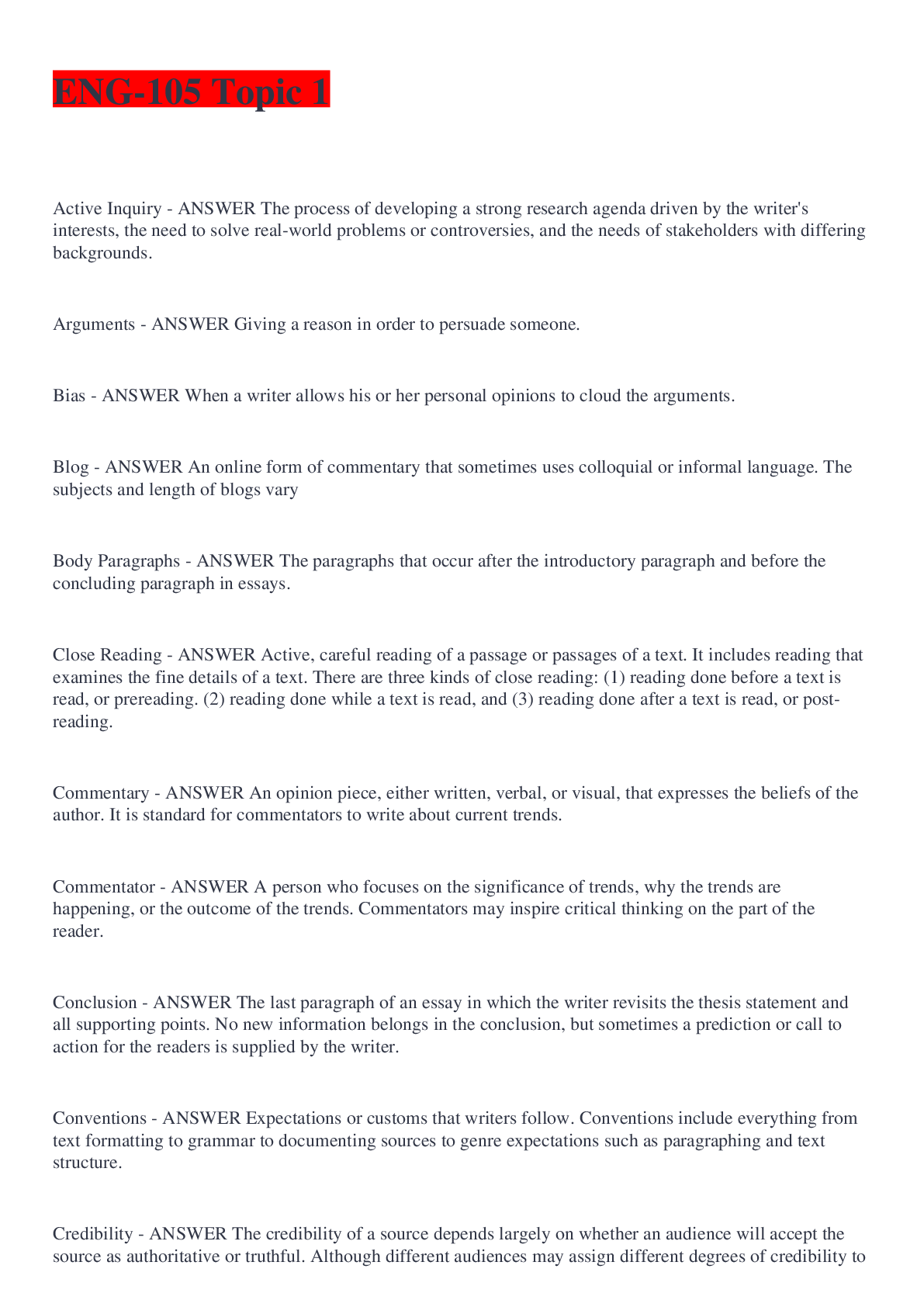
Active Inquiry - ANSWER The process of developing a strong research agenda driven by the writer's interests, the need to solve real-world problems or controversies, and the needs of stakeholders with differing backgrounds.
Arguments - ANSWER Giving a reason in order to persuade someone.
Bias - ANSWER When a writer allows his or her personal opinions to cloud the arguments.
Blog - ANSWER An online form of commentary that sometimes uses colloquial or informal language. The subjects and length of blogs vary
Body Paragraphs - ANSWER The paragraphs that occur after the introductory paragraph and before the concluding paragraph in essays.
Close Reading - ANSWER Active, careful reading of a passage or passages of a text. It includes reading that examines the fine details of a text. There are three kinds of close reading: (1) reading done before a text is read, or prereading. (2) reading done while a text is read, and (3) reading done after a text is read, or post-reading.
Commentary - ANSWER An opinion piece, either written, verbal, or visual, that expresses the beliefs of the author. It is standard for commentators to write about current trends.
Commentator - ANSWER A person who focuses on the significance of trends, why the trends are happening, or the outcome of the trends. Commentators may inspire critical thinking on the part of the reader.
Conclusion - ANSWER The last paragraph of an essay in which the writer revisits the thesis statement and all supporting points. No new information belongs in the conclusion, but sometimes a prediction or call to action for the readers is supplied by the writer.
Conventions - ANSWER Expectations or customs that writers follow. Conventions include everything from text formatting to grammar to documenting sources to genre expectations such as paragraphing and text structure.
Credibility - ANSWER The credibility of a source depends largely on whether an audience will accept the source as authoritative or truthful. Although different audiences may assign different degrees of credibility to the same source, sources typically achieve credibility through the expertise or political views of their authors, their perceived amount of bias, and heir use of acceptable evidence.
Criterion - ANSWER (plural: criteria) A standard upon which a judgement may be decided. Criteria assist in evaluations by giving the viewer guidelines by which to determine if the material is of value.
Deliberative Rhetoric - ANSWER Speech take place in a public assembly. The speaker advises the audience or warms them against an idea or practice. The audience is asked to decide whether something will be good or bad for the public.
Delivery (actio) - ANSWER Utilizing appropriate voice, tone, and gestures to communicate ideas.
Dialectic - ANSWER The strategies of argumentation used by a speaker to resolve conflict and establish truth.
Editing - ANSWER The act reading written material that has been revised and correcting conventions related to grammar and mechanics.
Editorial - ANSWER An opinion piece written by a commentator affiliated with the periodical that publishes the commentary.
Editorial Column - ANSWER A form of commentary authored by a professional writer whose opinion piece is featured in a newspaper or magazine on a regular basis.
Epideictic Rhetoric - ANSWER Speeches that praise or blame someone by describing their actions as shameful or commendable. This can take place at a celebration, commemoration/ceremony, or funeral.
Ethos - ANSWER An appeal to the credibility or character of the speaker or writer.
Evaluation - ANSWER The process of making a judgment or assessment about the value of a document or website using clearly defined and explained criteria along with evidence from the text.
Examples - ANSWER Giving a statement or story that helps to explain and/or support a point.
Exigence - ANSWER From the Latin word for "demand"; refers to the issue that gives rise to persuasive speech or writing.
Expert Opinions - ANSWER Professional with experience and/or degrees in their field who have conducted research and published that research with results that can be used as support in argumentative writing.
Explicit Thesis Stament - ANSWER A type of thesis statement that is clearly expressed in a single sentence.
Fad - ANSWER A craze that is superficial in nature and dies out quickly or transforms into some other whim.
First-Person Pronouns - ANSWER I, we, me, my, mine, our, and ours.
Five Canons - ANSWER Steps, which include invention, organization, style, memory, and delivery, that create effective persuasive speeches and writings.
Framing - ANSWER A word, phrase, or clause mentioned in the introduction that is reinforced in the body of the essay and revisited in the conclusion.
Free writing - ANSWER An invention strategy that involves nonstop writing about a topic for a set period of time. It is helpful to avoid editing ideas and thoughts or fixating on grammar and punctuation. Simply jot down any words, ideas, or phrases that come to mind about the topic.
GCU Style - ANSWER A graduated style developed by the University in order to help acclimate students in lower-division courses to the basics of APA formatting.
Generalization - ANSWER When a writer directly or indirectly states a claim that implies that everyone in that category falls that claim.
Genre - ANSWER A type or category of a text. For example, a persuasive assay is one genre of writing, and a rhetorical analysis is a different genre of writing. Every genre of writing has specific qualities and expectations. Writers should understand a genre's qualities in order to compose an effective text.
Genre Awareness - ANSWER Understanding that there are categories or types of artistic products, such as writing, painting, sculpting, dancing, and singing, that are used to express thought and feeling. Recognizing these different forms of expression opens doors for analyzing and understanding.
Grammar - ANSWER Includes writing details related to English rules such as spelling, verb tenses, fragments, and run-ons.
Hook - ANSWER Usually the first sentence or two in an essay that serves to catch or hook the reader's attention.
Sentence - ANSWER A type of sentence that asks or tells the reader what to do; it usually begins with a verb located at the beginning or very near the beginning of a sentence.
Implicit - ANSWER A type of thesis statement that is implied rather than expressly stated.
In-Text Citation - ANSWER The inclusion of borrowed material within the body of a text. In-text citations typically include a "head," "body," and "tail" to introduce the source, provide a quote or paraphrase, and follow up with additional information (such as page number or paragraph numbers).
Introduction - ANSWER The first paragraph of an essay. It serves as a bridge to help the reader enter into the essay and understand a bit of background or history
[Show More]

 Block 1 to 7.png)



.png)

.png)