Finance  >  EXAM  >  FIN 504 Midterm-Final With complete solutions (All)

FIN 504 Midterm-Final With complete solutions

Document Content and Description Below

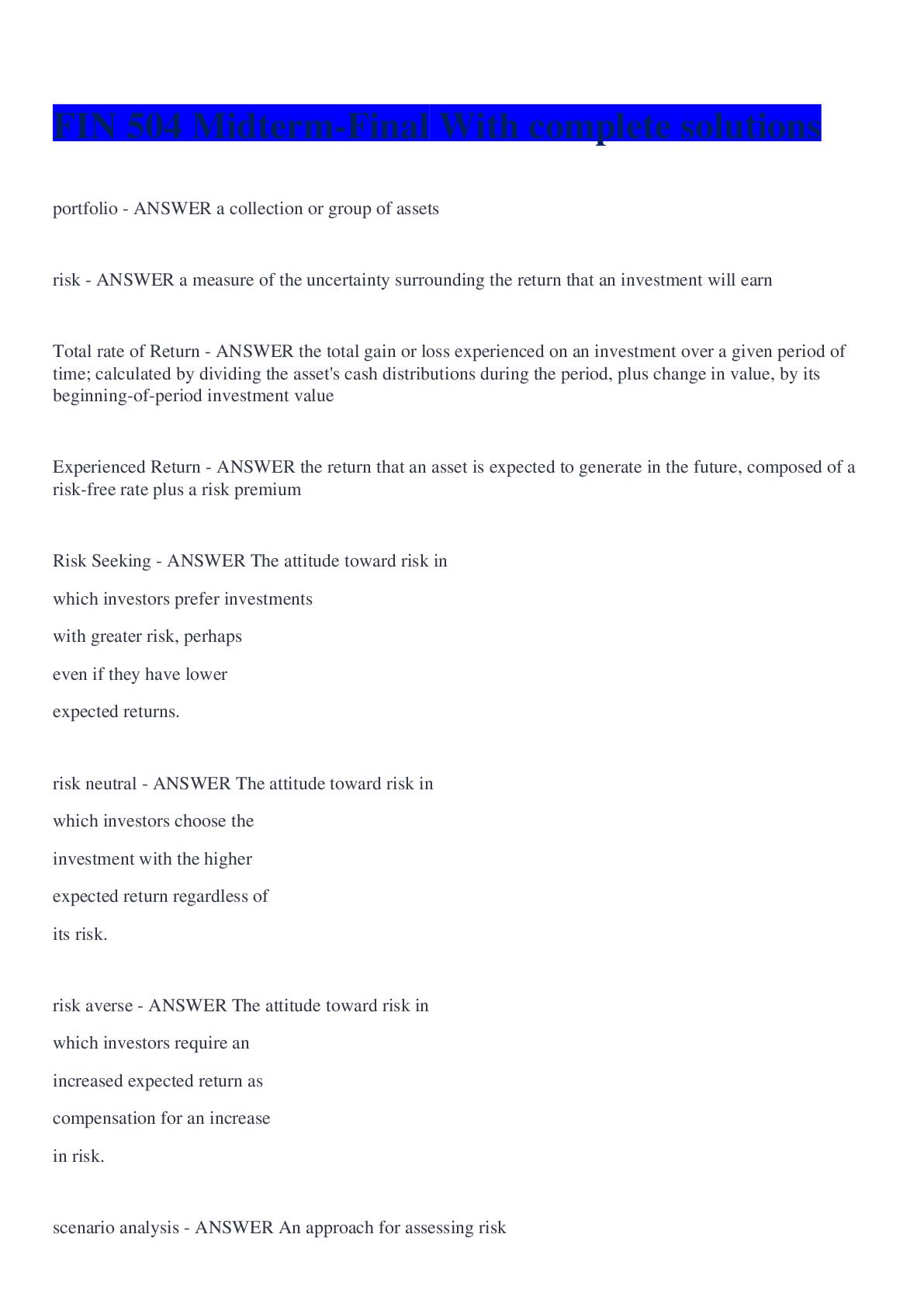
portfolio - ANSWER a collection or group of assets risk - ANSWER a measure of the uncertainty surrounding the return that an investment will earn Total rate of Return - ANSWER the total gain or ... loss experienced on an investment over a given period of time; calculated by dividing the asset's cash distributions during the period, plus change in value, by its beginning-of-period investment value Experienced Return - ANSWER the return that an asset is expected to generate in the future, composed of a risk-free rate plus a risk premium Risk Seeking - ANSWER The attitude toward risk in which investors prefer investments with greater risk, perhaps even if they have lower expected returns. risk neutral - ANSWER The attitude toward risk in which investors choose the investment with the higher expected return regardless of its risk. risk averse - ANSWER The attitude toward risk in which investors require an increased expected return as compensation for an increase in risk. scenario analysis - ANSWER An approach for assessing risk that uses several possible alternative outcomes (scenarios) to obtain a sense of the variability among returns. Range - ANSWER A measure of an asset's risk, which is found by subtracting the return associated with the pessimistic (worst) outcome from the return associated with the optimistic (best) outcome. probability distribution - ANSWER A model that relates probabilities to the associated outcomes. bar chart - ANSWER The simplest type of probability distribution; shows only a limited number of outcomes and associated probabilities for a given event. continuous probability distribution - ANSWER A probability distribution showing all the possible outcomes and associated probabilities for a given event. standard deviation (S) - ANSWER The most common statistical indicator of an asset's risk; it measures the dispersion around the average. normal probability distribution - ANSWER A symmetrical probability distribution whose shape resembles a "bell-shaped" curve. coefficient of variation (CV) - ANSWER A measure of relative dispersion that is useful in comparing the risks of assets with differing expected returns. efficient portfolio - ANSWER A portfolio that maximizes return for a given level of risk. correlation - ANSWER A statistical measure of the relationship between any two series of numbers. positively correlated - ANSWER Describes two series that move in the same direction. negatively correlated - ANSWER Describes two series that move in opposite directions. correlation coefficient - ANSWER A measure of the degree of correlation between two series. perfectly positively correlated - ANSWER Describes two positively correlated series that have a correlation coefficient of +1. perfectly negatively correlated - ANSWER Describes two negatively correlated series that have a correlation coefficient of -1. uncorrelated - ANSWER Describes two series that lack any interaction and therefore have a correlation coefficient of zero. political risk - ANSWER Risk that arises from the possibility that a host government will take actions harmful to foreign investors or that political turmoil will endanger investments. capital asset pricing model (CAPM) - ANSWER The classic theory that links risk and return for all assets. total risk - ANSWER The combination of a security's nondiversifiable risk and diversifiable risk. diversifiable risk - ANSWER The portion of an asset's risk that is attributable to firmspecific, random causes; can be eliminated through diversification. Also called unsystematic risk. nondiversifiable risk - ANSWER The relevant portion of an asset's risk attributable to market factors that affect all firms; cannot be eliminated through diversification. Also called systematic risk. beta coefficient (B) - ANSWER A relative measure of nondiversifiable risk. An index of the degree of movement of an asset's return in response to a change in the market return. market return - ANSWER The return on the market portfolio of all traded securities. risk-free rate of return (RF) - ANSWER The required return on a risk free asset, typically a 3-month U.S. Treasury bill. U.S. Treasury bills (T-bills) - ANSWER Short-term IOUs issued by the U.S. Treasury; considered the risk-free asset. security market line (SML) - ANSWER The depiction of the capital asset pricing model (CAPM) as a graph that reflects the required return in the marketplace for each level of nondiversifiable risk (beta). Cost of Capital - ANSWER Represents the firm's cost of financing and is the minimum rate of return that a project must earn to increase the firm's value. Capital - ANSWER A firm's long-term sources of financing, which include both debt and equity. Capital Structure - ANSWER The mix of debt and equity financing that a firm employs. weighted average cost of capital (WACC) - ANSWER A weighted average of a firm's cost of debt and equity financing, where the weights reflect the percentage of each type of financing used by the firm. cost of long-term debt - ANSWER The financing cost associated with new funds raised through long-term borrowing. Net Proceeds - ANSWER Funds actually received by the firm from the sale of a security Flotation Costs - ANSWER The total costs of issuing and selling a security. cost of preferred stock, rpcost of preferred stock, rp - ANSWER The ratio of the preferred stock dividend to the firm's net proceeds from the sale of preferred stock. cost of common stock equity - ANSWER The costs associated with using common stock equity financing. The cost of common stock equity is equal to the required return on the firm's common stock in the absence of flotation costs. Thus, the cost of common stock equity is the same as the cost of retained earnings, but the cost of issuing new common equity is higher. constant-growth valuation (Gordon growth) model - ANSWER A model that calculates the value of common stock as the present value of an infinite dividend stream that grows at a constant rate. capital asset pricing model (CAPM) - ANSWER Describes the relationship between the required return, rs, and the nondiversifiable risk of the firm as measured by the beta coefficient, b. cost of a new issue of common stock, rn - ANSWER The cost of common stock, net of underpricing and associated flotation costs. cost of retained earnings, rr - ANSWER The cost of using retained earnings as a financing source. The cost of retained earnings is equal to the required return on a firm's common stock, rs. Market Value Weights - ANSWER Weights that use market values to measure the proportion of each type of capital in the firm's financial structure. target capital structure - ANSWER The mix of debt and equity financing that a firm desires over the long term. The target capital structure should reflect the optimal mix of debt and equity for a particular firm. [Show More]

Last updated: 3 years ago

Preview 1 out of 8 pages

Buy Now

Instant download

We Accept:

Payment methods accepted on Scholarfriends (We Accept)
Preview image of FIN 504 Midterm-Final With complete solutions document

Buy this document to get the full access instantly

Instant Download Access after purchase

Buy Now

Instant download

We Accept:

Payment methods accepted on Scholarfriends (We Accept)

Reviews( 0 )

$7.00

Buy Now

We Accept:

Payment methods accepted on Scholarfriends (We Accept)

Instant download

Can't find what you want? Try our AI powered Search

51
0

Document information


Connected school, study & course


About the document


Uploaded On

Aug 20, 2022

Number of pages

8

Written in

All

Seller


Profile illustration for MARKALLAN
MARKALLAN

Member since 3 years

58 Documents Sold

Reviews Received
5
2
0
0
1
Additional information

This document has been written for:

Uploaded

Aug 20, 2022

Downloads

 0

Views

 51

Document Keyword Tags

Recommended For You

Get more on EXAM »
$7.00
What is Scholarfriends

Scholarfriends.com Online Platform by Browsegrades Inc. 651N South Broad St, Middletown DE. United States.

We are here to help

We're available through e-mail, Twitter, and live chat.
 FAQ
 Questions? Leave a message!


Copyright © Scholarfriends · High quality services·