Mood Disorders: Depression-Chapter 15- solved 100% -fall 2022/2023
Document Content and Description Below
A patient became severely depressed when the last of the family's six children moved out of the home 4 months ago. The patient repeatedly says, "No one cares about me. I'm not worth anything." Which response by the nurse
...
[Show More]
Last updated: 4 years ago
Preview 1 out of 15 pages
Instant download

Buy this Document to get the Full Access Instantly
Provided by Students Who Aced it
We Verify Document Content to Gurantee Accuracy
Reviews( 0 )
Document information
Connected school, study & course
About the document
Uploaded On
Aug 20, 2022
Number of pages
15
Written in
All

Additional information
This document has been written for:
Uploaded
Aug 20, 2022
Downloads
0
Views
89
Topic Tags
Recommended For You
Get more on EXAM »
$11
925 Pages
Test Bank for Fundamentals of Nursing 10th Edition Potter Perr...
$12.5
6 Pages
BIOS 105 Chapter 15 Questions and Answers (Verified Answers)

$22
586 Pages
Test Bank for Fundamentals of Nursing 11th Edition Potter Perr...
$15
522 Pages
College Physics 11th Edition (Volume 2) By Raymond Serway Chri...
$18.5
587 Pages
Test Bank For Fundamentals of Nursing 11th Edition Potter Perr...
.png)
$11
29 Pages
University of Melbourne FNCE 30002 Chapter 15 - Testbank ( WIT...
$12.5
74 Pages
CMS - Certified Sommelier Exam / WSET Advanced Exam 2024/25 So...
$1
15 Pages
PSI Life Insurance Exam Questions And Answers - Solved 100% 2...
$6
10 Pages
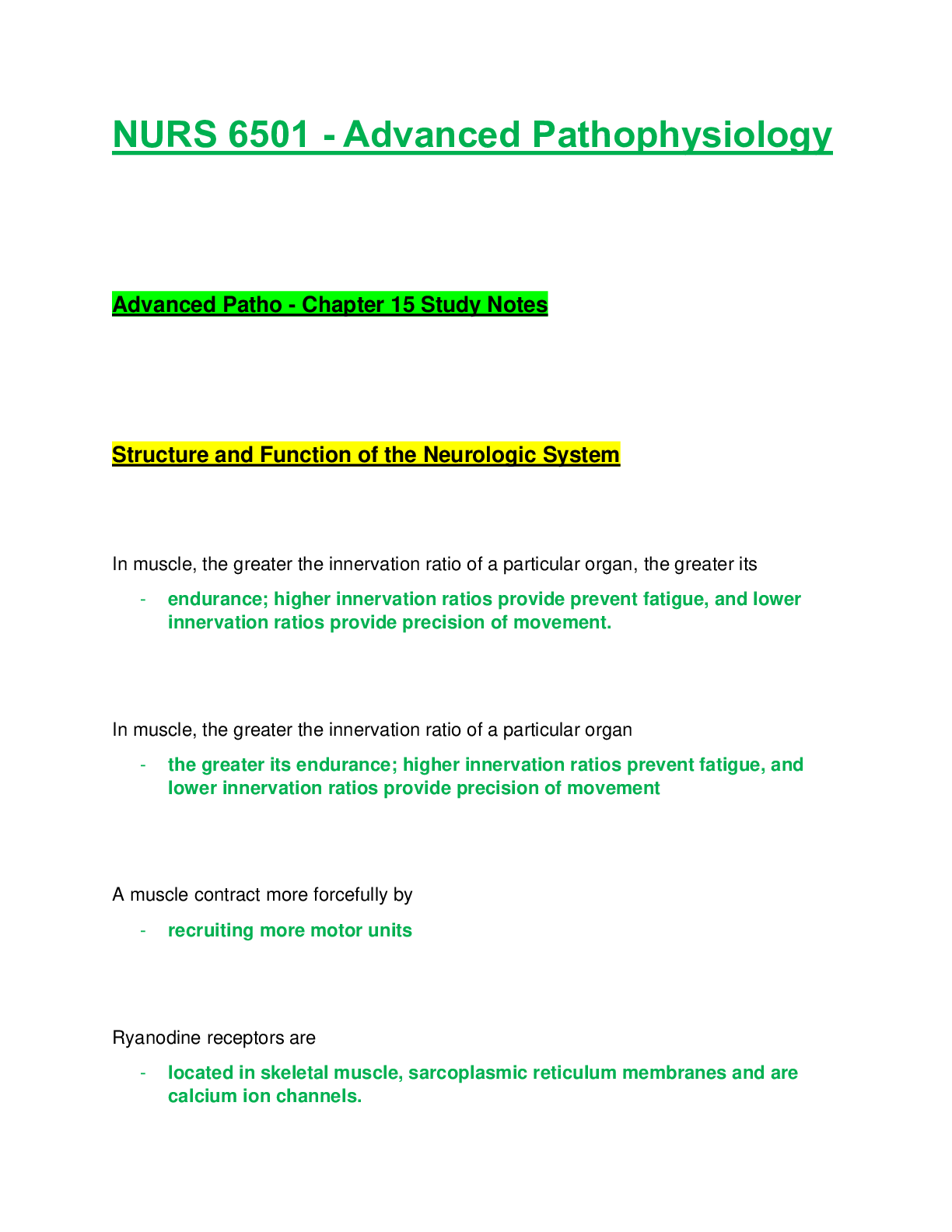
NURS 6501 / NURS6501: Advanced Pathophysiology - Chapter 15 St...

$15
6 Pages
Bloomberg market concepts test, solved 100%; distinction solut...
.png)
$6
9 Pages
Southern Methodist University - BIOL 3350chapter 15 cell bio P...
.png)
$7
2 Pages
WGU C201 Business Acumen Chapter 15 & 16: Accounting and Finan...
$10
25 Pages
Bloomberg market concepts test, solved 100%; distinction solut...

$23
202 Pages
Solutions Manual for Fluid Mechanics Fundamentals and Applicat...
More related documents below