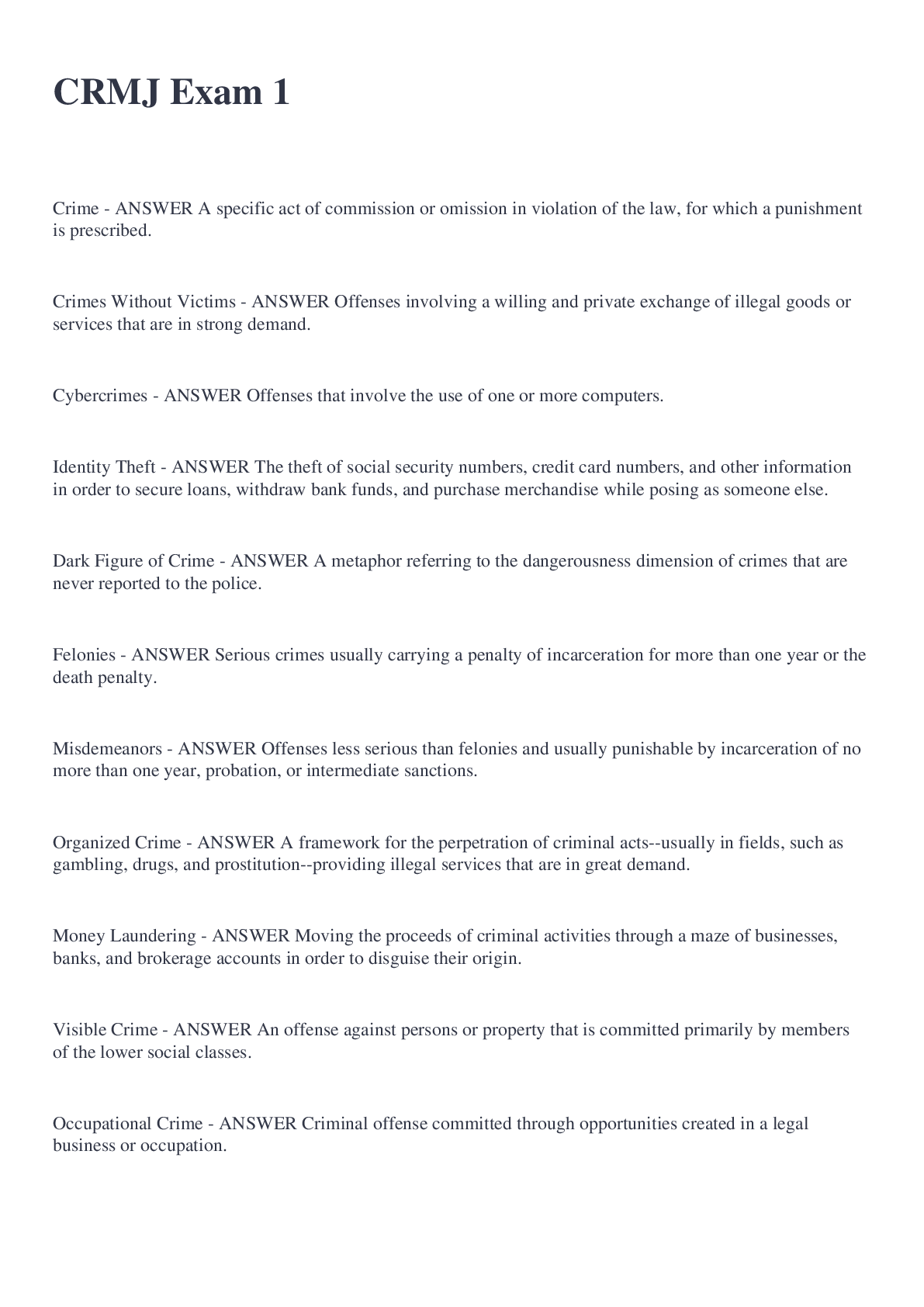
Crime - ANSWER A specific act of commission or omission in violation of the law, for which a punishment is prescribed.
Crimes Without Victims - ANSWER Offenses involving a willing and private exchange of illegal goods
...
Crime - ANSWER A specific act of commission or omission in violation of the law, for which a punishment is prescribed.
Crimes Without Victims - ANSWER Offenses involving a willing and private exchange of illegal goods or services that are in strong demand.
Cybercrimes - ANSWER Offenses that involve the use of one or more computers.
Identity Theft - ANSWER The theft of social security numbers, credit card numbers, and other information in order to secure loans, withdraw bank funds, and purchase merchandise while posing as someone else.
Dark Figure of Crime - ANSWER A metaphor referring to the dangerousness dimension of crimes that are never reported to the police.
Felonies - ANSWER Serious crimes usually carrying a penalty of incarceration for more than one year or the death penalty.
Misdemeanors - ANSWER Offenses less serious than felonies and usually punishable by incarceration of no more than one year, probation, or intermediate sanctions.
Organized Crime - ANSWER A framework for the perpetration of criminal acts--usually in fields, such as gambling, drugs, and prostitution--providing illegal services that are in great demand.
Money Laundering - ANSWER Moving the proceeds of criminal activities through a maze of businesses, banks, and brokerage accounts in order to disguise their origin.
Visible Crime - ANSWER An offense against persons or property that is committed primarily by members of the lower social classes.
Occupational Crime - ANSWER Criminal offense committed through opportunities created in a legal business or occupation.
Political Crime - ANSWER An act, usually done for ideological purposes, that constitutes a threat against the state or a criminal act by a state.
Public Policy - ANSWER Priorities and actions developed by government to use public resources as a means to deal with issues affecting society.
Sociological Explanations - ANSWER Explanations of crime that emphasize the social conditions that bear on the individual as causes of criminal behavior.
Anomie - ANSWER A breakdown in and disappearance of the rules of social behavior.
Theory of Differential Association - ANSWER The theory that people become criminals because they encounter more influences that view criminal behavior as normal and acceptable than influences that are hostile to criminal behavior.
Criminogenic - ANSWER Factors thought to bring about criminal behavior in an individual.
Biological Explanations - ANSWER Explanations of crime that emphasize physiological and neurological factors that may predispose a person to commit crimes.
Social Conflict Theories - ANSWER Theories that assume criminal law and the criminal justice system are primarily a means of controlling the poor and the have-nots.
Psychological Explanations - ANSWER Explanations of crime that emphasize mental processes and behavior.
Victimology - ANSWER A field of criminology that examines the role the victim plays in precipitating criminal incident and the impact of crimes on victims.
Adjudication - ANSWER The process of determining whether the defendant is guilty or not guilty.
Dual Court System - ANSWER A system based on a separate judicial system for each state in addition to a court system under the national government.
Arrest - ANSWER The physical taking of a person into custody on the grounds that probable cause exists to believe that he or she has committed a criminal offense.
Warrant - ANSWER A court oder authorizing police officials to take certain actions.
Information - ANSWER A document charging an individual with a specific crime.
Indictment - ANSWER A document returned by a grand jury as a "true bill" charging an individual with a specific crime on the basis of a determination of probable cause from evidence presented by a prosecuting attorney.
Exchange - ANSWER A mutual transfer of resources; a balance of benefits and deficits that flow from behavior based on decisions about the values and costs of alternatives.
Plea Bargain - ANSWER A defendant's plea of guilty to a criminal charge with the reasonable expectation of receiving some consideration from the state for doing so, usually a reduction of the charge.
[Show More]



.png)

 2ND EDITION JUDITH C.png)
.png)