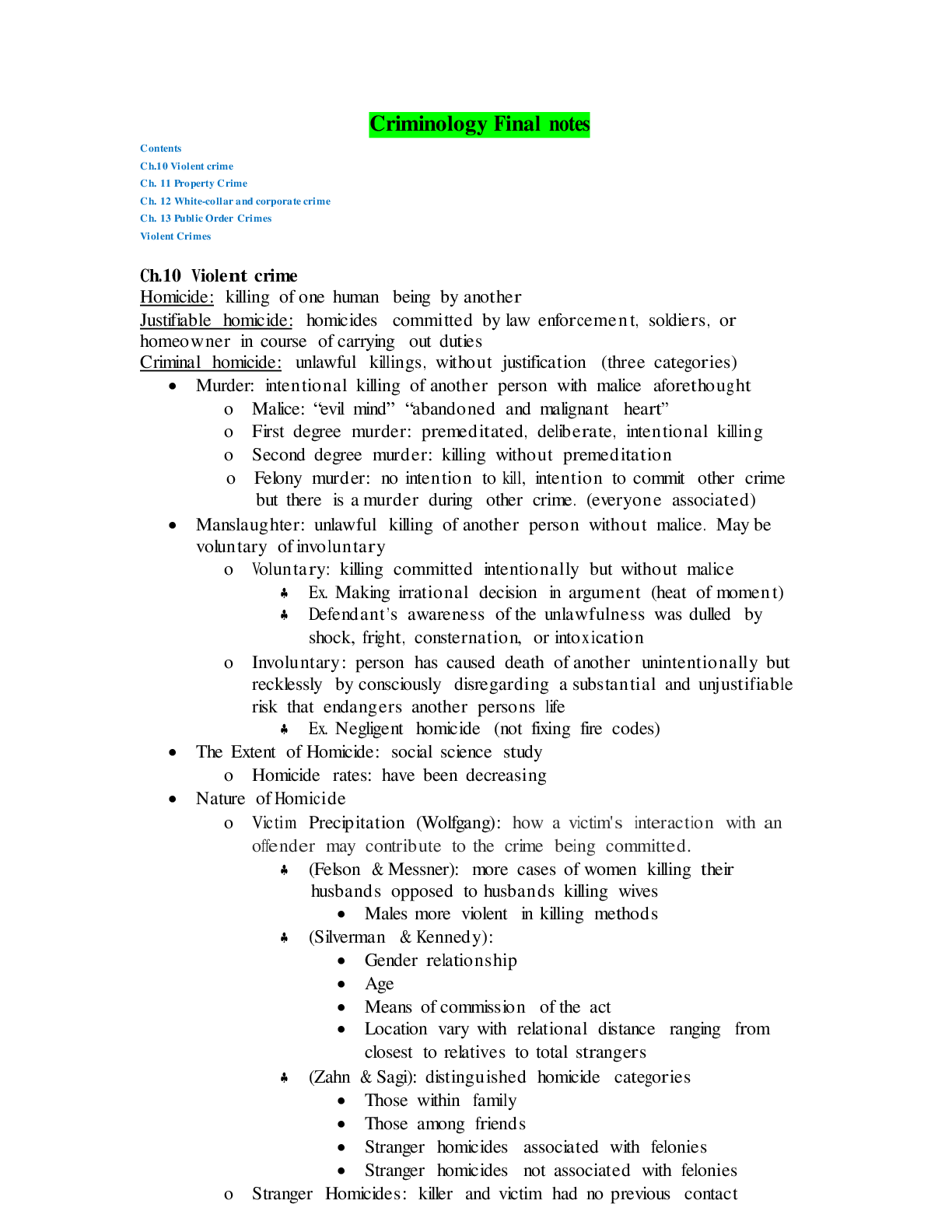
Criminology Final notes
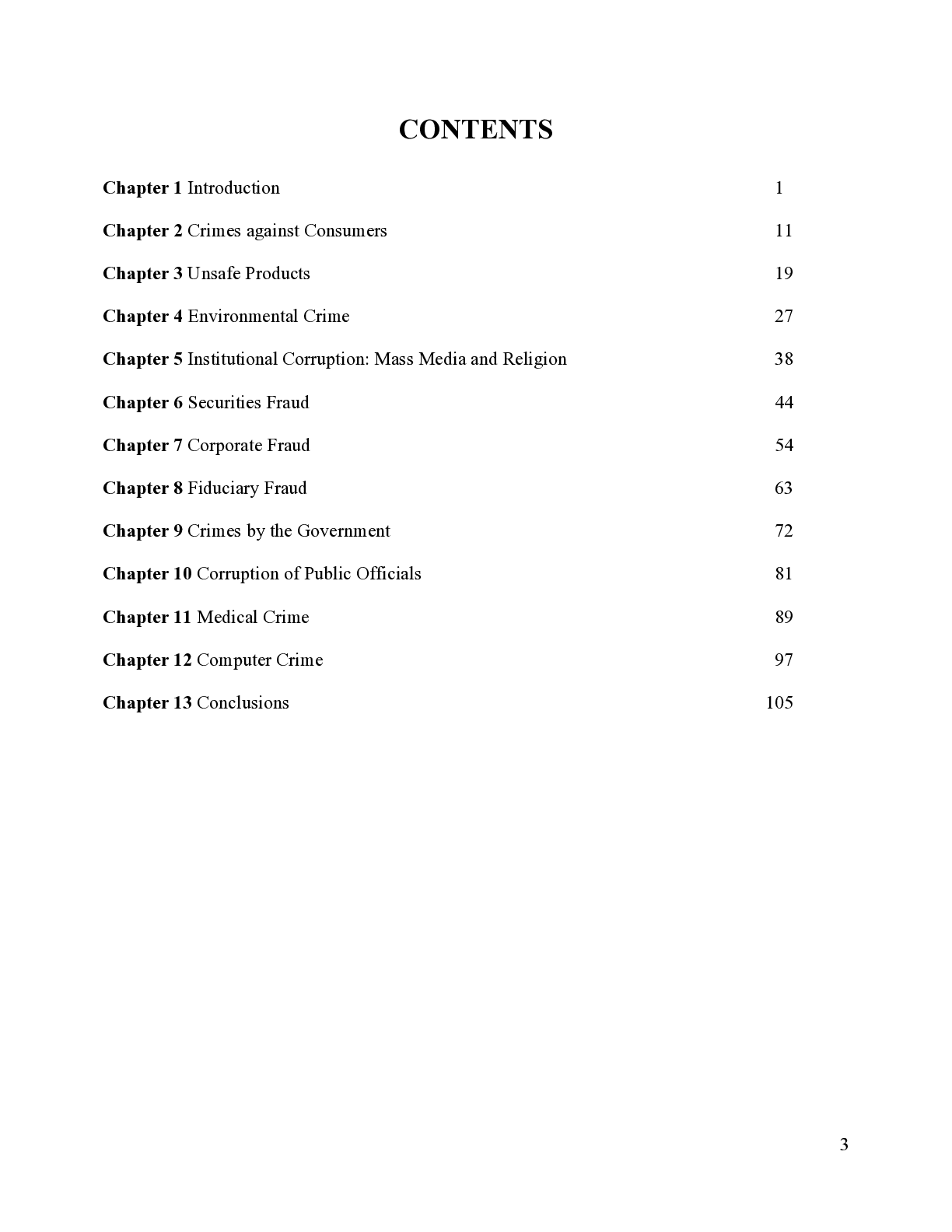
Contents
Ch.10 Violent crime
Ch. 11 Property Crime
Ch. 12 White-collar and corporate crime
Ch. 13 Public Order Crimes
Violent Crimes
Ch.10 Violent crime
Homicide: killing of one human b
...
Criminology Final notes
Contents
Ch.10 Violent crime
Ch. 11 Property Crime
Ch. 12 White-collar and corporate crime
Ch. 13 Public Order Crimes
Violent Crimes
Ch.10 Violent crime
Homicide: killing of one human being by another
Justifiable homicide: homicides committed by law enforcement, soldiers, or homeowner in course of carrying out duties
Criminal homicide: unlawful killings, without justification (three categories)
• Murder: intentional killing of another person with malice aforethought
o Malice: “evil mind” “abandoned and malignant heart”
o First degree murder: premeditated, deliberate, intentional killing
o Second degree murder: killing without premeditation
o Felony murder: no intention to kill, intention to commit other crime but there is a murder during other crime. (everyone associated)
• Manslaughter: unlawful killing of another person without malice. May be
voluntary of involuntary
o Voluntary: killing committed intentionally but without malice
Ex. Making irrational decision in argument (heat of moment)
Defendant’s awareness of the unlawfulness was dulled by shock, fright, consternation, or intoxication
o Involuntary: person has caused death of another unintentionally but
recklessly by consciously disregarding a substantial and unjustifiable risk that endangers another persons life
Ex. Negligent homicide (not fixing fire codes)
• The Extent of Homicide: social science study
o Homicide rates: have been decreasing
• Nature of Homicide
o Victim Precipitation (Wolfgang): how a victim's interaction with an offender may contribute to the crime being committed.
(Felson & Messner): more cases of women killing their
husbands opposed to husbands killing wives
• Males more violent in killing methods
(Silverman & Kennedy):
• Gender relationship
• Age
• Means of commission of the act
• Location vary with relational distance ranging from closest to relatives to total strangers
(Zahn & Sagi): distinguished homicide categories
• Those within family
• Those among friends
• Stranger homicides associated with felonies
• Stranger homicides not associated with felonies
o Stranger Homicides: killer and victim had no previous contact
(Reidel): assumes average rates are understated 14%
o Relatives & Acquaintances: killer and victim have intimate relationship
Significant percentage of all homicides: 44%
• Most occur after long-term abuse by husband
• Children more like to be killed by relative
o Young & old perpetrators: low homicide rates
o Homicide without apparent motive: 25% of all homicides
No history of alcohol abuse
Recent release from prison
Claims of amnesia for crime
Denial of crime
Exhibit psychotic behavior after crime
o Serial Murder: killing several victims over period of time
o Mass murder: killing of multiple victims in on event or in very quick succession
o Sociopaths (Levin & Fox): persons who lack internal controls,
disregard common values, and have an intense desire to dominate others
o Gang Murder: differ both quantitatively and qualitatively from nongang homicides.
Differ with respects to ethnicity, age, number of participants,
relationships
• Cross-National Comparison of the Homicide rates
o US rates lowering
o More developed countries have less homicides than less developed
o Moderate association between inequality of income and rate of homicide
Assault: attack on another person that is made with apparent ability to inflict injury
and that is intended to frighten or to cause physical harm
• Battery: an attack the results in touching or striking the victim
• Simple assault: inflicts little or no physical harm, felonious assault
• Aggravated assault: inflicts serious harm on the victim or uses a deadly weapon
• 6 stages of confrontational situation leading to assault:
1. One person insults another
2. Insulted person notices insult
3. Insulted person response: (fight or flight)
4. Insulter: fight or flight
5. Fight
6. Winner flees or waits for consequence
Family-related crimes:
• Spouse abuse: abuse of spouse
o Extent of spouse abuse: (Straus & Gelles) 1/6 couples experience physical assault during the year
½ domestic assault not reported
• most common reason is matter is private
• reported assaults to prevent future assault
• 2/3 of assaults are simple assaults
o Nature of spouse abuse: interpersonal violence is learned and transmitted from one generation to another
• Child Abuse: spouse abuse closely related to child abuse: correlation between
men beating women and men beating children
o Extent of child abuse: 3.7 million reports of suspected child abuse or neglect
o Nature of child abuse: high proportion of abusers suffered from
alcoholism, drug abuse, mental retardation, poor attachment, low self esteem, or sadistic psychopathy
• Abuse of elderly:
o Domestic elderly abuse
o Institutional elderly abuse
o Self-neglect or self-abuse
Rape and Sexual Assult:
• Rape: act of forced intercourse without consent
o Stranger rape: victim has had little or no prior contact with offender
o Predatory rape: offender uses deception or force, intends and plans to rape his victim by pretending to engage in legitimate dating behavior
o Date rape: legitamte dating situation turned bad, when force is
eventually used to gain sex from woman who is unwilling
• Psychological factors: suffering from mental illness
o Psychotic, sociopathic, sadistic, don’t feel masculine
• Sociocultural factors: rape is culturally related to societal norms that approve of aggression
• Rape and legal system: (Hale, Pleas of the Crown)- required stringent proof
o Difficulties of prosecution: needs collaborating evidence- semen, torn clothes, bruises, or eyewitness
o Legislative changes: feminist movement has impact on laws
(Schwartz & Clear)- rape should be a general assault crime
• Community Response: 1970- Bay Area Women Against Rape- emergency hotline; late 1970s federal and state funding across country
Kidnapping: abduction and detention by force or fraud and transport beyond the
authority of the place where the crime was committed
• Crimping or shanghaiing: involuntary service aboard ships and abduction of
women for purposes of prostitution abroad
Robbery: taking of property from a victim by force and violence or by the threat of violence
• Robbery is second degree felony (Model Penal Code)
• Characteristics for robbers
o Professional
o Opportunistic
o Addict
o Alcoholic
• Consequences: losing money or property; psychological and physical trauma Organized crime: started between 1875 and 1920; exploded during prohibition(18th amendment)
• Racketeer Influenced and Corrupt Organizations Act (1970): attacks
racketeering activities by prohibiting the investment of any funds derived from racketeering in any enterprise that is engaged in interstate commerce
• Federal Witness Protection Program (1970): witness protection
Emerging Problems: terrorism, hate-crim, gov’t militias, mass shooting
• Terrorism: resort of violence or a threat of violence on the part of a group
seeking to accomplish a purpose against the opposition of constituted authority
o Extent: terrorism is increasing
• Hate crimes: involving racial, sexual or prejudice acts
• Militias: military force raised from civil population; could threaten American constitution
• School Violence: violence has decreased over time; recent school shooting
have gained media attention
Violence & Gun control: after shootings, 80% of citizens want stricter policies
• Extent of gun-related offenses: still more prevalent than any other western
nation
o 60x more than England and Wales
• Youth and guns: most youth that had guns had friends with guns
• Controlling handgun use: ~20,000 laws regulate firearms
o Brady Law- 5 day waiting period and background check
• Gun-control debate: NRA vs. advocates for control (12 law enforcement groups & ¾ of American public)
[Show More]





.png)
.png)