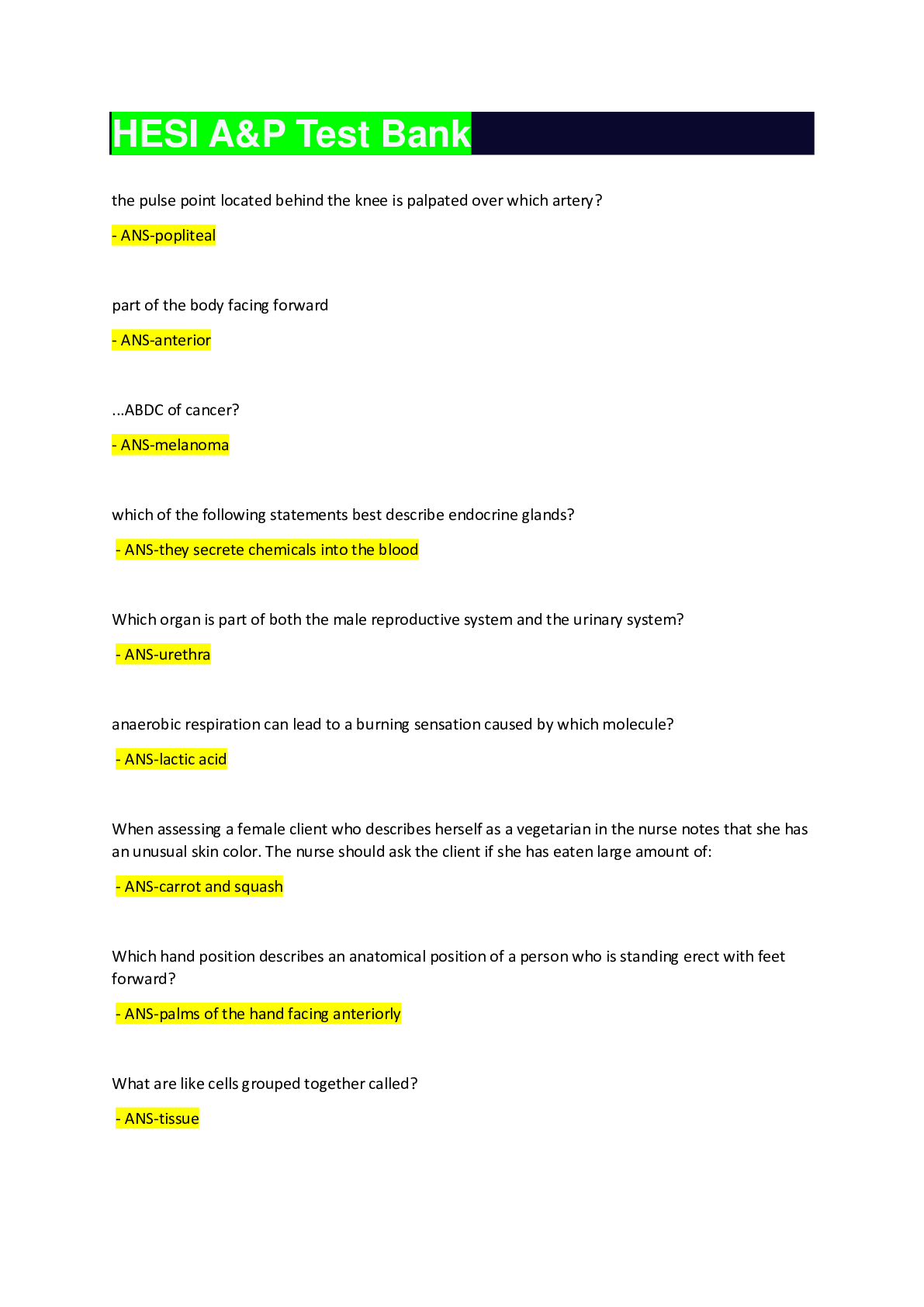
HESI PATHO, Pathophysiology HESI. Graded A+
Document Content and Description Below
HESI PATHO, Patho Hesi 2020/2021
Practice Questions, Pathophysiology
HESI. Graded A+
Which rationale best supports an older client's risk of complications related to a dysrhythmia? - An older
client is intolerant o
...
[Show More]
Last updated: 3 years ago
Preview 1 out of 71 pages
Instant download
Buy this Document to get the Full Access Instantly
Provided by Students Who Aced it
We Verify Document Content to Gurantee Accuracy
Reviews( 0 )
Document information
Connected school, study & course
About the document
Uploaded On
Aug 21, 2022
Number of pages
71
Written in
All

Additional information
This document has been written for:
Uploaded
Aug 21, 2022
Downloads
0
Views
304
Topic Tags
Recommended For You
Get more on HESI »
$20.5
84 Pages
HESI PATHOPHYSIOLOGY EXIT EXAM COMPLETE QUESTIONS || TEST BANK...
 Questions, Answers & Rationale, A+ Guide.png)

$25.5
396 Pages
NGN Nursing Med-Surg HESI Exit Exam – Latest 2025 Test Bank wi...

$18.5
93 Pages
HESI RN 2025 Exit NGN Exam – Verified Questions & Answers Upda...
.png)
$29
961 Pages
HESI RN COMPREHENSIVE EXIT EXAM Compiled 14 Versions Answers...
$13
28 Pages
NURS 4345 HESI Critical Care Comprehensive Exam 1 Questions an...

$13
13 Pages
NURS 306 ATI practice asssessment maternal new born ATI Matern...

$100.5
996 Pages
ATI TEAS 7 | 4 Versions for Reading, Math, Science, English, A...

.png)
$67.5
424 Pages
NCLEX RN ACTUAL TEST NCLEX RN P1 WITH VERIFIED ANSWERS (ALL CH...

More related documents below





.png)