NR 511|NR511 Midterm Exam Study Guide; Updated (2020) Complete A+ guide. ALL YOU NEED. (WEEK 1 TO WEEK 6)
$ 16
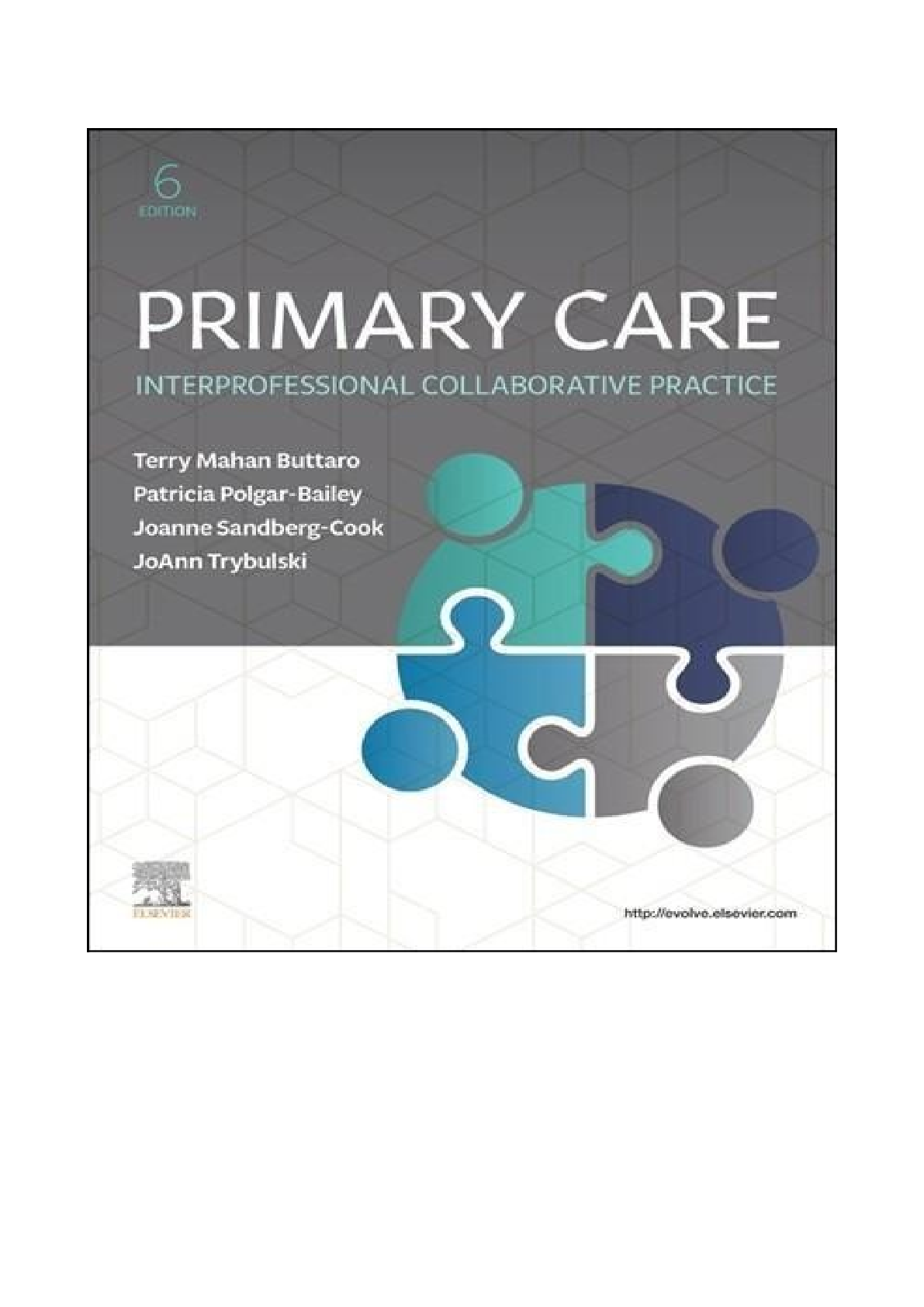
Test Bank for Buttaro's Primary Care A Collaborative Practice, 6th Edition.
*NURSING > EXAM > NURS 3302 Pharmacology Chapter 1-3 NCLEX-RN Questions with complete solution 2020(A LEVEL QUESTIONS) (All)
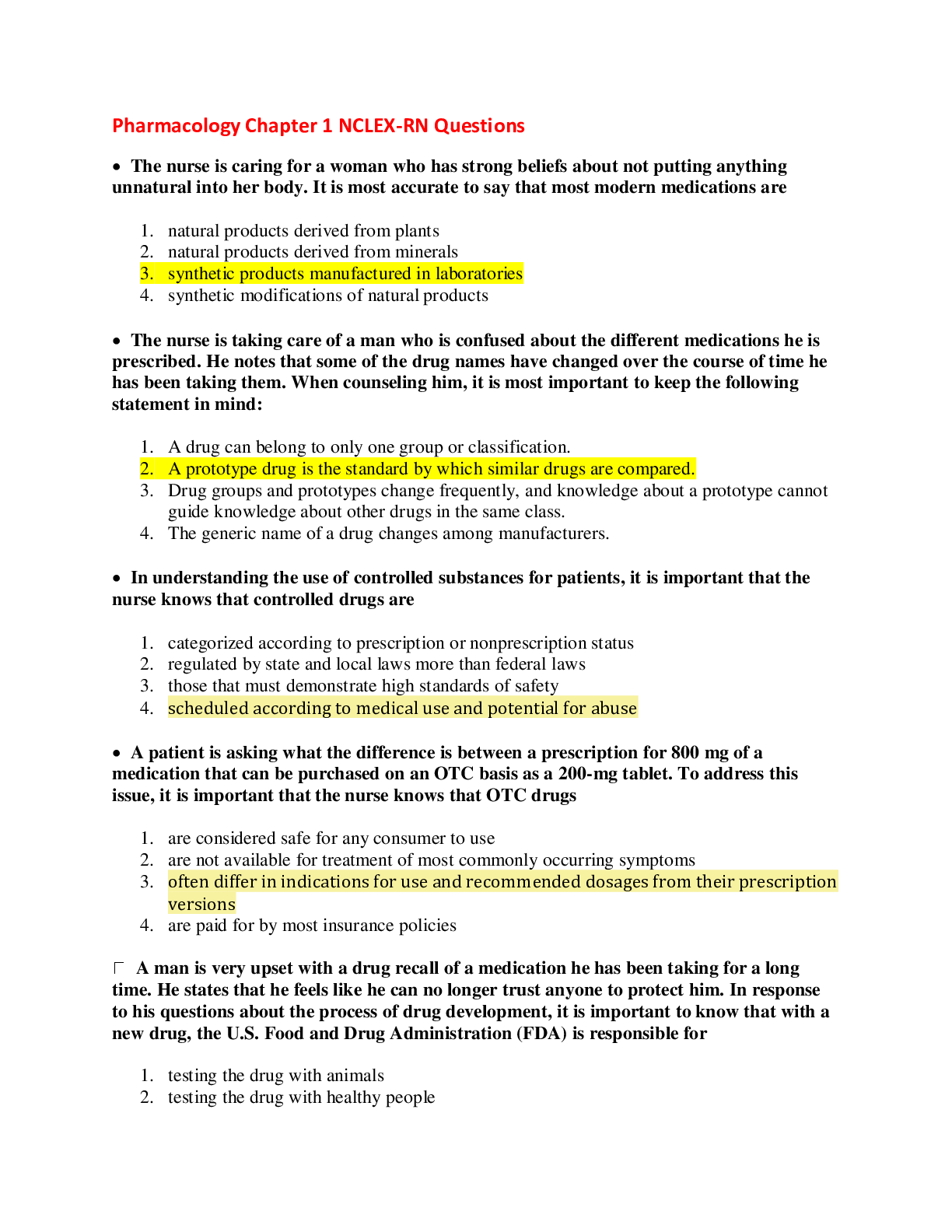
Pharmacology Chapter 1 NCLEX-RN Questions • The nurse is caring for a woman who has strong beliefs about not putting anything unnatural into her body. It is most accurate to say that most modern m ... edications are 1. natural products derived from plants 2. natural products derived from minerals 3. synthetic products manufactured in laboratories 4. synthetic modifications of natural products • The nurse is taking care of a man who is confused about the different medications he is prescribed. He notes that some of the drug names have changed over the course of time he has been taking them. When counseling him, it is most important to keep the following statement in mind: 1. A drug can belong to only one group or classification. 2. A prototype drug is the standard by which similar drugs are compared. 3. Drug groups and prototypes change frequently, and knowledge about a prototype cannot guide knowledge about other drugs in the same class. 4. The generic name of a drug changes among manufacturers. • In understanding the use of controlled substances for patients, it is important that the nurse knows that controlled drugs are 1. categorized according to prescription or nonprescription status 2. regulated by state and local laws more than federal laws 3. those that must demonstrate high standards of safety 4. scheduled according to medical use and potential for abuse • A patient is asking what the difference is between a prescription for 800 mg of a medication that can be purchased on an OTC basis as a 200-mg tablet. To address this issue, it is important that the nurse knows that OTC drugs 1. are considered safe for any consumer to use 2. are not available for treatment of most commonly occurring symptoms 3. often differ in indications for use and recommended dosages from their prescription versions 4. are paid for by most insurance policies • A man is very upset with a drug recall of a medication he has been taking for a long time. He states that he feels like he can no longer trust anyone to protect him. In response to his questions about the process of drug development, it is important to know that with a new drug, the U.S. Food and Drug Administration (FDA) is responsible for 1. testing the drug with animals 2. testing the drug with healthy people 3. marketing the drug to health care providers 4. evaluating the drug for safety and effectiveness • Error-reduction strategies during medication administration include (choose all that apply) 1. quiet zone signs at entrance to the medication room 2. protocols and checklist outlining medication administration 3. wearing of a sash or vest to signal others to avoid interruptions of the nurse during medication administration 4. carrying several patients’ prescanned medications on a tray Pharmacology Chapter 2 NCLEX-RN Questions • A nurse practitioner (NP) has just changed a patient’s medication from an oral form to a patch formulation to avoid the first-pass effect. The NP has explained it to the patient, but the patient still has questions and asks the nurse to explain again what is meant by the first-pass effect. The nurse would be most correct in explaining that this has to do with how 1. drugs initially bind to plasma proteins 2. initial renal function is involved in drug excretion 3. the way drugs first reach their target cells 4. initial metabolism of an oral drug occurs before it reaches the systemic circulation • A nurse is reading a research report about use of a medication that describes the pharmacokinetics of a particular medication that a patient is taking. Pharmacokinetics involves 1. drug effects on human cells 2. drug binding with receptors 3. drug absorption, distribution, metabolism, and elimination 4. drug stimulation of normal cell functions • A nurse is caring for a man who has worsening liver disease. In monitoring his medication, it is important to know that a patient with liver disease may have impaired drug 1. absorption 2. distribution 3. metabolism 4. excretion • A nurse is looking up information about the effects of a drug on different receptors. Characteristics of receptors include which of the following? 1. They are carbohydrates located in cell membranes or inside cells. 2. They are constantly synthesized and degraded in the body. 3. They bind with molecules of any drug circulating in the bloodstream. 4. They regulate the actions of all drugs. • A patient with an overdose of an oral drug usually receives which of the following? 1. specific antidote 2. activated charcoal 3. syrup of ipecac 4. strong laxative • The mother of a 14-month-old girl calls a nurse working in a pediatric clinic and reports that her daughter ingested an unknown number of sleeping pills about 4 hours ago and is now drowsy. The mother asks what she should do. The best response to give the mother is 1. “Administer a dose of syrup of ipecac to ensure vomiting” 2. “Call the Poison Control Center immediately” 3. “Administer a strong laxative and observe for a response” 4. “Call 911 to transport your daughter to the nearest emergency department” Pharmacology Chapter 3 NCLEX-RN Questions • A physician writes an order using the abbreviation MS. The order states “MS 10 mg IV push every 6 hours as needed for pain.” According to The Joint Commission’s “Do Not Use” list, what is the potential problem in this order? 1. The order does not include a dosage. 2. The drug could be magnesium sulfate or morphine sulfate. 3. The potential problem is minimal, and the order is clear. 4. The order does not include the route. • A prescriber has written an order for an oral medication to a patient following a cerebrovascular accident (stroke). Prior to administering the medication, which of the following nursing interventions is most important? 1. allowing the patient to take the medication with thickened liquids 2. placing the patient in the sitting position 3. assessing the patient’s blood pressure and pulse 4. assessing the patient’s ability to swallow • A prescriber has written an order for levothyroxine sodium 50 mg per day by mouth. The nurse knows that the standard dose is 50 mcg. What action should the nurse take? 1. Call the prescriber and question the order. 2. Administer 50 mcg instead. 3. Consult the pharmacist about the order. 4. Ask the patient what he or she usually takes • The nurse is administering the first dose of an anti-infective agent. Which of the following assessments should the nurse make prior to administering the anti-infective agent? 1. Assess the patient’s temperature. 2. Assess the patient’s level of consciousness. 3. Assess whether the patient is allergic to any anti-infective agent. 4. Assess whether the patient has taken the medication previously. • Which of the following nursing actions will prevent adverse drug events? 1. Use only the trade name when documenting medications. 2. Crush long-acting medications if the patient has dysphagia. 3. After receiving a verbal order, administer the medication and then write down the order. 4. Use bar code technology according to institutional policy • A nurse is administering an elixir. Which of the following measures is appropriate? 1. microgram 2. milligram 3. milliliter 4. kilogram • The nurse has administered lacosamide to the wrong patient. What is the first action the nurse should take? 1. Assess the patient’s vital signs and level of consciousness. 2. Notify the physician. 3. Fill out an incident report. 4. Call the respiratory therapist for administration of oxygen • A patient is to receive lamotrigine 300 mg by mouth two times per day. The pharmacy has delivered 50-mg tablets. How many tablets should the nurse administer each time? 1. 2 tablets 2. 4 tablets 3. 6 tablets 4. 8 tablets • A nurse is preparing to administer a subcutaneous injection. What size needle should the nurse use to administer the injection? 1. 18 gauge 2. 20 gauge 3. 23 gauge 4. 25 gauge • A patient is to receive an intramuscular injection of ketorolac. Which of the following muscles should be avoided? 1. deltoid 2. dorsogluteal 3. ventrogluteal 4. vastus lateralis • The patient receives regular insulin 5 units subcutaneously. To what degree is the syringe held for the injection? (Select all that apply.) 1. 30 degrees 2. 45 degrees 3. 60 degrees 4. 90 degrees • How is a medication delivered by piggyback administered? 1. It is pushed into the IV line. 2. It is retrograded into the IV line. 3. It is injected intramuscularly after another medication. 4. It is mixed with 50 to 100 mL of IV fluid in a separate container. During an initial nursing assessment, the patient reports that he is allergic to a particular medicine. What should the nurse ask the patient? 1. What symptoms occurred when you had the allergic reaction? 2. Did you need to take epinephrine (Adrenalin)? 3. Did your physician think this information needed to be communicated? 4. Have you ever overdosed on this medication? How do nursing interventions increase safety and effectiveness of drug therapy? 5. by avoiding the use of nondrug measures during drug therapy 6. by using multiple drugs to relieve most symptoms or problems 7. by teaching patients about their drug therapy 8. by avoiding excessive instructions. What should the nurse keep in mind when evaluating a patient’s response to drug therapy? 9. Few drugs cause adverse effects. 10. Drugs may cause virtually any symptom or problem. 11. Patients always report adverse effects. 12. Therapeutic effects are more important than adverse effects. [Show More]
Last updated: 3 years ago
Preview 1 out of 6 pages
Buy this document to get the full access instantly
Instant Download Access after purchase
Buy NowInstant download
We Accept:

Can't find what you want? Try our AI powered Search
Connected school, study & course
About the document
Uploaded On
Dec 16, 2020
Number of pages
6
Written in
All
This document has been written for:
Uploaded
Dec 16, 2020
Downloads
0
Views
103
Scholarfriends.com Online Platform by Browsegrades Inc. 651N South Broad St, Middletown DE. United States.
We're available through e-mail, Twitter, Facebook, and live chat.
FAQ
Questions? Leave a message!
Copyright © Scholarfriends · High quality services·

.png)


.png)