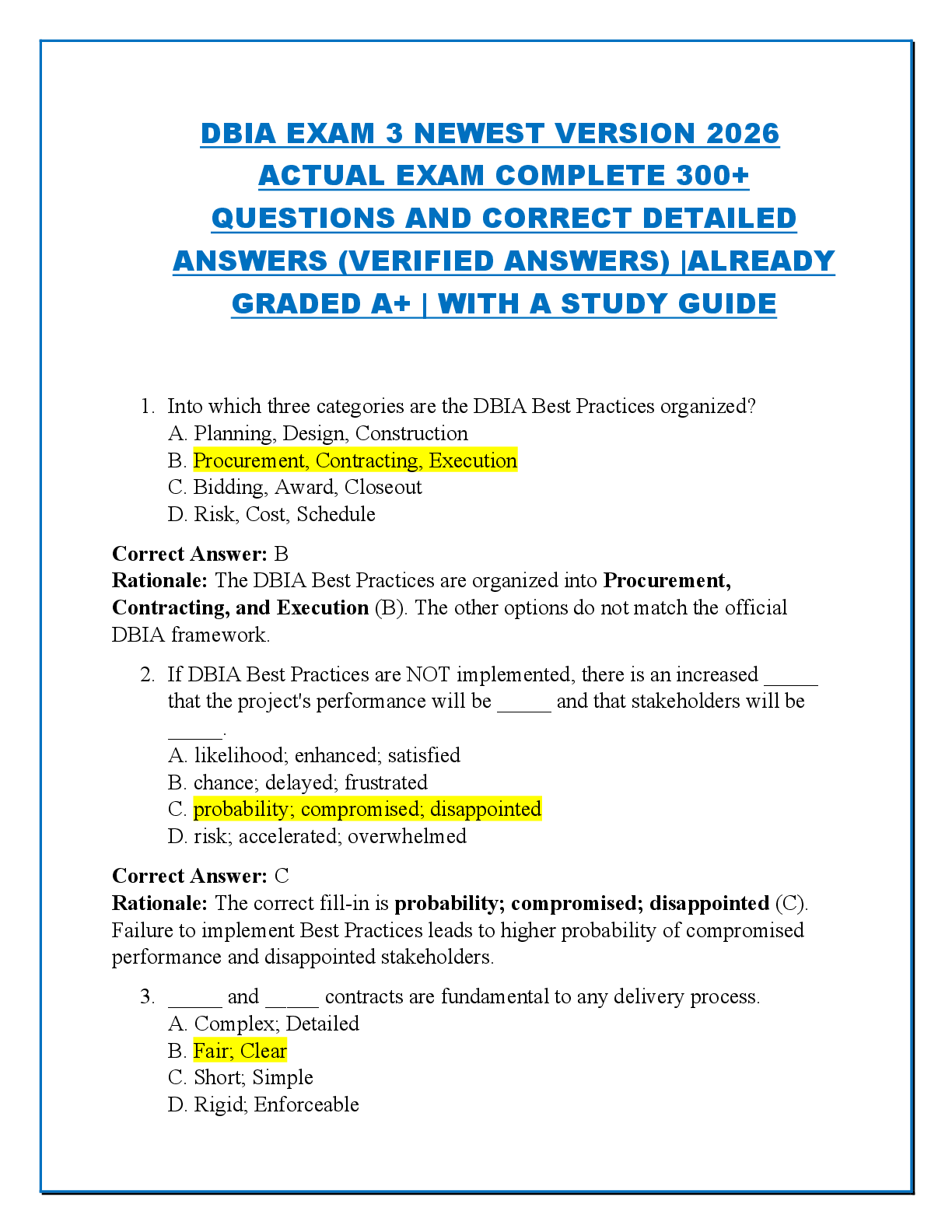
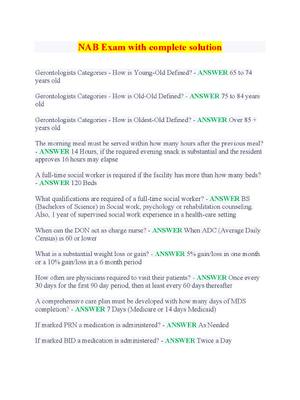
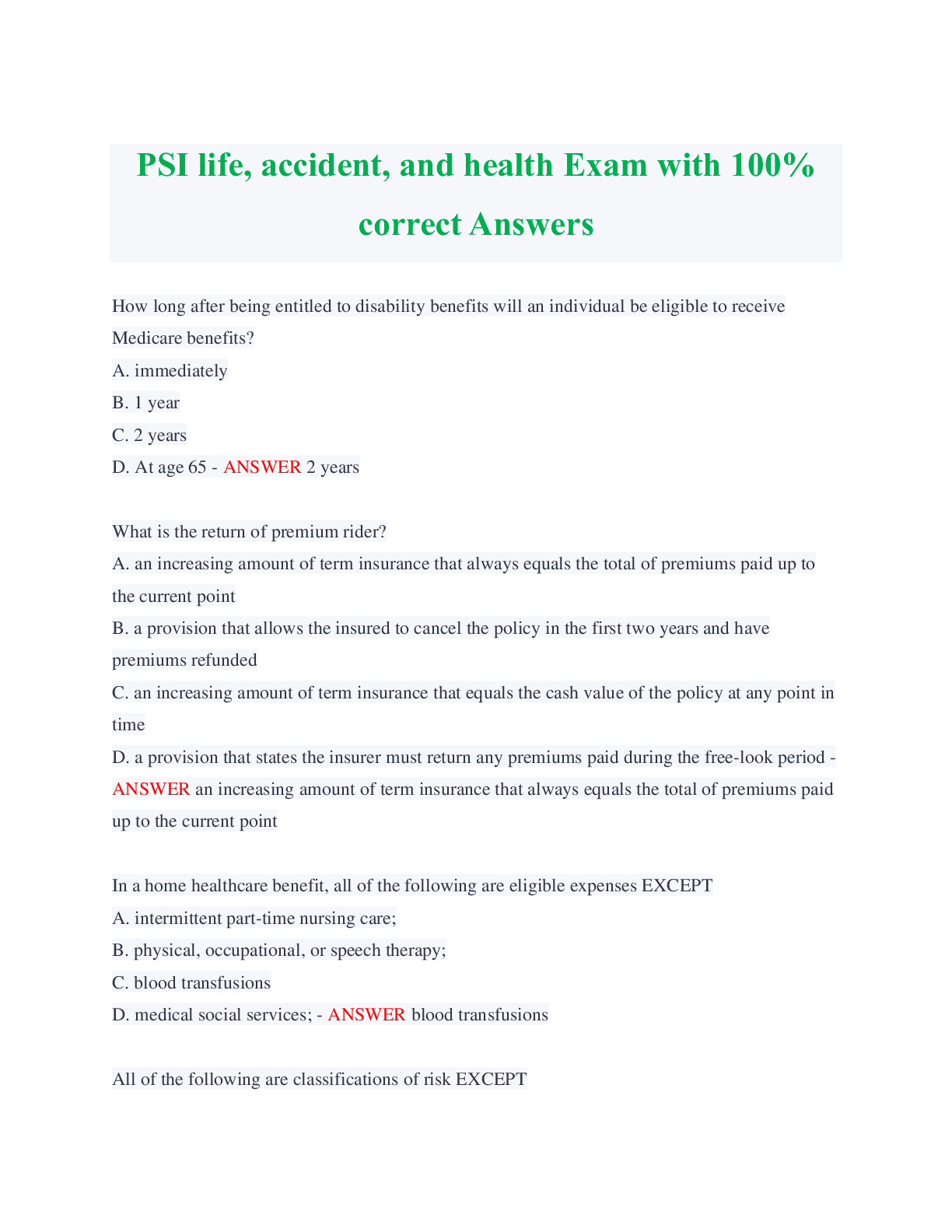
Development of Sensorimotor Integration - ANSWER Prenatal Period
Neonatal Period
First 6mo
6-12mo
13-24mo
2-3yrs
3-7yrs
Prenatal Period - ANSWER Responds first to tactile stimuli
Reflex Development
Innate tact
...
Development of Sensorimotor Integration - ANSWER Prenatal Period
Neonatal Period
First 6mo
6-12mo
13-24mo
2-3yrs
3-7yrs
Prenatal Period - ANSWER Responds first to tactile stimuli
Reflex Development
Innate tactile, proprioceptive, and vestibular input reactions
Neonatal Period - ANSWER Tactile, proprioceptive, and vestibular inputs are critical from birth onward for the eventual development of body scheme.
Vestibular system, although fully developed at birth, continues to be refined and impacts on the infant's arousal. Helps the infant to feel more organized and content.
Visual system develops as infant responds to human faces and items of high contrast places approximately 10in from the face.
Auditory system is immature at birth and develops as the infant orients to voices and other sounds.
First 6mo - ANSWER Vestibular, proprioceptive, and visual systems become more integrated and lay the foundation for postural control, which facilitates a steady visual field.
Tactile and proprioceptive systems continue to be refined, laying the foundation for development of somatosensory skills.
Visual and tactile systems become more integrated as the child reaches out and grasps objects, laying the foundation for eye-hand coordination.
Infant movement patterns progress from reflexive to voluntary and goal directed.
6-12mo - ANSWER Vestibular, visual, and somatosensory responses increase in quantity and quality as the infant becomes more mobile.
Tactile and proprioceptive perception becomes more refined, allowing for development of fine motor and motor planning skills.
Tactile and proprioceptive responses also lead to midline skills and eventual crossing of midline.
Auditory, tactle, and proprioceptive perception is heightened allowing for development of sounds for the purpose of communication.
Tactile, proprioceptive, gustatory, and olfactory perception are integrated, allowing for primitive self-feeding.
13-24mo - ANSWER Tactile perception becomes more precise allowing for discrimination and localization to further refinement of fine motor skills.
Further integration of all systems promotes the complexity of motor planning as the toddler's repertoire of movement patterns expands.
Symbolic gesturing and vocalization promotes ideation, indicating the toddler's ability to conceptualize.
Motor planning abilities contribute to self-concept as the toddler begins to master the environment.
2-3yrs - ANSWER This is a period of refinement as the vestibular, proprioceptive, and visual systems further develop, leading to improved balance and postural control.
Further development of tactile discrimination and localization lead to improved fine motor skills.
Motor planning and praxis ideation also progresses during this period for more skillful occupational performance.
3-7yrs - ANSWER Child is driven to challenge sensorimotor competencies through roughhouse play, playground activities, games, sports, music, dancing , arts and crafts, household chores, and school tasks. These occupations provide opportunities to promote psychosocial development and self-esteem.
Crossing Midline - ANSWER As the child becomes more mobile, movement against gravity and weightshift increase, leading to eventual crossing of the midline, often in attempt to reach for a toy, while weightbearing on the opposing upper extremity for balance. Begins at 9-12mo.
Laterality - ANSWER Hemispheric specialization for specific tasks varies with different individuals
Bilateral Integration - ANSWER As the child experiments with movement, the nervous system is stimulated, and the resulting sensations help the child to coordinate the two sides of the body. Begins at 9-12mo.
Visual-Motor Integration - ANSWER Dependent upon the lower level skills of visual attention, visual memory, visual discrimination, kinesthesia, position in space, figure ground, form constancy, and spatial relations.
Oral-Motor Control - ANSWER Developed in the area of feeding, provides the foundation for early oral communication and later language development.
Rooting Reflex - ANSWER Onset Age: 28wk gestation
Integration Age: 3mo
Stimulus: Stroke corner of the mouth, upper lip, and lower lip.
Response: Movement of the tongue, mouth, and/or head toward stimulus.
Relevance: Allows searching for and locating feeding source.
Suck-Swallow Reflex - ANSWER Onset Age: 28wk gestation
Integration Age: 2-5mo
Stimulus: Place examiner's index finger inside infant's mouth with head in midline.
Response: Strong, rhythmical sucking
Relevance: Allows ingestion of nourishment
Traction Reflex - ANSWER Onset Age: 28wk gestation
Integration Age: 2-5mo
Stimulus: Grasp infant's forearms and pull-to-sit
Response: Complete flexion of upper extremeties
Relevance: Enhances momentary reflexive grasp
Moro Reflex - ANSWER Onset Age: 28wk gestation
Integration: 4-6mo
Stimulus: Rapidly drop infant's head backward
Response: arm extension/ abduction, hand opening then arm flexion and adduction
Relevance: Facilitates ability to depart from dominant flexor posture (protective response)
Plantar Grasp Reflex - ANSWER Onset Age: 28wk
Integration Age: 9mo
Stimulus: Apply pressure with thumb on the infant's on the infant's ball of the foot.
Response: Toe Flexion
Relevance: Increases tactile input to the sole of the foot
Galant Reflex - ANSWER Onset Age: 32wk gestation
Integration Age: 2mo
Stimulus: Hold infant in prone suspension, gently scratch or tap alongside side the spine with finger, from shoulders to buttocks.
Response: Lateral trunk flexion and wrinkling of the skin on the stimulated side
Relevance: Facilitates lateral trunk movements necessary for trunk stabilization.
Asymmetric Tonic Neck Reflex (ATNR) - ANSWER Onset Age: 37wk gestation
Integration Age: 4-6mo
Stimulus: Fully rotate infant's head and hold for 5 sec
Response: Extension of extremities on the face side, flexion of extremities on the skull side
Relevance: Promotes visual hand regard
Palmar Grasp Reflex - ANSWER Onset Age: 37wk gestation
Integration Age: 4-6mo
Stimulus: Place examiner's finger in infant's palm
Response: Finger flexion (reflexive grasp)
Relevance: Increases tactile input on the pal, of the hand.
Tonic Labyrinthe (Supine) Reflex - ANSWER Onset Age: >37wk gestation
Integration Age: 6mo
Stimulus: Place infant in supine
Response: Increased extensor tone
Relevance: Facilitates total-body extensor tone
Tonic Labyrinthe (Prone) Reflex - ANSWER Onset Age: >37wk gestation
Integration Age: 6mo
Stimulus: Place infant in prone
Response: Increased flexor tone
Relevance: Facilitates total-body flexor tone
Labyrinthe (Optical Head Righting) Reflex - ANSWER Onset Age: Birth-2mo
Integration Age: Persists
Stimulus: Hold infant suspended vertically and tilt slowly (about 45°) to the side, forward, or backward
Response: Upright positioning of the head
Relevance: Orients head in space; maintains face vertical
Landau Reflex - ANSWER Onset Age: 3-4mo
Integration Age: 12-24mo
Stimulus: Hold infant in horizontal prone suspension
Response: Complete extension of head, trunk, and extremities
Relevance: Breaks up flexor dominance; facilitates prone extension
Symmetric Tonic Neck Reflex (STNR) - ANSWER Onset Age: 4-6mo
Integration Age: 8-12mo
Stimulus: Place infant in the crawling position and extend the head
Response: Flexion of hips and knees
Relevance: Breaks up total extensor posture; facilitates static quadruped position
Neck Righting on Body (NOB) Reflex - ANSWER Onset Age: 4-6mo
Integration Age: 5yrs
Stimulus: Place infant in supine and fully turn head to one side
Response: Log rolling of the entire body to maintain alignment with the head
Relevance: Maintains head/body alignment; initiates rolling (first ambulation effort)
Body Righting on Body (BOB) Reflex - ANSWER Onset Age: 4-6mo
Integration Age: 5yrs
Stimulus: Place infant in supine, flex one hip and knee toward the chest and hold briefly
Response: Segmental rolling of the upper trunk to maintain alignment
Relevance: Facilitates trunk/spinal rotation
Downward Parachute (Protective extension downward) Reflex - ANSWER Onset Age: 4mo
Integration Age: Persists
Stimulus: Rapidly lower infant toward supporting surface while suspended vertically
Response: Extension of the lower extremities
Relevance: Allows accurate placement of lower extremities in anticipation of a surface
Forward Parachute (Protective Extension Forward) Reflex - ANSWER Onset Age: 6-9mo
Integration Age: Persists
Stimulus: Suddenly tip infant foward toward supporting surface while vertically suspended
Response: Sudden extention of the upper extremities, hand opening, and neck extension
Relevance: Allows accurate placement of upper extremities in anticipation of supporting surface to prevent a fall.
Sideward Parachute (Protective Extension Sideward) Reflex - ANSWER Onset Age: 7mo
Integration Age: Persists
Stimulus Quickly but firmly tip infant off-balance to the side while in sitting position
Response: Arm extension to the side
Relevance: Protects body to prevent a fall; supports body for unilateral use of opposite arm
Backward Parachute (Protective Extension Backward) Reflex - ANSWER Onset Age: 9-10mo
Integration Age: Persists
Stimulus: Quickly but firmly tip infant off-balance backward
Response: Backward arm extension or arm extension to one side spinal rotation
Relevance: Protects body to prevent a fall; unilaterally facilitates
Prone Tilting Reflex - ANSWER Onset Age: 5mo
Integration Age: Persists
Stimulus: After positioning infant in prone, slowly raise one side of the supporting surface
Response: Curving of the spine toward the raised side (opposite to the pull of gravity); abduction/extension of arms and legs
Relevance: Maintain equilibrium without arm support; facilitate postural adjustments in all positions
Supine Tilting and Sitting Tilting Reflex - ANSWER Onset Age: 7-8mo
Integration Age: Persists
Stimulus: After positioning infant in supine or sitting, slowly raise one side of the supporting surface
Response: Curving of the spine toward the raised side (opposite to the pull of gravity); abduction/extension of arms and legs
Relevance: Maintain equilibrium without arm support; facilitate postural adjustments in all positions
Quadruped Tilting Reflex - ANSWER Onset Age: 9-12mo
Integration Age: Persists
Stimulus: After positioning infant on all fours, slowly raise one side of the supporting surface
Response: Curving of the spine toward the raised side (opposite to the pull of gravity); abduction/extension of arms and legs
Relevance: Maintain equilibrium without arm support; facilitate postural adjustments in all positions
Standing Tilting Reflex - ANSWER Onset Age: 12-21mo
Integration Age: Persists
Stimulus: After positioning infant in standing, slowly raise one side of the supporting surface
Response: Curving of the spine toward the raised side (opposite to the pull of gravity); abduction/extension of arms and legs
Relevance: Maintain equilibrium without arm support; facilitate postural adjustments in all positions
Prone Position - ANSWER 0-2mo: Turns head side to side. lifts head momentarily. Bends hips with bottom in air. Lifts head and sustains midline. Rotates head freely when up. Able to bear weight on forearms. Able to tuck chin and gaze at hands in forearm prop. Attempts to weight shift on forearms, resulting in a shoulder collapse.
5-6mo: Shifts weight on forearms and reaches forward. Bears weight and shifts weight on extended arms. Legs are closer together and thighs roll inward toward natural alignment. Hips are flat on surface. Equilibrium reactions are present.
5-8mo: Airplane posturing in prone position; chest and thighs lift off surface.
7-8mo: Pivots in prone position. Moves to prone position to sit.
9mo: Begins to dislike prone position.
Supine Position - ANSWER 0-3mo: Head held to one side. Able to turn head side to side.
3-4mo: Holds head in midline. Chin is tucked and neck lengthens in back. Legs come together. Lower back flattens against the floor.
4-5mo: Head lag is gone when pulled to a sitting position. Hands are together in space.
5-6mo: Lifts head independently. Brings feet to mouth. Brings hands to feet. Able to reach for toy with one or both hands. Hands predominantly open.
7-8mo: Equilibrium reactions are present.
Rolling - ANSWER 3-4mo: Rolls from prone position to side accidentally because of poor control of weight shift. Rolls from supine position to side.
5-6mo: Rolls from prone position to supine position. Rolls from supine position to side with right and left leg performing independent movements. Rolls from supine to prone position with right and left leg performing independent movements.
6-14mo: Rolls segmentally with roll initiated by the head, shoulder, or hips.
Creeping - ANSWER 7mo: Crawls forward on belly.
7-10mo: Reciprocal creep.
10-11mo: Creeps on hands and feet.
11-12mo: Creeps well.
Sitting - ANSWER 0-3mo (held in sitting): Head bobs in sitting. Back is rounded. Hips are apart, turned out, and bent. Head is steady. Chin tucks; able to gaze at the floor. Sits with less support
[Show More]




.png)