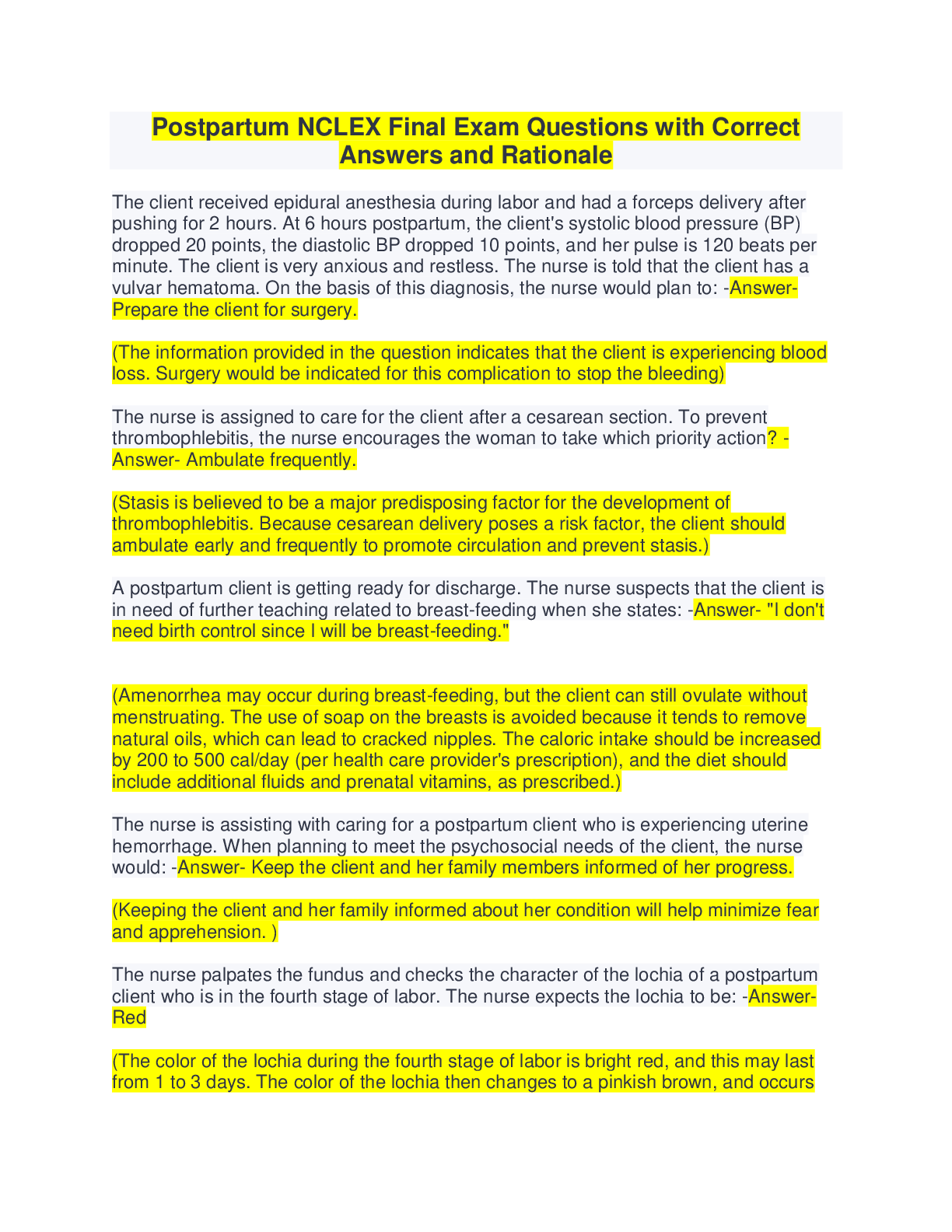
Postpartum NCLEX Final Exam Questions with Correct
Answers and Rationale
The client received epidural anesthesia during labor and had a forceps delivery after
pushing for 2 hours. At 6 hours postpartum, the client's s
...
Postpartum NCLEX Final Exam Questions with Correct
Answers and Rationale
The client received epidural anesthesia during labor and had a forceps delivery after
pushing for 2 hours. At 6 hours postpartum, the client's systolic blood pressure (BP)
dropped 20 points, the diastolic BP dropped 10 points, and her pulse is 120 beats per
minute. The client is very anxious and restless. The nurse is told that the client has a
vulvar hematoma. On the basis of this diagnosis, the nurse would plan to: -AnswerPrepare the client for surgery.
(The information provided in the question indicates that the client is experiencing blood
loss. Surgery would be indicated for this complication to stop the bleeding)
The nurse is assigned to care for the client after a cesarean section. To prevent
thrombophlebitis, the nurse encourages the woman to take which priority action? -
Answer- Ambulate frequently.
(Stasis is believed to be a major predisposing factor for the development of
thrombophlebitis. Because cesarean delivery poses a risk factor, the client should
ambulate early and frequently to promote circulation and prevent stasis.)
A postpartum client is getting ready for discharge. The nurse suspects that the client is
in need of further teaching related to breast-feeding when she states: -Answer- "I don't
need birth control since I will be breast-feeding."
(Amenorrhea may occur during breast-feeding, but the client can still ovulate without
menstruating. The use of soap on the breasts is avoided because it tends to remove
natural oils, which can lead to cracked nipples. The caloric intake should be increased
by 200 to 500 cal/day (per health care provider's prescription), and the diet should
include additional fluids and prenatal vitamins, as prescribed.)
The nurse is assisting with caring for a postpartum client who is experiencing uterine
hemorrhage. When planning to meet the psychosocial needs of the client, the nurse
would: -Answer- Keep the client and her family members informed of her progress.
(Keeping the client and her family informed about her condition will help minimize fear
and apprehension. )
The nurse palpates the fundus and checks the character of the lochia of a postpartum
client who is in the fourth stage of labor. The nurse expects the lochia to be: -AnswerRed
(The color of the lochia during the fourth stage of labor is bright red, and this may last
from 1 to 3 days. The color of the lochia then changes to a pinkish brown, and occursfrom day 4 to 10 postpartum. Finally, the lochia changes to a creamy white color that
occurs from day 10 to 14 postpartum.)
After episiotomy and the delivery of a newborn, the nurse performs a perineal check on
the mother. The nurse notes a trickle of bright red blood coming from the perineum. The
nurse checks the fundus and notes that it is firm. The nurse determines that: -AnswerThe bright red bleeding is abnormal and should be reported.
(Lochial flow should be distinguished from bleeding that originates from a laceration or
an episiotomy, which is usually brighter red than lochia and presents as a continuous
trickle of bleeding, even though the fundus of the uterus is firm. This bright red bleeding
is abnormal and needs to be reported. Therefore, the other options are incorrect
interpretations.)
The nurse is assigned to care for the client during the postpartum period. The client
asks the nurse what the term involution means. The nurse responds to the client,
knowing that involution is: -Answer- The progressive descent of the uterus into the
pelvic cavity, which occurs at a rate of approximately 1 cm/day
(Involution is the progressive descent of the uterus into the pelvic cavity. After birth,
descent occurs at a rate of approximately one fingerbreadth or 1 cm per day.)
A mother is breast-feeding her newborn baby and experiences breast engorgement.
The nurse encourages the mother to do which of the following to provide relief of the
engorgement? -Answer- Massage the breasts before feeding to stimulate let-down.
(Comfort measures for breast engorgement include massaging the breasts before
feeding to stimulate let-down, wearing a supportive and well-fitting bra at all times,
taking a warm shower or applying warm compresses just before feeding, and alternating
breasts during feeding.)
After delivery, the nurse checks the height of the uterine fundus. The nurse expects that
the position of the fundus would most likely be noted: -Answer- At the level of the
umbilicus
(After delivery, the uterine fundus should be at the level of the umbilicus or one to three
fingerbreadths below it and in the midline of the abdomen. If the fundus is 4 cm above
the umbilicus, this may indicate that there are blood clots in the uterus that need to be
expelled by fundal massage. If the fundus is noted to the right of the abdomen, it may
indicate a full bladder. By about 10 days postpartum, the uterus will be in the symphysis
pubis area.)
The nurse is caring for a postpartum client. At 4 hours postpartum, the client's
temperature is 102° F (38.9° C). The appropriate nursing action would be to: -AnswerNotify the registered nurse, who will then contact the health care provider (HCP).(During the first 24 hours postpartum, the mother's temperature may be elevated as a
result of dehydration. However, if the temperature is more than 2° F above normal, this
may indicate infection, and the HCP will need to be notified. Applying cool packs to the
abdomen is an inappropriate action and additionally, this action requires a prescription.
The remaining options may be a component of care but are not the most appropriate
based on the data in the question.)
The nurse is assisting with planning care for a postpartum woman who has small vulvar
hematomas. To assist with reducing the swelling, the nurse should: -Answer- Prepare
an ice pack for application to the area.
(The application of ice will reduce the swelling caused by hematoma formation in the
vulvar area. Options 1, 2, and 3 will not reduce swelling.)
The nurse is preparing a list of self-care instructions for a postpartum client who has
been diagnosed with mastitis. Choose the instructions that would be included on the list.
Select all that apply. -Answer- 1.
Wear a supportive non-underwire bra.
2.
Rest during the acute phase.
3.
Maintain a fluid intake of at least 3000 mL.
4.
Continue to breast-feed if the breasts are not too sore.
(Mastitis is an infection of the lactating breast. Client instructions include resting during
the acute phase, maintaining a fluid intake of at least 3000 mL per day, and taking
analgesics to relieve discomfort. Antibiotics may be prescribed and are taken until the
complete prescribed course is finished. They are not stopped when the soreness
subsides. Additional supportive measures include the use of moist heat or ice packs
and the wearing of a supportive bra. Continued decompression of the breast by breastfeeding or breast pump is important to empty the breast and prevent the formation of an
abscess.)
Methylergonovine (Methergine) is prescribed for a woman to treat postpartum
hemorrhage. Before the administration of methylergonovine, the priority nursing action
is to check the: -Answer- Blood pressure
(Methylergonovine, which is an ergot alkaloid, is an agent that is used to prevent or
control postpartum hemorrhage by contracting the uterus. Methylergonovine causes
continuous uterine contractions and may elevate the blood pressure. A priority beforethe administration of the medication is to check the blood pressure. The health care
provider should be notified if hypertension is present. Although options 1, 3, and 4 may
be components of the postpartum data collection procedures, option 2 is related
specifically to the administration of this medication. )
[Show More]