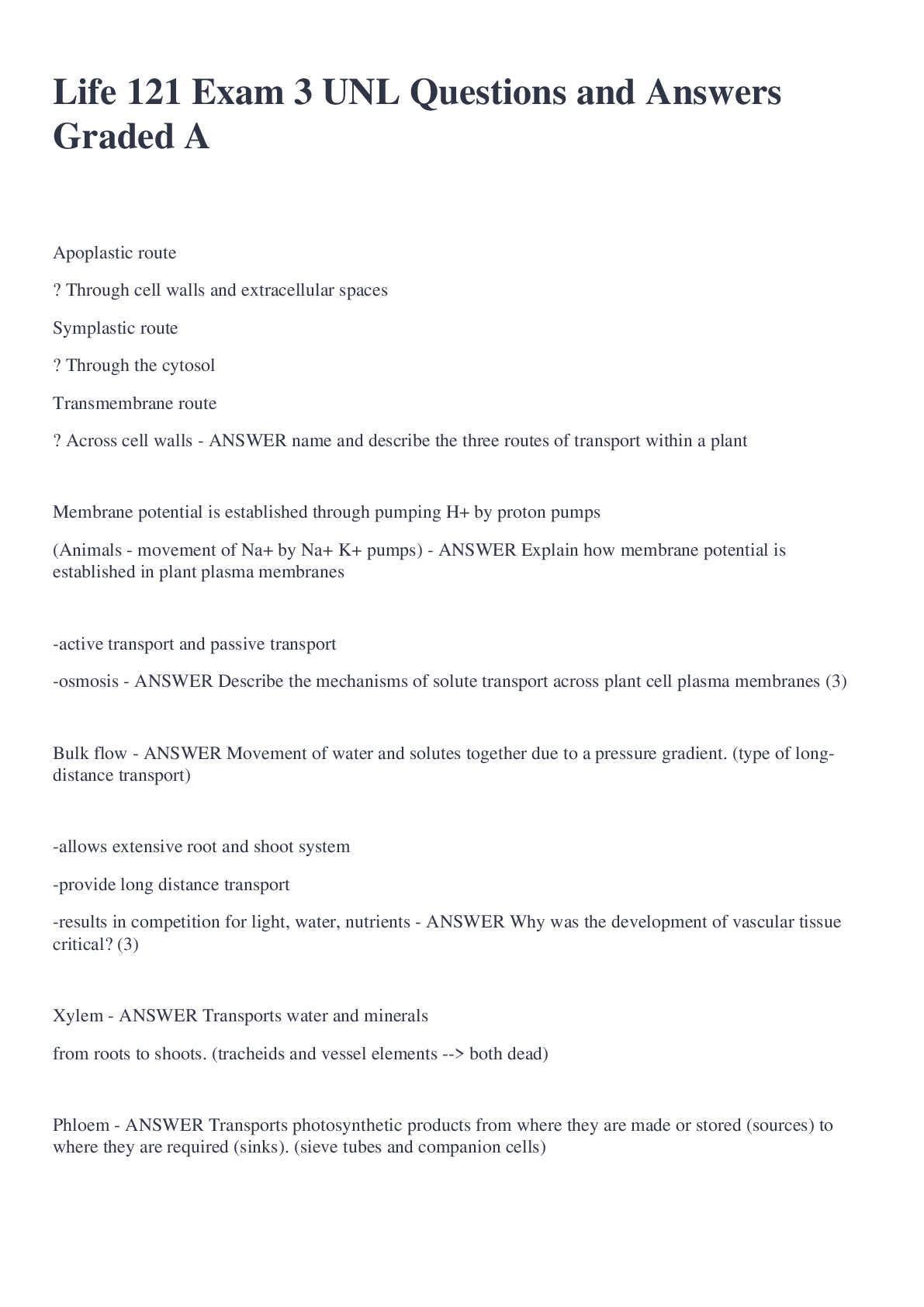
Apoplastic route
▪ Through cell walls and extracellular spaces
Symplastic route
▪ Through the cytosol
Transmembrane route
▪ Across cell walls - ANSWER name and describe the three routes of transport within a plant
...
Apoplastic route
▪ Through cell walls and extracellular spaces
Symplastic route
▪ Through the cytosol
Transmembrane route
▪ Across cell walls - ANSWER name and describe the three routes of transport within a plant
Membrane potential is established through pumping H+ by proton pumps
(Animals - movement of Na+ by Na+ K+ pumps) - ANSWER Explain how membrane potential is established in plant plasma membranes
-active transport and passive transport
-osmosis - ANSWER Describe the mechanisms of solute transport across plant cell plasma membranes (3)
Bulk flow - ANSWER Movement of water and solutes together due to a pressure gradient. (type of long-distance transport)
-allows extensive root and shoot system
-provide long distance transport
-results in competition for light, water, nutrients - ANSWER Why was the development of vascular tissue critical? (3)
Xylem - ANSWER Transports water and minerals
from roots to shoots. (tracheids and vessel elements --> both dead)
Phloem - ANSWER Transports photosynthetic products from where they are made or stored (sources) to where they are required (sinks). (sieve tubes and companion cells)
Apoplast - ANSWER transport pathway that consists of everything external to plasma membrane Cell walls, extracellular spaces, and the interior of vessel. (elements and tracheids)
Symplast - ANSWER transport pathway that consists of the cytosol of the living cells as well as the plasmodesmata.
transmembrane route - ANSWER a transport pathway that transports materials across cell walls.
water potential - ANSWER Water flows from regions of higher water potential to regions of lower water potential. Potential refers to water's capacity to perform work.
-The higher the pressure potential (Ψp), the more potential energy in a system: a positive Ψp increases Ψtotal, while a negative Ψp decreases Ψtotal. - ANSWER How does pressure affect water potential?
-Positive pressure inside cells is contained by the cell wall, producing turgor pressure, which is responsible for maintaining the structure of leaves; absence of turgor pressure causes wilting.
-Pressure potential is controlled by solute potential (when solute potential decreases, pressure potential increases) and the opening and closing of stomata. - ANSWER How does water potential affect the absorption and loss of water in plants?
turgor pressure - ANSWER The pressure exerted by the plasma membrane
against the cell wall
0 - ANSWER water at sea level and room temp is __MPa.
theres a lack of turgor pressure. there is no pressure on the cell walls. Can be reversed when the plant is watered. - ANSWER Why do plants wilt?
Plasmolysis - ANSWER The shrinking of protoplasm away from the cell wall of a plant or bacterium due to water loss from osmosis, thereby resulting in gaps between the cell wall and cell membrane.
Aquaporins - ANSWER Transport proteins in cell membrane that allow H2O passage. Affect rate of water movement across the membrane.
sources: net producer of sugar (mature leaves)
sinks: net consumer or storer of sugar (tuber or bulb) - ANSWER Explain the difference between sugar sources and sinks
translocation - ANSWER the process by which the products of photosynthesis are transported through phloem.
sieve tube - ANSWER The name of the tube that phloem flows through?
vessel - ANSWER the name of the tube that xylem flows through?
the plant will shed some of the sinks. aka the plant will drop flowers, seeds, or fruits (need more sunlight) - ANSWER If there are more sinks than sources, what does the plant do?
xylem - ANSWER transports waters and minerals from roots to shoots.
guard cells. changes in turgor pressure open and close the stomata. High pressure= open. low pressure = closed. - ANSWER What causes the opening and closing of stomata?
Stomata - ANSWER allow exchange of CO2 and O2 b/w air surrounding leaf and photosynthetic cells within a leaf.
regulate transpiration - ANSWER What is the purpose of the stomata?
-germinate quickly during rainy season.
-Xerophytes (highly modified leaves, stems carry out photosynthesis, store water in fleshy stems)
-CAM plants take in CO2 at night and close stomata during the day. - ANSWER What do desert plants do to reduce water loss?
transpiration - ANSWER the process by which moisture is carried through plants from roots to small pores on the underside of leaves, where it changes to vapor and is released to the atmosphere. (evaporation of water from plants)
root hairs absorb water and minerals, that moves through the layers of the plant (epidermis, cortex, and vascular cylinder) and the plant uses active transport to absorb the nutrients. - ANSWER How does the xylem absorb nutrients?
forces water and minerals in apoplast to cross plasma membrane of an endodermal cell to enter the vascular cylinder. (aka the endodermis controls entry to the vascular cylinder) - ANSWER What is the function of the endodermis?
transpiration and water cohesion pull water from shoots to roots. xylem is under negative pressure. - ANSWER how is water drawn up from the trunk of the tree?
Cohesion - ANSWER Water molecules attracted to each other
Pulls column of xylem sap
Adhesion - ANSWER Water molecules stick to hydrophilic walls of xylem cell walls
Offsets the force of gravity
cavitation - ANSWER the formation of a water vapor pocket by a break in the chain of water molecules. Caused by freezing and stress.
Ediacaran fauna - ANSWER earliest fossils. sponges and cnidarian. (leaf looking things)
Cambrian explosion - ANSWER period of evolution where animals developed hard parts and pinchers in reaction to higher rates of predator-prey relationships.
sponges lack true tissue. basal animals. monophyletic. most are marine, sedentary. filter feeders. Can regenerate. - ANSWER Know characteristics of sponges
Morphology, gross & cell anatomy, nutrition Similarity with choanoflagellates
-polyp (adhere to substrate by aboral end)
-medusa (moves freely by drifting and contracting body; medusa is typical jellyfish shape) - ANSWER 2 body types of cnidarians
-predator / prey relationships
-increasing oxygen capacity - ANSWER Explain reasons for increase in bilaterian (bilaterally symmetric form) diversity and decrease in Ediacaran diversity during the Cambrian period
-heterotrophs, multicellular.
-have nerves and muscle cells.
-diploid condition is dominant.
-usually sexual reproduction. - ANSWER Describe characteristics of animals Basic characterisitics
nutrition, reproduction, etc.
clade is defined by DNA similarities. have radial cleavage. (starfish) - ANSWER Characteristics of Deuterostomia
most diverse bilaterian clade. includes molluscs, annelids, and flatworms. - ANSWER Characteristics of Lophotrochozoa
bilaterian clade where animals molt. - ANSWER Characteristics of Ecdysozoa
Arthropods - ANSWER the most successful of all animal phyla. have segmented bodies, hard exoskeleton, and jointed appendages. (bugs)
food source for animals, destroy crops, spread diseases, important pollinators. - ANSWER What makes insects important?
Chordate - ANSWER bilateral symmetry. segmented bodies. have a notochord, dorsal hollow nerve cord, pharyngeal slits, muscular post anal tail.
Vertebrate - ANSWER organism with vertebral column, skull and a head.
Jawless vertebrates - ANSWER hagfishes, lampreys
Gnathostomes ("gnatho" = jaw. "stome" = mouth.) - ANSWER jaw, entire genome duplicated (4 sets of Hox genes), large forebrains (smell and vision), lateral line system (sense vibrations in water).
Chondrichthyans - ANSWER Cartilage fish. 2 mains groups: sharks and ratfishes. Some eat plankton others are carnivores.
Ray-finned fishes - ANSWER "bony fish". ossified endoskeleton. (seahorses, lion fish, eels)
lobe finned fishes - ANSWER have rod shaped bones surrounded by thick layer of muscle in pectoral and pelvic fins. teeth covered by true enamel.
Tiktaalik - ANSWER animal that made the transition to land for tetrapods. Predates earliest known tetrapod by 10 my. (found on the Ellesmere Island in the Canadian Arctic)
Tetrapods - ANSWER support weight on land. 4 limbs with digits. fusion of hips to backbone, ribs, and a neck. Adults lack gills, ears, glands, and other structures.
Amphibians - ANSWER extant basal tetrapods. addiction with damp habitats. skin is permeable to water. ectothermic (have to use environment to regulate body temperature). 3 groups: salamanders and newts, frogs and toads, Caecilians. undergo metamorphosis.
Amniotes - ANSWER basal group of the tetrapods. have amniotic egg. Reptiles and mammals are classified as this.
Reptiles - ANSWER have keratinized scales. internal fertilization. lay leathery shelled eggs on land. ectothermic except for birds.
Birds - ANSWER Largest tetrapod class. endotherms. flight. along w/ crocodiles, only extant species today. descendants of dinos.
Synapsids - ANSWER have a skull and an opening behind each eye. its the ancestor to the mammals.
Mammals - ANSWER have 3 middle ear bones. produce milk. hair.
Monotremes - ANSWER basal mammals. type of mammal that can sense movement. lay eggs. lack nipples. (platypus, echidna)
Marsupials - ANSWER type of mammal that has a pouch. has nipples, placenta, give birth to young. (opossums, kangaroos)
Eutherians - ANSWER type of mammal that has a long pregnancy, complex placentas, and are the largest group of mammals.
Primates - ANSWER clade of animals that has hands and feet, fingerprints, large brains, short jaws, forward looking eyes, parental care. (lemurs, tarsiers, gorillas)
Apes - ANSWER clade of animals that has long arms, short legs, no tail, large brains, flexible behavior. (bonobos, gorillas, gibbons)
Humans - ANSWER clade of animals that stand upright, bipedal, large brains, reduced jawbone and jaw muscle, reduced digestive tract.
Ctenophora - ANSWER "comb jellies".
Diploblastic - ANSWER having 2 embryonic germ layers. (endoderm and ectoderm but no mesoderm)
Tripoblastic - ANSWER 3 germ layers (endoderm, mesoderm, and ectoderm)
Pseudocoelomates - ANSWER "false" body cavity. Body cavity formed from mesoderm and endoderm.
Coelomates - ANSWER "true" body cavity. Space between digestive tract and the outer body wall. formed from mesoderm.
Acoelomates - ANSWER no body cavity. Usually flat organisms.
[Show More]