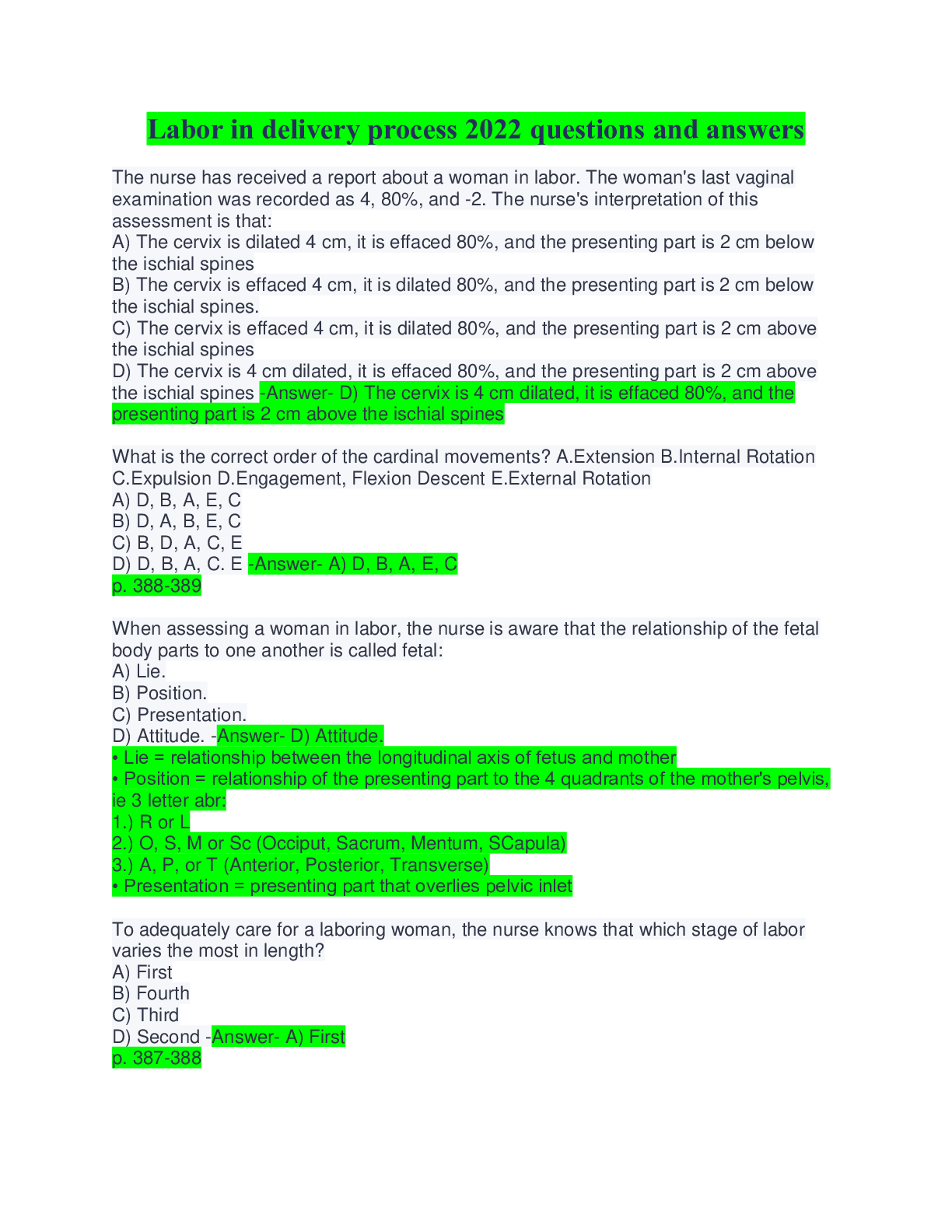
Labor in delivery process 2022 questions and answers
The nurse has received a report about a woman in labor. The woman's last vaginal examination was recorded as 4, 80%, and -2. The nurse's interpretation of this asse
...
Labor in delivery process 2022 questions and answers
The nurse has received a report about a woman in labor. The woman's last vaginal examination was recorded as 4, 80%, and -2. The nurse's interpretation of this assessment is that:
A) The cervix is dilated 4 cm, it is effaced 80%, and the presenting part is 2 cm below the ischial spines
B) The cervix is effaced 4 cm, it is dilated 80%, and the presenting part is 2 cm below the ischial spines.
C) The cervix is effaced 4 cm, it is dilated 80%, and the presenting part is 2 cm above the ischial spines
D) The cervix is 4 cm dilated, it is effaced 80%, and the presenting part is 2 cm above the ischial spines -Answer- D) The cervix is 4 cm dilated, it is effaced 80%, and the presenting part is 2 cm above the ischial spines
What is the correct order of the cardinal movements? A.Extension B.Internal Rotation C.Expulsion D.Engagement, Flexion Descent E.External Rotation
A) D, B, A, E, C
B) D, A, B, E, C
C) B, D, A, C, E
D) D, B, A, C. E -Answer- A) D, B, A, E, C
p. 388-389
When assessing a woman in labor, the nurse is aware that the relationship of the fetal body parts to one another is called fetal:
A) Lie.
B) Position.
C) Presentation.
D) Attitude. -Answer- D) Attitude.
• Lie = relationship between the longitudinal axis of fetus and mother
• Position = relationship of the presenting part to the 4 quadrants of the mother's pelvis, ie 3 letter abr:
1.) R or L
2.) O, S, M or Sc (Occiput, Sacrum, Mentum, SCapula)
3.) A, P, or T (Anterior, Posterior, Transverse)
• Presentation = presenting part that overlies pelvic inlet
To adequately care for a laboring woman, the nurse knows that which stage of labor varies the most in length?
A) First
B) Fourth
C) Third
D) Second -Answer- A) First
p. 387-388
Which position would the nurse suggest for second-stage labor if the pelvic outlet needs to be increased?
A) Sitting
B) Squatting
C) Side-lying
D) Semirecumbent -Answer- B) Squatting
p. 385
When assessing the fetus using Leopold maneuvers, the nurse feels a round, hard, movable fetal part just above the symphysis and a long, smooth surface in the mother's left side close to midline. In the fundus, there is a prominence- when pushed the whole body seems to follow. What is the likely position of the fetus?
A) RSA
B) ROA
C) LSP
D) LOA -Answer- D) LOA
p. 422
With regard to fetal positioning during labor, nurses should be aware that:
A) Birth is imminent when the presenting part is at +4 to +5 cm, below the spine.
B) Engagement is the term used to describe the beginning of labor.
C) The largest transverse diameter of the presenting part is the suboccipitobregmatic diameter.
D) Position is a measure of the degree of descent of the presenting part of the fetus through the birth canal. -Answer- A) Birth is imminent when the presenting part is at +4 to +5 cm, below the spine.
p. 378
• Primary Powers (involuntary uterine contractions) = term used to describe the beginning of labor.
• The largest transverse diameter of the presenting part is the biparietal or occipitomental diameter.
• Station = measure of the degree of descent of the presenting part of the fetus through the birth canal.
Which presentation is described accurately in terms of both presenting part and frequency of occurrence?
A) Cephalic: occiput; at least 95%
B) Cephalic: cranial; 80% to 85%
C) Shoulder: scapula; 10% to 15%
D) Breech: sacrum; 10% to 15% -Answer- A) Cephalic: occiput; at least 95%
p. 377
A client is admitted to the labor and delivery unit with contractions that are 3-5 minutes apart, lasting 60-70 seconds. She reports that she is leaking fluid. A vaginal exam reveals that her cervix is 80 percent effaced and 4 cm dilated and a -1 station. The nurse knows that the client is in which phase and stage of labor?
A) Latent phase, First Stage
B) Active Phase of First Stage
C) Latent phase of Second Stage
D) Transition -Answer- B) Active Phase of First Stage
Second stage = full dilation until birth
To assess uterine contractions the nurse would
A) Asses duration from the beginning of the contraction to the peak of the same contraction, frequency by measuring the time between the beginning of one contraction to the beginning of the next contraction.
B) Assess frequency as the time between the end of one contraction and the beginning of the next contraction, duration as the length of time from the beginning to the end of contractions, and palpate the uterus for strength
C) Assess duration from beginning to end of each contraction. Assess the strength of the contraction by the external fetal monitor reading. Measure frequency by measuring the beginning of one contraction to another.
D) Assess duration from beginning to end of each contraction., frequency by measuring the time between the beginnings of contractions, and palpate the fundus of the uterus for strength. -Answer- D) Assess duration from beginning to end of each contraction., frequency by measuring the time between the beginnings of contractions, and palpate the fundus of the uterus for strength.
p. 453
[Show More]