Wound Closure and Healing
Discuss the relationship between the type of tissue and the appropriate type of suture to be used
Identify characteristics of various types of sutures
Identify characteristics of var
...
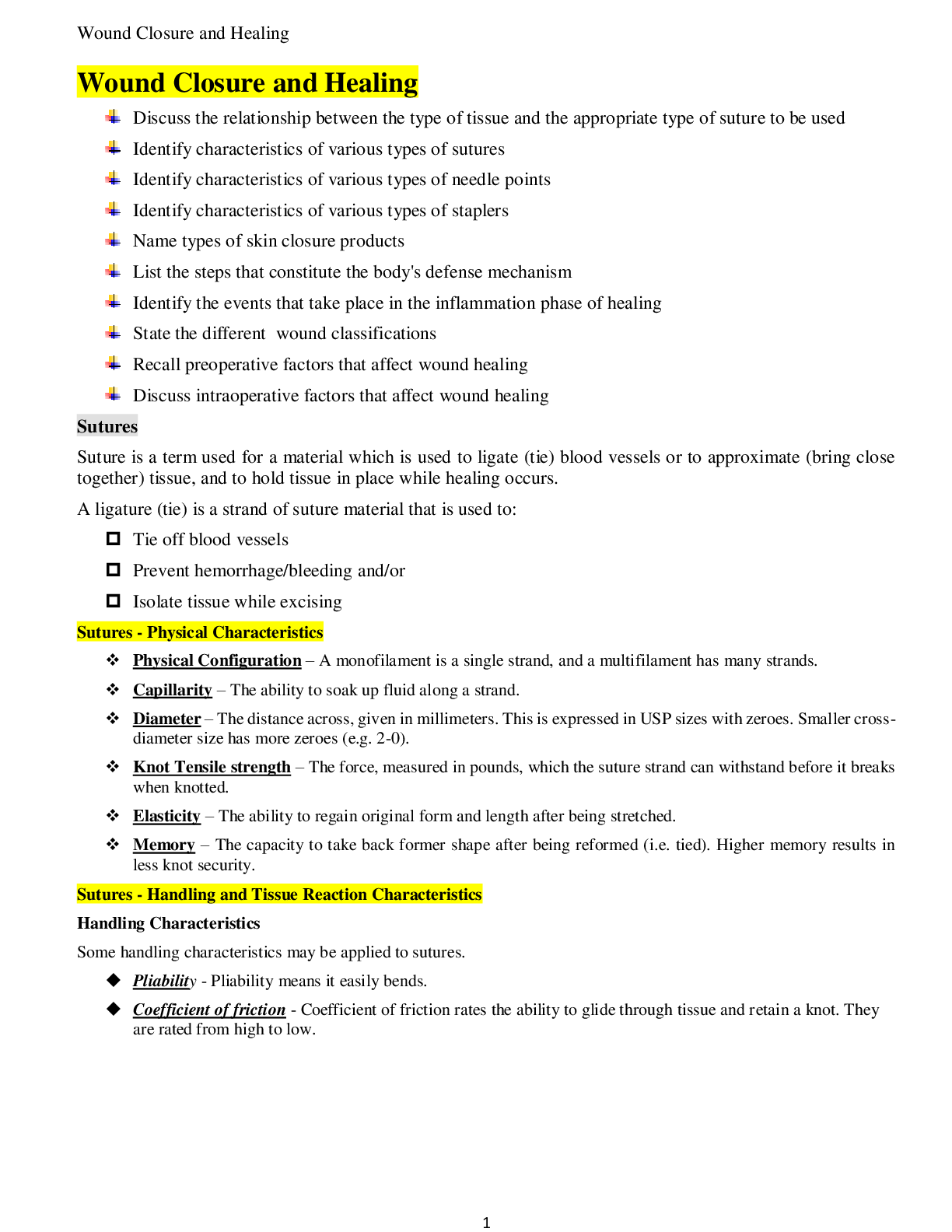
Wound Closure and Healing
Discuss the relationship between the type of tissue and the appropriate type of suture to be used
Identify characteristics of various types of sutures
Identify characteristics of various types of needle points
Identify characteristics of various types of staplers
Name types of skin closure products
List the steps that constitute the body's defense mechanism
Identify the events that take place in the inflammation phase of healing
State the different wound classifications
Recall preoperative factors that affect wound healing
Discuss intraoperative factors that affect wound healing
Sutures
Suture is a term used for a material which is used to ligate (tie) blood vessels or to approximate (bring close together) tissue, and to hold tissue in place while healing occurs.
A ligature (tie) is a strand of suture material that is used to:
Tie off blood vessels
Prevent hemorrhage/bleeding and/or
Isolate tissue while excising
Sutures - Physical Characteristics
Physical Configuration – A monofilament is a single strand, and a multifilament has many strands.
Capillarity – The ability to soak up fluid along a strand.
Diameter – The distance across, given in millimeters. This is expressed in USP sizes with zeroes. Smaller cross-diameter size has more zeroes (e.g. 2-0).
Knot Tensile strength – The force, measured in pounds, which the suture strand can withstand before it breaks when knotted.
Elasticity – The ability to regain original form and length after being stretched.
Memory – The capacity to take back former shape after being reformed (i.e. tied). Higher memory results in less knot security.
Sutures - Handling and Tissue Reaction Characteristics
Handling Characteristics
Some handling characteristics may be applied to sutures.
Pliability - Pliability means it easily bends.
Coefficient of friction - Coefficient of friction rates the ability to glide through tissue and retain a knot. They are rated from high to low.
Tissue Reaction Characteristics
Because they are foreign bodies, sutures cause some reaction.
The body reaction begins during insertion.
The actual reaction is to the type of material – an allergic response.
The inflammatory process/infection may persist until suture becomes encapsulated or absorbed
Main Classifications of Sutures: Sutures are classified into two main types.
Absorbable sutures -
Absorbable sutures are derived from the collagen of healthy animals or from a synthetic polymer.
The material can be digested, hydrolyzed, and/or assimilated by tissue during the healing process.
Nonabsorbable sutures -
Nonabsorbable sutures also are derived from natural or synthetic material.
There is no change to the suture during the healing process.
It becomes encapsulated or must be removed.
Natural Absorbable Sutures (There are two types of natural absorbable sutures commonly used.)
Surgical Gut:
The first type of natural, absorbable suture is surgical gut, which is obtained from collagen, the submucosa layer of the small intestine of sheep or serosa of cattle.
There are two types of surgical gut commonly used as sutures:
1. Plain Catgut (Type A):
Used for subcutaneous and rapidly healing tissues.
Also is used to ligate small vessels and suture subcutaneous fat and tissue under tension while healing.
Its fast-absorbing qualities make it ideal for skin or facial suturing.
Comes in a natural yellow-tan color, dyed blue or black, and in sizes 3 to 6-0.
2. Chromic Gut (Type C):
Treated with chromium salts, which slow the absorption process.
Used in infected tissues and slow-healing tissue, for ligation of larger vessels, biliary, urinary tracts, and muscle and fascia closure.
It comes in dark brown, dyed blue, and black, in sizes 3 to 7-0.
Handling Natural Absorbable Sutures
There are a few guidelines for handling natural absorbable sutures.
Handling surgical gut and collagen requires careful attention.
Both types are packaged in fluid, which may be irritating, particularly to eye tissue.
These sutures should not be opened until needed, as they lose pliability when dried out.
As a precaution, open packages over a small basin to prevent splashing on the field or into the eyes.
When using for ophthalmic cases, suture should be rinsed, but not soaked.
If the suture starts to dry, the material may be restored by quickly immersing in sterile water or normal saline solution that is not above 98.6°F. Do not soak!
Unwind the suture carefully and grasp the ends gently, pulling only to straighten. Excessive handling damages the strands and weakens material.
Characteristics of Synthetic Absorbable Sutures
Synthetic, absorbable sutures made from polymers are also available. These polymers have the following general characteristics:
Dyed or undyed – extruded strands
Monofilament or multifilament
Inert, nonantigenic, and nonpyrogenic
Produce only a mild tissue reaction
Used for ligating or suturing except when tissue is under stress (when tissues are being approximated.)
Broken down by the body by hydrolyzation, a process in which water gradually penetrates the suture filaments
Examples of Synthetic Absorbable Sutures
Synthetic absorbable sutures are made of polymers. Some examples of synthetic absorbable sutures include:
Polydioxanone Examples: "PDS" & "PDS II" sutures
May be used in slow healing tissues and for extended wound support
Applications may include abdominal and thoracic closure, subcutaneous tissue, and colorectal surgery
Polyglyconate Example: "Maxon"
Indicated for soft tissue except cardiovascular, neural, and ophthalmic tissues
Suture comes dyed green or clear, sizes 2 to 7-0.
Polyglactin 910 Example: "Vicryl
Used for ophthalmic procedures and when absorption is desired
Suture is available in two forms:
o Uncoated monofilament or "Vicryl" Suture: It is dyed violet and comes in sizes 9-0 to 10-0.
o Coated multifilament (Coated "Vicryl" Suture): It also comes in dyed violet, in sizes 2 to 9- 0. Undyed comes in sizes 1 to 8-0.
Polyglycolic acid Example: '"Dexon"
Suture used for peritoneal, fascial, and subcutaneous closure
It replaces surgical gut in many applications
The suture is prepared in the following ways:
o Uncoated or "Dexon S" suture - comes dyed green, in sizes 2 to 8-0. The undyed is natural beige and comes in sizes 2 to 7-0. There also is a dyed green monofilament which comes in size 9-0
o Coated or "Dexon Plus" suture - has a surfactant covering that is slick. It requires extra knots, and is cut longer than usual. It is available in the same sizes and colors as the uncoated.
Handling Synthetic Polymers
There are a few guidelines for handling synthetic polymers.
The expiration date is on the package.
It is important to rotate stock forward.
These sutures are packaged and used dry.
Do not soak or dip them in water or saline. This causes hydrolysis and reduction of tensile strength.
These sutures retain their pliability and are smooth and soft.
[Show More]