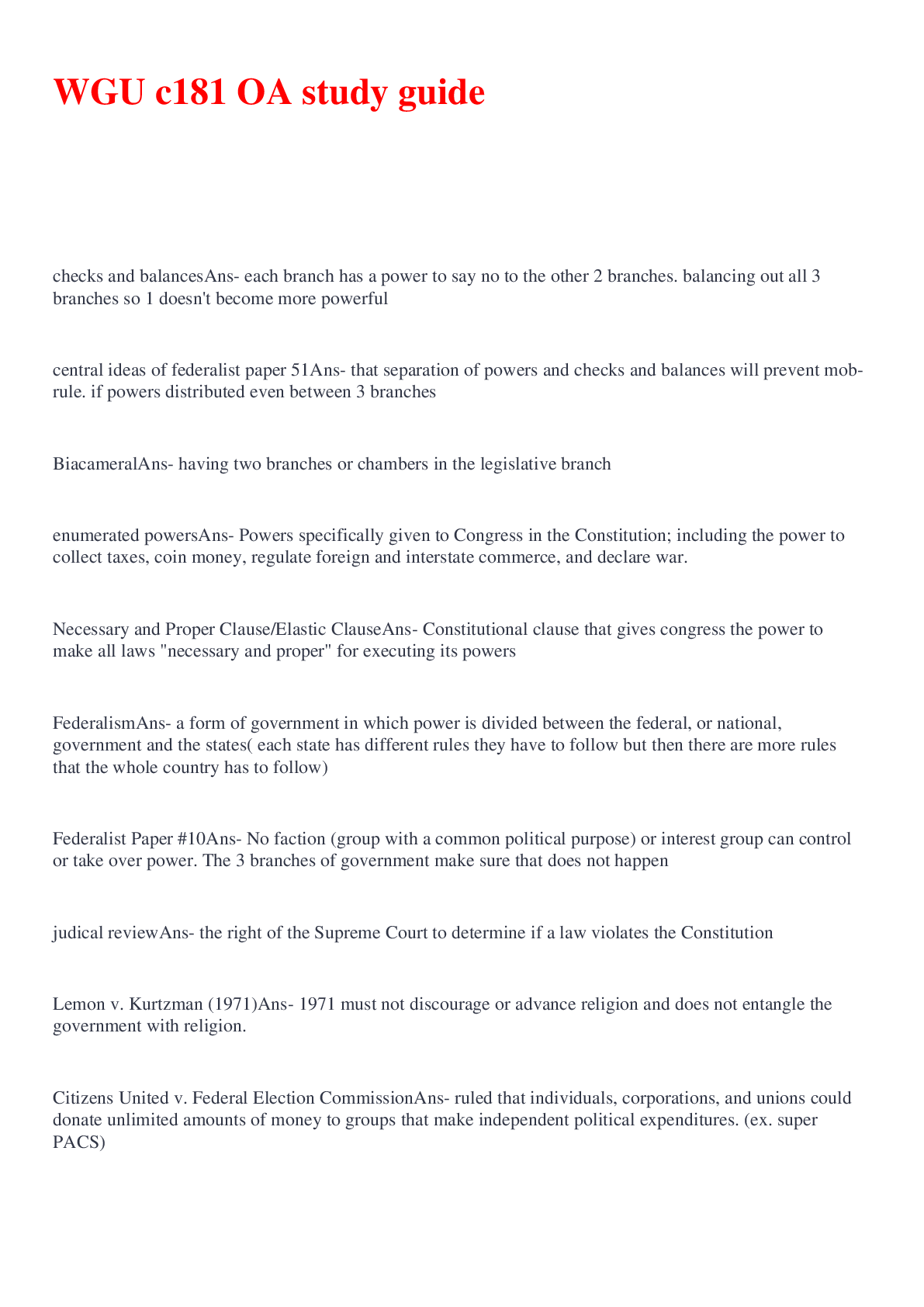
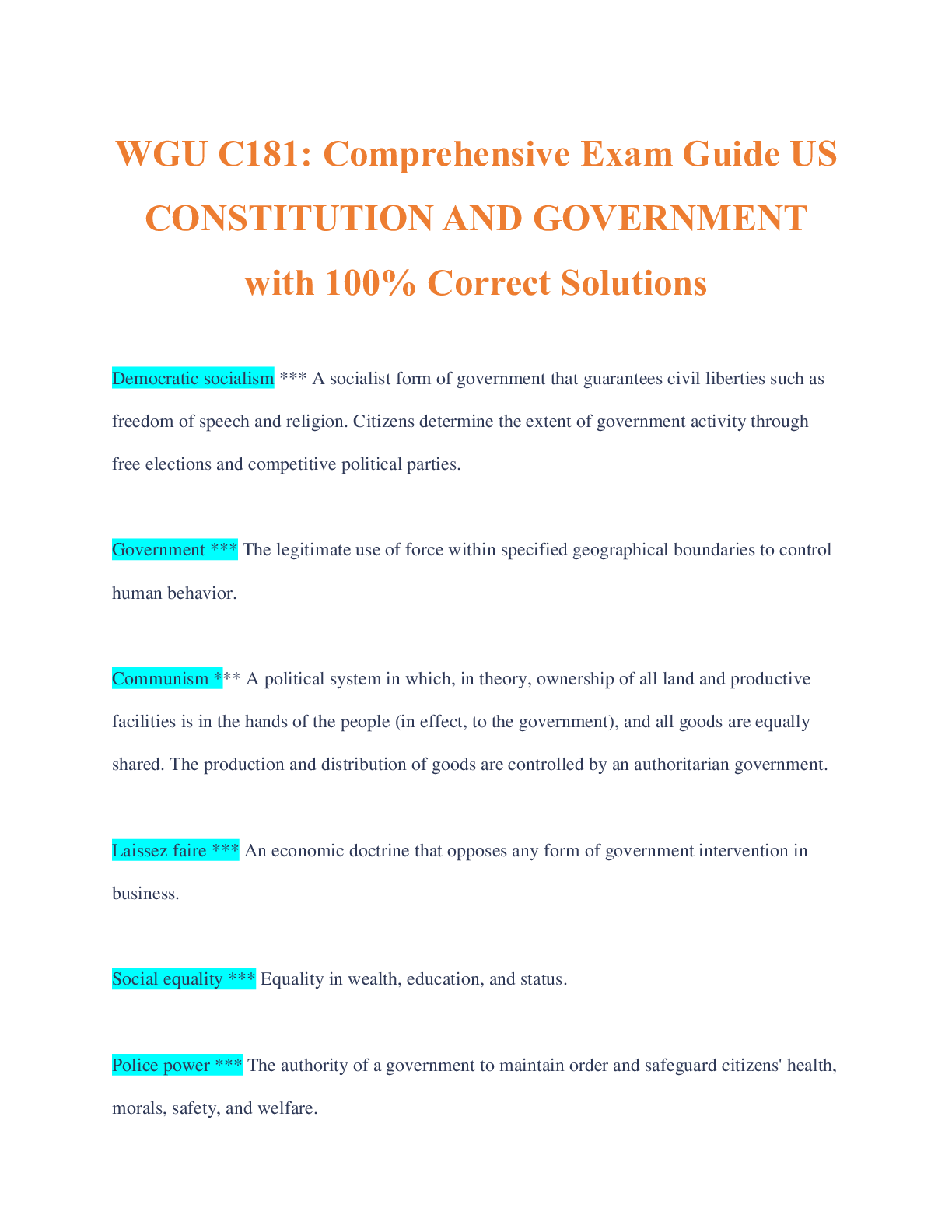
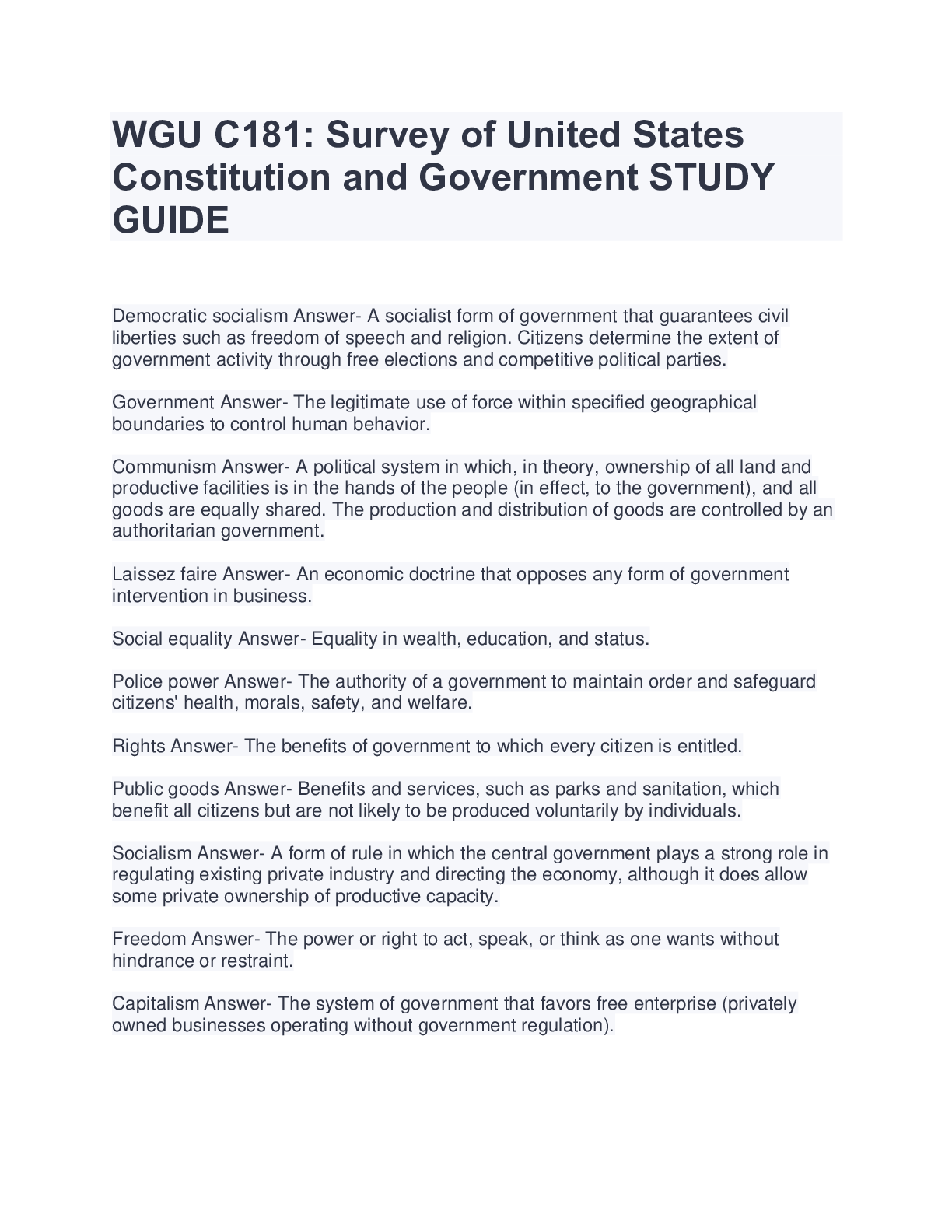
Maintaining Order Ans- Preserving life and protecting property, establishing basic order Providing public goods Ans- benefits and services available to everyone, such as education, sanitation, and p ... arks promoting equality Ans- Ensuring individuals or groups are not treated differently on the basis of their specific protected characteristics Liberalism according to John Locke Ans- The belief that states should leave individuals free to follow their individual pursuits What is the purpose of government according to john lockes philosophy of liberalism Ans- the protection of life, liberty, and property what three values are considered to be foundational to american government Ansfreedom, order and equality political equiality Ans- equality in political decision making, one vote per person with all votes counted equally Social equality Ans- equality in wealth, education, and status How does the US constitution guarantee political equality Ans- prohibits titles of nobility and does not make owning property a requirement for holding public office the original dilemma Ans- freedom vs order example of original dilemma Ans- mandatory testing for HIV/AIDS Modern dilemma Ans- Freedom vs. Equality example of freedom vs equality Ans- mandating that buses and trains are accessible to people with disabilties political ideology Ans- a consistent set of values and beliefs about the proper purpose and scope of government Totalitarianism Ans- belief that government should have unlimited power anarchism Ans- opposes government in any form Capitalism Ans- supports free enterprise Socialism Ans- central government plays strong role in regulating existing private industry and directing the economy What kind of economic system would libertarians support Ans- Laissez Faire Direct democracy Ans- rank-and file citizen rule themselves rather than electing representatives to govern on their behalf Indirect Democracy Ans- system of government where citizen elect public officials to govern on their behalf Social contract theory Ans- people agree to set up rulers for certain purposes and thus have the right to resist or remove rulers who act against these purposes Republic Ans- A government without a monarch; a government rooted in the consent of the governed, whose power is exercised by elected representatives responsible to the governed Under a confederation who has more power? (states or national governemnt?) AnsState government What powers did the states have under the article of confederation Ans- retain their sovereignty, which means that each has supreme power within it's boarders. The central government is weak, can only coordinate not control Major weakness of the articles of confederation Ans- 1. No ability to tax 2. No leadership position to direct the government 3. Did not allow the national government to regulate interstate and foreign commerce 4. could not be amended without the unaimous agreement of the congress Shay's rebellion Ans- demonstrated the weakness of the articles of confederation Virgina Plan Ans- Separation of government into three branches, division of the legislature into two houses and proportional representation in the legislature New Jersey Plan Ans- Single chamber legislature have the power to raise revenue and regulate commerce. Great Compromise Ans- House according to population, States represented equally The 4 elements of the preamble Ans- 1. Creates a people 2. explains the reason for the constitution 3. Articulates goals 4. Fashions a government 4 basic princples of the US constitution Ans- 1. republicanism 2. federalism 3. separation of powers 4. checks and balances Checks and balances Ans- gives each branch of the government some scrutiny of and control over the other branches to prevent the exclusive exercise of certain powers by any one of the three branches Supremacy clause Ans- In article 6 of the constitution that asserts that national laws take precedence over state laws when they conflict Enumerate powers Ans- the powers specifically granted to congress by the constitution Necessary and Proper Clause Ans- the last clause in section 8 of article I, which gives congress the means to execute the enumerate powers this is also called the elastic clause Article I Ans- What congress can and cant do and the qualifications of congress Article II Ans- What the president can and can't do and the qualifications for presidency Article III Ans- what the courts can/can't do, qualifications for supreme and smaller courts Article IV Ans- The people live under both national and state governments, the states have power to both independently and shared with the national government Article V Ans- process to change (amend) the constitution Article VI Ans- how and why the constitution rules Article VII Ans- ratification- how constitution was approved Federalists Ans- proponents of the new charter, and they wanted a strong national government Anti-Federalists Ans- opponents of the constitution and they wanted to protect the states from tyranny of a strong national government Federalist paper #10 Ans- Written by James Madison, stated proposed government was not likely to be dominated by any faction, and that they key to mending evils of factions is to have a large republic. the larger the better. Federalist paper #51 Ans- James Madison, Argued that the separation of powers and checks and balances would control efforts of tyranny. Ratification of US constitution Ans- ratified by 9 states, officially took effect after bill of rights were added as amendments The chief obstacle to ratification of the Constitution by the states was Ans- omission of a bill of rights How long did it take for bill of rights to be ratified Ans- 3 years passed in 1791 Federalism Ans- division of powers between central and regional governemnts Dual Federalism Ans- the constitution is a compact among sovereign states, so that the powers of government and the states are clearly differentiated Cooperative Federalism Ans- constitution is an agreement among people who are citizens of both state and nation, so there is much overlap between state power and national powers McCulloch v. Maryland Ans- Maryland was trying to tax the national bank and Supreme Court ruled that federal law was stronger than the state law Commerce Clause Ans- a provision of the US constitution that grants congress the ability to regulate commerce relationships between foreign countries, states, and indian tribes Interstate Commerce Ans- trades between states are regulated by federal government as stated in article 1 of the constitution Grants in aid Ans- an amount of money given to a local government, an institution, or a particular scholar. mandates Ans- a requirement that a state undertake an activity or provide a service, in keeping with minimum national standards preemption Ans- The power of Congress to enact laws by which the national government assumes total or partial responsibility for a state government function. Majoritarianism Ans- Government should do what the majority of the people want Pluralism Ans- public does not demonstrate clear, consistent opinions, and that the government should instead listen to interest groups political socialization Ans- complex process in which people acquire their political values Primary Structuring Ans- what is learned first is learned best Structuring principle Ans- What is learned first structures learning later 3 key agents of political socilization Ans- 1. Family 2. School 3. Community/peers party identification Ans- often learned by parents all minority groups are______likely that whites to support government action to improve economic opportunity Ans- more likely Minority groups tend to favor Ans- Equality over freedom and freedom over order Gatekeepers Ans- decide which events to report and how to handle the elements in those stories horse race journalism Ans- focus on who is ahead watch dog journalism Ans- journalism that scrutinizes public and business institutions and publicizes perceived misconduct Conventional participation Ans- relatively routine political behavior that uses institutional channels and is acceptable to the dominant culture, voting writer letters unconventional participation Ans- relatively uncommon behavior that challenges or defies established institutions or dominate culture (riots, linking arms to prevent entrance, in your face) Less risky participation Ans- conventional african american's right to vote Ans- 15th Amendment Women's right to vote Ans- 19th amendment Lowered voting age to 18 Ans- 26th Amendment structuring the vote choice Ans- The idea of reducing the number of candidates on the ballot to those who have a realistic chance of winning 12th amendment Ans- provided the separate ballots are used for president and vice president, more rules for electing a president. Electoral votes required to win the presidency Ans- 270 interest group Ans- organized body of individuals who share some political goals and try to influence public policy decisions Agenda building Ans- the process by which new issues are brought into the political limelight program monitoring Ans- keeping track of government programs, usually done by interest groups Redistricting Ans- divide or organize an area into new political or school districts Reapportionment Ans- redistribution of representation in a legislative body, according to changes in census Gerrymandering Ans- manipulated the boundaries of an electoral constituency so a to favor one party or class Formal powers of the president Ans- 1. serve as administrative head of the nation 2. act as commander in chief of the military 3. Veto legislation 4. appoint various officals 5. make treaties Executive order Ans- a rule or order issued by the president to an executive branch of [Show More]
Last updated: 3 years ago
Preview 1 out of 9 pages
Buy this document to get the full access instantly
Instant Download Access after purchase
Buy NowInstant download
We Accept:
Can't find what you want? Try our AI powered Search
Connected school, study & course
About the document
Uploaded On
Aug 25, 2022
Number of pages
9
Written in
All
This document has been written for:
Uploaded
Aug 25, 2022
Downloads
0
Views
62
Scholarfriends.com Online Platform by Browsegrades Inc. 651N South Broad St, Middletown DE. United States.
We're available through e-mail, Twitter, and live chat.
FAQ
Questions? Leave a message!
Copyright © Scholarfriends · High quality services·