Leadership is best defined as:
a. an interpersonal process of participating by encouraging fellowship.
b.
delegation of authority and responsibility and the coordination of activities.
c. inspiring people to accompli
...
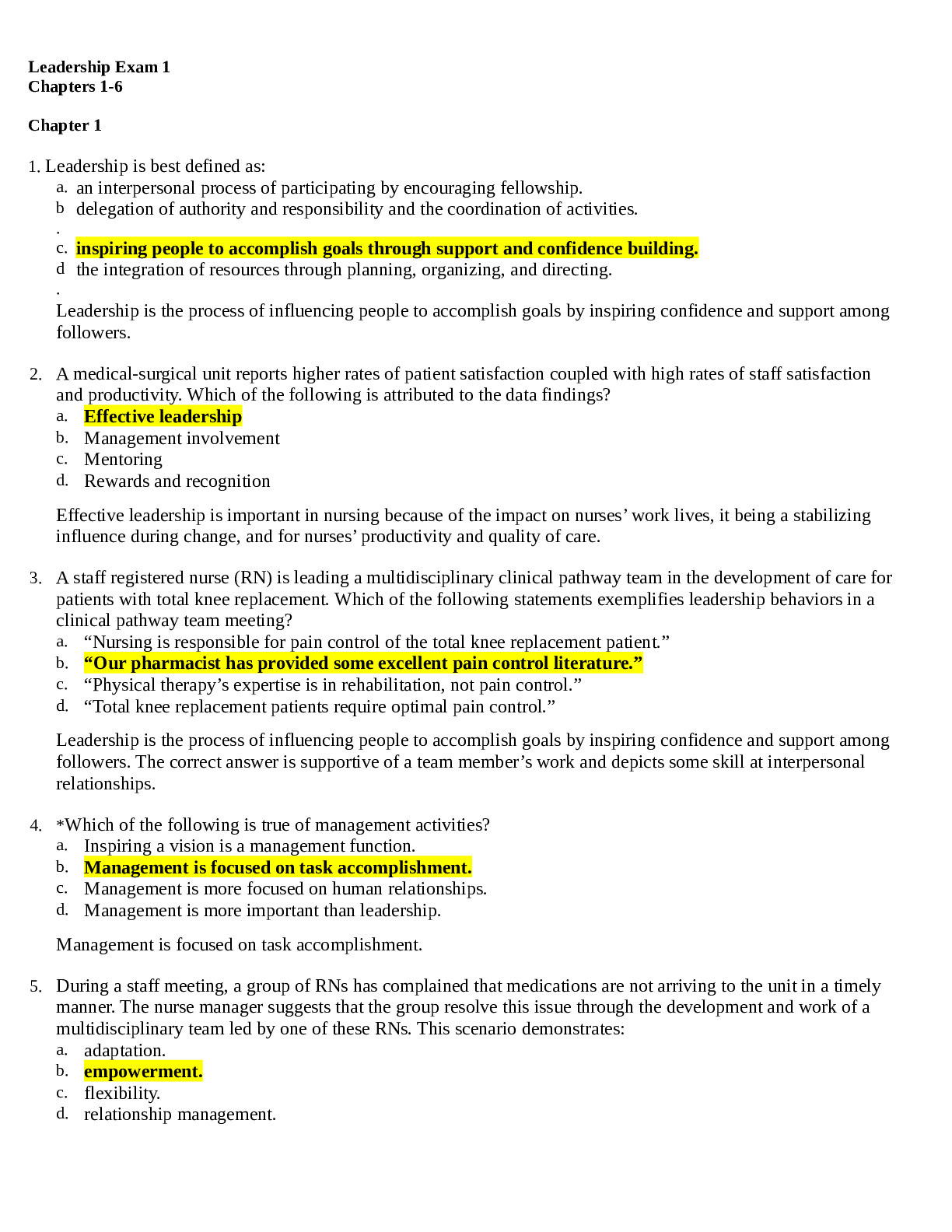
Leadership is best defined as:
a. an interpersonal process of participating by encouraging fellowship.
b.
delegation of authority and responsibility and the coordination of activities.
c. inspiring people to accomplish goals through support and confidence building.
d.
the integration of resources through planning, organizing, and directing.
Leadership is the process of influencing people to accomplish goals by inspiring confidence and support among
followers.
2. A medical-surgical unit reports higher rates of patient satisfaction coupled with high rates of staff satisfaction
and productivity. Which of the following is attributed to the data findings?
a. Effective leadership
b. Management involvement
c. Mentoring
d. Rewards and recognition
Effective leadership is important in nursing because of the impact on nurses’ work lives, it being a stabilizing
influence during change, and for nurses’ productivity and quality of care.
3. A staff registered nurse (RN) is leading a multidisciplinary clinical pathway team in the development of care for
patients with total knee replacement. Which of the following statements exemplifies leadership behaviors in a
clinical pathway team meeting?
a. “Nursing is responsible for pain control of the total knee replacement patient.”
b. “Our pharmacist has provided some excellent pain control literature.”
c. “Physical therapy’s expertise is in rehabilitation, not pain control.”
d. “Total knee replacement patients require optimal pain control.”
Leadership is the process of influencing people to accomplish goals by inspiring confidence and support among
followers. The correct answer is supportive of a team member’s work and depicts some skill at interpersonal
relationships.
4. *Which of the following is true of management activities?
a. Inspiring a vision is a management function.
b. Management is focused on task accomplishment.
c. Management is more focused on human relationships.
d. Management is more important than leadership.
Management is focused on task accomplishment.
5. During a staff meeting, a group of RNs has complained that medications are not arriving to the unit in a timely
manner. The nurse manager suggests that the group resolve this issue through the development and work of a
multidisciplinary team led by one of these RNs. This scenario demonstrates:
a. adaptation.
b. empowerment.
c. flexibility.
d. relationship management.Empowerment is the giving of authority, responsibility, and the freedom to act. In this situation, the manager has
given authority, responsibility, and the freedom to act in the investigation and resolution of this issue.
6. *A nurse is caring for an elderly patient who was admitted after sustaining a fall at home. When creating a care
plan for the patient, she requests that the doctor order a home health visit to assess for home safety and
medication compliance. In addition, the nurse is concerned about the nutrition of the patient and requests a
dietitian evaluation. The nurse is demonstrating which of the following leadership skills?
a. Care provider
b. Business principles
c. Care coordination
d. Change management
Care coordination is the delivery of nursing services that involves the organization and coordination of complex
activities. The nurse uses managerial and leadership skills to facilitate delivery of quality care.
7. Interpersonal communication and the ability to apply _____ are two critical skills every nurse needs to enhance
professional practice.
a. vision
b. supervision
c. delegation
d. problem solving
Every nurse needs two critical skills to enhance professional practice. One is a skill at interpersonal
relationships. This is fundamental to leadership and the work of nursing. The second skill is applying the
problem-solving process. This involves critical thinking, problem identification, and the development of
objectivity.
8. Good leaders need to be able to demonstrate an intuitive skill of empathy and expressiveness when dealing with
others in the workplace. This requires sensitivity and awareness of the emotions and moods of others and is
known as:
a. social awareness.
b. self-awareness.
c. self-management.
d. relationship management.
Social awareness is an intuitive skill of empathy and expressiveness in being sensitive and aware of the
emotions and moods of others.
9. *The personal leadership skill for nurses that consists of self-awareness, discipline, motivation, social
awareness, and relationship management is known as what?
a. Leadership.
b. Management.
c. Emotional intelligence
d. Vision
Among the important personal leadership skills for nurses is emotional intelligence (EI). EI traits are emotional
factors consisting of five defining attributes: self-awareness, self-regulation or discipline, motivation, social
awareness, and relationship management.
10. _____ are vital to good leaders because they are able to take the vision of the leader and achieve the determined
goals.
a. Managers
b. Motivators
c. Visionariesd. Followers
Without followers, there is no leadership. Followers are vital because they accept or reject the leader and
determine the leader’s personal power.
11. The best leadership style for unfavorable conditions is:
a. leader–member relations.
b. task-oriented structure.
c. position power.
d. laissez-faire.
The need for task-oriented leaders occurs when the situation is extreme. The best leadership style for
unfavorable conditions is task-oriented.
12. Nursing management is defined as:
a. delegation of authority and responsibility and the coordination of tasks.
b.
the integration of resources through planning, organizing, and directing.
c. the process of influencing patients to accomplish goals.
d.
the coordination and integration of nursing resources by applying the management process to
accomplish nursing care and service goals and objectives.
The coordination and integration of nursing resources by applying the management process to accomplish
nursing care and service goals and objectives is the definition of nursing management.
13. *A nursing unit has demonstrated lower patient satisfaction scores during the last quarter. The manager of the
unit has formed a small team to set long- and short-term goals for the unit with action plans to increase patient
satisfaction. This is an example of which management process?
a. Planning
b. Organizing
c. Coordinating
d. Controlling
Planning is the managerial function of selecting priorities, results, and methods to achieve results.
14. A nursing unit has discovered a series of medication errors with regard to a particular computerized physician
order set and the calculation within the order. The unit manager has a theory on changes that should be made
within the order to decrease the confusion for nursing staff. However, the nurse manager realizes that changes
would need to be made with pharmacy input as well as other nursing units within the facility and the
multihospital system. Which of the following management theories is exemplified when the nurse manager
considers the impact of change on the organization as a whole?
a. Contingency theory
b. Systems theory
c. Complexity theory
d. Chaos theory
Systems theory helps managers recognize their work as being embedded within a system. Managers use this
theory to learn that changing one part of a system inevitably affects the whole system.
15. *The role of the _____ is to provide leadership and direction for all aspects of nursing services with a focus on
integrating the system and building a culture.
a. nurse manager
b. care provider
c. nurse executive
d. senior leader
[Show More]