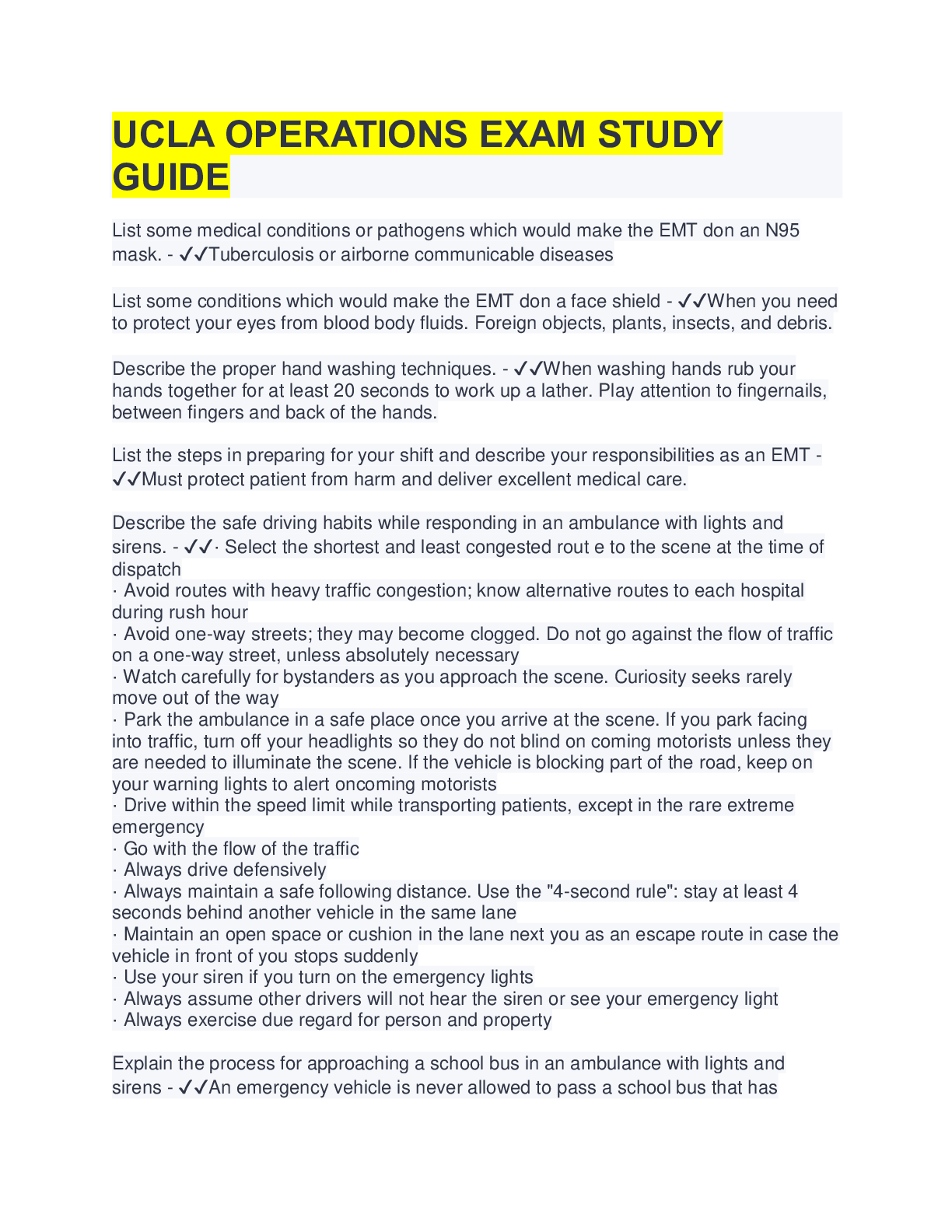
UCLA OPERATIONS EXAM STUDY
GUIDE
List some medical conditions or pathogens which would make the EMT don an N95
mask. - ✔✔Tuberculosis or airborne communicable diseases
List some conditions which would make the EMT do
...
UCLA OPERATIONS EXAM STUDY
GUIDE
List some medical conditions or pathogens which would make the EMT don an N95
mask. - ✔✔Tuberculosis or airborne communicable diseases
List some conditions which would make the EMT don a face shield - ✔✔When you need
to protect your eyes from blood body fluids. Foreign objects, plants, insects, and debris.
Describe the proper hand washing techniques. - ✔✔When washing hands rub your
hands together for at least 20 seconds to work up a lather. Play attention to fingernails,
between fingers and back of the hands.
List the steps in preparing for your shift and describe your responsibilities as an EMT -
✔✔Must protect patient from harm and deliver excellent medical care.
Describe the safe driving habits while responding in an ambulance with lights and
sirens. - ✔✔· Select the shortest and least congested rout e to the scene at the time of
dispatch
· Avoid routes with heavy traffic congestion; know alternative routes to each hospital
during rush hour
· Avoid one-way streets; they may become clogged. Do not go against the flow of traffic
on a one-way street, unless absolutely necessary
· Watch carefully for bystanders as you approach the scene. Curiosity seeks rarely
move out of the way
· Park the ambulance in a safe place once you arrive at the scene. If you park facing
into traffic, turn off your headlights so they do not blind on coming motorists unless they
are needed to illuminate the scene. If the vehicle is blocking part of the road, keep on
your warning lights to alert oncoming motorists
· Drive within the speed limit while transporting patients, except in the rare extreme
emergency
· Go with the flow of the traffic
· Always drive defensively
· Always maintain a safe following distance. Use the "4-second rule": stay at least 4
seconds behind another vehicle in the same lane
· Maintain an open space or cushion in the lane next you as an escape route in case the
vehicle in front of you stops suddenly
· Use your siren if you turn on the emergency lights
· Always assume other drivers will not hear the siren or see your emergency light
· Always exercise due regard for person and property
Explain the process for approaching a school bus in an ambulance with lights and
sirens - ✔✔An emergency vehicle is never allowed to pass a school bus that has
stopped to load or unload children and is displaying its flashing red lights or extended
"stop arm"
Should turn off sirens and wait till flashing lights are off
Describe the type of patient who would benefit from helicopter transport - ✔✔Patients
with time dependent injuries and illnesses. Ex: stroke, heart attack, spinal cord, scuba
diving incidents, near drowning, skiing and wilderness accidents, trauma patients
candidates for limb replacements, burn center, hyperbolic chamber
List techniques to improve radio communication - ✔✔Organize radio communication
before pushing the transmit button
Accurate patient report
Ensure a clear frequency before speaking
Wait 1 second before speaking
Clear, calm, and monotone voice
Keep it brief and use clear text
Don't say please, thank you, and you're welcome
Use affirmative and negative instead of yes or no
Say over when finished transmitting
Do not provide diagnosis
List the components which are assessed during scene size up - ✔✔Gain big picture
perspective of the call, determine whether it is safe to proceed, are additional resources
needed, and identify the initial approach to mitigate the emergency
List the resources an EMT has to help identify an unknown hazardous material -
✔✔Place cards can tell you if there is hazardous materials around and a hazardous
material team can be called to help out
Describe additional resources which may be required to assist the EMS provider -
✔✔Firefighters, utility workers, hazardous materials technicians, and law enforcement
personel
Discuss the importance of patient management at the scene of a crime and how the
EMT would go about moving items found at the crime scene - ✔✔Have to be careful
about moving items found on a crime scene. CPR and Appropriate treatment must be
given unless obvious signs of death
Explain some scene findings which would make the EMT think there was the presence
of a weapon of mass destruction - ✔✔Type of Location- temple? Large Gathering?
Special Events?
Type of Call- report of explosion or suspicious device nearby? Reports of people fleeing
the scene?
Number of Patients- Multiple victims with similar symptoms?
Victims' Statements- What are victims saying?(Ex: everyone is passing out)
Preincident indicators- credible threats? Increase in violent political activism?
Describe the steps of the primary assessment including treatment that would need to be
taken. - ✔✔A-Airway-> should be open and patent. If unconsious fix asap
B-Breathing-> Rate(respiratory rate), Rhythm(should have an equal rhythm), and
quality(difficulty breathing)C-Circulation-> Pulse(B), Skin Parameters (color, texture, and
moisture)
List the order of operations when arriving on scene and assessing a patient - ✔✔Scene
Size-up à Primary Assessment à History Taking à Secondary Assessment: Medical or
Trauma à Reassessment
Describe the proper technique for lifting and moving a patient - ✔✔Power Lift
· Tighten your back in its normal upright position, and use abs to lock it in a slight curve
· Spread legs apart about 15in and bend legs to lower torso and arms
· With arms extended down each side of the body, grasp the stretcher with your hands
held palm up and just in front of the plane described by the anterior torso and imaginary
lines extending vertically from it to the ground
· Adjust your orientation and position until the weight is balanced and cerntered
between both arms
· Reposition your feet make sure they are flat and do not bend more than 90 deg an do
not extend past your toes
· With the arms extended downward lift by straightening your legs until you are fully
standing. Make sure your back is held upright and that your upper body comes up
before your hips
List the criteria for a rapid extrication of a patient - ✔✔· The vehicle or scene is unsafe
· Explosives or other hazardous materials are on the scene
· There is a fire or a danger fire
· The patient cannot be properly assessed before being removed from the vehicle
· The patient needs immediate intervention that requires a supine position
· The patient has a life-threatening condition that requires rapid transport to the hospital
· The patient blocks your access to another seriously injured patient
Describe the process for making patient contact when the patient is in a vehicle and the
doors cannot be opened - ✔✔Should break a side mirror with a spring-loaded window
breaker
Explain the proper place to dispose of a sharps - ✔✔· Do not recap, break, or bend
needles. Even the most careful providers may expose themselves through an accidental
needlestick
· Dispose of all sharp items that have been in contact with human secretions in
approved, closed, rigid containers
[Show More]