Econ 201 WVU Final Exam
In a competitive market, no single producer can influence the market price because
a. many other sellers are offering a product that is essentially identical.
b. consumers have more influence o
...
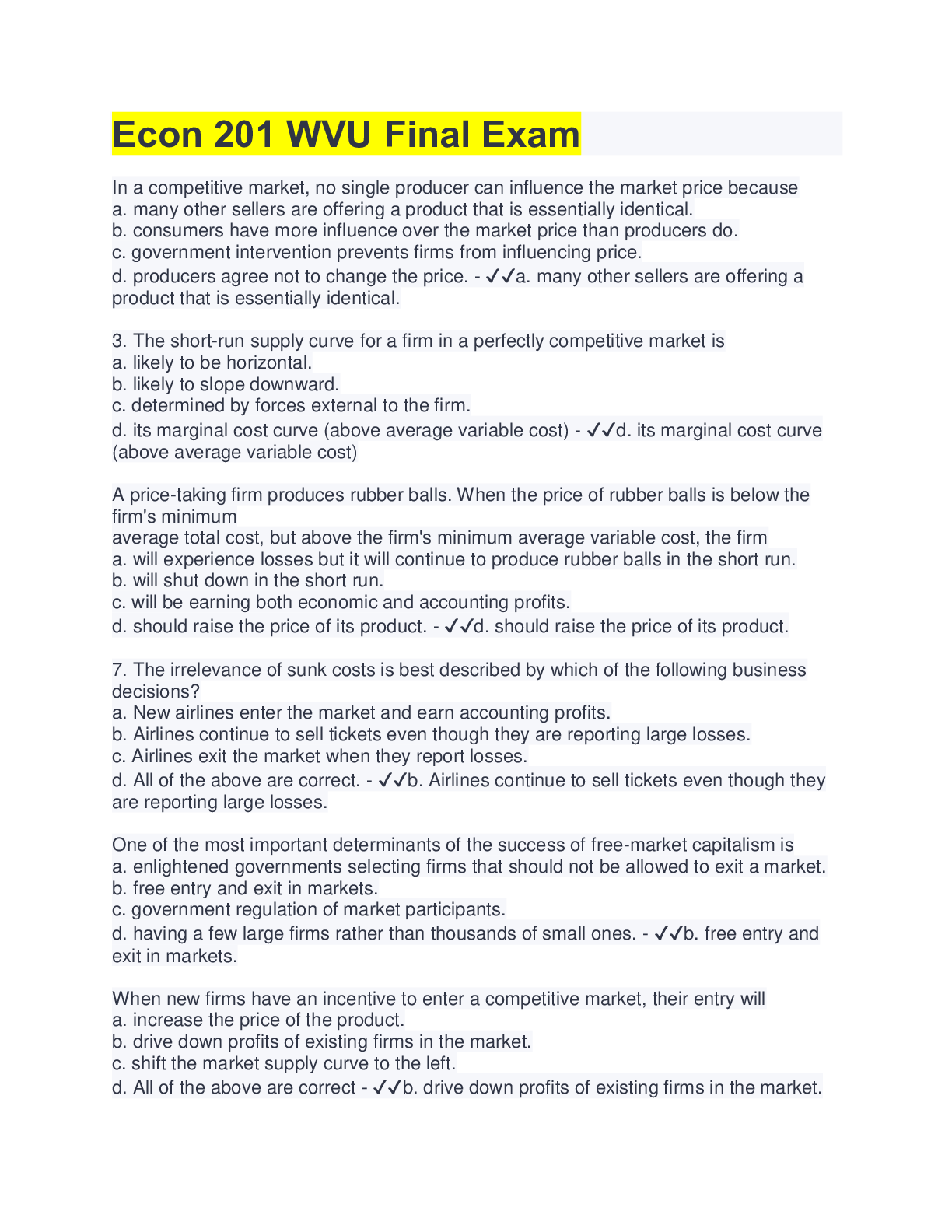
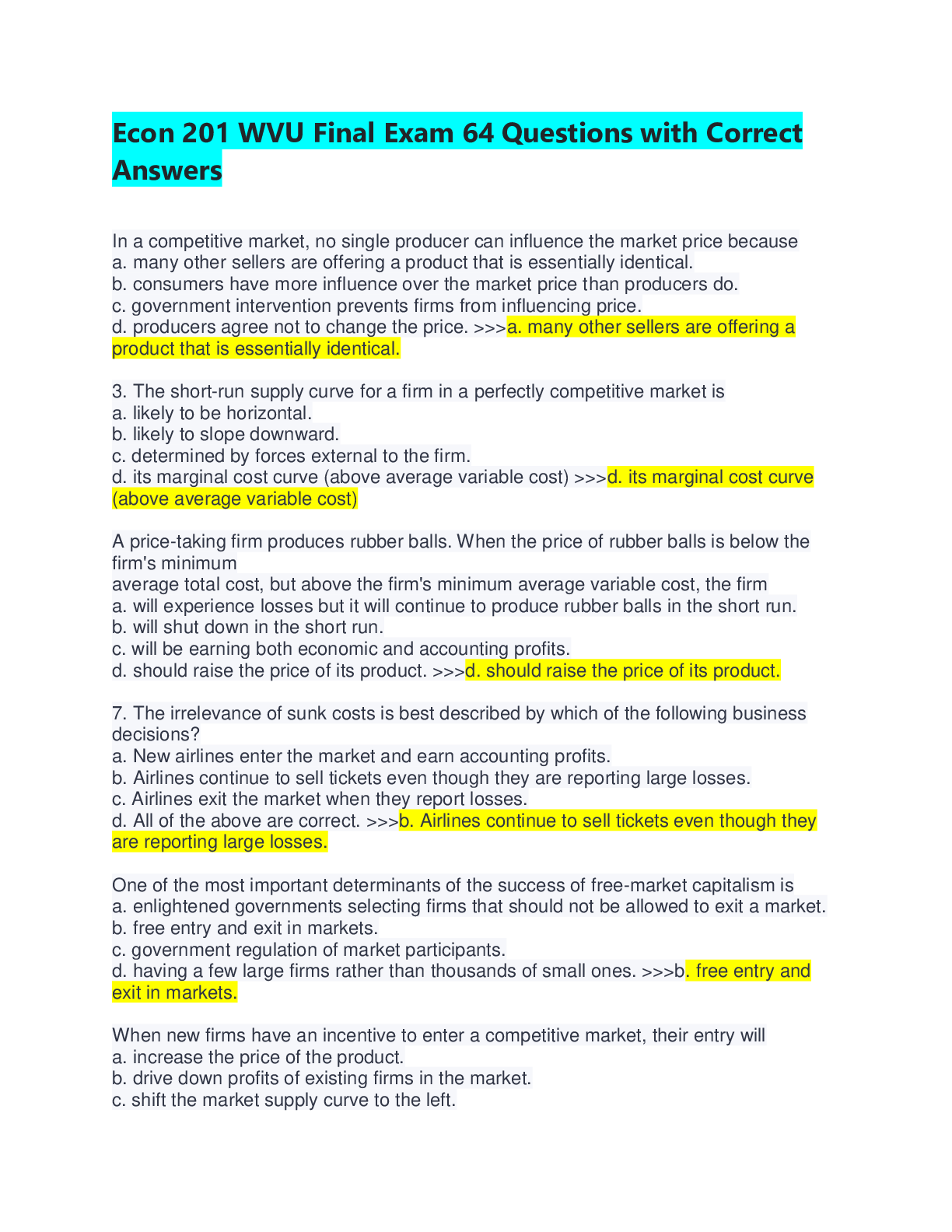
Econ 201 WVU Final Exam
In a competitive market, no single producer can influence the market price because
a. many other sellers are offering a product that is essentially identical.
b. consumers have more influence over the market price than producers do.
c. government intervention prevents firms from influencing price.
d. producers agree not to change the price. - ✔✔a. many other sellers are offering a
product that is essentially identical.
3. The short-run supply curve for a firm in a perfectly competitive market is
a. likely to be horizontal.
b. likely to slope downward.
c. determined by forces external to the firm.
d. its marginal cost curve (above average variable cost) - ✔✔d. its marginal cost curve
(above average variable cost)
A price-taking firm produces rubber balls. When the price of rubber balls is below the
firm's minimum
average total cost, but above the firm's minimum average variable cost, the firm
a. will experience losses but it will continue to produce rubber balls in the short run.
b. will shut down in the short run.
c. will be earning both economic and accounting profits.
d. should raise the price of its product. - ✔✔d. should raise the price of its product.
7. The irrelevance of sunk costs is best described by which of the following business
decisions?
a. New airlines enter the market and earn accounting profits.
b. Airlines continue to sell tickets even though they are reporting large losses.
c. Airlines exit the market when they report losses.
d. All of the above are correct. - ✔✔b. Airlines continue to sell tickets even though they
are reporting large losses.
One of the most important determinants of the success of free-market capitalism is
a. enlightened governments selecting firms that should not be allowed to exit a market.
b. free entry and exit in markets.
c. government regulation of market participants.
d. having a few large firms rather than thousands of small ones. - ✔✔b. free entry and
exit in markets.
When new firms have an incentive to enter a competitive market, their entry will
a. increase the price of the product.
b. drive down profits of existing firms in the market.
c. shift the market supply curve to the left.
d. All of the above are correct - ✔✔b. drive down profits of existing firms in the market.
Which of the following is an implicit cost of owning a business?
(i) interest expense on existing business loans
(ii) forgone savings account interest when personal money is invested in the business
(iii) damaged or lost inventory
a. (i) only
b. (ii) only
c. (i) and (ii)
d. All of the above are correct. - ✔✔b. (ii) only
Economists normally assume that the goal of a firm is to
a. maximize its total revenue. b. maximize its profit.
b. maximize its profit.
c. minimize its explicit costs.
d. minimize its total cost. - ✔✔b. maximize its profit.
The marginal product of labor can be defined as
a. change in profit/change in labor.
b. change in output/change in labor.
c. change in labor/change in output.
d. change in labor/change in total cost. - ✔✔b. change in output/change in labor.
Which of these assumptions is often realistic for a firm in the short run?
a. The firm can vary both the size of its factory and the number of workers it employs.
b. The firm can vary the size of its factory, but not the number of workers it employs.
c. The firm can vary the number of workers it employs, but not the size of its factory.
d. The firm can vary neither the size of its factory nor the number of workers it employs.
- ✔✔c. The firm can vary the number of workers it employs, but not the size of its
factory.
Average total cost tells us the
a. total cost of the first unit of output, not including fixed cost.
b. cost of a typical unit of output.
c. cost of the last unit of output, including fixed cost.
d. variable cost of a firm that is producing at least one unit of output. - ✔✔b. cost of a
typical unit of output.
When a monopolist increases the amount of output that it produces and sells, the price
of its output
a. stays the same.
b. increases.
c. decreases.
d. may increase or decrease depending on the price elasticity of demand. - ✔✔c.
decreases.
The monopolist's profit-maximizing quantity of output is determined by the intersection
of
a. marginal cost and demand
b. marginal cost and marginal revenue
c. average total cost and marginal revenue
d. average variable cost and average revenue - ✔✔b. marginal cost and marginal
revenue
A monopolist will choose to increase output when
a. market price increases.
b. at all levels of output, marginal cost increases.
c. at the present level of output, marginal revenue exceeds marginal cost.
d. All of the above are correct. - ✔✔c. at the present level of output, marginal revenue
exceeds marginal cost.
The social problem caused by monopoly is
a. an inefficiently low quantity of output.
b. an inefficiently high value of marginal cost.
c. excessive monopoly profits.
d. excessive producer surplus. - ✔✔a. an inefficiently low quantity of output.
One problem with regulating a monopolist by setting price equal to its average total cost
is that
a. regulators are unable to effectively control prices and/or production.
b. it does not provide an incentive for the monopolist to reduce its cost.
c. a monopolist's costs, by definition, are higher than costs of perfectly competitive
firms.
d. a monopolist is still able to generate excessive economic profits. - ✔✔b. it does not
provide an incentive for the monopolist to reduce its cost.
The concern that "political failure" or "government failure" may be worse than "market
failure" supports
which of the following public policies toward monopolies?
a. public ownership of monopolies
b. government regulation of monopolies
c. government incentives to promote competition in monopolized industries
d. doing nothing at all - ✔✔d. doing nothing at all
If a previously non-discriminating monopolist begins to price-discriminate,
a. discrimination will increase consumer surplus.
b. discrimination will reduce total surplus.
c. discrimination will convert consumer surplus and deadweight loss into producer
surplus.
d. the price effect will come to dominate the output effect in determining its revenue. -
✔✔c. discrimination will convert consumer surplus and deadweight loss into producer
surplus.
Cartels are difficult to maintain because
a. antitrust laws are difficult to enforce.
b. cartel agreements are conducive to monopoly outcomes.
c. there is always tension between cooperation and self-interest in a cartel.
d. All of the above are correct. - ✔✔c. there is always tension between cooperation and
self-interest in a cartel.
When each firm chooses its own best strategy, given the strategy the other one actually
chooses, the market
has reached
a. a competitive equilibrium.
b. an open market solution.
c. a socially optimal solution.
d. a Nash equilibrium. - ✔✔d. a Nash equilibrium.
The oligopoly game is paradoxical because overall oligopoly profit would be higher if
each firm produces the
amount agreed to in the cartel, but
a. each has a good reason to cheat and produce less, which reduces its profit in the
end.
b. each has a good reason to cheat and produce more, which reduces its profit in the
end.
c. both firms behave irrationally, which reduces their profits in the end.
d. profit for each firm at the Nash equilibrium is greater than its profit under the cartel. -
✔✔b. each has a good reason to cheat and produce more, which reduces its profit in
the end.
Comparative advantage reflects
a. productivity.
b. relative opportunity cost.
c. efficiency.
d. terms of trade advantage. - ✔✔b. relative opportunity cost.
Which of the following would definitely result in a higher price in the market for
Snickers?
a. demand increases and supply decreases
b. demand and supply both decrease
c. demand decreases and supply increases
d. demand and supply both increase - ✔✔a. demand increases and supply decreases
When supply and demand both increase, equilibrium
a. price will increase.
b. price will decrease.
c. quantity may increase, decrease, or remain unchanged.
d. price may increase, decrease, or remain unchanged. - ✔✔d. price may increase,
decrease, or remain unchanged.
New oak tables are normal goods. What would happen to the equilibrium price and
quantity in the market for
oak tables if the price of oak wood rises, and consumer income rises?
a. Price will fall and the effect on quantity is ambiguous.
b. Price will rise and the effect on quantity is ambiguous.
c. Quantity will fall and the effect on price is ambiguous.
d. Quantity will rise and the effect on price is ambiguous. - ✔✔b. Price will rise and the
effect on quantity is ambiguous.
What will happen to the market for pens if the price of pencils falls, and the wages of
pen-makers decrease?
a. Price will rise and quantity may rise or fall.
b. Price will fall and quantity may rise or fall.
c. Quantity will rise and price may rise or fall.
d. Quantity will fall and price may rise or fall - ✔✔b. Price will fall and quantity may rise
or fall.
If two supply curves pass through the same point and one is steep and the other is
closer to horizontal, which
of the following would be correct?
a. The flatter supply curve is more inelastic.
b. The steeper supply curve is more inelastic.
c. The elasticity of supply will be the same for both curves.
d. Nothing can be said about their relative elasiticities - ✔✔b. The steeper supply curve
is more inelastic.
The discovery of a new type of wheat increases the supply of wheat, which most likely
causes
a. consumer surplus to fall and tot
[Show More]




 (1).png)

.png)