Emt Final 200 Study Guide
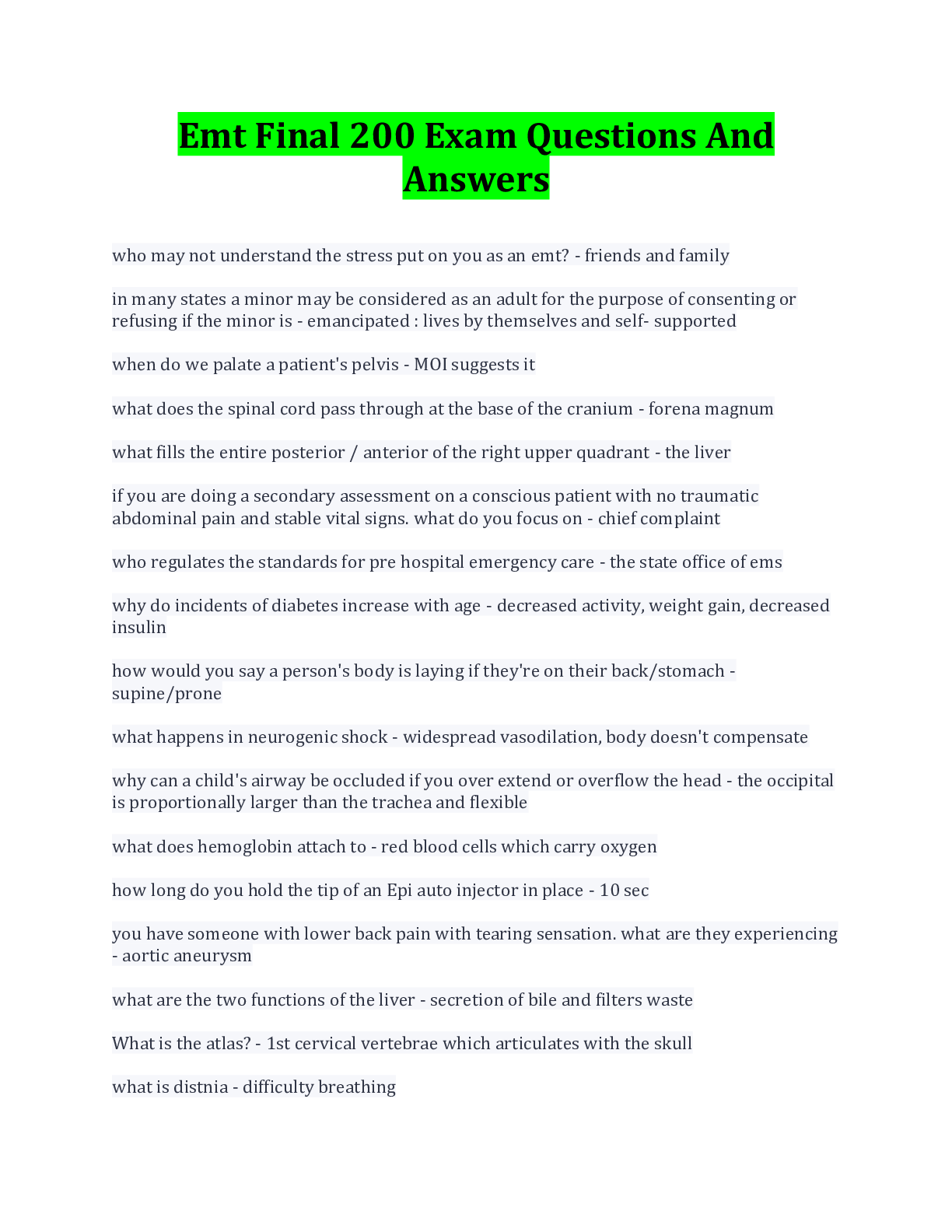
who may not understand the stress put on you as an emt? - ✔✔friends and family
in many states a minor may be considered as an adult for the purpose of consenting or
refusing if the minor is -
...
Emt Final 200 Study Guide
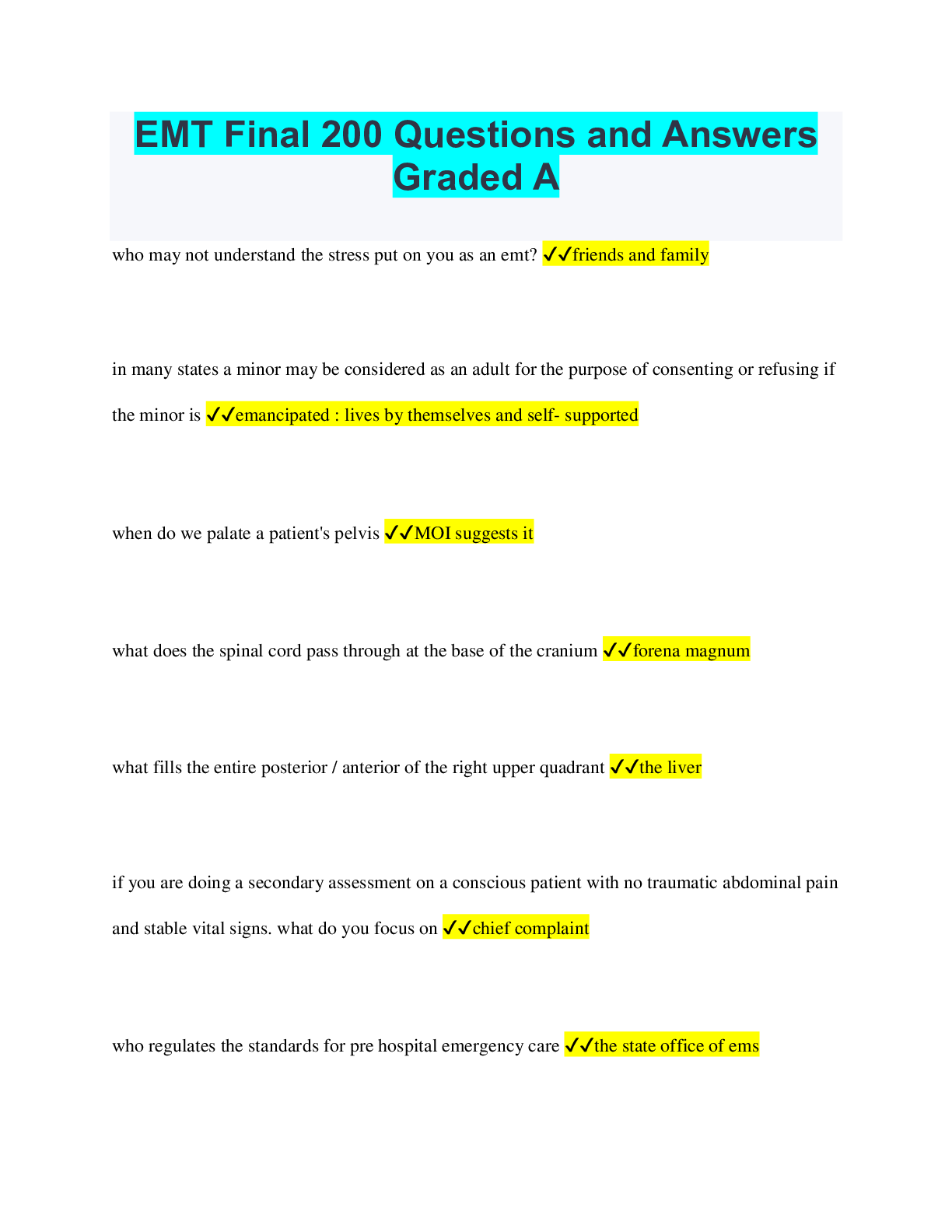
who may not understand the stress put on you as an emt? - ✔✔friends and family
in many states a minor may be considered as an adult for the purpose of consenting or
refusing if the minor is - ✔✔emancipated : lives by themselves and self- supported
when do we palate a patient's pelvis - ✔✔MOI suggests it
what does the spinal cord pass through at the base of the cranium - ✔✔forena magnum
what fills the entire posterior / anterior of the right upper quadrant - ✔✔the liver
if you are doing a secondary assessment on a conscious patient with no traumatic
abdominal pain and stable vital signs. what do you focus on - ✔✔chief complaint
who regulates the standards for pre hospital emergency care - ✔✔the state office of
ems
why do incidents of diabetes increase with age - ✔✔decreased activity, weight gain,
decreased insulin
how would you say a person's body is laying if they're on their back/stomach -
✔✔supine/prone
what happens in neurogenic shock - ✔✔widespread vasodilation, body doesn't
compensate
why can a child's airway be occluded if you over extend or overflow the head - ✔✔the
occipital is proportionally larger than the trachea and flexible
what does hemoglobin attach to - ✔✔red blood cells which carry oxygen
how long do you hold the tip of an Epi auto injector in place - ✔✔10 sec
you have someone with lower back pain with tearing sensation. what are they
experiencing - ✔✔aortic aneurysm
what are the two functions of the liver - ✔✔secretion of bile and filters waste
What is the atlas? - ✔✔1st cervical vertebrae which articulates with the skull
what is distnia - ✔✔difficulty breathing
head trauma, stroke, poisoning or brain tumor. which one of these would cause
metabolic seizure - ✔✔poisoning
if you have a change in a patient condition, what do we reassess - ✔✔ABC
if you have JVD, that suggests a blood problem returning to the heart, the patient is at
what angle - ✔✔35 degree angle
how do we suction with orpharanix of a patient - ✔✔on the way out
at our level, why do we assume that a person is having an AMI when complaining of
chest pain - ✔✔we can't diagnose them in the field
the team of health care professionals who are responsible for providing emergency care
and transportation for the suck and injured - ✔✔the ems system
the stomach, gallbladder, liver, or appendix. which one would most likely bleed
profusely - ✔✔the liver
what is the back portion of the body considered - ✔✔posterior
weight gain, lack of appetite, weight loss, polyuria, low blood glucose levels. which sign
or symptom would you most likely encounter in a patient with a new onset of type 1
diabetes - ✔✔weight loss and polyuria
what are the finger bones called - ✔✔phalangies
chest pain patient with a history of hypertension. you give high flow O2 and he has a
Nitro patch on the right upper chest. His pressure is 78/50. what do you do - ✔✔with a
gloved hand, take the Nitro patch off and wipe the chest off. raise the feet to treat the
BP
where does the blood in the inferior vena cava come from to get back to the heart -
✔✔legs, kidneys, abdomen, but not the brain
33yr old unresponsive patient with rapid shallow respirations. how do we treat that -
✔✔positive pressure ventilations
if you have a patient that takes numerous meds, what is it best to do with those meds
during transport - ✔✔take them with you
what is bradycardia and tachycardia - ✔✔heart rate less than 60 and heart rate greater
than 100
how do we administer oxygen to a hypoxic patient with chronic lung disease - ✔✔start
at a lower flow and gradually build up until you see improvement
What's a sign and symptom of acute hyperventilation syndrome - ✔✔tachitnia and
extremities will become numb and tingly
what is the best way to move a patient with a wheeled ambulance stretcher - ✔✔push
with the head and guide with the feet
if you move a patient from a bed to an ambulance stretcher, what kind of carry is that -
✔✔direct carry
you've got an unresponsive patient that we cannot get IV access on. what's the most
appropriate access to administer medications by - ✔✔IO
what are risk factors of an MI - ✔✔the male sex, family history, diet, stress, diabetes
why do we give aspirin to patients that are having an MI - ✔✔makes the platelets less
sticky and the blood not able to clot
how do the kidneys help regulate blood pressure - ✔✔sodium and water
what is the substance responsible for causing an allergic reaction called - ✔✔an
allergen
What's the final stage of death and dying - ✔✔acceptance
What's the 1st thing we do when we arrive on scene - ✔✔check scene safety
you have an individual who is unconscious with rapid , shallow breathing and copious
amounts of bloody secretions in his mouth. how do we take care of that - ✔✔suction on
the way out for no more than 15 secs and alternate with 2 mins of oxygenation
if you're going to push a wheelchair, stretcher, etc, how do you need your arms to be -
✔✔not extended
compressions to ventilation 2 rescuer for a child - ✔✔15 to 2
you have an individual who has some respiratory distress. you place him in a
comfortable position, but you don't give him oxygen. what are you - ✔✔negligent
what are crackling air bubbles under the skin called - ✔✔subutaneous emphasema
you go to an elder couple's residence and find them unconscious in the bed. no
evidence of trauma. you begin your assessment and began to smell natural gas. how do
you get them out - ✔✔clothes drag or blanket
who is responsible for authorizing you to perform on an emt level - ✔✔the medical
director
What's low blood sugar called - ✔✔hypoglycemia
What's the most rapidly fatal cause of anaphylaxis - ✔✔upper airway obstruction
restlessness and anxiety. rapid shallow breathing with cool, clam my skin and absent
peripheral pulses. what is not a sign of compensated shock - ✔✔absent peripheral
pulses
what is unique about the diaphrag
[Show More]


.png)

.png)