NES Physical Education Test
Which stage of development is typically characterized by slow and steady physical
growth, refinement of fundamental motor skills, and the ability to think in concrete
operational terms?
a.
...
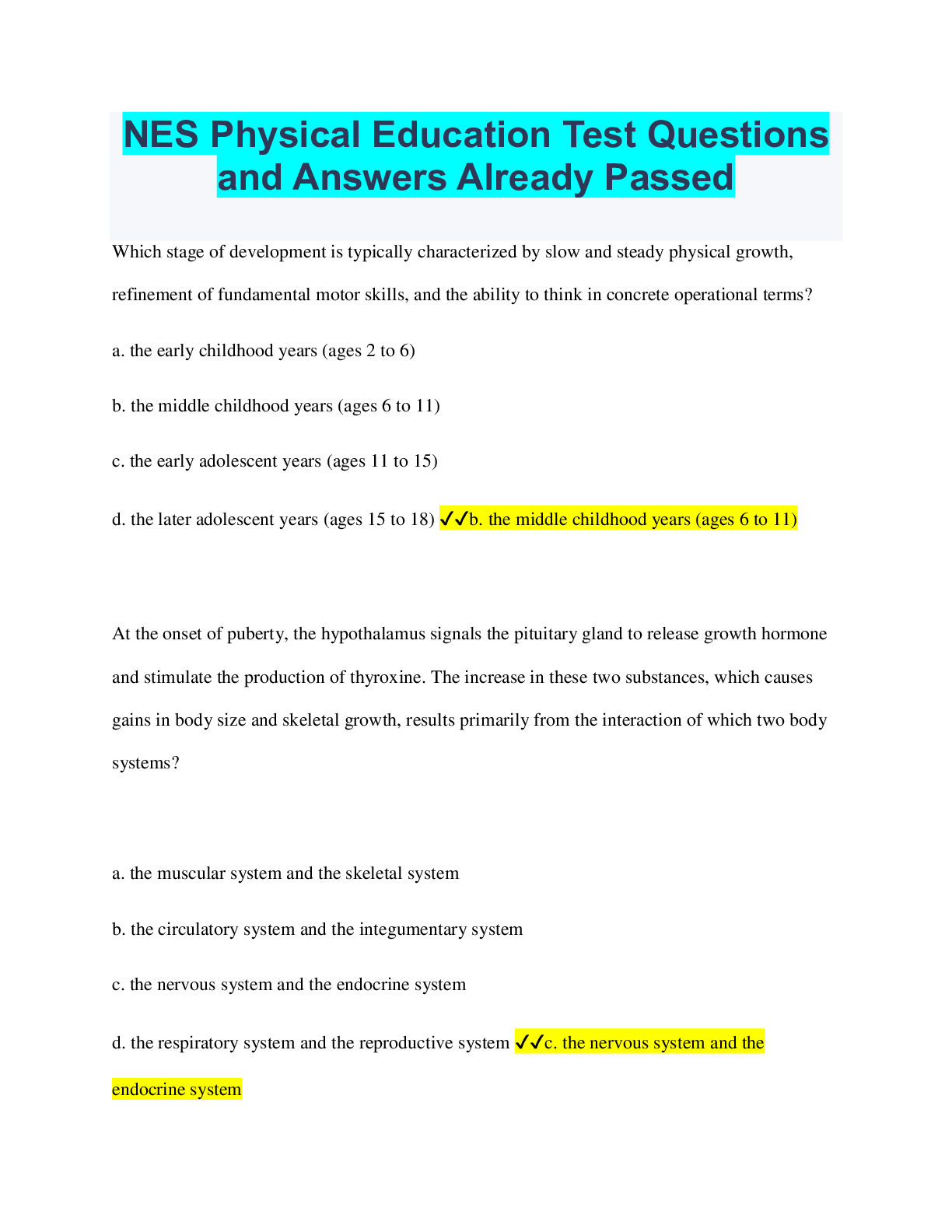
NES Physical Education Test
Which stage of development is typically characterized by slow and steady physical
growth, refinement of fundamental motor skills, and the ability to think in concrete
operational terms?
a. the early childhood years (ages 2 to 6)
b. the middle childhood years (ages 6 to 11)
c. the early adolescent years (ages 11 to 15)
d. the later adolescent years (ages 15 to 18) - ✔✔b. the middle childhood years (ages 6
to 11)
At the onset of puberty, the hypothalamus signals the pituitary gland to release growth
hormone and stimulate the production of thyroxine. The increase in these two
substances, which causes gains in body size and skeletal growth, results primarily from
the interaction of which two body systems?
a. the muscular system and the skeletal system
b. the circulatory system and the integumentary system
c. the nervous system and the endocrine system
d. the respiratory system and the reproductive system - ✔✔c. the nervous system and
the endocrine system
In the context of motor learning, the concept of readiness refers to the:
a. combination of maturation and experience that allows an individual to learn and
acquire a new motor skill.
b. ability of an individual to alter motor behaviors in order to adjust to changing demands
in a learning environment.
c. capacity of human biology, as in neural and bone development, to reorganize and
respond to a motor challenge or injury.
d. interplay of environmental factors that results in favorable or ideal conditions in which
to learn a new motor skill. - ✔✔a. combination of maturation and experience that allows
an individual to learn and acquire a new motor skill.
During a soccer unit, a physical education teacher provides cues to promote students'
efficiency in skill execution. For example, for passes, the teacher reminds students to
place their non-kicking foot alongside the ball with toes pointed at the target to help
create velocity in the kicking foot and improve accuracy. To increase the distance of
throw-ins, the teacher tells students to bring the ball back behind their heads with
elbows bent, and then flex their trunk and extend their arms forcefully and directly
overhead on the release. This approach is most closely aligned with which of the
following national standards for physical education?
a. Achieves and maintains a health-enhancing level of physical fitness.
b. Demonstrates competency in motor skills and movement patterns needed to perform
a variety of physical activities.
c. Demonstrates understanding of movement concepts, principles, strategies, and
tactics as they apply to the learning and performance of physical activities.
d. Exhibits responsible personal and social behavior that respects self and others in
physical activity settings. - ✔✔c. Demonstrates understanding of movement concepts,
principles, strategies, and tactics as they apply to the learning and performance of
physical activities.
In a game of volleyball, a "bump" or forearm pass is the most appropriate technique to
use to:
a. spike the ball over the net.
b. play a ball that arrives low and with force.
c. receive a ball off of the net.
d. return a ball that arrives at chest height or higher. - ✔✔b. play a ball that arrives low
and with force.
Parachute play contributes to the development of skills important for dance by
encouraging students to focus on:
a. visual clues for recognizing a rhythm.
b. shaping movement to mirror shapes created by others.
c. the ways in which movement can express an idea.
d. coordinating movement timing with the movement of others. - ✔✔d. coordinating
movement timing with the movement of others.
In the exercise shown above, the student's arm is down to the side with the hand slightly
behind the body for support. The other arm extends overhead and reaches to the
opposite side. The stretch is held briefly. The student repeats the movement with the
other arm. This stretch targets which of the following muscles?
a. biceps
b. erector spinae
c. gluteus maximus
d. latissimus dorsi - ✔✔d. latissimus dorsi
Which of the following strategies is likely to be most effective for supporting an
adolescent's efforts to lose weight?
a. having regular family meal and snack times
b. sending the adolescent to school with homemade lunches instead of lunch money
c. involving the entire family in a healthy eating plan
d. reminding the adolescent frequently of the health risks prevented by losing weight -
✔✔c. involving the entire family in a healthy eating plan
A group of six- and seven-year-old children are playing "amoeba tag." Two children join
hands and run around together, chasing and trying to tag others. The first two children
tagged join hands with the two "amoebas" and form a chain. At this point, the four
children split into two groups. Play continues as each group tries to tag children and add
them to its chain. Groups may remain as one chain or divide into even-numbered
groups. Chains may link together at will. The game continues until all are tagged.
Which of the following is a primary advantage of engaging children in this activity?
a. It promotes the development of problem-solving skills and consensus-building
techniques.
b. It eliminates risks to children involving accidental collisions or falls.
c. It encourages children to communicate, cooperate, and use reasoning skills.
d. It evens out disparities among children related to individual fitness attributes such as
speed and stamina. - ✔✔c. It encourages children to communicate, cooperate, and use
reasoning skills.
Students prepare to play team handball on an indoor court. The teacher reminds
students that the game resembles soccer played with the hands, incorporates strategies
from basketball, and prohibits physical contact. Objectives include eluding defenders
and throwing a ball into the opponent's goal, as well as defending one's goal. Only the
goalies may occupy a designated area in front of their goal nets. Which of the following
additional rules would best maximize participation and promote strategic skills?
a. switching from zone defense to player-to-player defense on the teacher's signal as
required by the situation
b. requiring that each offensive play include three completed passes before a shot on
goal
c. specifying that offensive players use bounce shots rather than set or jump shots on
attempts to score
d. having goalies put the ball into play from center court following goals or defensive
blocks - ✔✔b. requiring that each offensive play include three completed passes before
a shot on goal
In an elementary physical education class, students practice racket skills. They use
junior rackets to practice drop serves and forehand strokes against a wall and then with
partners. One child who has muscular dystrophy is willing and physically able to
participate. In which of the following ways could the teacher best address this child's
needs in the context of this activity?
a. Build in opportunities for rest breaks during class and allow the child to practice the
skills at his or her own pace.
b. Simplify directions used to introduce the activity to the class and refrain from
providing verbal cues to the child.
c. Provide the child with extra practice time before the main activity and try to eliminate
distractions during the activity.
d. Define an individual practice space for the child and his or her partner by using
colored tape or cones for boundaries. - ✔✔a. Build in opportunities for rest breaks
during class and allow the child to practice the skills at his or her own pace.
The formal process of assessing possible exposure to injury in a physical education
environment and taking action to minimize its likelihood is known as:
a. risk management.
b. negligence per se.
c. facilities management.
d. duty of care. - ✔✔a. risk management.
Competency 1 - ✔✔Competency 1 requires an understanding of the stages and
characteristics of human growth and development.
Contraction of skeletal muscles is most dependent upon which of the following
substances? - ✔✔calcium
In the sequence of motor development, middle childhood through adolescence is
generally considered the period in which: - ✔✔sport skills and complex motor behaviors
are developed and refined.
Competency 3 - ✔✔During middle childhood and adolescence, children's physical
abilities increase as they grow. Their muscles become capable of generating more force
and their hearts and lungs become more efficient at sustaining physical activity. They
develop better balance, coordination, agility, and speed and learn and practice many
motor tasks that in turn help them acquire more complex motor skills. During the middle
school and high school years, stude
[Show More]


.png)

 (1).png)