Accountability - The implementation of appropriate *technical and organisational measures* to ensure and be able to *demonstrate* that the handling of personal data is performed in accordance with relevant law, an idea c
...
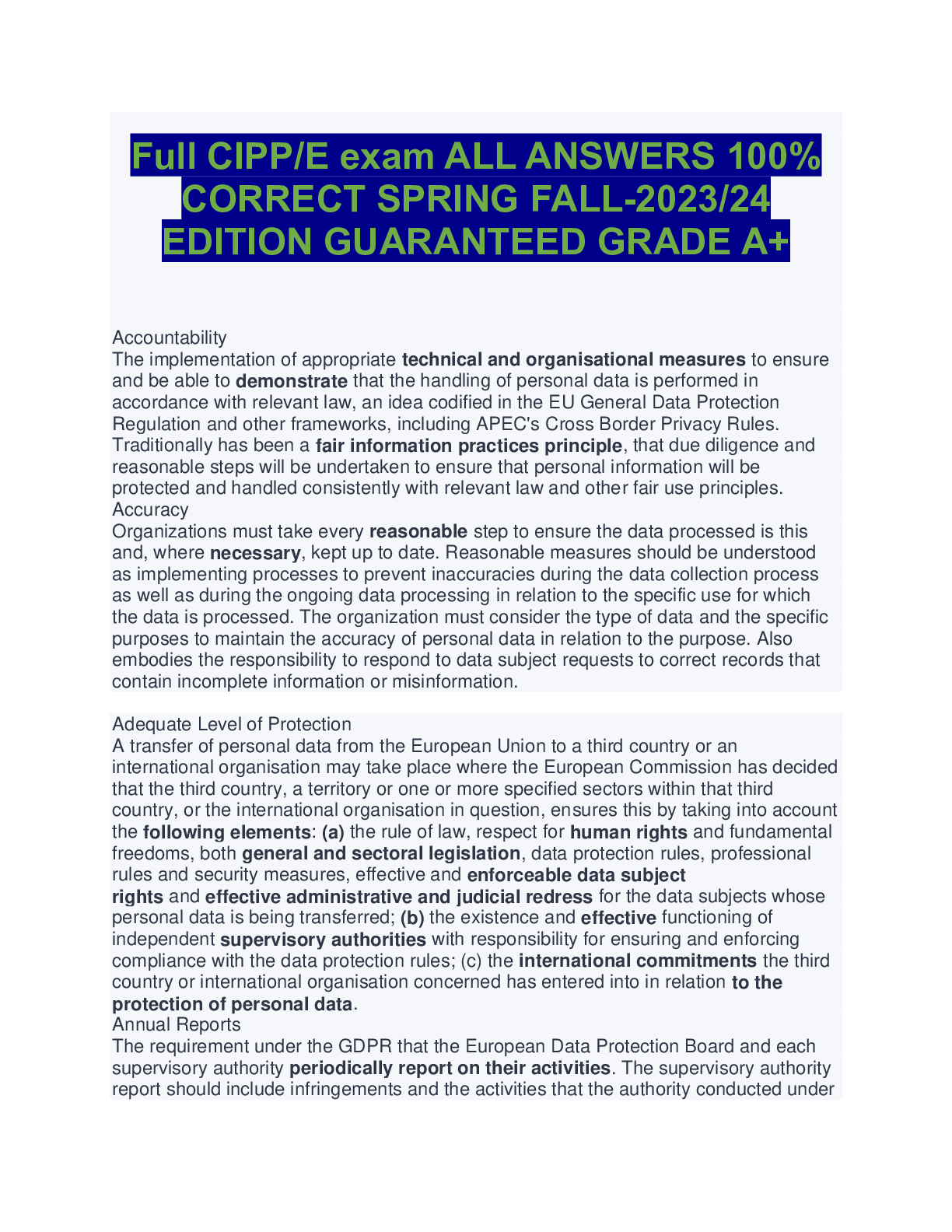
Accountability - The implementation of appropriate *technical and organisational measures* to ensure and be able to *demonstrate* that the handling of personal data is performed in accordance with relevant law, an idea codified in the EU General Data Protection Regulation and other frameworks, including APEC's Cross Border Privacy Rules. Traditionally has been a *fair information practices principle*, that due diligence and reasonable steps will be undertaken to ensure that personal information will be protected and handled consistently with relevant law and other fair use principles.
Accuracy - Organizations must take every *reasonable* step to ensure the data processed is this and, where *necessary*, kept up to date. Reasonable measures should be understood as implementing processes to prevent inaccuracies during the data collection process as well as during the ongoing data processing in relation to the specific use for which the data is processed. The organization must consider the type of data and the specific purposes to maintain the accuracy of personal data in relation to the purpose. Also embodies the responsibility to respond to data subject requests to correct records that contain incomplete information or misinformation.
Adequate Level of Protection - A transfer of personal data from the European Union to a third country or an international organisation may take place where the European Commission has decided that the third country, a territory or one or more specified sectors within that third country, or the international organisation in question, ensures this by taking into account the *following elements*: *(a)* the rule of law, respect for *human rights* and fundamental freedoms, both *general and sectoral legislation*, data protection rules, professional rules and security measures, effective and *enforceable data subject rights* and *effective administrative and judicial redress* for the data subjects whose personal data is being transferred; *(b)* the existence and *effective* functioning of independent *supervisory authorities* with responsibility for ensuring and enforcing compliance with the data protection rules; (c) the *international commitments* the third country or international organisation concerned has entered into in relation *to the protection of personal data*.
Annual Reports - The requirement under the GDPR that the European Data Protection Board and each supervisory authority *periodically report on their activities*. The supervisory authority report should include infringements and the activities that the authority conducted under their Article 58(2) powers. The EDPB report should include *guidelines, recommendations, best practices and binding decisions*. Additionally, the report should include the protection of natural persons with regard to processing in the EU and, where relevant, in third countries and international organisations. Shall be *made public and be transmitted to the European Parliament, to the Council and to the Commission*.
Anonymous Information - In contrast to personal data, this is not related to an identified or an identifiable natural person and *cannot be combined with other information to re-identify individuals*. It has been rendered unidentifiable and, as such, is not protected by the GDPR.
Anti-discrimination Laws - *indications of special classes* of personal *data*. If there exists law protecting against discrimination based on a class or status, it is likely personal information relating to that class or status is *subject to more stringent* data protection regulation, under the GDPR or otherwise.
Appropriate Safeguards - The GDPR refers to these in a number of contexts, *including* the *transfer* of personal data *to third countries* outside the European Union, the processing of *special categories* of data, *and* the processing of personal data in a *law enforcement* context. This generally refers to the application of the general data protection principles, in particular purpose limitation, data minimisation, limited storage periods, data quality, data protection by design and by default, legal basis for processing, processing of special categories of personal data, measures to ensure data security, and the requirements in respect of onward transfers to bodies not bound by the binding corporate rules. This *may* also *refer to* the use of *encryption or pseudonymization*, *standard* data protection *clause*s adopted by the Commission, contractual clauses authorized by a supervisory authority, or *certification schemes* or *codes of conduct* authorized by the Commission or a supervisory authority. Should ensure compliance with data protection requirements and the rights of the data subjects appropriate to processing within the European Union.
Appropriate Technical and Organizational Measures - The GDPR requires a *risk-based approach* to data protection, whereby organizations *take into account* the *nature*, *scope*, *context and purposes* of processing, as well as the risks of varying *likelihood* and *severity to* the *rights and freedoms* of natural persons, and institute policies, controls and certain technologies to mitigate those risks. These might help meet the obligation to keep personal data secure, including technical safeguards against accidents and negligence or deliberate and malevolent actions, or involve the implementation of data protection policies. These measures should be demonstrable on demand to data protection authorities and reviewed regularly.
Article 29 Working Party - Was a European Union organization that functioned as an *independent advisory body* on data protection and privacy and consisted of the collected data protection authorities of the member states. It was *replaced by* the similarly constituted European Data Protection Board (*EDPB*) on May 25, 2018, *when* the *GDPR went into effect*.
Authentication - The process by which an entity (such as a person or computer system) determines whether another entity is who it claims to be. *is required* by the GDPR *when* the data subject is *exercising certain rights*, such as the rights to *deletion or rectification*, and might include supplying log-in details or biometric information. However, the data controller should not be obliged to acquire additional information in order to identify the data subject for the sole purpose of complying with any provision of the Regulation.
Automated Processing - A processing operation that is performed without any human intervention. "Profiling" is defined in the GDPR, for example, as the automated processing of personal data to evaluate certain personal aspects relating to a natural person, in particular to *analyse or predict aspects concerning that natural person's performance at work, economic situation, health, personal preferences, interests, reliability, behaviour, location or movements*. Data subjects, under the GDPR, have a *right to object* to such processing.
Availability - Data is this if it is *accessible when needed* by the organization or data subject. The GDPR requires that *a business* be able to ensure this of personal data and have the ability to *restore it and access* to personal data in a *timely manner* in the event of a physical or technical incident.
Background Screening/Checks - Organizations may want to verify an applicant's ability to function in the working environment as well as assuring the safety and security of existing workers. Range from checking a person's educational background to checking on past criminal activity. *Employee consent requirements* for such checks *vary by member state and may be negotiated with local works councils*.
Behavioral Advertising - Most often done via automated processing of personal data, or profiling, the GDPR requires that *data subjects* be able to *opt-out of any automated processing, to be informed of the logic involved in any automatic personal data processing and, at least when based on profiling, be informed of the consequences of such processing*. If cookies are used to store or access information for the purposes of behavioral advertising, the ePrivacy Directive requires that data subjects provide consent for the placement of such cookies, after having been provided with clear and comprehensive information.
Binding Corporate Rules - An appropriate safeguard allowed by the GDPR to facilitate *cross-border transfers* of personal data *between* the various *entities of a corporate group worldwide*. They do so by ensuring that the same high level of protection of personal data is complied with by all members of the organizational group by means of a single set of binding and enforceable rules. Compel organizations to be able to demonstrate their compliance with all aspects of applicable data protection legislation and *are approved by a member state data protection authority*. To date, relatively few organizations have had these approved.
Binding Safe Processor Rules - Previously, the EU distinguished between these for controllers and processors. With the GDPR, there is *now no distinction* made between the two in this context and *Binding Corporate Rules are appropriate for both Controllers and Processors*.
Biometrics - Data concerning the *intrinsic physical or behavioral characteristics* of an individual. Examples include *DNA, fingerprints, retina and iris patterns, voice, face, handwriting, keystroke technique* and *gait*. The GDPR, in Article 9, lists these for the purpose of uniquely identifying a natural person as a special category of data for which processing is not allowed other than in specific circumstances.
Bodily Privacy - One of the four classes of privacy, along with information privacy, territorial privacy and communications privacy. It focuses on a person's physical being and any invasion thereof. Such an invasion can take the form of *genetic testing, drug testing* or *body cavity searches*.
[Show More]