ASIS CPP review practice Quiz Security
Management
A business unit's top leadership will develop a plan that provides a general direction for
the organization. This plan is the fundamental template for direction that d
...
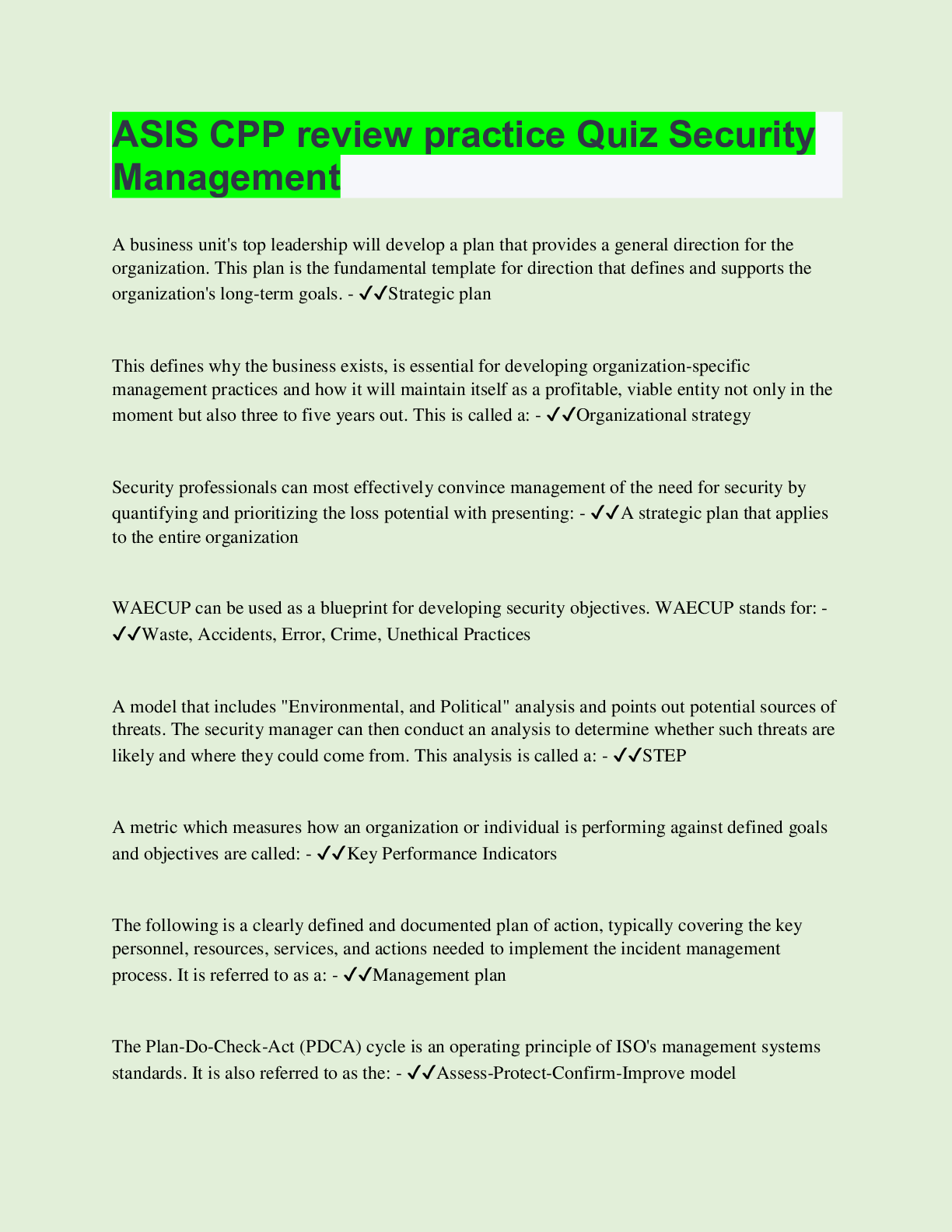
ASIS CPP review practice Quiz Security
Management
A business unit's top leadership will develop a plan that provides a general direction for
the organization. This plan is the fundamental template for direction that defines and
supports the organization's long-term goals. - ✔✔Strategic plan
This defines why the business exists, is essential for developing organization-specific
management practices and how it will maintain itself as a profitable, viable entity not
only in the moment but also three to five years out. This is called a: - ✔✔Organizational
strategy
Security professionals can most effectively convince management of the need for
security by quantifying and prioritizing the loss potential with presenting: - ✔✔A strategic
plan that applies to the entire organization
WAECUP can be used as a blueprint for developing security objectives. WAECUP
stands for: - ✔✔Waste, Accidents, Error, Crime, Unethical Practices
A model that includes "Environmental, and Political" analysis and points out potential
sources of threats. The security manager can then conduct an analysis to determine
whether such threats are likely and where they could come from. This analysis is called
a: - ✔✔STEP
A metric which measures how an organization or individual is performing against
defined goals and objectives are called: - ✔✔Key Performance Indicators
The following is a clearly defined and documented plan of action, typically covering the
key personnel, resources, services, and actions needed to implement the incident
management process. It is referred to as a: - ✔✔Management plan
The Plan-Do-Check-Act (PDCA) cycle is an operating principle of ISO's management
systems standards. It is also referred to as the: - ✔✔Assess-Protect-Confirm-Improve
model
The Plan-Do-Check-Act (PDCA) cycle has a step which looks at the planning analysis,
then devises a solution, prioritizes the next steps, and develops a detailed action plan.
This step is referred to as which part of the cycle? - ✔✔Do
The Plan-Do-Check-Act (PDCA) cycle has a step where, one examines the solutions
devised to address the problems. The point is to check whether the solutions are
producing outcomes that are consistent with the plan. This step is referred to as which
part of the cycle? - ✔✔Check
In the Plan-Do-Check-Act (PDCA) cycle, this is the most critical stage and calls for
identifying and analyzing the organization's problems and events that could disrupt
operations and assets. This step is referred to as which part of the cycle? - ✔✔Plan
Managing involves these five (5) basic functions. - ✔✔Planning, Organizing, Directing,
Coordinating, Controlling
In addition to the five (5) functions of management, managers should be guided by two
(2) other principles, which are: - ✔✔"Quality" and "Who is the customer?"
There are three (3) dimensions to managing the security of assets. - ✔✔Technical
expertise, Management ability and Ability to deal with people.
The "span of control" principle suggests that a single person can supervise only a
limited number of staff members effectively. The specific number depends on such
factors as the nature of the work and type of organization, but as a general rule one
manager can effectively supervise up to how many persons? - ✔✔Up to ten (10)
persons
The following theory asserts that a person's behavior is driven by basic needs at
different levels and is still widely recommended to analyze individual employee
motivation. - ✔✔Maslow's Theory
The following theory asserts is based on the premise that the opposite of satisfaction is
not dissatisfaction but simply no satisfaction. The theory maintains that two sets of
factors determine a worker's motivation, attitude, and success. - ✔✔Hertzberg's Theory
The following theory asserts job content (motivators), such as achievement, recognition,
responsibility, and satisfaction are derived from work itself, is BEST described as -
✔✔Hertzberg's Theory
The following theory asserts that managers should avoid quick fixes. Manipulating
hygiene factors may alleviate dissatisfaction but will not result in a state of satisfaction.
Allowing an individual to reach a state of satisfaction requires changes in the work
content itself, such as increased autonomy or responsibility. - ✔✔Hertzberg's Theory
The following theory contends that workers are inherently lazy and tend to avoid work.
They lack creative ambition, require constant supervision, and are motivated by fear. -
✔✔McGregor's Theory
A set of criteria, guidelines, and best practices that can be used to enhance the quality
and reliability of products, services, or processes, is the definition for: - ✔✔Standard
The "integration of traditional security functions and information [systems], IT security
functions" is known as: - ✔✔IT and Security Convergence
"An organization can be an adaptive, problem-solving, innovative system operating in
and coping with rapidly changing environments. Bureaucracy and the "organization
man" will have no place in future organizations." This is a theory known as: - ✔✔Warren
Bennis' Theory
To monitor and measure an organization's risk management performance, a set of
performance indicators should be developed to measure both the management systems
and its outcomes. Measurements should meet the following metrics: - ✔✔Quantitative
or Qualitative
An analysis approach that does not us
[Show More]