What are the phases of the life cycle? - ANSWER • Material Solution Analysis Phase (MSA)
• Technology Maturation and Risk Reduction (TMRR)
• Engineering and Manufacturing Development (EMD)
• Production and Deploment (
...
What are the phases of the life cycle? - ANSWER • Material Solution Analysis Phase (MSA)
• Technology Maturation and Risk Reduction (TMRR)
• Engineering and Manufacturing Development (EMD)
• Production and Deploment (PD)
• Operations and Support (OS)
The _______________ is prepared to support a Milestone C decision and documents the user's operational performance capabilities in the terms of thresholds and objectives. - ANSWER Capability Production Document
Determine which of the following are technology transition methods used to ensure the transition of innovative concepts and superior technology to the user and acquisition customer. Select all that apply.
a) Advanced Technology Demonstrations
b) Advanced Technology Development Joint Warfighting
c) Experiments
d) Modeling and Simulation
e) Joint Capabilities Technology Demonstrations - ANSWER a, b, & c:
Advanced Technology Demonstrations, Joint
War-fighting Experiments, and Joint Capabilities
Technology Demonstrations
Determine which of the following are true with regard to Milestone A. Select all that apply.
a) The MDA issues an Acquisition Decision Memorandum.
b) A favorable Milestone A decision does not yet mean that a new acquisition program has been initiated.
c) The MDA approves the system architecture
d) The MDA approves the Acquisition Strategy.
e) The MDA approves initiation of increments II and III of evolutionary acquisition.
f) The MDA approves the exit criteria for the next phase. - ANSWER a, The MDA issues an Acquisition Decision Memorandum
b, A favorable Milestone A decision does not yet mean that a new acquisition program has been initiated.
d, The MDA approves the Acquisition Strategy.
f, The MDA approves the exit criteria for the next phase.
Match each term to its correct statement.
1. Materiel Development Decision
2. Materiel Solution Analysis Phase
3. Technology Maturation and Risk Reduction Phase
A. A project exits the _______________ when the Analysis of Alternatives has been completed and the
MDA approves the Materiel Solution and the Acquisition Strategy.
B. The MDA reviews the Analysis of Alternatives Study Guidance at the _______________.
C. The _______________ consists of reducing program risks to an acceptable level through competative prototyping. - ANSWER A -2, B - 1, C - 3
A project exits the Materiel Solution Analysis Phase when the Analysis of Alternatives has been completed and the MDA approves the Materiel Solution and the Acquisition Strategy. The MDA reviews and approves the Analysis of Alternatives Study Guidance and Plan at the Material Development Decision. The Technology Maturation and Risk Reduction Phase consists of demonstrating critical technologies and reduces risks to an acceptable level through competitive prototyping.
Capabilities Decision Document (CDD) - ANSWER describes specific program capability needs
At Milestone B, the MDA considers any updated information requirements from the DRFPRD, such as: - ANSWER Validated and Approved CDD
System Threat Assessment
Program protection plan
Technology Readiness Assessment
Affordability Assessment
Test and Evaluation Master Plan (TEMP)
Systems Engineering Plan (SEP)
At Milestone B, the MDA: - ANSWER At Milestone B, the MDA:
Approves entry into EMD
Approves the Acquisition Strategy
Approves the Acquisition Program Baseline
Approves the LRIP quantities
Approves the Exit criteria for EMD
Approves the Type of Contract
Issues Milestone B Certification
(10 USC 2366b)
Issues Acquisition Decision Memorandum
Determine which of the following are true with regard to Milestone B. Select all that apply.
a) The MDA approves Low-Rate Initial Production (LRIP) quantities (where applicable).
b) Programs that enter the acquisition process at Milestone B must have an ICD that provides the context for determination and approval of the needed capability and a CDD that describes specific program capability needs.
c) The MDA approves the acquisition strategy.
d) A favorable Milestone B decision does not yet mean that a new acquisition program has been initiated. - ANSWER a, The MDA approves Low-Rate Initial Production (LRIP) quantities (where applicable).
b, Programs that enter the acquisition process at Milestone B must have an ICD that provides the context for determination and approval of the needed capability and a CDD that describes specific program capability needs.
c, The MDA approves the acquisition strategy.
Approval at Milestone C is dependent on the following criteria being met: - ANSWER Acceptable performance in developmental, test and evaluation, and operational assessment; mature software capability; demonstrated system integration or demonstrated commercial products in a relevant environment; and no significant manufacturing risks
Approved CPD
Acceptable interoperability
Acceptable operational supportability
Demonstration that the system is affordable throughout the life cycle, fully funded, and properly phased for rapid deployment.
At Milestone C, the MDA approves the: - ANSWER Updated Acquisition Strategy
Updated Acquisition Program Baseline
Exit criteria for LRIP or limited deployment
Issues an Acquisition Decision Memorandum
The Production & Deployment phase consists of the: - ANSWER LRIP effort
Full-Rate Production (FRP) Decision Review
Full-Rate Production & Deployment effort
The LRIP effort is intended to: - ANSWER Provide test articles for IOTE
Establish an initial production base for the system
Permit an orderly increase in the production rate for the system, upon successful completion of operational testing. This effort is guided by the CPD.
Determine which of the following are true with regard to Milestone C. Select all that apply.
a) A favorable Milestone C decision for an MDAP authorizes the PM to commence full-rate production.
b) Approval at Milestone C is dependent on an approved CPD.
c) Approval at Milestone C is dependent on compliance with the DOD Strategic Plan.
d) Approval at Milestone C is dependent on demonstration that the system is affordable throughout the life cycle.
e) At Milestone C the MDA approves the updated acquisition strategy. - ANSWER All except a
Which of the following matches each term to its correct statement?
Low-Rate Initial Production Effort
FRP Decision Review
Full-Rate Production & Deployment Effort
Production & Deployment Phase
A. Results in completion of manufacturing development, establishes an initial production base, and permits
an orderly increase in the production rate, upon completion of operational testing.
B. The MDA considers the independent cost estimate, manpower estimate, and results of operational and
live fire testing and evaluation.
C. The purpose of this is to achieve an operational capability that satisfies mission needs.
D. Acquisition program enters this after initial operational testing and evaluation, and submission of the
Beyond LRIP and Live Fire Testing reports. - ANSWER A-1, B-2, C-4, D-3
DoDI 5000.02 - ANSWER states that all acquisition programs or increments must establish program goals (thresholds and objectives) for the minimum number of cost, schedule, and performance parameters that describe the program over its life cycle.
The DoD does not obligate funds for ACAT I or ACAT IA programs beyond Milestone B until - ANSWER the Milestone Decision Authority (MDA) approves the APB.
The APB is consistent with the CDD, as follows: - ANSWER If a single, time-phased CDD/CPD defines multiple capability levels, the APB contains multiple sets of parameter values, each defining an increment
If the users incrementally update and validate a single CDD/CPD to define increasing capability, the PM incrementally updates APB performance parameter values
If the users submit multiple CDDs/CPDs the PM prepares separate APBs, each defining an increment
Select all of the following statements that are true with regard to the Acquisition Program Baseline.
a) The APB for a program using an evolutionary acquisition strategy contains separate entries for each increment.
b) APB parameter values represent the program as it is expected to be produced or deployed.
c) The Program Manager (PM) bases the APB on average and customary performance requirements, schedule requirements, and estimates of total program cost for MDAPs.
d) Every acquisition program establishes an APB beginning at program initiation.
e) The APB contains only those parameters that, if thresholds are not met, will require the MDA to reevaluate the program and consider alternative program concepts or designs. - ANSWER The APB for a program using an evolutionary acquisition strategy contains separate entries for each increment: APB parameter values represent the program as it is expected to be produced or deployed; every acquisition program establishes an APB beginning at the program initiation; the APB contains only those parameters that, if thresholds are not met, will require the MDA to reevaluate the program and consider alternative program concepts or design approaches.
2 Approaches to the acquisition strategy: - ANSWER Evolutionary (the preferred approach)
Single step to full capability
The acquisition strategy approach to be followed depends on the - ANSWER Availability of time-phased capability needs in the CDD/CPD
Maturity of technologies
Relative costs and benefits of executing the program in increments versus a single step
Select all of the following that are true with regard to the acquisition strategy.
a) The acquisition strategy evolves through an iterative process and becomes increasingly more definitive in describing the relationship of the essential elements of a program.
b) The acquisition strategy defines the program structure used to achieve full capability and the approach to be followed in Full-Rate Production & Deployment.
c) The acquisition strategy defines the program structure used to achieve full capability and the approach to be followed in Full-Rate Production & Deployment.
d) The PM develops the acquisition strategy in preparation for program initiation, prior to the program initiation decision.
e) The PM updates the acquisition strategy prior to all major program decision points or whenever the approved acquisition strategy changes. - ANSWER a) The acquisition strategy evolves through an iterative process and becomes increasingly more definitive in describing the relationship of the essential elements of a program.
d) The PM develops the acquisition strategy in preparation for program initiation, prior to the program initiation decision.
e) The PM updates the acquisition strategy prior to all major program decision points or whenever the approved acquisition strategy changes.
Which of the following matches each term to its correct statement?
1. Evolutionary
2. Single Step to Full Capability
A. The full system capability is developed and demonstrated prior to Milestone C
B. The ultimate capability delivered to the user is divided into two or more increments, with increasing levels of capability
A - 2, B - 1
B - 2, A - 1 - ANSWER A - 2, B - 1
B - 2, A - 1
The Under Secretary of Defense (USD) Comptroller: - ANSWER • Controls the budget and the release of funds
• Is responsible for the Budgeting and Execution phases of the Planning, Programming, Budgeting and Execution (PPBE) process
The Under Secretary of Defense (Policy): - ANSWER • Is charged with approving certain aspects of programs involving other nations
• Is responsible for Defense Planning and Programming Guidance (DPPG) during the planning phase of PPBE
The Under Secretary of Defense Acquisition, Technology, and Logistics (USD (AT&L)): - ANSWER Defense Acquisition Executive (DAE) - (Establishes policy and procedures for DoD acquisition matters)
Chairs of the Defense Acquisition Board (DAB) - (•Makes program milestone decisions for Major Defense Acquisition Programs (MDAPs))
The Director, Cost Assessment and Program Evaluation (CAPE): - ANSWER •Responsible for analysis and advice on matters relating to the planning and programming phases of the Planning, Programming, Budgeting and Execution (PPBE) system
•Formulation of study guidance for analyses of alternatives for major defense acquisition programs and performance of such analyses
•Review, analysis, and evaluation of programs for executing approved strategies and policies, ensuring that information on programs is presented accurately and completely, and assessing the effect of spending by the Department of Defense on the United States economy
True or False: The USD Comptroller is responsible for the Budgeting phase of PPBE. - ANSWER True
True or False: The DAB reports directly to the President on all matters relating to the national security. - ANSWER False
True or False: The USD (AT&L) chairs the Defense Acquisition Board (DAB). - ANSWER True
True or False: The Program Manager is the top-level official for ALL defense acquisitions. - ANSWER False
What are 2 types of acquisition categories? - ANSWER • Weapon systems and Command, Control, Communications, Computers, and Intelligence (C4I) Systems
• Automated Information Systems (AIS).
C4I systems - ANSWER perform command, control, communications, or intelligence functions for the fighting forces.
physically part of, dedicated to, or essential in real time to the mission performance of weapon systems
fall under the Weapons/C4I chain of authority
What are the 3 main categories for weapons systems and C4I systems? - ANSWER • ACAT I (ID + IC)
• ACAT II
• ACAT III
ACAT ID (MDAP) - ANSWER Designated by: DAE
Decision by: DAE or as delegated
Criteria: $480M RDTE or $2,798 Procuremenyt (FY14) constant dollars); MDA designates; or special interest
ACAT IC (MDAP) - ANSWER Designated by: DAE
Decision by: Head of Component or delegate to CAE ( no lower)
Criteria: $480M RDTE or $2,798 Procurement (FY14 constant dollars)
ACAT III - ANSWER Designated by: CAE
Decision by: Designated by the CAE
Criteria: Does not meet ACAT II or above criteria
ACAT II programs - ANSWER Those acquisition programs that do not meet the criteria for an ACAT I program (not classified as MDAPs), but do meet the criteria for a Major System. The Milestone Decision Authority for ACAT II programs is the CAE.
Major System - ANSWER Program estimated by the DoD Component Head to require eventual total expenditure for:
•Research, development, test, and evaluation of more than $185 million in FY 2014 constant dollars
•Procurement of more than $835 million in FY 2014 constant dollars
•The dollar estimate shall consider all blocks that will make up an evolutionary acquisition program (to the extent that subsequent blocks can be defined)
also include those programs designated by the DoD Component Head to be ACAT II
ACAT III programs - ANSWER those acquisition programs that do not meet the criteria for an ACAT I (for MDAPs) or ACAT IA (for AISs) or an ACAT II.
The Milestone Decision Authority is designated by the _____ and shall be at the _____ appropriate level. - ANSWER CAE, lowest
For three of the following ACATs the Milestone Decision Authority (MDA) is the DoD Component Acquisition Executive (CAE) or his/her designated authority. Select the remaining ACAT which has the Under Secretary of Defense Acquisition, Technology, and Logistics (USD (AT&L)) as its MDA.
ACAT IC
ACAT ID
ACAT II
ACAT III - ANSWER ACAT ID the Milestone Decision Authority (MDA) is the Under Secretary of Defense Acquisition, Technology, and Logistics (USD (AT&L)).
For ACATs IC, II, and III the MDA is the DOD Component Acquisition Executive (CAE) or his/her designated authority.
True or False: ACAT II programs are classified as Major Defense Acquisition Programs (MDAPs). - ANSWER False
True or False: Acquisition categories were established to determine the level of management review, decision authority, and applicable reporting requirements. - ANSWER True
higher the category, the higher the level of review/decision-makers, and the more formal the review and associated documentation of program information and tests results.
Criteria to determine the acquisition category can be found in DoDD 5000.01. - ANSWER False,
DODI 5000.02 outlines the criteria for acquisition categories.
ACAT programs that exceed a RDT&E threshold of $480 million or a Procurement threshold of $2.79 billion are classified as MDAPs. (2014 constant dollars) - ANSWER True
These ACAT programs have unique, statutorily imposed acquisition strategy, execution, and reporting requirements. MDAPs can be classified as ACAT ID or ACAT IC.
Types of ACAT Automated Information Systems (AIS) - ANSWER 1. ACAT IAM (MAIS)
2. ACAT IAC (MAIS)
3. ACAT II
4. ACAT III
ACAT IAM (MAIS) (Automated Information System)
Designated by:
Decision by:
Criteria: - ANSWER Delegated by: DAE (Defense Aquisition Executive)or as delegated
Decision by: DAE (Defense Aquisition Executive) or as delegated
Criteria: $40 all expenditures in a single FY; $165M all expenditures between MSA phase to deployme t; or $520M all expenditures form MSA phase through sustainment; or special interest
ACAT IAC (MAIS) (Automated Information System)
Designated by:
Decision by:
Criteria: - ANSWER Designated by: DAE (Defense Aquisition Executive)
Decision by: Head of Cmponent or delegate to CAE Designated by the CAE (Component Aquisition Executive) ( no lower)
Criteria: Same as ACAT IAM
ACAT II (Automated Information System) - ANSWER Designated by: CAE
Decision by: Designated by the CAE (Component Aquisition Executive)
Criteria: Does not meet MAIS criteria
ACAT III - ANSWER Designated by: CAE
Decision by: Designated by the CAE
Criteria: Does not meet MAIS criteria
ACAT IA programs are Major Automated Information Systems (MAISs). A MAIS is estimated by the Under Secretary of Defense Acquisition, Technology and Logistics (USD (AT&L)) to exceed: - ANSWER •$40M in FY 2014 constant dollars for all expenditures incurred in a single year
•or $165M in FY 2014 constant dollars for all expendatures from the beginning of the Materiel solution Analysis Phase through deployment,
•or $520M ni FY 2014 constant dollars for all expendatures from the beginning of the MSA phase through sustainment.
ACAT IA programs have two subcategories: - ANSWER 1. ACAT IAM
2. ACAT IAC
ACAT IAM - ANSWER the Milestone Decision Authority (MDA) is the USD(AT&L) or as delegated. The "M" in ACAT IAM refers to Major Automated Information System (MAIS)
ACAT IAC - ANSWER the USD(AT&L) has delegated milestone decision authority to the Head of the DoD Component or, if delegated, the CAE. The "C" in ACAT IAC refers to Component
ACAT III programs - ANSWER acquisition programs that do not meet the criteria for an ACAT IA
includes less-than-major AISs
There is no ACAT II for AISs
Milestone Decision Authority - ANSWER designated by the DoD Component Acquisition Executive (CAE)
at the lowest appropriate level
True or False: there should be no more than two levels of review between a Program Manager (PM) and the MDA - ANSWER True
ADM - ANSWER Aquisition Decision Memorandum
CDD - ANSWER Capability Development Document
USD (AT&L) - ANSWER Under Secretary of Defense Acquisition, Technology, and Logistics
PPBE - ANSWER Planning, Programming, Budgeting, and Execution
C41 - ANSWER Command, Control, Communications, Computers, and Intelligence
MDA - ANSWER Milestone Decision Authority
Weapons/C4I programs that do not meet the criteria for an ACAT I program, but they do meet the criteria for a Major System. The Milestone Decision authority is the Component Acquisition Executive. - ANSWER ACAT II
A Major Defense Acquisition Programs (MDAPs) category for which the Milestone Decision Authority (MDA) is the Under Secretary of Defense (Acquisition, Technology, and Logistics).
ACAT IAM
ACAT II
ACAT ID - ANSWER ACAT ID
DAB - ANSWER the Department's senior-level forum for advising the Under Secretary of Defense (Acquisition, Technology, and Logistics) (USD (AT&L)) on critical decisions concerning acquisition category (ACAT) ID programs
The CIS Program (command, control, communications, computers, and intelligence information) is a
Weapons/C4I System
Automated Information System - ANSWER Weapons/C4I System
DODI 5000.02 defines AIS as computer resources that collect, process, transmit and display information but are NOT dedicated to, physically part of, or essential in real time to the mission performance of weapon systems
True or False: The Total Life-Cycle Cost is part of the criteria used to assign an ACAT to the CIS Program. - ANSWER False, Only RDT&E and Procurement funds estimated to be expended are listed as ACAT selection criteria in DODI 5000.02 for determining ACATs.
Based only on the dollar thresholds in DoDI 5000.02, the Life-Cycle Costs shown on the right and the fact that this program is Weapons/C4I, what ACAT would be assigned to CIS?
ACAT I
ACAT II
ACAT III - ANSWER ACAT I
Which of the following factors are impacted by an ACAT level designation? (Select all that apply.)
Determination of which phases are required.
Level at which Milestone Reviews are conducted.
Documentation required for Milestone Reviews.
Mandatory length of phases.
Required program office staffing levels. - ANSWER Level at which Milestone Reviews are conducted.
Documentation required for Milestone Reviews.
Which of the following Acquisition Categories (ACATs) are established for the Navy and Marines only? - ANSWER Acquisition Category (ACAT) IV
Programs are divided into acquisition categories (ACATs) based primarily on program cost. - ANSWER True
An Automated Information System program estimates that they will require eventual expenditure of more than $520 million (FY 2014) from program inception through sustainment. What Acquisition Category (ACAT) designation will this program have? - ANSWER Acquisition Category (ACAT) IA .
Which of the following institutions issues directives and regulations and formulates, directs, and executes national security policy? - ANSWER The Executive Branch.
Who controls the budget and the release of funds, and reports directly to the Secretary of Defense? - ANSWER Under Secretary of Defense Comptroller (USD[C])
Which JCIDS key player/ organization is the highest level and the owner for the JCIDS process? - ANSWER Joint Requirements Oversight Council.
Which JCIDS key player manages the overall flow of documents into and out of the JCIDS process for staffing and validation? - ANSWER JCIDS Gatekeeper.
Which JCIDS key player is responsible for integrating Stakeholder views in concept development, capabilities planning and force development? - ANSWER Functional Capabilities Board
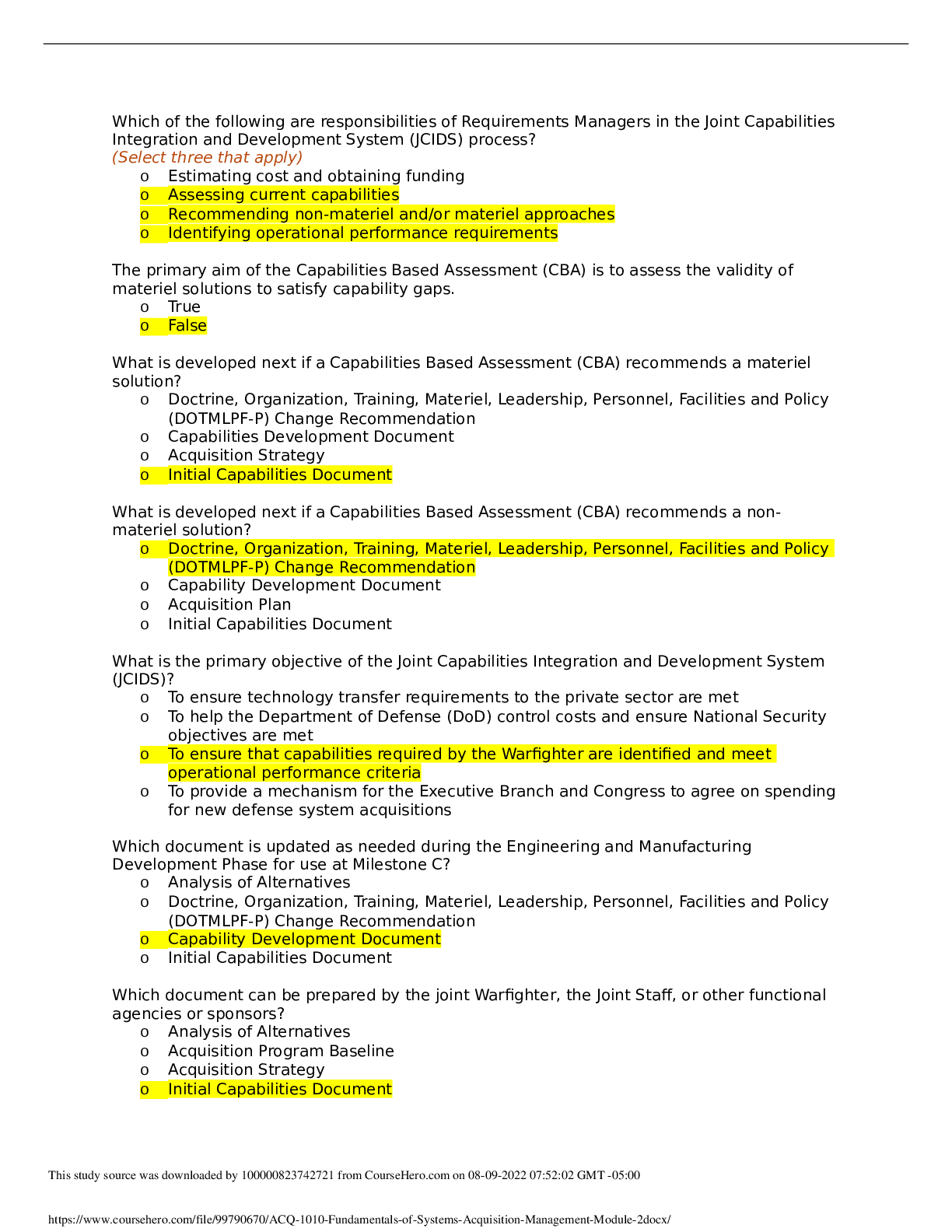
Which of the following are responsibilities of Requirements Managers in the JCIDS process? (Select all that apply) - ANSWER ~ Assessing current capabilities
~ Recommending non-materiel and/ or materiel approaches
~ Identifying operational performance requirements
The primary aim of the CBA is to assess the validity of materiel solutions to capabilities gaps. - ANSWER True
What is developed next if a CBA recommends a materiel solution? - ANSWER Initial Capabilities Document
What is developed next if a CBA recommends a non-materiel solution? - ANSWER ~ DOTMLPF-P Change Recommendation.
[Show More]

.png)