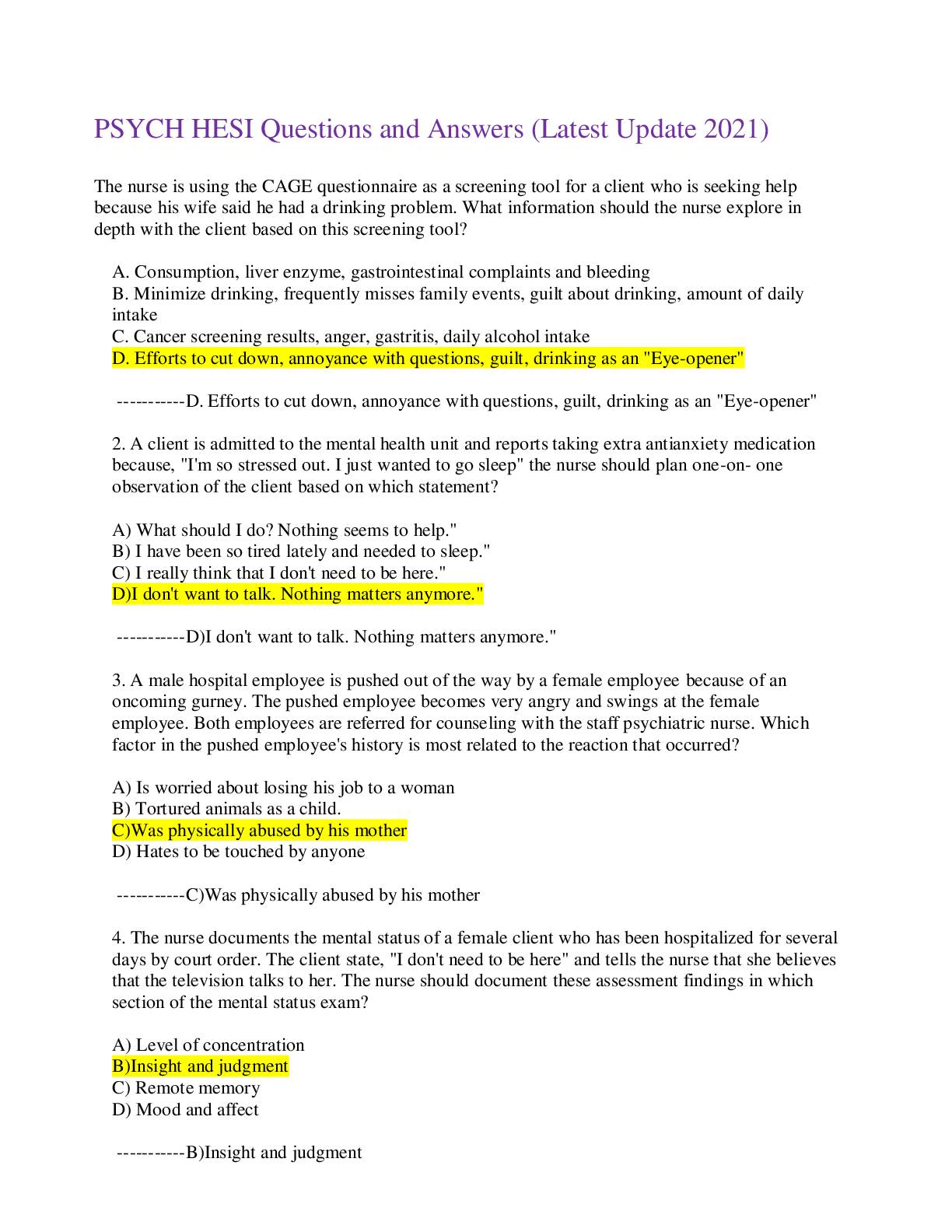
The nurse is using the CAGE questionnaire as a screening tool for a client who is seeking help because his wife said he had a drinking problem. What information should the nurse explore in depth with the client based on
...
The nurse is using the CAGE questionnaire as a screening tool for a client who is seeking help because his wife said he had a drinking problem. What information should the nurse explore in depth with the client based on this screening tool?
2. A client is admitted to the mental health unit and reports taking extra antianxiety medication because, "I'm so stressed out. I just wanted to go sleep" the nurse should plan one-on- one observation of the client based on which statement?
3. A male hospital employee is pushed out of the way by a female employee because of an oncoming gurney. The pushed employee becomes very angry and swings at the female employee. Both employees are referred for counseling with the staff psychiatric nurse. Which factor in the pushed employee's history is most related to the reaction that occurred?
4. The nurse documents the mental status of a female client who has been hospitalized for several days by court order. The client state, "I don't need to be here" and tells the nurse that she believes that the television talks to her. The nurse should document these assessment findings in which section of the mental status exam?
5. The nurse on the evening shift receives report that a client is scheduled for electroconvulsive treatment (ECT) in the morning. Which intervention should the nurse implement the evening before the scheduled ECT?
6. A client who is admitted to the mental health unit report shortness of breath and dizziness. The client tells the nurse, "I feel like I'm going to die" which nursing problem should the nurse include in this client's plan of care?
7. A female client is brought to the emergency department after police officers found her disoriented, disorganized, and confuse. The nurse also determines that the client is homeless and slightly suspicious. This client's treatment plan should include what priority problem?
8. A male client is admitted to the psychiatric unit for recurrent negative symptoms of chronic schizophrenia and medication adjustment of risperidone (Risperdal). When the client walks to the nurse's station in a literally contracted position, he states that something has made his body confort into a monster. What action should the nurse take
9. A mental health worker (MHW) is caring for a client with escalating aggressive behavior. Which action by the MHW warrants immediate intervention by the nurse?
10. Which nursing actions are likely to help promote the self-esteem of a male client with mental depression. (Select all that apply)
11. The nurse is preparing medications for a client with bipolar disorder and notices that the antipsychotic medication was discontinued several days ago. Which medication should also be discontinued?
12. The nurse is teaching a client about the initiation of a prescribed abstinence therapy using disulfiram (Antabuse). What information should the client acknowledge understanding?
13. A male client with schizophrenia is admitted to the mental health unit aµer abruptly stopping his prescripTon for ziprasidone (Geodon) one month ago. Which quesTon is most important for the nurse to ask the client
hear
14. *During an annual physical by the occupational nurse working in a corporate clinic, a male employee tells the nurse that his high stress job is causing trouble in his personal life. he further explains the he often gets so angry while driving to and from work that he has considered "getting even" with other drivers. how should the nurse respond?*
15. A client who has agoraphobia (a fear of crowds) is beginning desensitization with the therapist, and the nurse is reinforcing the process. Which intervention has the highest priority for this client's plan of care?
16. A female client request that her husband be allowed to stay in the room during the admission assessment . While interviewing the client, the nurse notes a discrepancy between the client's verbal and non-verbal communication. What action should the nurse take?
17. A male client approaches the nurse with an angry expressions on his face and raises his voice, saying , My roommate is the most selfish, self-centered, angry person I have ever met. If he loses his temper one more time with me , I am going to punch him out! The nurse recognizes that the client is using which defense mechanism?
18. The nurse orients a female client with depression to her new room on the mental health unit. The client states, "It seems strange that I don't have a TV in my room." Which statement would be best for the nurse to provide?
19. Following surgery, a male client with antisocial personality disorder frequently requests that a specific nurse be assigned to his care and is belligerent when another nurse is assigned. What action should the charge nurse implement?
20. Narcan was administered to an adult client following a suicide attempt with an overdose of hydrocodone bitartrate (vicodin). Within 15 min the client is alert and oriented. In planning nursing care which intervention has the highest priority at this time?
21. A client postpartum depression receives a prescription for sertraline (Zoloft). What information is most important to include in client teaching?
22. A male client with bipolar disorder who began taking lithium carbonate Five days ago is complaining of excessive thirst, and the nurse Finds him attempting to drink water from the bathroom sink faucet. Which intervention should the nurse implement?
23. When preparing to administer a prescribed medication to a homeless male at a community psychiatric clinic, the client tells the nurse that he usually takes a different dosage. What action should the nurse take?
24. The nurse complete an assessment of a client who is experiencing intimate partner violence (IPV) which finding of the injuries should the nurse include in the documentation?
25. The nurse is planning client teaching for a 35 year old client with early alcoholic cirrhosis. Which self-care measure should the nurse emphasize for the client's recovery?
26. A client who is being treated with lithium carbonate for bipolar develops diarrhea, vomiting, and drowsiness. What action should the nurse take?
27. A client with depression remains in bed most of the day, declines activities and refused to eat. Which nursing problem has the greatest priority for this client?
28. A female client engages in repeated checks of door and window locks. Behavior that prevents her form arriving on time and interferes with her ability to function effectively. What action should the nurse take?
29. A client who is admitted with a closed head injury after a fall has a block alcohol level (BAL) of 0.28 (28%) and is difficult to arouse. Which intervention during the first 6 hours following admission should the nurse identify as the priority?
30. The nurse leading a group sessions of adolescent clients gives the members a handout about anger management. One of the male clients is fidgety, interrupts peers when they try to talk and talks about his pets at home. What nursing action is best for the nurse to take?
31. The nurse is preparing medications for a client with bipolar disorder and notices that the antipsychotic medication was discounted several days ago. Which medication should also be discountinued?
32. The nurse is completing the admission assessment of and underweight adolescent whois admitted to a psychiatric unit with a diagnosis of depression. Which finding requires notification to the healthcare provider?
33. A middle aged adult with major depressive disorder suffers from pyschomotor retardation, hypersommia, and amotivation. Which intervention is likely to be most effective in returning this client to a normal level of functioning?
34. A male client with a long history of alcohol dependency arrives in the Emergency Department describing the feeling of bugs crawling on his body. His blood pressure is 170/102, pulse rate is 110 beats/minute, and his blood alcohol level (BAL) is 0 mg/dL. Which prescription should the nurse administer?
35. A female client reports feeling hopeless and is unable to stop crying. She explains that she is worried about losing her job. Since the client's husband recently lost his job she feels her employment is essential to the family's survival. To evaluate the effectiveness of cognitive-behavioral techniques, which client outcome should the nurse include in the plan of care?
36. A male client with schizophrenia is demonstrating echolalia, which is becoming annoying to other clients on the unit. What intervention is best for the nurse to implement?
37. A young adult male is hospitalized due to depression and an attempted suicide attempt. The client reports that the he lost job and was angry with his employer for firing him when he took an overdose of pain medications. Which behavior best indicates to the nurse that his condition is improving?
38. A male client comes to the emergency center he has an erection that will no resolve the client reports that he is taking trazodone (desyrel) for insomnia which information is most important for the nurse to ask this client?
39. Following involvment in a motor vehicle collision, a middle-aged adult client is admitted to the hospital with multiple facial fractures. The client's blood alcohol level is high on admission. Which PRN prescription should be administered if the client begins to exhibit signs and symptopms of delirium tremens (DTs)?
40. A female client, who is wearing dirty clothes and has a foul body odor, comes to the clinic reporting feeling scared because she is being stalked. What action is most important for the nurse to take?
41. A male veteran who recently returned from a war zone has post traumatic stress disorder (PTSD) and is admitted to the psychiatric ward because of admitted suicicdal ideations. On admission, the client's family informed the healthcare provider that therapy sessions did not seem to be helping. Select only one intervention that has the highest priority
42. A middle aged female client with no previous psychiatric history is seen in the mental health clinic because her family describes her as having paranoid thoughts. On assessment, she tells the nurse, "I want to find out why these people are stalking me!" Which response should the nurse provide?
43. A client on the mental health unit is becoming more agitated, shouting at the staff, and pacing in the hallway. When a PRN medication is offered, the client refuses the medication and defiantly sits on the floor in the middle of the unit hallway. What nursing intervention should the nurse implement first?
44. A client who is known to abuse drugs is admitted to the pyschiatric unit. Which medication should the nurse anticipate administering to a client who is exhibiting benzodiazepine withdrawl symptoms?
45. The nurse accepts a transfer to the mental health unit and understands that the client is distractible and exhibiting a decreased ability to concentrate. The nurse has only 15 minutes to talk with the client. To develop a treatment plan for this client, which assessment is most important for the nurse to obtain?
46. A male adult is admitted because of an acetaminophen (Tylenol) overdose. After transfer to mental health unit the client is told he has liver damage. Which information is most important for the nurse to include in the client's a discharge plan?
47. A male adolescent was admitted to the unit two days ago for depression. When the mental health nurse tries to interview the client to establish rapport, he becomes very irritated and sarcastic. Which action is best for the nurse to take?
48. After receiving treatment for anorexia, a student asks the school nurse for permission to work in the school cafeterias part of the school's work study program. What action should the nurse take?
49. A female client on a psychiatric unit is sweating profusely while she vigorously does push ups and then runs the length of the corridor several times before crashing into furniture in the sitting room. Picking herself up, she begins to toss chairs aside, looking for a red one to sit in. When another client objects to the disturbance, the client shouts, "I am the boss here. I do what I want." Which nursing problem best supports these observations?
50. While sitting in the day-room of the mental health unit, a male adolescent avoids eye contact, looks at the floor, and talks softy when interacting with the nurse. The two trade places, and the nurse demonstrates the client's behaviors. What is the main goal of this therapeutic technique?
51. A nurse is providing education about strategies for a safety plan for a female client who is a victim of intimate partner violence. Which strategies should be included in the safety plans? (select all that apply)
52. A client is receiving substitution therapy during withdrawal from benzodiazepines. Which expected outcome statement has the highest priority when planning nursing care?
53. The nurse is developing unit policies that will incldue nursing guidelines for maintaining a therapeutic milieu. Which interventions should be included when providing a therapeutic milieu in an inpatient setting?
54. A high school girl reveals to the school nurse that she has been engaging in self- induced vomiting as a weight control measure. Which initial assessment should the nurse focus on with this adolescent?
55. An adolescent male receives a prescription for an antidepressant drug because he is exhibiting a depressed affect. While the client is taking the anitdepressant, which comparison of the client's behavior before and after taking the drug is most important for the nurse to obtain?
56. A family high school teacher who was a child of alcoholic parents seek counseling at the community health clinic because of depression over a student who was killed by a drunk driver. After several weeks of counseling, which client behavior is the best indicator that the client is coping well with the anxiety related to the students death?
57. While interviewing a client, the nurse takes notes to assist with accurate documentation later. Which statement is most accurate regarding note-taking during an interview?
58. Which client statement suggest to the nurse that the client is using the defense mechanism of projection to deal with anxiety related to admission to a psychiatric unit?
59. A male client with bipolar disorder tells the nurse that he needs to "make some deals so that he can improve his retirement savings." Based on this information, which client outcome should the nurse include in the plan of care?
60.A client with schizophrenia explains that she has 20 children and then very seriously points to the nurse and explains that she is one of them. What is the most therapeutic response for the nurse to provide?
61. The nurse on the day shift receives report about a client with depression who w the weekend. The nurse walks into the client's room in the morning and finds the what intervention is best for the nurse to implement?
62. A client who refuse antipsychotic medications disrupts group activities, talks with nonsensical words wanders into client's room. The nurse decides that the client needs constant observation based on which of these assessment findings?
63. A teenager who has lost 20 pounds in the last three months is admitted to the hospital with hypotension and tachycardia. The client reports irregular menses and hair loss. Which intervention is most important for the nurse to include to in the clients plan of care?
64. A male client with known auditory hallucinations begins talkingloudly and gesturing wildly while in the unit's day room. What action should the nurse implement first?
65. A woman brings her 48 year old husband to the outpatient psychiatric unit and describes his behavior to the admitting nurse. She states that he has been sleepwalking, cannot remember who he is, and exhibits multiple personalities. The nurse knows that these behaviors are often associated with
66. A male client who recently lost a loved one arrives at the mental health center and tells the nurse he is no longer interested in his usual activities and has not slept for several days. Which nursing problem should the nurse include in this client's plan of care?
67. A female client with a history of drinking who was admitted 8 hours ago after receiving treatment for minor abrasions occurred from a fall at home. The nurse determines the client's blood alcohol level (BAL) was not analyzed on administration. what action should the nurse take?
68. A male client is admitted to the psychiatric inpatient unit with a bandaged flesh wound after attempting to shoot himself. he is recently divorced one year ago, lost his job four months ago, and suffered a break up of his current relationship last week. What is the most likely source of this client's current feelings of depression
69. What is the most important goal for a client diagnosed with major depression who has been receiving an antidepressant medication for two weeks
70. A male adult comes to the mental health clinic and walks back and fourth in front of the office door, but does not enter the office. He then walks around a chair that is in the hallway several times before sitting down in the chair. What action should the nurse take first
71. A male client in the mental health unit is guarded and vaguely answers the nurse's questions. He isolates to his room and sometimes opens the door to peek into the hall. Which problem can the nurse anticipate
72. A male client who is seen in the mental health clinic monthly reports feeling very stressed and nervous and further describes becoming angry increasingly more often during the last month. What action should the nurse take first
73. A 25-year-old female client has been particularly restless and the nurse finds her trying to leave the psychiatric unit. She tells the nurse, "Please let me go! I must leave because the secret police are after me." Which response is best for the nurse to make?
74. A male client arrives at the mental health clinic and asks the nurse for more lithium and the antidepressant (Elavil) that he uses to help him sleep. After reviewing his assessment findings with the healthcare provider, a serum creatinine is obtained. What information supports the reason for this laboratory test
75. When preparing to administer a domestic violence screening tool to a female client, which statement should the nurse provide
76. A client with schizophrenia who is taking Haldol begins exhibiting tremors of the extremities. Which intervention should the nurse implement *(think toxicity)*
77. Patient with schizophrenia, drug and alcohol abuse in hospital for hepatitis, contant healthcare provider before giving
78. Antidepressant side effects
79. An woman who started chemotherapy three days ago for cancer of the breast calls the clinic reporting that she is so upset she cannot sleep. The client has several PRN medications available. Which drug should the nurse instruct her to take?
80. A young woman is preparing to be discharged from the psychiatric unit. Which nursing intervention is most important for the nurse to include in this phase of the nurse client relationship
81. Postpartum depression Sign & Symptoms (3)
82. Patient is stealing clothes. What intervention can the nurse implement?
83.Heatlh assessment of history of alcohol dependency WHAT ELSE WOULD BE A CONCERN
84. Patient had a knee surgery post op and diaphoretic and visual hallucinations (what to do first)
85. Aspiration due to caustic material related to suicide attempt. (nursing diagnosis)
86. A 38 year old female client is admitted with a diagnosis of paranoid schizophrenia. When her tray is brought to her food to eat and tells the nurse, "I know you are trying to poison me with that food." Which response would be most appropriate for the nurse to make?
87. During a one-to-one session, the nurse begins to become angry with the client. Which action should the nurse take?
88. A client with paranoia is admitted to the mental health unit and immediately goes to the corner of the room and sits quietly without communicating. In approaching the client, what intervention should the nurse implement first?
89. History of alcoholism admitted for detoxification; 6 mg of ativan was administered. what additional prescription should the nurse administer immediately?
90. Schizoprenic client return to clinic 2 weeks after recieving dose of haldol; important info for the nurse to obtain during this visit
91. PTSD admitted to psychiatric unit, which intervention is most important for plan of care (think of an ideal environment)
92. "Idont know, i just cant think" what activity should the nurse suggest
93. Assessing male client with paranoia, which behavior can this client be expected to exhibit
94. 8 month old with profound mental and physical disabilities. (what to ask the mother)
95. Bipolar disorder depakote for manic reactions. monitored for seizure
96. Chronically depressed older male client of a long term care facility becomes more reclusive and today refuses to leave room (what intervention should you implement, what should u ask the client?)
97. Wife having affair, sober of 3 years, i believe in god
98. Smearing feces on the bathroom wall. what intervention should you implement?
99. Patient says "i know marijuana is not addicting". what is the nurse's best response?
100. Patient has catatonic schizoprenia, emphysema, DM2, hyperlipidemia. what should the nurse do first?
101. Patient is admitted with borderline personality disorder self inflicted lacerations on abdomen. what should the nurse do?
102. Male client admitted depression and self mutilation. what should the nurse ask the patient?
103. admitted relationship distress with spouse and depressed mood, which diagnostic test. what test should the nurse request?
104. 1.5 lithium admitted for suicidal ideations. what should the nurse advise the patient?
105. Teen in ER for threatening teacher. what interventions should the nurse implement?
106. Patient seeing snakes. what medication should the nurse administer
107. Patient complains of blindness
108. College student hears kill, kill. what question should the nurse ask the patient?
109. A client with bulimia what do you do? (think fluids)
110. 14 year old eating disorder what do you get them involved in
111. Client 164 cm 36 kg after syncope episode at home. what nursing intervention should the nurse implement?
112. Attempted suicide by slashing wrists. what should the nurse do first?
113. How do you take antabuse
114. A male client is admitted to the er; overdose of benzodiazepine. what should the nurse administer?
115. Cancer patient who becomes dependent.
116. Patient hears voice and becomes agitated. what should the nurse do?
117. Patient is suffering from recent suicide attempt, wife filed for divorce, loss job. what intervention should the nurse implement?
118. Female low cut blouse, red lipstick. What should the nurse do?
119. Mother yells "dont touch him" as the nurse gives child
120. Female depressed patient begins to talk and exhibit energy. what should the nurse do?
121. Male employee says imgonna shoot a coworker. what is the first thing the nurse should do?
122. Client sitting in corner of day room during admission assessment, what nursing action
123. Two days after last drink, shouts at wife and kids, what nursing intervention has the highest priority (think nursing diagnosis)
124. Nurse documents that a male client with schizophrenia is delusional, what statement made by the client would be an example? Why?
125. Female brought to ER for rape by date
126. Male client on atypical antipsychotic drug olanzapine (zyprexa) (possible side effects?)
127. Sometimes my thoughts go so fast, is it time to eat. What kind of thinking is the patient exhibiting?
128. An adolescent male receives a prescription for an antidepressant drug because he is exhibiting a depressed affect. While the client is taking the antidepressant, which comparison of the client’s behavior before and after taking the drug is most important for the nurse to obtain?
129. The nurse is using the CAGE questionnaire as a screening tool for a client who is seeking help because his wife said he had a drinking problem. Which information should the nurse explore in depth with the client based on this screening tool?
130. A young adult male is hospitalized due to depression and an attempt suicide attempt. The client reports that he lost his job and was angry with the employer for firing him when he took an overdose of pain medications. Which behavior best indicated to the nurse that his condition is improving?
140. A male client with schizophrenia is demonstrating echolalia, which is becoming annoying to other clients on the unit. What intervention is best for the nurse to implement?
141. A female client engages in repeated checks of door and window locks, behavior that prevents her from arriving on time and interferes with her ability to function effectively. What action should the nurse take?
142. The nurse is teaching a client about the initiation of a prescribed abstinence therapy using disulfiram (Antabuse). What information should the client acknowledge understanding?
143. A middle-aged adult with major depressive disorder suffers from psychomotor retardation, hypersomnia, and amotivation. Which intervention is likely to be most effective in returning this client to a normal level of functioning?
144. A male client is admitted to the psychiatric unit for recurrent negative symptoms of chronic schizophrenia and medication adjustment of risperidone (Risperdal). When the client walks to the nurse’s station in a laterally contracted position, he states that something has made his body contort into a monster. What action should the nurse take?
145. The nurse is preparing medications for a client with bipolar disorder and notices that the antipsychotic medications are discontinued several days ago. Which medication should also be discontinued?
146. The nurse leading a group session of adolescent clients gives the members a handout about anger management. One of the male clients is fidgety, interrupts peers when they try and talk, and talks about his pets at home. What nursing action is best for the nurse to take?
147. A client who is admitted with a closed head injury after a fall has a blood alcohol level (BAL) of 0.28 (28%) and is difficult to arouse. Which interventions during the first 6 hours following admission should the nurse identify as the priority?
[Show More]