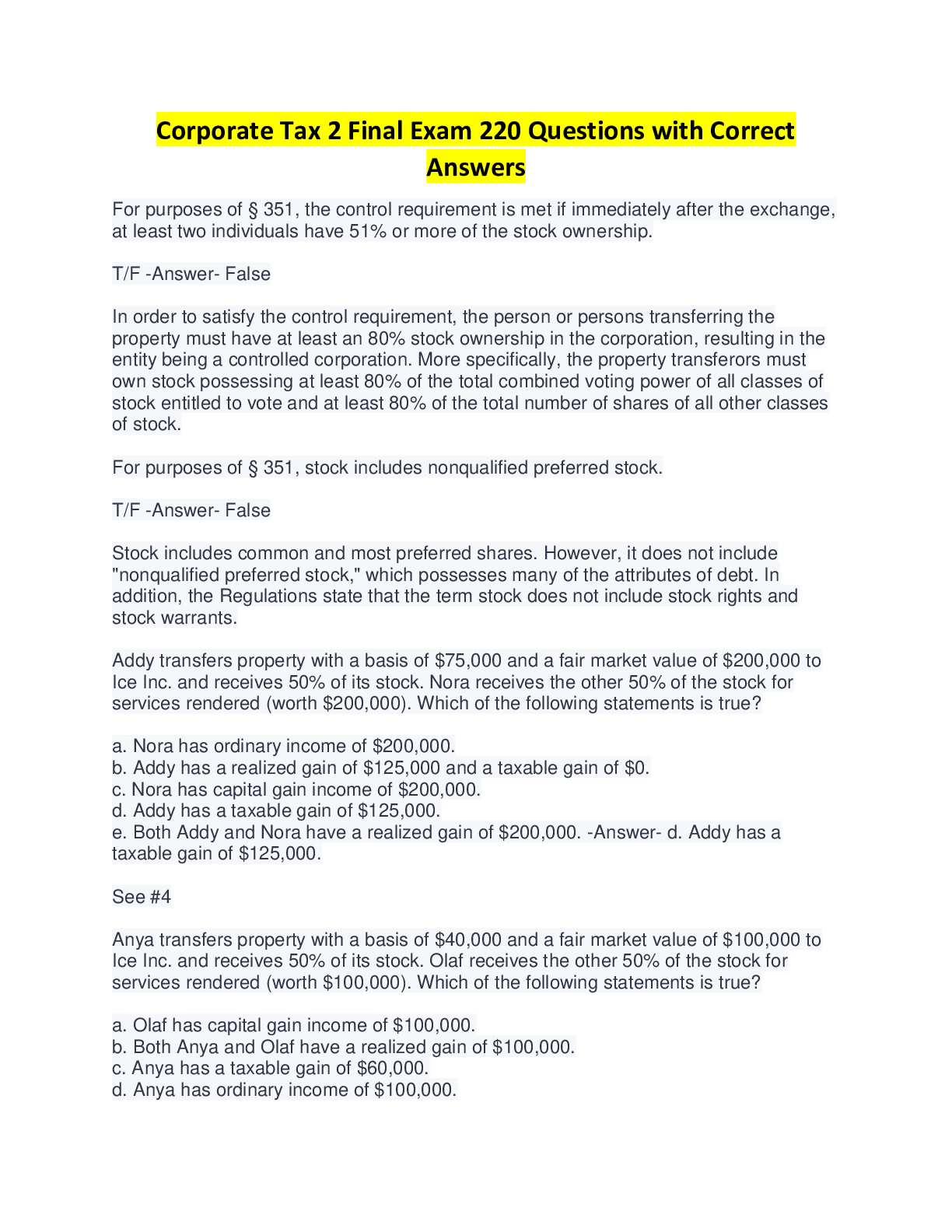
Corporate Tax 2 Final Exam 220 Questions with Correct Answers
For purposes of § 351, the control requirement is met if immediately after the exchange, at least two individuals have 51% or more of the stock ownership.
...
Corporate Tax 2 Final Exam 220 Questions with Correct Answers
For purposes of § 351, the control requirement is met if immediately after the exchange, at least two individuals have 51% or more of the stock ownership.
T/F -Answer- False
In order to satisfy the control requirement, the person or persons transferring the property must have at least an 80% stock ownership in the corporation, resulting in the entity being a controlled corporation. More specifically, the property transferors must own stock possessing at least 80% of the total combined voting power of all classes of stock entitled to vote and at least 80% of the total number of shares of all other classes of stock.
For purposes of § 351, stock includes nonqualified preferred stock.
T/F -Answer- False
Stock includes common and most preferred shares. However, it does not include "nonqualified preferred stock," which possesses many of the attributes of debt. In addition, the Regulations state that the term stock does not include stock rights and stock warrants.
Addy transfers property with a basis of $75,000 and a fair market value of $200,000 to Ice Inc. and receives 50% of its stock. Nora receives the other 50% of the stock for services rendered (worth $200,000). Which of the following statements is true?
a. Nora has ordinary income of $200,000.
b. Addy has a realized gain of $125,000 and a taxable gain of $0.
c. Nora has capital gain income of $200,000.
d. Addy has a taxable gain of $125,000.
e. Both Addy and Nora have a realized gain of $200,000. -Answer- d. Addy has a taxable gain of $125,000.
See #4
Anya transfers property with a basis of $40,000 and a fair market value of $100,000 to Ice Inc. and receives 50% of its stock. Olaf receives the other 50% of the stock for services rendered (worth $100,000). Which of the following statements is true?
a. Olaf has capital gain income of $100,000.
b. Both Anya and Olaf have a realized gain of $100,000.
c. Anya has a taxable gain of $60,000.
d. Anya has ordinary income of $100,000.
e. Anya has a realized gain of $60,000 and a taxable gain of $0. -Answer- c. Anya has a taxable gain of $60,000.
Olaf has ordinary income of $100,000 because he contributes only services. Anya contributes property, but she receives only 50% of Ice's stock. Because Anya does not own at least 80% of Ice's stock, she has a taxable gain of $60,000 [$100,000 (FMV of the stock) less the $40,000 basis of the property]. The control requirement of § 351 has not been met.
The determination of a liability under § 357 would not include any obligation that would have been deductible to the transferor had the obligation been paid before the transfer.
T/F -Answer- True
This is an exception to the general rule of § 357. Therefore, accounts payable of a cash basis taxpayer would not be considered as a liability.
The definition of liabilities under § 357(c) includes obligations that would have been deductible to the transferor had those obligations been paid before the transfer. -Answer- False
Such obligations are excluded. Therefore, trade accounts payable of a cash basis taxpayer are not considered liabilities for purposes of § 357(c).
Wallace transfers land (basis of $140,000 and fair market value of $320,000) to Dragon Corporation for 80% of its stock and a note payable in the amount of $80,000. Dragon assumes Wallace's mortgage on the land of $200,000. Which of the following statements is true?
a. Wallace has a recognized gain on the transfer of $140,000.
b. Wallace has a recognized gain on the transfer of $80,000.
c. Wallace has a recognized gain on the transfer of $60,000.
d. Dragon Corporation has a basis in the land of $320,000.
e. Dragon Corporation has a basis in the land of $220,000. -Answer- a. Wallace has a recognized gain on the transfer of $140,000.
The mortgage on the land exceeds Wallace's basis in the land by $60,000 and is recognized as gain under § 357(c). Dragon Corporation's note payable of $80,000 is treated as boot. Thus, Wallace's recognized gain is $140,000. Dragon Corporation's basis in the land is $280,000 [$140,000 (Wallace's basis) + $140,000 (recognized gain)].
If §§ 357(b) and (c) apply in the same transaction, § 357(c) predominates.
T/F -Answer- False
Conceivably, a situation could arise where both §§ 357(b) and (c) apply in the same transfer. In such a situation, § 357(b) predominates. This could be significant because § 357(b) does not automatically create gain on the transfer, as does § 357(c), but merely converts the liability to boot. Thus, the realized gain limitation continues to apply to § 357(b) transactions.
Ginger transfers land to Dove Corporation for 90% of the stock in Dove Corporation worth $20,000 plus a note payable to Ginger in the amount of $40,000 and the assumption by Dove Corporation of a mortgage on the land in the amount of $100,000. The land, which has a basis to Ginger of $70,000, is worth $160,000. Which of the following statements is true?
a. Dove Corporation will have a basis in the land transferred by Ginger of $160,000.
b. Ginger will not recognize a gain on the transfer.
c. Ginger will have a gain on the transfer of $70,000.
d. Dove Corporation will have a basis in the land transferred by Ginger of $70,000.
e.Ginger will have a gain on the transfer of $30,000. -Answer- c. Ginger will have a gain on the transfer of $70,000.
The mortgage on the land exceeds Ginger's basis in the land by $30,000. This amount would be gain under § 357(c). In addition, the note payable to Ginger does not qualify for nonrecognition under § 351; thus, Ginger would have additional gain of $40,000.
Amount realized:
Stock$20,000
Note40,000
Release of mortgage
100,000
$160,000
Less: Basis of land(70,000)
Realized gain$90,000
Recognized gain ($30,000 + $40,000)$70,000
Dove Corporation will have a basis of $140,000 in the land [$70,000 (Ginger's basis in the land) + $70,000 (gain recognized by Ginger with respect to the transfer of the land)].
Which of the following transfers represents an exception to the general rule of § 357?
a. A transfer when the owner of the property retains the liability attached to the property
b. A transfer involving depreciable property
c. A transfer that can be shown as having a valid business purpose
d. A transfer in the absence of any motive of tax avoidance
e. A transfer where the liability attached to the property exceeds the basis in the property -Answer- e. A transfer where the liability attached to the property exceeds the basis in the property
[Show More]

.png)



.png)
.png)