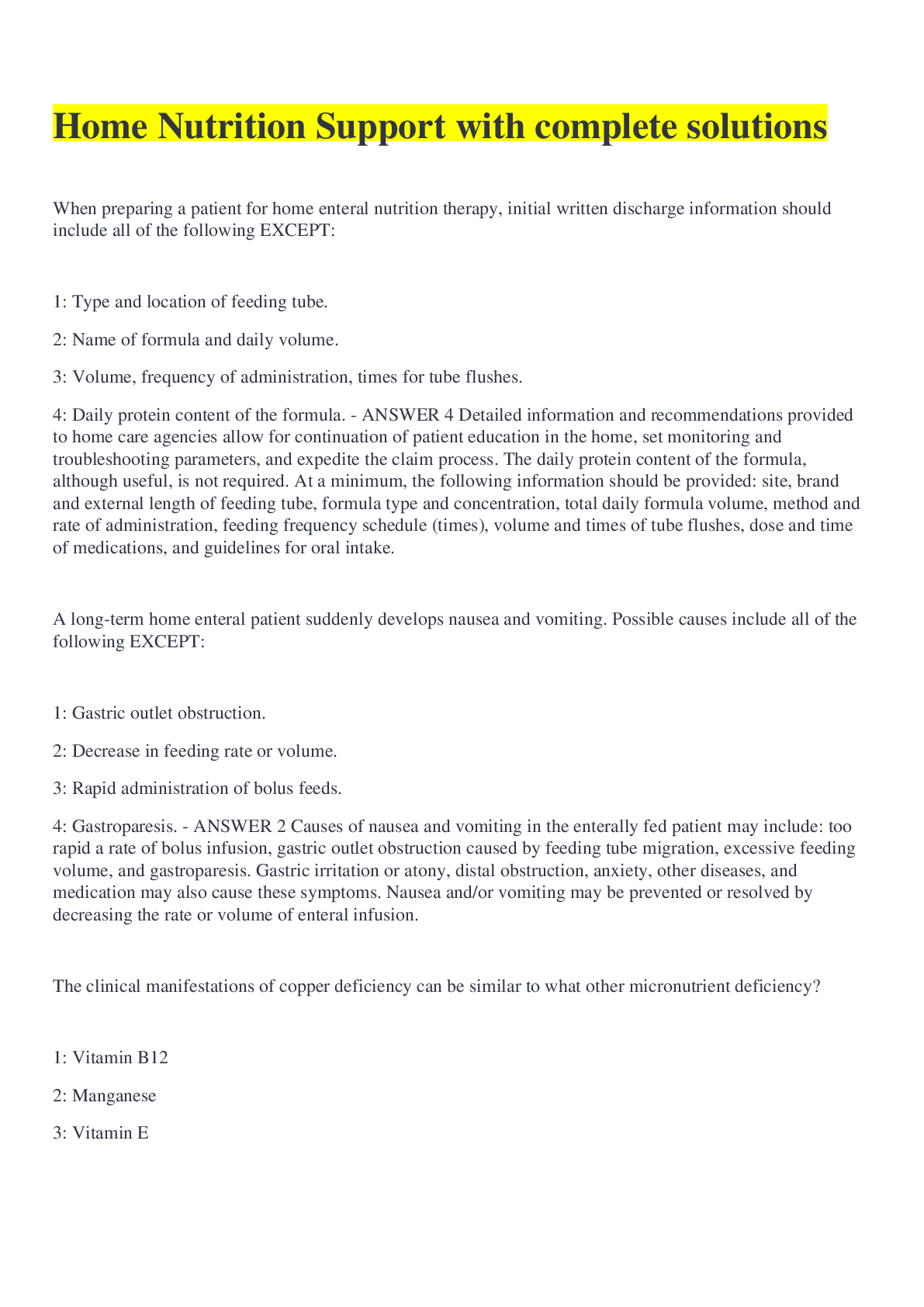
When preparing a patient for home enteral nutrition therapy, initial written discharge information should include all of the following EXCEPT:
1: Type and location of feeding tube.
2: Name of formula and daily volum
...
When preparing a patient for home enteral nutrition therapy, initial written discharge information should include all of the following EXCEPT:
1: Type and location of feeding tube.
2: Name of formula and daily volume.
3: Volume, frequency of administration, times for tube flushes.
4: Daily protein content of the formula. - ANSWER 4 Detailed information and recommendations provided to home care agencies allow for continuation of patient education in the home, set monitoring and troubleshooting parameters, and expedite the claim process. The daily protein content of the formula, although useful, is not required. At a minimum, the following information should be provided: site, brand and external length of feeding tube, formula type and concentration, total daily formula volume, method and rate of administration, feeding frequency schedule (times), volume and times of tube flushes, dose and time of medications, and guidelines for oral intake.
A long-term home enteral patient suddenly develops nausea and vomiting. Possible causes include all of the following EXCEPT:
1: Gastric outlet obstruction.
2: Decrease in feeding rate or volume.
3: Rapid administration of bolus feeds.
4: Gastroparesis. - ANSWER 2 Causes of nausea and vomiting in the enterally fed patient may include: too rapid a rate of bolus infusion, gastric outlet obstruction caused by feeding tube migration, excessive feeding volume, and gastroparesis. Gastric irritation or atony, distal obstruction, anxiety, other diseases, and medication may also cause these symptoms. Nausea and/or vomiting may be prevented or resolved by decreasing the rate or volume of enteral infusion.
The clinical manifestations of copper deficiency can be similar to what other micronutrient deficiency?
1: Vitamin B12
2: Manganese
3: Vitamin E
4: Zinc - ANSWER 1 Assessing micronutrient status in long-term home parenteral nutrition consumers is challenging, requiring astute symptom observation. This may be complicated when one deficiency mimics another. Clinical manifestations of copper deficiency include pancytopenia as well as neurological deterioration with sensory ataxia, lower limb spasticity, and acral parethesias. These neurological presentations are also associated with vitamin B12 deficiency.
Which of the following is true concerning manganese and long-term parenteral nutrition patients?
1: Manganese deficiency occurs with prolonged parenteral nutrition infusion
2: Hypermanganesemia has been reported only in patients with cholestasis
3: Manganese contamination in commercial trace element preparations may result in hypermanganesemia
4: The best indicator of manganese status is serum manganese - ANSWER 3 The AMA-NAG recommendation for manganese in parenteral nutrition solutions for adults is 60-100 mcg/d. However, over recent years there have been several reports of hypermanganesemia in patients on long-term parenteral nutrition infusion who were receiving the AMA-NAG recommendations. Hypermanganesemia and deposition of manganese in the brain have been reported in patients with and without cholestasis. An article by Berger & Shenkin states that since manganese is a contaminant of parenteral nutrition solutions, ideally there should be a manganese-limited trace element preparation for patients without cholestasis and a manganese-free trace element preparation for patients with cholestasis. The best indicator of manganese status is manganese superoxide dismutase on mononuclear cells. There is relatively little risk of manganese deficiency for long-term parenteral nutrition patients.
Which of the following is the best way to determine chromium deficiency?
1: Serum chromium levels
2: Empiric treatment when deficiency suspected
3: Urinary chromium levels
4: Serum glucose to insulin ratio - ANSWER 2 Treating patients with hyperglycemia with chromium supplementation and watching for resolution of symptoms empirically is the best way to determine if the patient was chromium deficient. There are no known reliable indicators of chromium status
Which of the following is true concerning zinc status in long-term parenteral nutrition patients?
1: Serum zinc is a reliable indicator of zinc status
2: Parenteral doses of 50 mg/d have been proven safe
3: Parenteral zinc interferes with copper bioavailability
4: Zinc deficiency is the most common suspected trace element abnormality - ANSWER 4 Most patients who require long-term parenteral nutrition have a dysfunctional GI tract that can contribute to increased GI losses. These GI losses can increase zinc losses and thus increase zinc requirements. Therefore, it is not surprising that zinc is the most commonly suspected trace element abnormality in long-term parenteral nutrition patients. Serum zinc is not a reliable indicator of zinc status. It can be within normal limits, and the patient may be in negative zinc status. Parenteral zinc doses 30 mg and greater have been shown to produce adverse effects and toxicity. The interaction between zinc and copper occurs when taken through the GI tract, not when infused intravenously.
Which of the following is true concerning the risk of aluminum toxicity from long-term parenteral nutrition?
1: The amount on the manufacturer's label is greater than measured amounts
2: Each parenteral nutrition bag must provide the amount of aluminum per liter
3: The clinical manifestations of aluminum toxicity are specific and sensitive
4: Aluminum toxicity is the primary etiology of metabolic bone disease - ANSWER 1 Manufacturer's of large volume, small volume, and pharmacy bulk packages of components for parenteral nutrition must label each with the amount of aluminum anticipated to be in the product when the product expires. The amount on the label has been shown to be approximately 10 times more than what was actually measured in a bag prepared according to a patient's prescription. Pharmacies are not required to list the aluminum content on each patient's parenteral nutrition bag. The clinical manifestations of aluminum toxicity (neurological, hepatic, hematologic, and skeletal) are neither specific nor sensitive for aluminum toxicity alone. The etiology of metabolic bone disease is multifactorial. Aluminum toxicity is only one of many potential contributors.
Which of the following is the most practical approach for managing micronutrients in long-term parenteral nutrition patients?
1: Obtain serum values for all vitamins and trace elements yearly
2: Perform a micronutrient assessment every 6 months
3: Provide micronutrients only when laboratory values indicate declining levels
4: Do not use commercial preparations; provide each micronutrient individually - ANSWER 2 Currently, the most practical approach to managing micronutrients and monitoring micronutrient status in long-term parenteral nutrition patients is to perform a micronutrient assessment every 6 months. During this assessment, the clinician reviews nutrient intake, potential nutrient losses, medications, and medical/surgical history, and performs a nutrition-focused physical examination. Every patient should get micronutrients daily unless there is a potential or identified nutrient toxicity. Whenever a nutrient is omitted or added to standard micronutrient recommendations, the patient should be monitored for a potential deficiency or toxicity that could develop over time. Laboratory values are not always reliable indicators. Normal levels can give a false sense of security when in fact the patient is deficient or toxic.
Failure to monitor which micronutrient in long-term home PN patients is most likely to result in toxicity?
1: Manganese
2: Zinc
3: Folate
4: Molybdenum - ANSWER 1 Hypermanganesemia can occur in all patients on long-term PN, regardless of liver function. Current trace element additives for PN contain greater than five times the current estimated requirement for manganese. There are several published reports of hypermanganesemia, some symptomatic, and some not, in patients on long-term PN. Manganese toxicity symptoms include headache and Parkinson-like abnormalities. While zinc and folic acid are important nutrients, not all patients are at risk for those specific deficiencies, and toxicity symptoms are not reported in those using standard PN. Those with high ostomy or stool output are at risk for zinc deficiency. Plasma zinc is not a reliable indicator of zinc status, so the test is of very limited value. There is little found in the literature about Molybdenum deficiency or toxicity in long-term PN patients, and routine monitoring is not recommended.
Medicare will cover enteral tube feeding in which of these situations?
1: Documented 10% weight loss in the past 3 months, and serum albumin < 3.0 in a patient who has poor appetite
2: A permanent impairment or disease of the mouth, esophagus or stomach that prevents food from reaching the small bowel
3: Decline in mental status, 10% weight loss in the past 3 months, serum albumin < 3.0, and inability to prepare meals due to partial paralysis
4: A temporary (less than 3 months) impairment or disease of the mouth, esophagus or stomach that prevents food from reaching the small bowel - ANSWER 2 Under Medicare coverage guidelines for HEN, the beneficiary must meet one of two basic criteria by having 1) a permanent non-function or disease of the structures that normally permit food to reach the small bowel; or 2) a disease of the small bowel that impairs digestion and absorption of an oral diet. The beneficiary must also meet the test of permanence, which is based on the judgment of the attending physician and is substantiated in the medical record. "Permanence" means that the condition is of long and indefinite duration, usually 90 days or greater. Permanence does not exclude the possibility of improvement. Additionally, the beneficiary must require tube feeding to maintain weight and strength commensurate with overall health status, and adequate nutrition must not be possible by dietary adjustment and/or oral supplements.
A malnourished patient has been diagnosed with metastatic ovarian cancer and has been on PN in the hospital. She has been diagnosed with partial mechanical small bowel obstruction that is inoperable. She is taking small amounts of a full liquid diet by mouth, but is unable to take enough nutrition to maintain her weight. She has lost 12% of her body weight in the past 2 months. According to current Medicare guidelines, this patient's PN will be covered under which of the following circumstances?
1: The physician must write an order for the patient to be n.p.o. or
2: Medical record must include a radiology report documenting the presence of partial small bowel obstruction
3: Medical record must document failure of an enteral tube feeding trial, or explain why an enteral feeding tube is not an option
4: No further documentation is necessary to confirm coverage - ANSWER 3 Medicare has stringent guidelines for the use of home PN. Complete documentation of the presence of malnutrition as well as the diagnosis for nonfunctional GI tract is critical to assure coverage. The diagnosis of partial small bowel obstruction alone will not qualify a person for PN under present medicare guidelines. Normally, an enteral tube feed trial must be done and shown to fail. This pertains to many other conditions as well, for example: motility disturbances, short bowel > 5ft beyond the ligament of Treitz, mild malabsorptive disorders, regional enteritis, and enterocutaneous fistula with ability to feed distally.
Under current Medicare guidelines, coverage for an enteral feeding pump can be justified under which circumstances?
1: The patient is being fed using a jejunal feeding tube
2: The patient states that bolus tube feedings interrupt his daily schedule; his preference is to infuse feedings during the night using a pump
3: The patient's caregiver has difficulty preparing several bolus feedings each day
4: The patient has severe dysphagia and is at risk for aspiration - ANSWER 1 Medicare guidelines require documentation of medical reason for the use of pump for feeding. Pump feedings are significantly more expensive than bolus feedings. Some of the conditions in which pump feedings are allowed are: nausea and vomiting, gastro esophageal reflux, need for slow controlled infusion to prevent blood glucose fluctuation, jejunostomy feeding tube, dumping syndrome, or diarrhea.
Alkaline phosphatase levels have been progressively elevating in the past 3 months in an adult patient with short bowel syndrome, who has been receiving 12 hour per day cycled 3-in-1 home PN. The clinician's initial plan will include:
1: Removal of all trace elements from PN.
2: Increasing lipid calories to prevent essential fatty acid deficiency.
3: Evaluation for possible overfeeding of dextrose and /or lipid.
4: Addition of choline and carnitine to the PN. - ANSWER 3 Studies indicate that patients on long term PN have a 25-100% risk of developing PN-associated liver disease. Overfeeding of lipid or dextrose is one of the most likely causes. Manganese and copper may become elevated in cholestatic patients, because they are excreted via the biliary tract, but a causal relationship with PN-associated liver disease has not been established. Carnitine can be added to PN if deficiency exists, and after other causes of liver dysfunction have been addressed, but it has not been proven to prevent or cure liver dysfunction. Choline deficiency also may be related to the development of PN-associated liver dysfunction, but use of IV choline is not yet approved by the FDA, and benefits of supplementation have not been proven.
Which trace element deficiency is most likely to occur in long-term PN-dependent patients after 3 to 6 months of therapy?
1: Iron
2: Zinc
3: Chromium
4: Manganese - ANSWER 1 Without a dietary iron source, patient's iron stores are expected to be depleted within 6 months. Iron is not part of standard trace element mixtures, and is not routinely added to PN solutions for several reasons. Iron (Fe) is incompatible with lipid emulsions. Use of iron dextran carries a low risk of serious hypersensitivity reactions. Fe can be added to non-lipid containing PN, but is typically not done as it increases risk of iron overload, as parenteral administration bypasses the normal gastrointestinal homeostatic control mechanisms. Although not proven, an association has also been found between iron therapy and infection, with the belief that provision of Fe might stimulate bacterial growth and impair host resistance. As for zinc, chromium, and manganese: the majority of patients will not be at risk for deficiency, as these are routinely supplemented in PN.
Indications for home parenteral nutrition may include all the following EXCEPT
1: Intestinal failure
2: End-stage renal disease (ESRD)
3: Short-term loss of GI function
4: Failed enteral tube feeding trial - ANSWER 2 GI length and function form the basis for the decision to initiate parenteral nutrition (PN). Diagnoses associated with home parenteral nutrition (HPN) include intestinal failure from Crohn's disease, and short-bowel syndrome that usually becomes a long-term or lifetime therapy. HPN may also be indicated when there is a shor-term loss of GI function due to complications associated with a diagnosis or the effects of treatments such as radiation enteritis secondary to cancer treatment. Other patients for whom HPN may be considered are those that have a temporary or permanent failure of enteral feedings. End-stage renal disease (ESRD) is not an indication for PN in and of itself as ESRD is not a diagnosis involving the small bowel or the bowel's ability to absorb nutrients.
Third party payors (insurance companies) are LEAST likely to reimburse which of the following HEN expenses?
1: Feeding bags and tubing
[Show More]




.png)