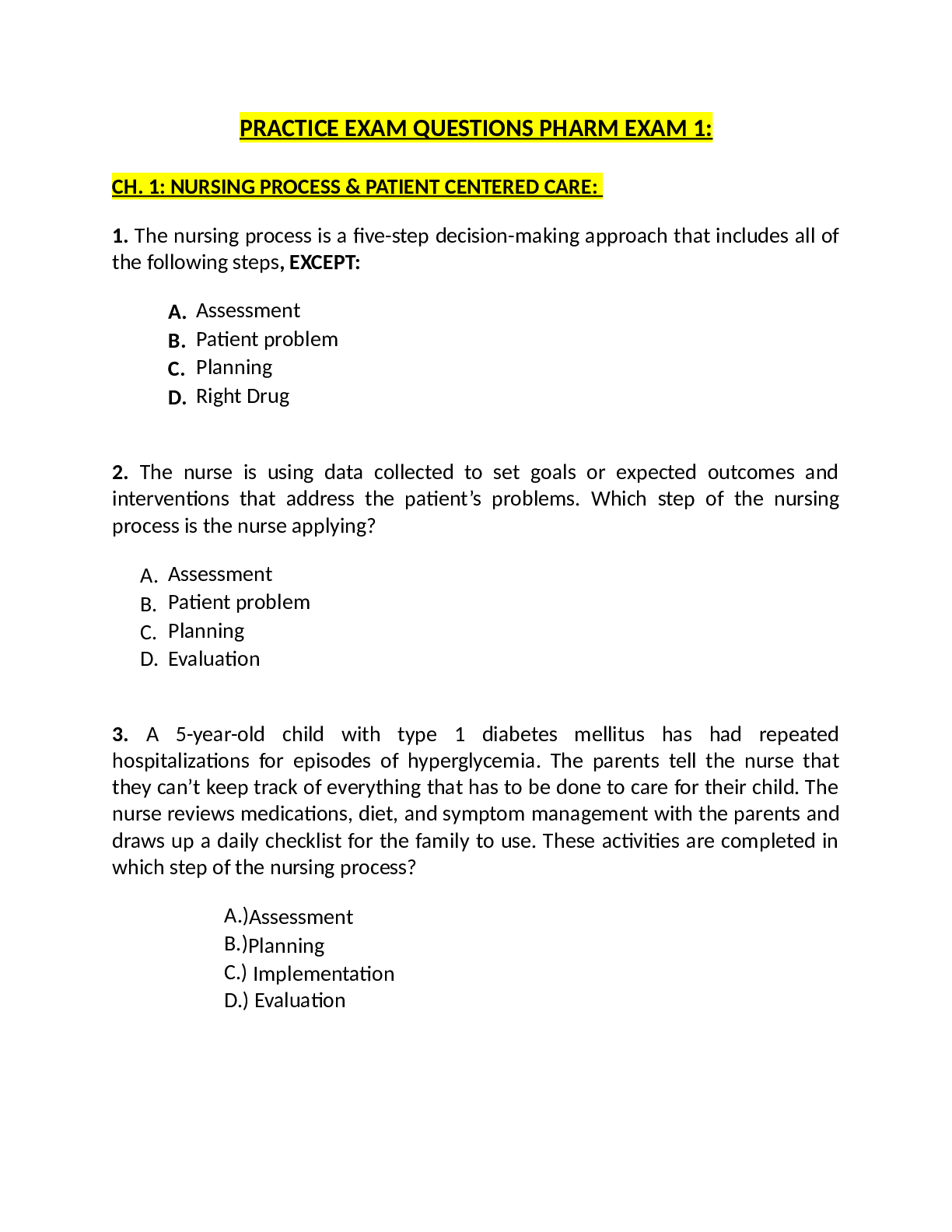
1. The nursing process is a five-step decision-making approach that includes all of
the following steps, EXCEPT:
A. Assessment
B. Patient problem
C. Planning
D. Right Drug
2. The nurse is using data collected to se
...
1. The nursing process is a five-step decision-making approach that includes all of
the following steps, EXCEPT:
A. Assessment
B. Patient problem
C. Planning
D. Right Drug
2. The nurse is using data collected to set goals or expected outcomes and
interventions that address the patient’s problems. Which step of the nursing
process is the nurse applying?
A. Assessment
B. Patient problem
C. Planning
D. Evaluation
3. A 5-year-old child with type 1 diabetes mellitus has had repeated
hospitalizations for episodes of hyperglycemia. The parents tell the nurse that
they can’t keep track of everything that has to be done to care for their child. The
nurse reviews medications, diet, and symptom management with the parents and
draws up a daily checklist for the family to use. These activities are completed in
which step of the nursing process?
A.)Assessment
B.)Planning
C.) Implementation
D.) Evaluation
4. The nurse is preparing to administer a medication and reviews the patient’s
chart for drug allergies, serum creatinine, and blood urea nitrogen (BUN) levels.
The nurse’s actions are reflective of which phase of the nursing process?
A. Assessment
B. Evaluation
C. Implementation
D. Planning
5. Which assessment is categorized as objective data?
A.) A list of herbal supplements regularly used
B.) Lab values associated with the drugs the patient is taking
C.) The ages and relationship to the patient of all household members
D.) Usual dietary patterns and food intake
6. The nurse reviews a patient’s database and learns that the patient lives alone, is
forgetful, and does not have an established routine. The patient will be sent home
with three new medications to be taken at different times of the day. The nurse
develops a daily medication chart and enlists a family member to put the patient’s
pills in a pill organizer. This is an example of which phase of the nursing process?
A. Assessment
B. Evaluation
C. Implementation
D. Planning
7. A patient who is hospitalized for chronic obstructive pulmonary disease (COPD)
wants to go home. The nurse and the patient discuss the patient’s situation and
decide that the patient may go home when able to perform self-care without
dyspnea and hypoxia. This is an example of which phase of the nursing process?
A. Assessment
B. Evaluation
C. Implementation
D. Planning
8. A patient will be sent home with a metered-dose inhaler, and the nurse is
providing teaching. Which is a correctly written goal for this process?
A. The nurse will demonstrate the correct use of a metered-dose inhaler to
the patient.
B. The nurse will teach the patient how to administer medication with a
metered-dose inhaler.
C. The patient will know how to self-administer the medication using the
metered-dose inhaler.
D. The patient will independently administer the medication using the
metered-dose inhaler at the end of the session.
9. The nurse is developing a plan of care for a patient who has chronic lung
disease and hypoxia. The patient has been admitted for increased oxygen needs
above a baseline of 2 L/min. The nurse develops a goal stating, “The patient will
have oxygen saturations of >95% on room air at the time of discharge from the
hospital.” What is wrong with this goal?
A. It cannot be evaluated.
B. It is not measurable.
C. It is not patient-centered.
D. It is not realistic.
10. The nurse is developing a teaching plan for an elderly patient who will begin
taking an antihypertensive drug that causes dizziness and orthostatic hypotension.
Which patient problem documented by the nurse is appropriate for this patient?
A. Deficient knowledge related to drug side effects
B. Ineffective health maintenance related to age
C. Readiness for enhanced knowledge related to medication side effects
D. Risk for injury related to side effects of the medication............
[Show More]