Sociology Midterm II Exam Review
Deviance: when someone deviates from the norm and receives a negative reaction
Crime: when defiance is against the “law”
Law: a norm stipulated by governing bodies
Informal punishment
...
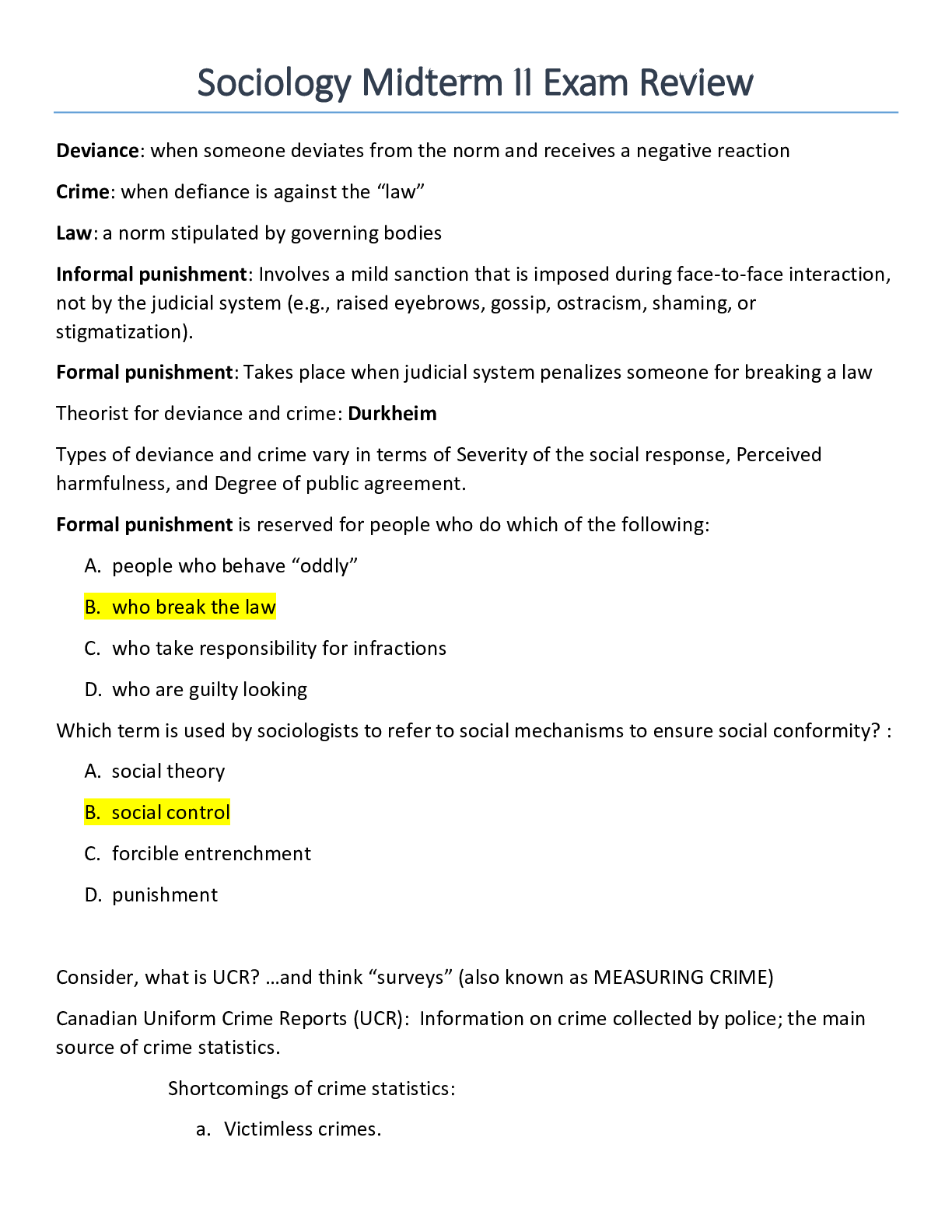
Sociology Midterm II Exam Review
Deviance: when someone deviates from the norm and receives a negative reaction
Crime: when defiance is against the “law”
Law: a norm stipulated by governing bodies
Informal punishment: Involves a mild sanction that is imposed during face-to-face interaction, not by the judicial system (e.g., raised eyebrows, gossip, ostracism, shaming, or stigmatization).
Formal punishment: Takes place when judicial system penalizes someone for breaking a law
Theorist for deviance and crime: Durkheim
Types of deviance and crime vary in terms of Severity of the social response, Perceived harmfulness, and Degree of public agreement.
Formal punishment is reserved for people who do which of the following:
A. people who behave “oddly”
B. who break the law
C. who take responsibility for infractions
D. who are guilty looking
Which term is used by sociologists to refer to social mechanisms to ensure social conformity? :
A. social theory
B. social control
C. forcible entrenchment
D. punishment
Consider, what is UCR? …and think “surveys” (also known as MEASURING CRIME)
Canadian Uniform Crime Reports (UCR): Information on crime collected by police; the main source of crime statistics.
Shortcomings of crime statistics:
a. Victimless crimes.
b. Authorities and the wider public impact the reporting of criminal acts.
Self-report surveys
b. Respondents report involvement in criminal activities (perpetrators or victims).
c. They report approximately the same rate of serious crime as official statistics.
d. They find two or three times the rate of less serious crimes.
Victimization surveys
e. Surveys in which people are asked whether they have been victims of crime.
f. The 2009 survey examined householders’ experience with crime.
a. Impact of victimization
b. Perceptions of personal safety
A victimless crime is a legal offense to which all parties consent and no party is injured.
Who benefits the most by the way society defines crime?
1. Mass media: It allows them to rake in hefty profits.
2. The criminal justice system: It allows them to increase spending on crime prevention, control, and punishment.
3. Politicians: Some base their entire careers on get-tough policies.
Understand what strain theory is. Who’s idea?
Strain theory, developed by Robert K. Merton, argued that society may be set up in a way that encourages too much deviance. Merton believed there was a disjunction between socially approved means to success and legitimate cultural goals.
1. Cultural value of ‘material success.’
2. Lack of legitimate opportunities to succeed.
Discrepancy between cultural ideals and structural realities is dysfunctional, which Produces strain.
Know Howard Becker’s Theory?
Symbolic Interactionist Approach: People may learn deviant and criminal behaviour when they interact with others.
The Three-stage process of learning defiant behavior (study of marijuana users).
1. Learning to smoke the drug in a way that produces real effects
2. Learning to recognize the effects and connect them with drug use
3. Learning to enjoy the perceived sensations
What is the main function of prison according to those who see imprisonment as a way of preventing criminals from doing more harm?
The main function of prison is correction.
What does incapacitation mean?
Law. to deprive of the legal power to act in a specified way or ways.
What is the most important factor of learning a deviant behaviour?
Behaviours are deviant when they are labeled as deviant by society.
Conforming members interpret and determine the distinction between deviance and non-deviance.
Deviance is not inherent to an act, but rather it is the result of the externally imposed label of “deviant.”
What is the difference between street crime and white-collar crime? Give an example.
• Street crime is any criminal offense that typically takes place or originates in a public place.
o Against person (someone attacks you and steals your purse)
o Against property (someone stole your car)
o Drug crime (possession)
• White-collar crime refers to non-violent crimes committed by business or government professionals for financial gain.
o Involves lying, cheating or stealing.
o Fraud, embezzlement, forgery, money laundering, Internet scams,
o tax evasion, environmental law violations and security violations
Aboriginal people tend to commit so-called street crimes that are more detectable than white-collar crimes
What are the goals of incarceration?
Goals of Incarceration
• Opportunity for Rehabilitation?
• Means of Deterrence?
• Institutions of Revenge?
• Institutions of Incapacitation?
Don’t forget the effect of socialization?
o Deviants may depart from mainstream culture in many ways, but they are strict conformists when it comes to the norms of their own subculture.
o They tend to share the same beliefs, dress alike, eat similar food, and adopt the same mannerisms and speech patterns
Know and understand the four factors of why aboriginal people are overrepresented in Canadian prisons?
i. Poverty
ii. More visible street crimes committed
iii. Discrimination by criminal justice system
iv. Weakened social control over community members due to Western culture’s disruption of social life in Aboriginal communities
Durkheim said deviance and crime are functional and beneficial for society.
• He though this because when someone breaks a rule it gives people the chance to condemn and punish, reminds people of their common values, clarifies the moral boundaries, and reinforces social solidarity.
What is a subculture? How did we get those? What is a gang subculture?
o A subculture is a set of distinctive values, norms, and practices within a larger culture.
o They tend to share the same beliefs, dress alike, eat similar food, and adopt the same mannerisms and speech patterns.
o Justifications used to make illegal activities appear morally acceptable and normal.
o Gang members strongly discourage deviance within the subculture.
Delinquency-prone adolescence lack social control. What are the four reasons why that might be?
1. Few social attachments
2. Few legitimate opportunities
3. Few involvements in conventional institutions
4. Weak beliefs in traditional values and morality
Know the major theories for deviance and crime:
Symbolic Interaction: It is learned.
Functionalism: It clarifies our values when punished
Conflict Theory: Conflict between the rich and powerful who ‘get away’ with their crimes.
Feminist: It is about power between women and male dominance to the degree of women’s prosecution.
What is the definition of wealth?
A. Income after taxes
B. Assets minus liabilities
C. Accumulated income
D. Purchasing power
Know the advantages of wealth?
1. Enhances your sense of well-being
2. Can give you more political influence
3. Improves your health
“Wealth is not without its advantages and the case to the contrary, although it has often been made, has never proved widely persuasive.” (John Kenneth Galbraith)
What is a Quintile?
• A statistical value of a data set that represents 20% of a given population.
• used to create cut-off points for a given population.
What is Human Capital?
• is the sum of useful skills and knowledge that an individual possesses.
What are the factors of economic success?
• Degree of natural talent
• Degree of effort
• Level of education [‘developed skill’ – Human capital]
• Social and Cultural capital
The definition and measurement of poverty is important because of its impact on which of the following?
A. the definition of undeserving poor
B. incarceration rates
C. social policies
D. stereotypes about the poor
Understand the three myths about poverty.
1. People are poor because they don’t want to work.
2. Most poor people are immigrants.
3. Most poor people are trapped in poverty.
Is stratification inevitable?
Marx’s (conflict theorist) view it is? Nope.
o Did not view social stratification as inevitable—believed capitalist growth would produce a society without classes and class conflict.
o Bourgeoisie – ownership class
o Proletariat – working class
o Believed capitalism would experience escalating economic crises of ‘overproduction’ or ‘underconsumption.’
Davis and Moore (functionalists) view: Yes.
Asserts the inevitability of social stratification.
1. Some jobs are more important than others.
2. People must make sacrifices to train for important jobs. Incentives (money / prestige) are required for motivation.
3. Substantial inequality is necessary.
Understand the four main classes of a capitalists’ society:
1. large property owners
2. small property owners
3. propertyless but relatively highly educated and well paid employees
4. propertyless manual workers
The concept that a Judge’s job is more important than the court clerk is an illustration of what?
A. Weberian theory
B. Maxist theory
C. Functionalist theory
D. Conflict theory
According to David and Moore’s theory of stratification, talented people need incentive else they will not be willing to make the effort to train for the good jobs. Which of the following correctly identifies these incentives?
A. money and leisure time
B. Prestige and employment satisfaction
C. Money and prestige
D. Bonus packages and a good looking boss
In an open society, one’s chances for social mobility are based on which of the following?
A. prestige
B. Family status
C. achievement
D. race
Global inequality results from the various dysfunctional characteristics of poor societies. Why this global inequity?
1. lack sufficient capital for investment in
Western-style agriculture and industry
2. lack rational Western-style business techniques
3. lack stable Western-style governments
4. lack a Western mentality
Global inequality is the result of patterns of domination and submission - with the colonizing countries impoverishing the less powerful countries.
According to our chapter 7 lecture, who in our history has been the main victims of internal colonialism in Canada?
A. Swiss Canadians
B. Japanese Canadians
C. Irish Canadians
D. Aboriginal peoples
What is ethnicity for most Irish Canadians?
A. Beyond negotiation
B. Imposed
C. Its like institutional racism
D. A matter of choice with respect
What is a W.A.S.P?
White Anglo-Saxon Protestants
Why is this significant?
A vertical mosaic (John Porter)
A highly ethnically and racially stratified society.
The retention of ethnic and racial culture was a big problem in Canada because it hampered the upward mobility of immigrants.
Symbolic ethnicity: Nostalgic allegiance to culture of immigrant generation, or that of the old country, that is not usually incorporated in everyday behaviour.
Race: a socially defined category of people whose perceived physical markers are significant.
Ethnicity: comprised of people whose perceived cultural markers are socially significant.
What is the difference between Colonialism and Internal Colonialism?
Colonialism
o Involves people from one country invading and taking political, cultural, and economic control over people from another country.
Internal colonialism
o Involves one race or ethnic group subjugating another in the same country.
o It prevents assimilation by segregating the subordinate group in terms of jobs, housing, and social contacts.
Genocide is the intentional extermination of an entire population defined as a race or a people.
Understand the three advantages of ethnicity:
1. Economic advantages
2. Political advantages
3. Emotional support and cohesive integration of values/ strengths/ innovations
Employment equity: A policy that gives preference to minority group members if equally qualified people are available for a position.
What is “split labour markets”?
Exists where low-wage workers of one race and high-wage workers of another race compete for the same jobs.
High-wage workers are likely to resent the presence of low-wage competitors.
Conflict is bound to result and racist attitudes to develop or become reinforced.
What is “pluralism”?
The retention of racial and ethnic culture combined with equal access to basic social resources.
Two hundred years ago – Canada was a society based on expulsion, conquest, slavery, and segregation.
Today – Canada is a society based on segregation, pluralism, and assimilation.
How did the political power house of the Quebecois influence the province of Quebec?
A. Developed postural constipation
B. Allowed the assimilation of immigrants into English culture
C. Contributed to the modernization of the Quebec state
D. Influenced Quebec’s independence
Understand black slavery in Canada?
Black Canadians
Black slaves were bought and sold in Canada at
least until the 1820s.
Slavery
The ownership and control of people.
Slavery became illegal in 1833 with the British government’s ban on slavery throughout the British Empire.
Sex: Biologically being born with male or female genitals and the male or female hormones that stimulate the development of your reproductive system.
Gender: Sense of being male or female and playing masculine and feminine roles as defined as appropriate by your culture and society.
What is the opinion according to the American Psychiatric Association’s in regard to sexual orientation?
A. One’s sexual orientation may not be a choice
B. One’s sexual orientation is fluid through life
C. One’s sexual orientation is clearly a choice
D. One’s sexual orientation is a crapp shoot
What is consistent with a person’s sex?
Sex
Refers to the biological differences between males and females:
male or female genitals and a genetic program that releases male or female hormones to stimulate the development of the reproductive system.
What is consistent with a person’s gender identity?
A. Hormones, chromosomes, and physiology
B. Sexual desires and behaviours
C. Self-definition
D. Culturally appropriate behaviour and attitudes
Know the differences between:
SEX – refers to the biological differences between males and females
GENDER – behavior that conforms to widely shared expectations about how members of a particular sexual category are supposed to act
GENDER IDENTITY – a person’s sense of belonging to a particular sexual category
Understand these terms:
Homosexual – people who prefer sexual partners of the same sex; usually we call homosexual men gay and homosexual women lesbians
Transvestites – defy society’s gender norms and blur widely accepted gender roles
Bisexuals – people who enjoy sexual partners of both sexes
Transsexuals – identify with a gender that is culturally inconsistent with their biological sex
Heteronormativity – the belief that sex is binary and that sex ought to be perfectly aligned with gender
Know what “essentialism” is…
- A school of thought that views gender differences as a reflection of biological differences between men and women (functionalist thinking)
Who said it…? “Men take charge, women take care.”
-
If john-tom thinks of himself as a boy, which of the following has he formed?
A. His male entity
B. His gender role
C. His male persona
D. His gender identity
Understand “hostile environment harassment”.
- …
Understand Social Constructionism
- Those features of life that appear natural of innate are sustained by social processes that vary both historically and culturally. Gender is considered social constructionism
Queer Theory denies the existence of table sexual orientations.
A. True
B. False
Homophobia is defined as:
A. Fear of being home alone
B. Fear of homosexuals
C. Fear of being a homosexual
D. Fear of being homo-lactose intolerant
Acquaintance rape is a sexual assault involving intercourse committed by someone the victim knows.
A. True
B. False
4 main factors in the Gender Gap in earnings:
1. Gender discrimination. What is that?
- Rewarding women and men differently for the same work
2. Women tend to be concentrated in low wage occupations. What reasons could that be?
- Occupational sex segregation
3. Heavy domestic duties reduce earning. Like what?
- Child-rearing, housework, eldercare
Work done by women is commonly considered less valuable than work done by men, because if is viewed as involving fewer skills
[Show More]