Chapter 16: Ears Exam 2022
External Ear - Answer- -auricle or pinna
-consists of movable cartilage and skin
External Auditory Canal - Answer- -cul-de-sac 2.5-3cm long in the adult and
terminates at the eardrum or ty
...
Chapter 16: Ears Exam 2022
External Ear - Answer- -auricle or pinna
-consists of movable cartilage and skin
External Auditory Canal - Answer- -cul-de-sac 2.5-3cm long in the adult and
terminates at the eardrum or tympanic membrane (TM)
Cerumen - Answer- -a yellow, waxy material that lubricates and protects the ear
-the wax forms a sticky barrier that helps keep foreign bodied from entering and
reaching the sensitive tympanic membrane
Tympanic Membrane - Answer- -tilted obliquely to ear canal
-facing downward, somewhat forward
-translucent with a pearly gray color and a prominent cone of light in the
anteroinferior quadrant, which is the reflection of the otoscope light
What does the tympanic membrane separate? - Answer- external and middle ear
Middle Ear - Answer- -tiny air-filled cavity inside the temporal bone
-contains tiny ear bones (auditory ossicles: malleus, incus, stapes)
Eustachian Tube - Answer- -connects middle ear with the nasopharynx and allows
passage of air
-tube is normally closed, but opens with swallowing or yawning
What are the 3 functions of the middle ear? - Answer- (1) conducts sound vibrations
from the outer ear to the central hearing apparatus in the inner ear
(2) it protects the inner ear by reducing the amplitude of loud sounds
(3) its eustachian tube allows equalization of air pressure on each side of the
tympanic membrane so the membrane does not rupture
Inner Ear - Answer- -embedded in bone
Bony Labyrinth - Answer- -holds the sensory organs for equilibrium and hearing
-contains vestibule and semicircular canals which comprise the vestibular apparatus
Cochlea - Answer- -contains the central hearing apparatus
Pathways of Hearing - Answer- -air conduction (AC) and bone conduction (BC)
-bones of the skull vibrate
-vibrations are transmitted directly to the inner ear and to cranial nerve VIII
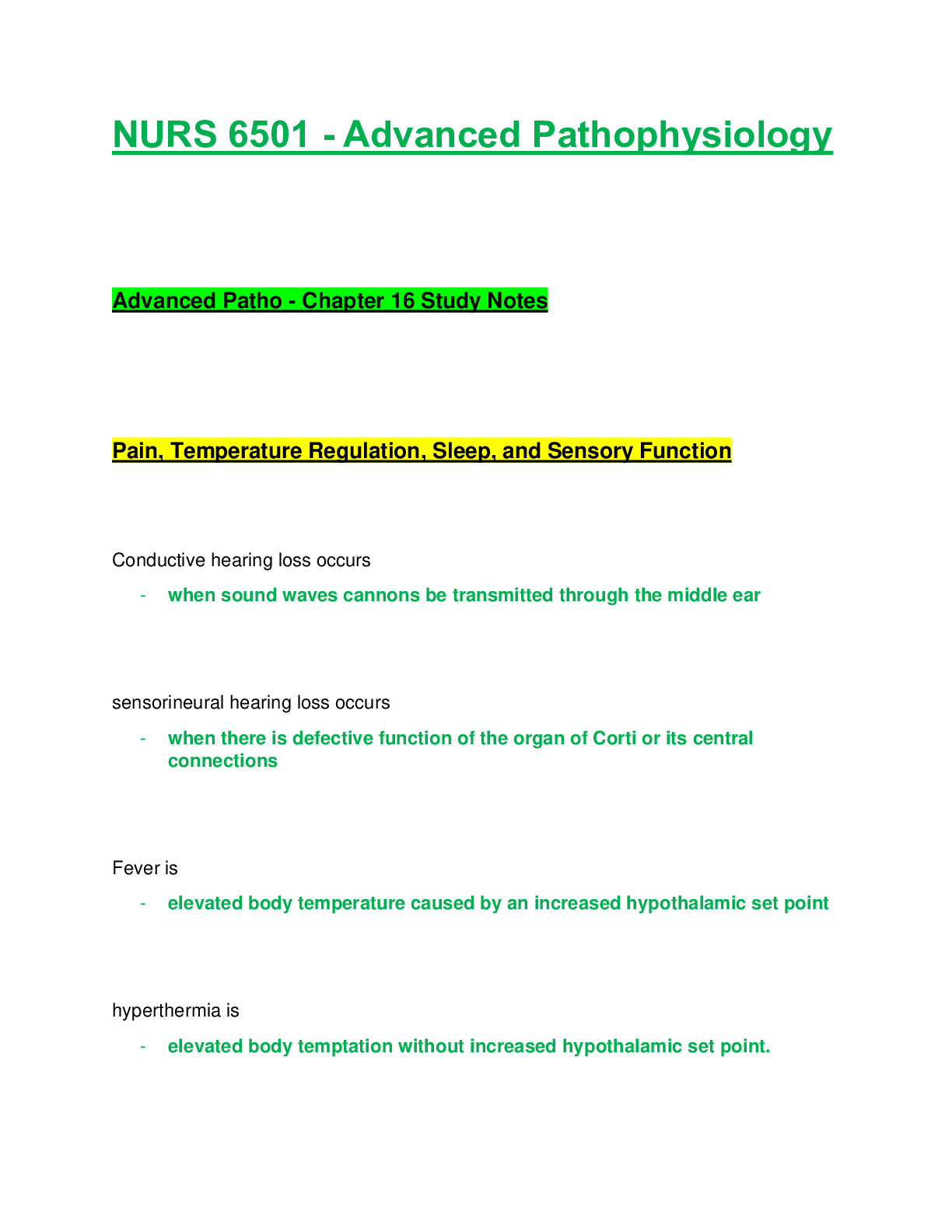
Conductive Hearing Loss - Answer- -hearing loss involves a mechanical dysfunction
of the external or middle ear
-it is a partial loss because the person is able to hear if the sound amplitude is
increased enough to reach normal nerve elements in the inner ear
-may be caused by impacted cerumen, foreign bodies, a perforated tympanic
membrane, pus or serum in the middle ear and otosclerosis (decrease in mobility of
the ossicles)
Sensorineural Hearing Loss - Answer- -loss signifies pathology of the inner ear,
cranial nerve VIII, or the auditory areas of the cerebral cortex
-simple increase in amplitude may not enable the person to understand words
-may be caused by prebycusis, a gradual nerve degeneration that occurs with aging,
and by ototoxic drugs
Mixed - Answer- loss is a combination of conductive and sensorinueral types in the
same ear
Otosclerosis - Answer- -gradual bone formation that causes the footplate of the steps
to become fixed in the oval window, impeding the transmission of sound causing
progressive deafness
The Aging Adult - Answer- -cilia lining becomes coarse and stiff
-may cause cerumen to accumulate and oxidize, which greatly reduces hearing
-impacted cerumen is common
Presbycusis (age-related hearing loss) - Answer- -associated with communication
problems, a decrease in health-related quality of life, and a loss of physical and
cognitive function, as well as depression, dementia, an increase in falls,
hospitalizations, social isolation and loneliness, and increased mortality
-sensorineural loss that affects middle ear structures or cause damage to nerve cells
in the inner ear or to cranial nerve VIII
-person first first notices a high-frequency tone loss, such as difficulty hearing a
phone ringing or a microwave beeping
-harder to hear consonants than vowels and words sound garbled
Otitis Media - Answer- -occurs because of obstruction of the eustachian tube or
passage of nasopharyngeal secretions into the middle ear
-creates a ripe environment for bacteria to grow
-acute OM is so common that up to 60% of children experience an episode during
the 1st year of life, and by age 3 years up to 83% have suffered an episode
Two Types of Cerumen - Answer- -wet, honey-brown wax (Caucasians and African
Americans)
-dry, flaky white wax (East Asians and American Indians)
Subjective Data: What you ask patient about - Answer- -earache
-infections
-discharge
-hearing loss
-environmental noise
-tinnitus
-vertigo
-patient-centered care
Otalgia - Answer- occurs directly from ear disease or is referred pain from a problem
in teeth or oropharynx
Otorrhea - Answer- -suggests infected canal or perforated eardrum such as:
>external otitis: purulent, sanguineous, or watery discharge
>acute OM with perforation: purulent discharge
>cholsteatoma: dirty yellow-gray discharge, foul odor
Recruitment - Answer- hearing loss with low intensity speech, but sound actually
becomes painful when speaker repeats in a loud voice
Tinnitus - Answer- perception of sound without an external source; occurs with
sensorineural hearing loss, cerumen impaction, middle ear infection, and other ear
disorders
Subjective Vertigo - Answer- feeling of spinning of person
CONTINUES.....
[Show More]