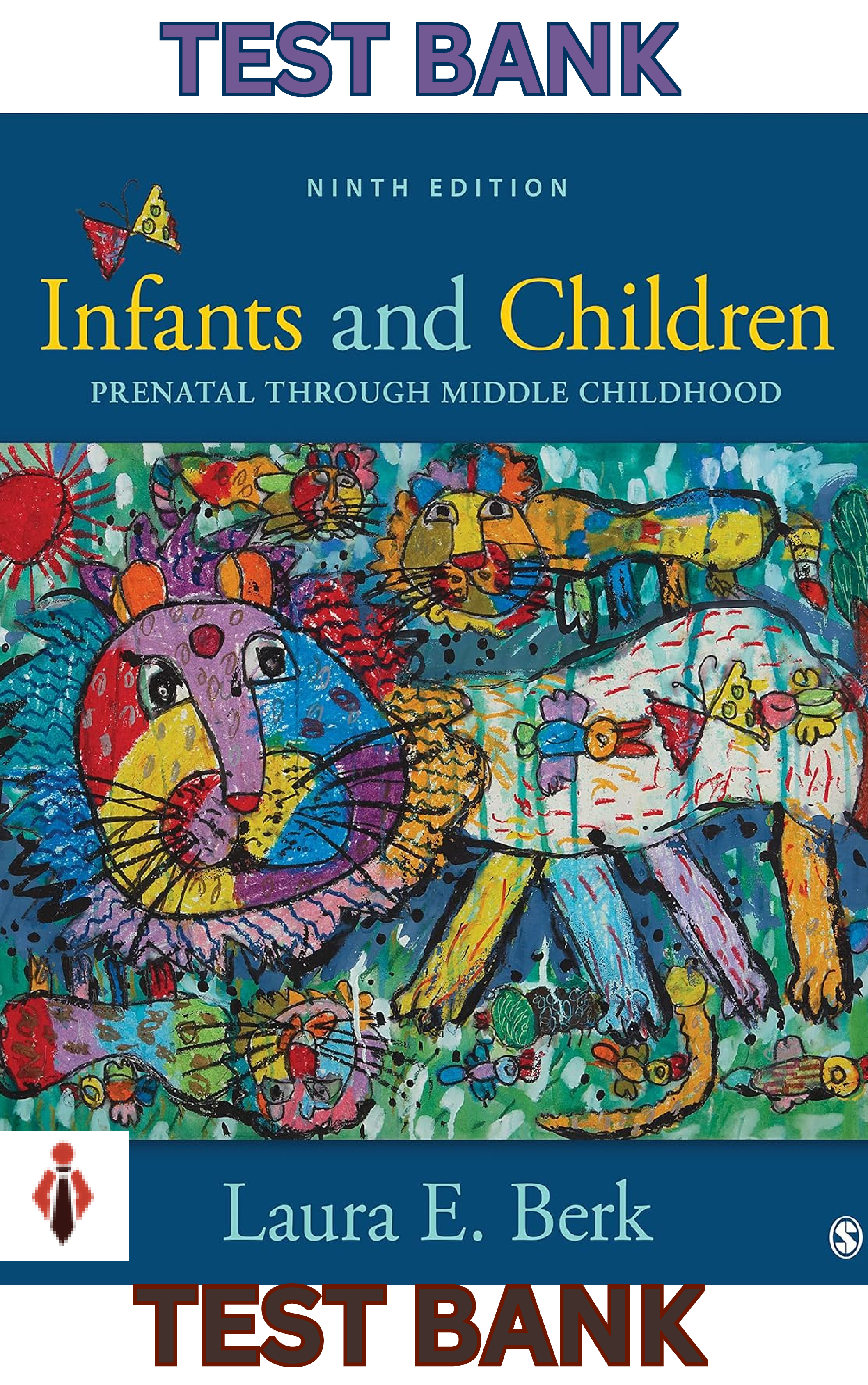
Test Bank for Infants and Children Prenatal Through Middle Childhood, 9th Edition, 9e by Laura E. Berk TEST BANK
ISBN-13: 9781071895115
Full chapters included
Chapter 1 History, Theory, and Research Strategies
Th
...
Test Bank for Infants and Children Prenatal Through Middle Childhood, 9th Edition, 9e by Laura E. Berk TEST BANK
ISBN-13: 9781071895115
Full chapters included
Chapter 1 History, Theory, and Research Strategies
The Field of Child Development
Domains of Development
Periods of Development
Basic Issues
Continuous or Discontinuous Development?
One Course of Development or Many?
Relative Influence of Nature and Nurture?
A Balanced Point of View
BIOLOGY AND ENVIRONMENT Resilient Children
Historical Foundations
Medieval Times
The Reformation
Philosophies of the Enlightenment
Scientific Beginnings
Mid-Twentieth-Century Theories
The Psychoanalytic Perspective
Behaviorism and Social Learning Theory
Piaget’s Cognitive-Developmental Theory
Recent Theoretical Perspectives
Information Processing
Developmental Neuroscience
Ethology and Evolutionary Developmental Psychology
Vygotsky’s Sociocultural Theory
Ecological Systems Theory
Development as a Dynamic System
SOCIAL ISSUES: HEALTH Family Chaos Undermines Children’s Well-Being
Comparing Child Development Theories
Studying the Child
Common Research Methods
CULTURAL INFLUENCES Immigrant Youths: Adapting to a New Land
General Research Designs
Designs for Studying Development
Improving Developmental Designs
Ethics in Research on Children
Summary
Important Terms and Concepts
PART II FOUNDATIONS OF DEVELOPMENT
Chapter 2 Genetic and Environmental Foundations
Genetic Foundations
The Genetic Code
The Sex Cells
Sex Determination
Multiple Offspring
Patterns of Gene–Gene Interaction
Chromosomal Abnormalities
Reproductive Choices
SOCIAL ISSUES: HEALTH The Pros and Cons of Reproductive Technologies
Genetic Counseling
Prenatal Diagnosis
Adoption
Environmental Contexts for Development
The Family
Socioeconomic Status and Family Functioning
SOCIAL ISSUES: EDUCATION Worldwide Education of Girls: Transforming Current and Future Generations
Affluence
Poverty
Beyond the Family: Neighborhoods and Schools
The Cultural Context
CULTURAL INFLUENCES Familism Promotes Competence in Hispanic Children and Youths
Understanding the Relationship Between Heredity and Environment
The Question, “How Much?”
The Question, “How?”
BIOLOGY AND ENVIRONMENT The Tutsi Genocide and Epigenetic Transmission of Maternal Stress to Children
Summary
Important Terms and Concepts
Chapter 3 Prenatal Development
Motivations for Parenthood
Why Have Children?
How Large a Family?
Is There a Best Time During Adulthood to Have a Child?
Prenatal Development
Conception
Germinal Period
Period of the Embryo
Period of the Fetus
Prenatal Environmental Influences
Teratogens
BIOLOGY AND ENVIRONMENT Self-Regulation Therapy for Children with Fetal Alcohol Spectrum Disorder (FASD)
Other Maternal Factors
SOCIAL ISSUES: HEALTH The Nurse–Family Partnership: Reducing Maternal Stress and Enhancing Child Development Through Social Support
The Importance of Prenatal Health Care
CULTURAL INFLUENCES Culturally Sensitive Prenatal Health Care: Perspectives of Expectant Mothers
Summary
Important Terms and Concepts
Chapter 4 Birth and the Newborn Baby
The Stages of Childbirth
Stage 1: Dilation and Effacement of the Cervix
Stage 2: Delivery of the Baby
Stage 3: Birth of the Placenta
The Baby’s Adaptation to Labor and Delivery
The Newborn Baby’s Appearance
Assessing the Newborn’s Physical Condition: The Apgar Scale
Approaches to Childbirth
Natural, or Prepared, Childbirth
Home Delivery
Medical Interventions
Fetal Monitoring
Labor and Delivery Medication
Instrument Delivery
Cesarean Delivery
Birth Complications
Oxygen Deprivation
Preterm and Low-Birth-Weight Infants
Birth Complications, Parenting, and Resilience
CULTURAL INFLUENCES A Cross-National Perspective on Health Care and Other Policies for Parents and Newborn Babies
The Newborn Baby’s Capacities
Reflexes
States
SOCIAL ISSUES: HEALTH The Mysterious Tragedy of Sudden Infant Death Syndrome
Sensory Capacities
Neonatal Behavioral Assessment
The Transition to Parenthood
Early Parent–Infant Contact
Changes in the Family System
BIOLOGY AND ENVIRONMENT Parental Depression and Child Development
Single-Mother Families
Parent Interventions
Summary
Important Terms and Concepts
PART III INFANCY AND TODDLERHOOD: THE FIRST TWO YEARS
Chapter 5 Physical Development in Infancy and Toddlerhood
Body Growth
Changes in Body Size and Muscle–Fat Makeup
Changes in Body Proportions
Individual and Group Differences
Brain Development
Development of Neurons
Measures of Brain Functioning
Development of the Cerebral Cortex
Sensitive Periods in Brain Development
BIOLOGY AND ENVIRONMENT Brain Plasticity: Insights from Research on Children with Brain Injury
Changing States of Arousal
CULTURAL INFLUENCES Cultural Variation in Infant Sleeping Arrangements
Influences on Early Physical Growth
Heredity
Nutrition
Malnutrition
Emotional Well-Being
Learning Capacities
Classical Conditioning
Operant Conditioning
Habituation
Statistical Learning
Imitation
Motor Development
The Sequence of Motor Development
Motor Skills as Dynamic Systems
Fine-Motor Development: Reaching and Grasping
Perceptual Development
Hearing
BIOLOGY AND ENVIRONMENT “Tuning in” to Familiar Speech, Faces, and Music: A Sensitive Period for Culture- Specific Learning
Vision
Object Perception
Intermodal Perception
Understanding Perceptual Development
Summary
Important Terms and Concepts
Chapter 6 Cognitive Development in Infancy and Toddlerhood
Piaget’s Cognitive-Developmental Theory
Piaget’s Ideas About Cognitive Change
The Sensorimotor Stage
Follow-Up Research on Infant Cognitive Development
SOCIAL ISSUES: EDUCATION Baby Learning from Screen Media: The Video Deficit Effect
Evaluation of the Sensorimotor Stage
Information Processing
Assumptions of the Information-Processing Perspective
Attention
Memory
Categorization
BIOLOGY AND ENVIRONMENT Infantile Amnesia
Evaluation of Information-Processing Findings
The Social Context of Early Cognitive Development
Individual Differences in Early Mental Development
CULTURAL INFLUENCES Social Origins of Make-Believe Play
Infant and Toddler Intelligence Tests
Early Environment and Mental Development
Early Intervention for At-Risk Infants and Toddlers
Language Development
Theories of Language Development
BIOLOGY AND ENVIRONMENT Thiamine Deficiency in the First Year and Later Language Impairment
Getting Ready to Talk
First Words
The Two-Word Utterance Phase
Individual and Cultural Differences
Supporting Early Language Development
Summary
Important Terms and Concepts
Chapter 7 Emotional and Social Development in Infancy and Toddlerhood
Emotional Development
Basic Emotions
Understanding and Responding to the Emotions of Others
Emergence of Self-Conscious Emotions
Beginnings of Emotional Self-Regulation
Temperament and Development
The Structure of Temperament
Measuring Temperament
Stability of Temperament
BIOLOGY AND ENVIRONMENT Development of Shyness and Sociability
Genetic and Environmental Influences
Temperament and Child Rearing: The Goodness-of-Fit Model
Development of Attachment
Bowlby’s Ethological Theory
Measuring the Security of Attachment
Stability of Attachment
Cultural Variations
Factors That Affect Attachment Security
Multiple Attachments
SOCIAL ISSUES: HEALTH Does Child Care in Infancy Threaten Attachment Security and Later Adjustment?
CULTURAL INFLUENCES The Role of Fathers’ Involvement in Children’s Development
From Attachment to Peer Sociability
Attachment and Later Development
Self-Development
Self-Awareness
Categorizing the Self
Self-Control
Summary
Important Terms and Concepts
MILESTONES Development in Infancy and Toddlerhood
PART IV EARLY CHILDHOOD: TWO TO SIX YEARS
Chapter 8 Physical Development in Early Childhood
A Changing Body and Brain
Skeletal Growth
Brain Development
Influences on Physical Growth and Health
BIOLOGY AND ENVIRONMENT Childhood Poverty and Brain Development
Heredity and Hormones
Sleep Habits and Problems
Nutrition
Infectious Disease
Childhood Injuries
SOCIAL ISSUES: HEALTH Otitis Media and Development
Motor Development
Gross-Motor Development
Fine-Motor Development
CULTURAL INFLUENCES Why Are Children from Asian Cultures Advanced in Drawing Skills?
Individual Differences in Motor Skills
Enhancing Early Childhood Motor Development
Summary
Important Terms and Concepts
Chapter 9 Cognitive Development in Early Childhood
Piaget’s Theory: The Preoperational Stage
Advances in Mental Representation
Make-Believe Play
Symbol–Real-World Relations
Limitations of Preoperational Thought
Follow-Up Research on Preoperational Thought
SOCIAL ISSUES: EDUCATION Children’s Gestures Facilitate Cognitive Change
Evaluation of the Preoperational Stage
Piaget and Education
Vygotsky’s Sociocultural Theory
Private Speech
Social Origins of Early Childhood Cognition
Vygotsky and Early Childhood Education
Evaluation of Vygotsky’s Theory
CULTURAL INFLUENCES Children in Village and Tribal Cultures Observe and Participate in Adult Work
Information Processing
Executive Function
Memory
Problem Solving
The Young Child’s Theory of Mind
Early Literacy and Mathematical Development
BIOLOGY AND ENVIRONMENT Autism and Theory of Mind
Individual Differences in Mental Development
Early Childhood Intelligence Tests
Home Environment and Mental Development
Preschool, Kindergarten, and Child Care
SOCIAL ISSUES: EDUCATION Teaching Through Guided Play
Educational Screen Media
Language Development
Vocabulary
Grammar
Conversation
Supporting Language Learning in Early Childhood
Summary
Important Terms and Concepts
Chapter 10 Emotional and Social Development in Early Childhood
Self-Understanding
Foundations of Self-Concept
Emergence of Self-Esteem
Emotional Development
Understanding Emotion
Emotional Self-Regulation
Self-Conscious Emotions
Empathy and Sympathy
Peer Relations
Advances in Peer Sociability
First Friendships
Peer Relations and School Readiness
Social Problem Solving
Parental Influences on Early Peer Relations
Foundations of Morality and Aggression
The Psychoanalytic Perspective
Social Learning Theory
CULTURAL INFLUENCES Ethnic Differences in the Consequences of Physical Punishment
The Cognitive-Developmental Perspective
Development of Aggression
Gender Typing
Gender-Stereotyped Beliefs and Behaviors
Biological Influences on Gender Typing
Environmental Influences on Gender Typing
Gender Identity
BIOLOGY AND ENVIRONMENT Transgender Children
Reducing Gender Stereotyping in Young Children
Child Rearing and Emotional and Social Development
Styles of Child Rearing
What Makes Authoritative Child Rearing Effective?
Cultural Variations
Child Maltreatment
Summary
Important Terms and Concepts
MILESTONES Development in Early Childhood
PART V MIDDLE CHILDHOOD: SIX TO ELEVEN YEARS
Chapter 11 Physical Development in Middle Childhood
Body Growth
Worldwide Variations in Body Size
Secular Trends in Physical Growth
Skeletal Growth
Brain Development
Health Issues
Nutrition
Overweight and Obesity
SOCIAL ISSUES: HEALTH Family Stressors and Childhood Obesity
Vision and Hearing
Bedwetting
Illnesses
Unintentional Injuries
Health Education
Motor Development and Play
Gross-Motor Development
Fine-Motor Development
Individual Differences in Motor Skills
Games with Rules
Adult-Organized Youth Sports
Shadows of Our Evolutionary Past
Physical Education
SOCIAL ISSUES: EDUCATION School Recess—A Time to Play, a Time to Learn
Summary
Important Terms and Concepts
Chapter 12 Cognitive Development in Middle Childhood
Piaget’s Theory: The Concrete Operational Stage
Attainments of the Concrete Operational Stage
Limitations of Concrete Operational Thought
Follow-Up Research on Concrete Operational Thought
Evaluation of the Concrete Operational Stage
Information Processing
Executive Function
BIOLOGY AND ENVIRONMENT Children with Attention-Deficit Hyperactivity Disorder
Memory Strategies
Knowledge and Memory
Culture, Schooling, and Memory Strategies
The School-Age Child’s Theory of Mind
Cognitive Self-Regulation
Applications of Information Processing to Academic Learning
Individual Differences in Mental Development
Defining and Measuring Intelligence
Other Efforts to Define Intelligence
Explaining Individual and Group Differences in IQ
CULTURAL INFLUENCES The Flynn Effect: Massive Generational Gains in IQ
Reducing Cultural Bias in Testing
Language Development
Vocabulary and Grammar
Pragmatics
Learning Two Languages
Children’s Learning in School
Educational Philosophies
Teacher–Student Interaction
Grouping Practices
SOCIAL ISSUES: EDUCATION Magnet Schools: Equal Access to High-Quality Education
Educational Screen Media
Teaching Children with Special Needs
How Well-Educated Are U.S. Children?
Summary
Important Terms and Concepts
Chapter 13 Emotional and Social Development in Middle Childhood
Self-Understanding
Self-Concept
Cognitive, Social, and Cultural Influences on Self-Concept
Self-Esteem
Influences on Self-Esteem
Emotional Development
Self-Conscious Emotions
Emotional Understanding
Emotional Self-Regulation
Moral Development
Moral and Social-Conventional Understanding
Understanding Individual Rights
Culture and Moral Understanding
Understanding Diversity and Inequality
Peer Relations
Peer Groups
Friendships
Peer Acceptance
BIOLOGY AND ENVIRONMENT Bullies and Their Victims
Gender Typing
Gender-Stereotyped Beliefs
Gender Identity and Behavior
Family Influences
Parent–Child Relationships
Siblings
Only Children
Lesbian and Gay Families
Never-Married Parent Families
Divorce
Blended Families
Maternal Employment and Dual-Earner Families
Some Common Problems of Development
Fears and Anxieties
Child Sexual Abuse
CULTURAL INFLUENCES Impact of Ethnic and Political Violence on Children
Fostering Resilience in Middle Childhood
SOCIAL ISSUES: HEALTH Children’s Eyewitness Testimony
[Show More]