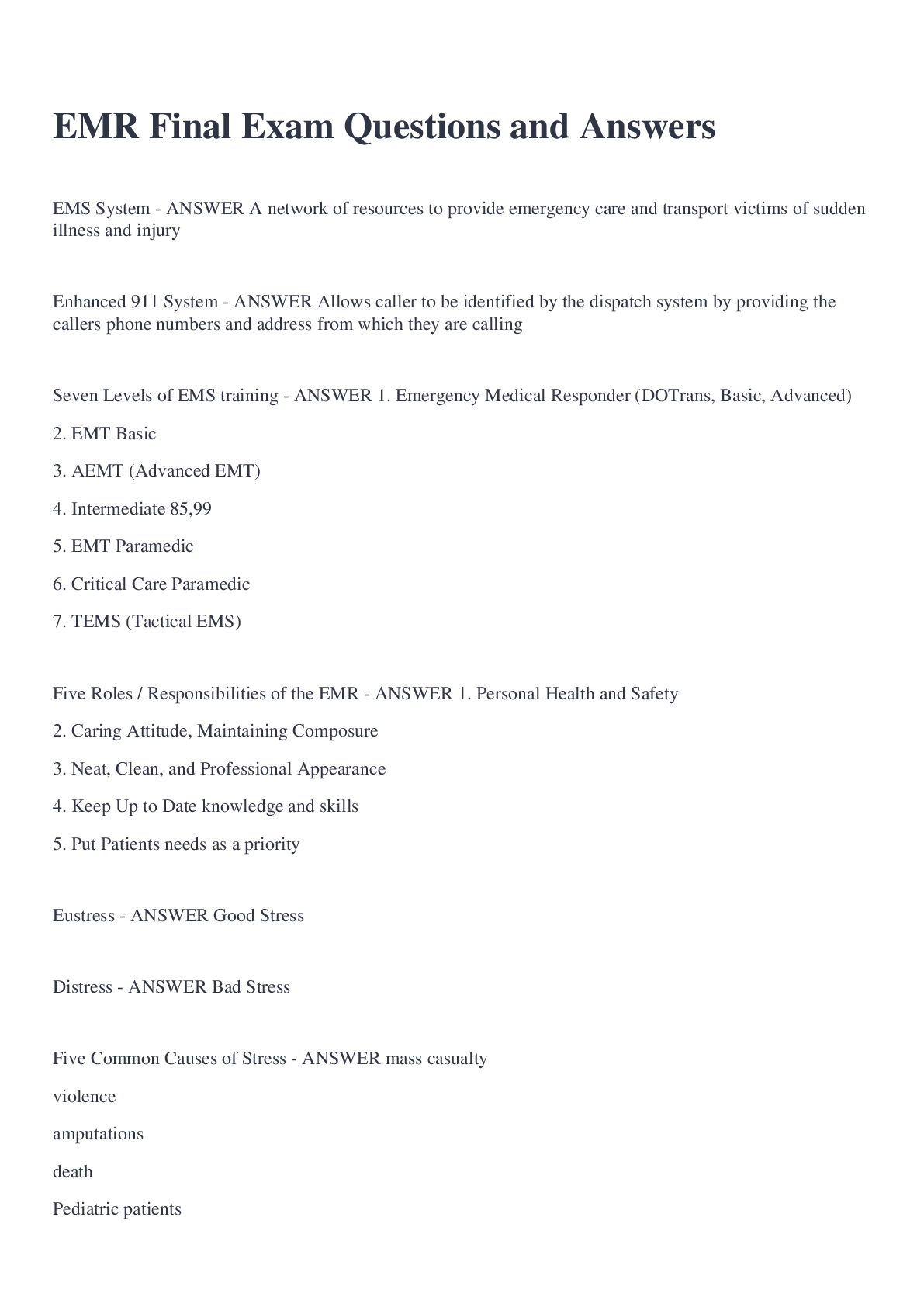
EMS System - ANSWER A network of resources to provide emergency care and transport victims of sudden illness and injury
Enhanced 911 System - ANSWER Allows caller to be identified by the dispatch system by providing t
...
EMS System - ANSWER A network of resources to provide emergency care and transport victims of sudden illness and injury
Enhanced 911 System - ANSWER Allows caller to be identified by the dispatch system by providing the callers phone numbers and address from which they are calling
Seven Levels of EMS training - ANSWER 1. Emergency Medical Responder (DOTrans, Basic, Advanced)
2. EMT Basic
3. AEMT (Advanced EMT)
4. Intermediate 85,99
5. EMT Paramedic
6. Critical Care Paramedic
7. TEMS (Tactical EMS)
Five Roles / Responsibilities of the EMR - ANSWER 1. Personal Health and Safety
2. Caring Attitude, Maintaining Composure
3. Neat, Clean, and Professional Appearance
4. Keep Up to Date knowledge and skills
5. Put Patients needs as a priority
Eustress - ANSWER Good Stress
Distress - ANSWER Bad Stress
Five Common Causes of Stress - ANSWER mass casualty
violence
amputations
death
Pediatric patients
Five Stages of the Grieving Process - ANSWER 1. Denial (Disbelief)
2. Anger
3. Bargaining
4. Depression
5. Acceptance
Five Signs of Stress - ANSWER irritability
can't concentrate
difficulty sleeping
anxiety (guilt)
loss of appetite
Four Lifestyle Changes to Deal with Stress - ANSWER 1. Eat healthier
2. Exercise (Meditation)
3. Balance Work
4. Listening to Family and friends
CISD - ANSWER Critical Incident Stress Debriefing
Critical Incident Stress Debriefing: Purpose - ANSWER Deals with Traumatic Incidents, a debriefing is a confidential group meeting which encourages open discussion of the incident. The goal is to assist the EMS personal in dealing with the stress related to the incident
Four Types of Body Substance Isolation - ANSWER Hand washing
Proper disposal of medical equipment
use of personal protective equipment
Scene Safety (?)
Scene Safety - ANSWER Assessment of scene (surroundings) that will provide information to the first responder and will help ensure their well-being
Scope of Practice - ANSWER The legal duties to the patient, medical director, and public
Standard of Care - ANSWER care expected based on training and experience taking into account the conditions under which the care is rendered
Competence - ANSWER The ability to understand questions and to the implication of decisions made
( do you know who / where / what you are? )
Expressed Consent - ANSWER The patient must be told in an easy to understand nature and the extent of the procedure to be preformed as well as the possible risks involved
Implied Consent - ANSWER Consent based on the assumption that the unresponsive patient would consent to life saving interventions
Advanced Directives - ANSWER Written documentation that specifies what medical treatment a patient wishes to have and what to withhold should the patient become unable to make a decision
Assault and Battery - ANSWER Unlawfully touching a patient without consent providing emergency medical care when a competent patient does not consent to the emergency medical care
Abandonment - ANSWER Terminating care of the patient without insuring that care will continue at the same level or higher
Four Components of Negligence - ANSWER 1. Duty to act (legal obligation)
2. Breach of Duty (failure to act)
3. Injury where Inflicted (some injury occurred)
4. Proximate Cause (the actions of the EMR caused injury)
Negligence - ANSWER Deviating from the accepted standard of care resulting in further injury of the patient
Good Samaritan Law - ANSWER State Laws intended to protect care providers from liability if they deliver the standard care in good faith to the level of their training and to the best of their ability. Don't protect from Wanton, Gross, or Willful Negligence
Anatomical Position - ANSWER body is erect facing forward, arms are at the sides palms face forward
Anterior / Posterior - ANSWER Front / Back
Medial / Lateral - ANSWER Toward the Middle / Toward the side
Superior / Inferior - ANSWER Toward the Head / Toward the Feet
Skeletal - ANSWER Gives the Body its shape
protects vital internal organs
Axial - ANSWER Skull
only movable bone is the mandible
Muscular - ANSWER Gives the Body shape
Protects interal organs provides for movement
Muscles are Voluntary (cardiac is involuntary)
Respiratory - ANSWER Delivers oxgen to the body
removes carbon
Circulatory - ANSWER Delivers oxgen and nutrients to the tissues and removes waste products from the tissues
Central Nervous System - ANSWER Brain and Spinal Cord
Peripheral Nervous System - ANSWER Does not regenerate when injured
Skin - ANSWER Protects the body from the environment, bacteria and other organisms
regulates temperature and prevents dehydration
Senses heat/cold touch pressure and pain transmits to the brain and spinal cord
The Breathing Process - ANSWER Trachea to Bronchiole Tubes to Bronchiole to Alevoli
Body Mechanics - ANSWER The proper use of the body to facial lifting and moving to prevent injury
Rules of Body Mechanics to prevent Injury - ANSWER weight of patient and need for help
know your physical ability and limitations
lift without twisting and feet properly
communicate clearly with partner
Reasons for using an Emergency Move - ANSWER immediate danger to the patient if not moved
life saving care cant be given
further injury is potential
Lifting techniques - ANSWER The Firefighter's Carry
Blanket Lift
Drag Direct Ground Lift
Chair Lift (Extremity Lift)
Recovery Position - ANSWER Left Side Unresponsive without trauma
Right Side Unresponsive without drama
Allow the patient to assume a position of comfort
Injuries which require spinal immobilization - ANSWER Spine
Neck
Head
Clinical Death - ANSWER The moment that breathing and heart activity stops, this death can be reversed
Biological Death - ANSWER Death of brain cells
this death irreversible
occurs 6-10 minutes of respiratory arrest
Brain Damage begins - ANSWER within 4 to 6 minutes
opening the air way: unresponsive, gag reflex - ANSWER Nasal Airway
Using a Nasal Airway - ANSWER measure nose to corner of mouth
insert longer side down right nostril
one breath every 5 seconds (adult)
opening the air way: unresponsive, no gag reflex - ANSWER Oral Airway
Using an Oral Airway - ANSWER measure earlobe to corner of mouth
insert curved part up until tension is felt then rotate and insert rest of the way
One breath every 5 seconds (adult)
Maintain an Open Airway - ANSWER Nasal Airway
Oral Airway
Open a patient's Airway - ANSWER Head Tilt / Chin Lift
Jaw Thrust
Clearing an Airway - ANSWER The Recovery Position
Finger Sweeps
Suctioning
Max Suction Time - ANSWER adult 15 sec
child 10 sec
infant 5 sec
Normal Resp. Rate - ANSWER adult 12-20 breaths pm
child 15-30 breath pm
infant 25-50 breath pm
Five Methods for Ventilating a Patient - ANSWER mouth to mask
two person valve mask
mouth to barrier device
one person bag valve mask
mouth to mouth
Rates for Rescue Breathing (breath : second) - ANSWER Adult 1:5
Child 1:3-5
Infant :3-5
Newborn: 1:1.5
Oxygen Flow Rate: Non-rebreather face mask - ANSWER 12-15 liter per minute 80-95% oxygen
Oxygen Flow Rate: Nasal Cannula - ANSWER 2-8 liters per minute 22-44% oxygen
Five Components of Patient Assessment - ANSWER Scene Size Up
Primary
Secondary
Reassess
Patient Care Report
Scene Size Up - ANSWER BSI
Scene Safety
Mechanism of Injury
Number of Patients
Additional Resources if Needed (EMR)
CSI (Consider Spine Immobilization)
Components of Primary Assessment - ANSWER General Impression (intro, whats the problem)
Assess Responsiveness (AVPU)
Check Airway, Breathing, Circulation (stop any bleeding if there is any) (ABC)
Identify Priority Patients
Update EMS
AVPU - ANSWER Alert
Verbal
Pain
Unresponsive
DCAP BTLS - ANSWER Deformities
Contusions (brusises)
Abrasions (scrapes)
Penetrations (puncture)
Burns
Tenderness
Lacerations
Swelling
SAMPLE - ANSWER Signs and Symptoms (OPQRST)
Allergies
Medication
Past Med History
Last Oral Intake
Event (what was going on before?)
OPQRST - ANSWER Onset (when did it start)
Palliation (what makes it better)
Quality (describe pain)
Radiation (does it spread anywhere else)
Severity (1-10 scale)
Time (when medical attention was needed)
Chief Complaint - ANSWER main injury (cause for distress)
Sign - ANSWER first responder observations (see hear feel smell in relation to the injury or illness)
Symptom - ANSWER patient tells about how they feel
Heart Attack - ANSWER failure of circulation to the heart muscle that damages or kills a portion of the heart (pressure on chest) shortness of breath is common as well
Congestive Heart Failure - ANSWER medical emergency affects the lungs and heart occurs when the heart can not circulate blood properly. the fluid can lead to respiratory difficulty. may complain of swelling due to fluid build up
Chronic Obstructive Pulmonary Disease (COPD) - ANSWER variety of lung problems related to disease including emphysema and chronic bronchitis. Usually occurs in middle age or older people.
Altered Mental Status - ANSWER a sudden or gradual decrease in their responsiveness and understanding ranging from disorientation to unresponsiveness.
Cerebrovascular Accident (Stroke) - ANSWER blocking (bursting) of a verse that supplies blood to the brain an inadequate supply of oxygen to a portion of the brain causing death
Seizures - ANSWER Irregular electrical activity in the brain causing serious change in behavior and usually related to a nervous system malfunction. Rarely life threatening.
Diabetes - ANSWER prevents individuals from producing enough insulin or utilizing insulin efficiently
Hyperglycemia - ANSWER high blood sugar
can produce a coma
takes several days to develop
Hypoglycemia - ANSWER low blood sugar
caused by too high a level of insulin in the blood (produces a drop in blood sugar)
Anaphylactic Shock - ANSWER Allergic Reaction
Hypothermia - ANSWER general cooling of the body which creates a state of low body temperature
Hyperthermia - ANSWER Heat Stroke
Four Routes of Poison - ANSWER Ingestion
Inhalation
Absorption
Injection
Five Causes of Anaphylactic Shock - ANSWER bees
food
inhaled
chemicals
medicine
Six Causes for Altered Mental Status - ANSWER Strokes
Diabetes
Heat
Cold
Seizures
Poison
Three Types of External Bleeding - ANSWER Arterial
Venous
Capillary
Arterial Bleeding - ANSWER Blood Spirt (from wound)
Bright Red (oxygen rich)
Venous Bleeding - ANSWER Blood Flows (steady)
Dark Red (oxygen poor)
Capillary Bleeding - ANSWER Blood Oozes (clotting quickly)
High Chance of Infection
Abrasions - ANSWER damages the surface of the skin, but not all layers
Lacerations - ANSWER Jagged cuts where tissue along the edge of the wound is torn and a rough edge is produced
Puncture Wounds - ANSWER Puncturing objects tear through skin damages all tissues in its path, can be shallow or deep (internal bleeding)
Sucking Chest Wounds - ANSWER puncture wounds to the chest
patients may cough up blood
the chest may collapse (lungs) (because air is in-between the lungs and check wall)
Avulsions - ANSWER large flaps of skin are torn loose or off, replace before removing
Amputations - ANSWER cutting or tearing off of the fingers, toes, hands, feet, arms, or legs
Impaled Objects - ANSWER Object is still protruding from the body.
Impaled Object should be removed when - ANSWER it impales the airway
preforming CPR
Evisceration - ANSWER abdominal organs protrude through soft tissue injury
Four Quadrants of the Abdomen - ANSWER (going clockwise)
right upper quadrant
left upper quadrant
right lower quadrant
left lower quadrant
Best Way to Control Bleeding - ANSWER Direct Pressure
Amputated Part Care - ANSWER Put it in a bag or wrapped in something
then on ice (NOT directly)
Penetrating Chest Wound - ANSWER link n log (that bitch)
Shock - ANSWER failure of the circular system to provide enough blood to the vital organs of the body
Eight Types of Shock (RN CHAMPS) - ANSWER Respiratory
Neurogenic
Cardiogenic
Hypovolemic
Anaphylactic
Metabolic
Psychogenic
Septic
Respiratory Shock - ANSWER breathing shock from failure of the respiratory system
Neurogenic Shock - ANSWER Nerve shock from failure of the blood vessels to constrict
Cardiogenic Shock - ANSWER Heart Shock from damage to the heart
Hypovolemic Shock - ANSWER Bleeding Shock from fluid loss
Metabolic Shock - ANSWER Body fluid shock from loss of fluids from vomiting and diarrhea
Psychogenic Shock - ANSWER Shock from fainting, from interruption of blood flow to the brain
Septic Shock - ANSWER Blood Stream Shock caused by infections
Signs of Shock - ANSWER altered mental status
rapid or weak pulse
skin is pale (cool clammy cyanotic)
nausea (w/ vomit and thirst)
dizziness
Emergency Care for Shock - ANSWER wrap in blanket (heat)
place the patient in a position of comfort (comfort)
elevate legs (unless spinal injury)
Three Types of Burns - ANSWER Superficial (first degree)
Partial Thickness (second degree)
Full Thickness (third degree)
Treatment for Burns - ANSWER Stop burning process by flushing the burned area with cool water
remove clothing around burned area (minor: wet dress major: dry dress)
Mechanism of Injury - ANSWER a force or forces that may have caused the injury
Three Forces that cause musculoskeletal Injuries - ANSWER ????
Fracture - ANSWER any break crack chip split or crumbling of a bone
Dislocation - ANSWER occurs when one end of a bone that is part of a joint is pull or pushed out of place
Sprain - ANSWER partial or complete tearing of a ligament
Strain - ANSWER overstretching or tearing of a muscle
Six Symptoms of a Fracture - ANSWER Deformity (angulation)
Pain (Tenderness Numbness)
Sound of Breaking
Swelling
Slow Capillary Refill
Bruising
PSD - ANSWER Pain
Swelling
Deformity
Manual Stabilization - ANSWER to steady a body part in order to help reduce involuntary movement caused by pain or muscle spasms
Five Symptoms of Spinal Injury - ANSWER Tenderness (in the area of the injury)
Pain Associated with movement
Numbness
Weakness
Loss of Bowel Control
Five Symptoms of Head Injury - ANSWER Unresponsive
Deep Cuts (or tears exposed brain tissues)
Swelling and discoloration (under eyes)
fragements of bone (through the skin)
(Deformity of the Skull)
Placenta - ANSWER Organ of pregnancy, composed of maternal and fetal issues (organ where exchange between mother and fetus occurs)
Umbilical Cord - ANSWER structure that connects fetus to the placenta
[Show More]